
TranceAddict Forums (www.tranceaddict.com/forums)
- Political Discussion / Debate
-- Mount Kilimanjaro loses snowcap - first time in 11,000 years
Pages (2): [1] 2 »
Mount Kilimanjaro loses snowcap - first time in 11,000 years
Further evidence of global warming? Just one of those darn cyclical phases? (Wasn't the last cycle the start of the last Ice Age?). Discuss:
| quote: |
| Photos Show Climate Change; Ministers Meet in UK Mon Mar 14, 2005 8:54 AM ET By Jeremy Lovell LONDON (Reuters) - A photo of Mount Kilimanjaro stripped of its snowcap for the first time in 11,000 years will be used as dramatic testimony for action against global warming as ministers from the world's biggest polluters meet Tuesday. Gathering in London for a two-day brainstorming session on the environment agenda of Britain's presidency of the Group of Eight rich nations, the environment and energy ministers from 20 countries will be handed a book containing the stark image of Africa's tallest mountain, among others. "This is a wake-up call and an unequivocal message that a low-carbon global economy is necessary, achievable and affordable," said Steve Howard of the Climate Group charity which organized the book and an associated exhibition. "We are breaking climate change out of the environment box. This crisis affects all of us. This is a global challenge and we need real leadership to address these major problems -- and these ministers can give that leadership," he told Reuters. The pictures include one of Kilimanjaro almost bare of its icecap because of global warming, and coastal defenses in the Marshall Islands threatened with swamping from rising sea levels. British Prime Minister Tony Blair has vowed to make climate change and Africa the twin targets of Britain's presidencies of both the G8 and European Union this year -- bringing both to the fore at a summit meeting in Gleneagles in Scotland in July. The Kyoto Protocol on cutting emissions of greenhouse gases came into force in February but is still shunned by the world's biggest emitter, the United States, and puts scant limits on China, rising fast up the ranks. INFORMAL INFORMATION EXCHANGE Senior officials from both countries will be at the London meeting, whose main thrust is how to achieve the environmental Holy Grail of a sustainably growing low carbon economy. "There is an attempt to draw the United States in after its refusal to sign Kyoto," said a spokeswoman for environmental pressure group Greenpeace. "It is very sensitive given that the developing countries are trying to climb the development curve and the developed countries must not be seen to be doing anything to hold them back," she told Reuters. A senior official at Britain's Department of the Environment, Food and Rural Affairs, which is co-organizing the meeting -- the first of environment and energy ministers from developed and developing nations -- said the aim was to find common ground. "This is a chance for people to get together and by not forcing them to negotiate a very concrete outcome ... allow them to explore common interests," she said. "There are plenty of technologies out there which we can deploy which can help with that shift (to a low-carbon economy) straight away. We know that energy efficiency can already deliver huge carbon savings at a net benefit to our society," she told Reuters. British think-tank the Institute for Public Policy Research has proposed a multi-tiered approach, calling for progressively deeper cuts in greenhouse gas emissions by rich nations but more flexible commitments from the developing world. These should be made against the backdrop of long-term efforts to take Kyoto -- with the United States and Australia aboard in some form -- beyond the end of its first phase in 2012, it said. http://today.reuters.com/news/newsA...T-ENERGY-DC.XML |
no.
youre a commu-fascist|
An odd proposition, given that much of Asia has just gone through the coldest winter they've experienced in years. Are we to conclude, therefore, that we must address the global cooling threat immediately?
I think it should suffice to say, that photographs of meteorological anomalies and localized temperature trends over a geologically insignificant period of time are not a cogent basis upon which to posit a global climate shift, much less to even begin to establish a demonstrable causal link between such a climate shift and CO2 emissions.
what he meant to say is we need to get more data from a longer period of time in order to properly make a claim between co2 emissions and global warming. What he is thinking is we're just getting out of an ice age and this could be a normal occurance of events.
Hmm...maybe we should look at all the factors, and not the ones that fit our agenda.
http://www.heartland.org/Article.cfm?artId=14287
| quote: |
| According to Nature�s Betsy Mason, �Although it�s tempting to blame the (Kilimanjaro) ice loss on global warming, researchers think that deforestation of the mountain�s foothills is the more likely culprit.� Forests at the base of Kilimanjaro have been steadily disappearing for decades. �Without the forests� humidity,� Mason reports, �previously moisture-laden winds blew dry. No longer replenished with water, the ice is evaporating in the strong equatorial sunshine.� |
| quote: |
| Originally posted by Arbiter An odd proposition, given that much of Asia has just gone through the coldest winter they've experienced in years. Are we to conclude, therefore, that we must address the global cooling threat immediately? I think it should suffice to say, that photographs of meteorological anomalies and localized temperature trends over a geologically insignificant period of time are not a cogent basis upon which to posit a global climate shift, much less to even begin to establish a demonstrable causal link between such a climate shift and CO2 emissions. |
| quote: |
| Originally posted by NeoPhono Hmm...maybe we should look at all the factors, and not the ones that fit our agenda. http://www.heartland.org/Article.cfm?artId=14287 |
Good post, Neo.
I completely concede that one possible instance like this does not in any way entail a sound conclusion of global warming. It's why I posted it as a question, rather than an assertion.
And as always, trancaholic makes a very good point as well.
| quote: |
| Originally posted by MisterOpus1 And as always, trancaholic makes a very good point as well. |

| quote: |
| Originally posted by Arbiter An odd proposition, given that much of Asia has just gone through the coldest winter they've experienced in years. Are we to conclude, therefore, that we must address the global cooling threat immediately? I think it should suffice to say, that photographs of meteorological anomalies and localized temperature trends over a geologically insignificant period of time are not a cogent basis upon which to posit a global climate shift, much less to even begin to establish a demonstrable causal link between such a climate shift and CO2 emissions. |

| quote: |
| Originally posted by trancaholic Adhering to the maximum expected utility principle (which is the currently accepted model of rational behaviour) we should take actions to limit CO_2 emissions, not because it is very likely that global warming is taking place, but because the consequences of not acting in a setting where global warming is taking place is much much worse than that of acting in a setting where global warming is not taking place. It's the same reasoning that makes you lock your door at night, even if there's only a remote chance of a criminal actually trying to gain entry to your house. |
| quote: |
| Originally posted by Arbiter A false analogy, to be sure. A criminal attempting to enter a house is a known problem that can occur and has many times in the past and which also has a definite cause. A more analagous behavior would be to spend billions of dollars constructing the walls, ceilings, and floors out of gold ore because you hold the unfounded belief that it is the only material that will prevent aliens from teleporting you out of your house and abducting you, despite the fact that there is no reliable evidence that alien abductions have ever occurred nor is there any evidence to suggest that the proposed solution would address the problem in any way. |
| quote: |
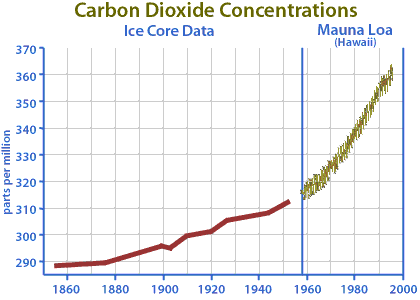
| Originally posted by DrUg_Tit0 I think your analogy is much more faulty than tranceaholic's one. Let's look at the basic premises: 1) Carbon dioxide is better at absorbing heat than other major gases in our atmosphere like oxygen and nitrogen. 2) Carbon dioxide amount in our atmosphere has increased by about 40% since 1850. 3) There has not been an increase in natural emissions of carbon dioxide. 4) There has been a significant increase in human emissions of carbon dioxide. 5) Mean global temperature has shown a slight increase since it started to be measured. Therefore we may conclude that it is likely that carbon dioxide increase in atmosphere should cause global warming, and that conclusion is also supported with evidence. The evidence shown is so far shakey, but since there is no other evidence to prove the opposite and since the evidence is among the lines of what we should expect from the first 4 premises, it is reasonable to conclude that global warming is a pretty realistic threat. |
| quote: |
| Originally posted by Arbiter A false analogy, to be sure. A criminal attempting to enter a house is a known problem that can occur and has many times in the past and which also has a definite cause. A more analagous behavior would be to spend billions of dollars constructing the walls, ceilings, and floors out of gold ore because you hold the unfounded belief that it is the only material that will prevent aliens from teleporting you out of your house and abducting you, despite the fact that there is no reliable evidence that alien abductions have ever occurred nor is there any evidence to suggest that the proposed solution would address the problem in any way. |
| quote: |
| Originally posted by Arbiter Temperatures have generally been increasing wherever they have been measured at roughly the same rate for over 300 years - far longer than human carbon dioxide emissions could be considered significant. They have not increased any faster since the carbon dioxide content of the atmosphere has begun to increase. If we were to wrongly assume that carbon dioxide was responsible for the increase in temperature, then the increase of temperature should correlate proportionately with increases in atmospheric carbon dioxide. They do not. The hypothesis is refuted by observation, and therefore must be discarded in accordance with the proper scientific method. |


| quote: |
| Originally posted by DrUg_Tit0 |

There is a concensus in the scientific community that there is global warming. Sorry I don't have any fancy charts to prove it.
During the 80's and early 90's the conservatives poo pooed the mounting scientific evidence of global warming as liberal crazies. Now if you press them on it they say that even if it is occurring it could be just a natural change unrelated to man's pollution. After the polar caps melt and the world is thrown into global catastrophe they'll be saying why don't you liberals stop winning that you warned us and think of a way to get us out of the mess we're in. Who knows maybe they'll be showing us graphs that prove we're really ok even though were up to our necks in water.
| quote: |
| Originally posted by trancaholic Your analogy makes no sense for two reasons: * First, if there has never been any recorded alien abductions how would we know - or even suspect - that gold could somehow mess with the alien's teleportation beams? |
| quote: |
| * Second, your analogy involves two alternatives: encasing your house in gold and death. Clearly the first option is not available to most people, and considering the general worth of a human life (as inferred from differences in calculations on traffic safety near schools and retirement homes, or as inferred from the price tag of a hired murder) it will actually be more expensive to encase your house than to die. In contrast, with human pollution experience tells us that it is always more expensive to clean up than preventing the pollution in the first place. On the scale of global warming I would say that this difference in price tags will be enormous. Consider some of the harbor cities that would have to be abandoned: Manhattan, New Orleans, Amsterdam, Rome, Rio... Then add all the other cities that you can find in your atlas but didn't think of initially. You can take quite a lot of preemptive measures to fight CO_2 emissions for the amount of money that will be needed to relocate these millions (billions?) of people and their daily lives. Now, you say that my analogy (which I gave purely for elucidation purposes) is clearly false as criminals gaining entry to houses happen occasionally, whereas the heating of the earth by human pollution never happened. Besides that a good deal of scientists see evidence that you are wrong on the last part, I would attack that reasoning by saying that the difference, which you see, is entirely due to a consciously stated difference in granularity of the two scenarios. For instance, I have never personally had a criminal enter my house (unless one of my friends haven't told me everything that I should know), so with that kind of granularity it would make no sense for me to lock my door, as according to statistics a criminal coming to visit me must be an impossibility. On the other hand, we have plenty of examples of humans destroying eco systems through pollution in the past, so with that granularity it would make sense to consider global warming (as an instance of pollution) a possibility. |
| quote: |
| Originally posted by igottaknow There is a concensus in the scientific community that there is global warming. Sorry I don't have any fancy charts to prove it. During the 80's and early 90's the conservatives poo pooed the mounting scientific evidence of global warming as liberal crazies. Now if you press them on it they say that even if it is occurring it could be just a natural change unrelated to man's pollution. After the polar caps melt and the world is thrown into global catastrophe they'll be saying why don't you liberals stop winning that you warned us and think of a way to get us out of the mess we're in. Who knows maybe they'll be showing us graphs that prove we're really ok even though were up to our necks in water. |
even if there were some consensus, pollution always seems to come from *another* country.
look at Sweden spending its pollution control money on Poland due to acid rain. (it stings a bit)
China is slowly fogging Japan's skies. (and many of their own cities)
Accountability is crucial to fixing the problem. And countries that cant even muster Western standards arent going to spend their profits helping the environment by making less money for pollutions sake|
| quote: |
| Originally posted by Arbiter There is no consensus in the scientific community. Even if there were a consensus, however, it would mean nothing. Scientific "consensus" has proven incorrect many times throughout history, and with the amount of junk science floating around these days I suspect it will be even more frequently in the future. |
I remember in the early to mid 80s there was going to be a hole in the atmosphere from all the hair spray people were using and we were all going to burn to a crisp. Fear of global warming ended the big hair era!
| quote: |
| Originally posted by Arbiter There is a precisely equal body of evidence that gold interferes with alien teleportation technology and that a reduction in carbon dioxide emissions would halt global warming. In both cases, there is precisely no evidence. In fact, in both cases, there is no reliable evidence that the supposed problem to be solved even exists. By the definition of "prevent" one cannot prevent something unless it would have otherwise occurred. Since we have no sound basis upon which to posit that either alien abductions or global warming will occur, any endeavor of ours to prevent them is, deductively, an exercise in futility. |
| quote: |
| Originally posted by Arbiter It seems to me that your argument regarding granularity is flawed by the same leap of faith which has plagued all of your arguments to this point. Although it may be true that no criminal has ever attempted to enter your house, you must surely be aware that there are criminals, and that in the general course of their activities they sometimes attempt to enter houses belonging to people who do not want them to enter, for illicit purposes. If you were unable to make the connection that this means there is a possibility that some such crimilar may attempt to enter a particular house - such as your own - at some indeterminite time in the future, then you would be lacking a fundamental reasoning skill to associate objects of similar properties with actors and actions known to be associated with some of those objects. However, the relationship between human destruction of ecosystems and the so-called global warming threat is not an example of this type of reasoning. Rather, it is a fallacy of composition. The biosphere consists of, among other things, a large number of distinct ecosystems. It is fallacious, however, to assume that the biosphere itself has the same properties and simplicity of its constituent parts. |
| quote: |
| Originally posted by Arbiter If the utility of a particular course of action is properly measured as a cost/benefit ratio, then the utility of measures to reduce carbon dioxide emissions is extremely low, as the costs are outrageously high and the benefits, so far as reliable scientific evidence suggests, are nonexistent. |
| quote: |
| Originally posted by BadBadNeil I remember in the early to mid 80s there was going to be a hole in the atmosphere from all the hair spray people were using and we were all going to burn to a crisp. Fear of global warming ended the big hair era! |
| quote: |
| Originally posted by trancaholic What you're talking about is the hole in the ozone layer. It did take place, and it did grow larger and larger. Only it was over Antarctica and Switzerland, so you wouldn't have noticed. However, now that final years of solid pollution with CFC gases have reached the ozone layer, and only small amounts are being released, we are seeing a strengthening of the ozone layer - just as predicted by those doomsday scientists. |

Powered by: vBulletin
Copyright © 2000-2021, Jelsoft Enterprises Ltd.