
TranceAddict Forums (www.tranceaddict.com/forums)
- Political Discussion / Debate
-- The State of the 2004 US Economy with Weekly Updates
Pages (5): « 1 [2] 3 4 5 »
Week ending Feb 29
RELEASE: GDP [United States]: 4.1%
FIRST TAKE: In a positive surprise, 4Q GDP growth was revised up to 4.1% from 4.0% on stronger than initially reported business equipment and software spending, more inventory investment, stronger exports and higher nondurable consumption.
RELEASE: NAPM - NY Report [United States]: 267.2
FIRST TAKE: The New York City recovery is continuing in full force, according to the NAPM-NY report for February. After bottoming in August 2003, the Business Conditions Index (BCI) has grown for six consecutive months and now stands at 267.2, its highest level since September 2001.
RELEASE: University of Michigan Consumer Sentiment Survey [United States]: 94.4
FIRST TAKE: The University of Michigan Consumer Sentiment Index final value for February was 94.4, down 9.4 points from January, but up 1.3 points from the preliminary reading. The expectations component of the index fell most sharply, to below its December value and received the smaller upward revision from the mid-month value.
RELEASE: Chicago PMI [United States]: 63.6
FIRST TAKE: As expected, the Chicago PMI dipped in February from January�s more than nine-year high. However, the index reading slightly exceeded the subdued consensus expectation. Overall, manufacturing activity in the Chicago region remains very strong.
RELEASE: ECRI Weekly Leading Index [United States]: 133.7
FIRST TAKE: The six-month growth rate of the ECRI Weekly Leading Index (WLI) held steady at 10.4% during the week ending February 20. This came as the index�s level increased from 132.9 to 133.7.
RELEASE: Agricultural Prices [United States]: 1.8%
FIRST TAKE: Agricultural commodity prices regained the ground last month in January, rising 1.8% in February. Cattle prices fell again, as did the prices for eggs, lettuce and broccoli. However, these were offset by price gains registered by soybeans, broilers, corn and hogs.
RELEASE: Durable Goods (Advance) [United States]: -1.8%
FIRST TAKE: January data is a bit of a muddle. Orders fell 1.8%, almost completely because of transportation, but December�s previously reported small orders decline was revised up to a 1.6% increase, an unusually large revision. So it seems if you net out the two months, we�re back where we started, flat since November. Bottom line: disappointing. Business is still skittish.
RELEASE: Jobless Claims [United States]: 350,000
FIRST TAKE: Initial jobless claims rose slightly last week, to 350,000, while the previous week�s total was unchanged at 344,000. Last week�s figure exceeded consensus expectations somewhat. A number of 350,000 is consistent with an improving labor market. Continuing claims fell to 3.1 million in mid-February, while the total for the prior week was revised down by 26,000 to 3.164 million.
RELEASE: Job Openings and Labor Turnover Survey [United States]: 10.6%
FIRST TAKE: In December 2003 the rate of job openings and hiring was slightly higher than for December 2002. The openings rate rose to 2%, from 1.8% a year earlier, while hiring was up to 2.4%, from 2.3% a year earlier. The layoff rate was unchanged, at 1.4%.
RELEASE: New Home Sales (C25) [United States]: 1,106,000
FIRST TAKE: January new home sales fell 1.7% from an upwardly revised December level, leaving them in lofty territory. Sales are up 9.6% year over year.
RELEASE: The Conference Board Help Wanted Index [United States]: 38
FIRST TAKE: The volume of help wanted advertising eked up by one point in January to 38. The December figure was revised down from 38 to 37. Last spring, the index bottomed out at 35. Since June,however, it has shown scant improvement. The story has not changed. Layoffs are abating, but employers are in no hurry to resume hiring.
RELEASE: Weekly Natural Gas Storage Report [United States]: 1,267 Bcf
FIRST TAKE: Underground storage of natural gas decreased by 164 billion cubic feet during the week ending February 20. The draw was slightly larger than anticipated and should therefore have a moderately bullish impact on natural gas markets.
RELEASE: Bankruptcy Filings [United States]: -0.1%
FIRST TAKE: Personal bankruptcy filings fell for the second consecutive time in the fourth quarter, while business bankruptcies continued their descent. Personal filings were virtually unchanged from last year. Business filings fell 12.7% from last year, their largest decline since the start of 1999. For all of 2003, personal filings grew 5.7% and filings per thousand households set a new record of 14.9. Business filings fell 9.2%, their second consecutive decline.
RELEASE: MBA Mortgage Applications Survey [United States]: 854.5
FIRST TAKE: Low mortgage rates boosted the demand for mortgages, and the MBA index posted another modest gain last week. The composite index is up by 2% to 854.5. Both components of the index advanced. As long as mortgage rates remain low, mortgage demand for purchase will be strong. By contrast, the refi index�s increase still leaves it standing considerably below its heights of last year.
RELEASE: ABC News/Money Magazine Consumer Comfort Index [United States]: -13
FIRST TAKE: The consumer comfort index was unchanged this week, holding at a 13-week low. Within the components, consumers downgraded their assessment of the economy but were more upbeat about their personal finances.
RELEASE: Chicago Fed National Activity Index [United States]: 0.49
FIRST TAKE: The Chicago Fed�s National Activity Index was 0.49 for the month of January. This makes it the fifth straight month in which the index showed that the U.S. economy is growing above its historical trend rate of growth. Also, January�s reading shows a vast improvement over December, in which the initial estimate was revised downward from 0.13 to 0.05.
RELEASE: Monthly Mass Layoffs [United States]: 2,428
FIRST TAKE: After trending downward during the second half of 2003, mass layoffs surged in January. Employers initiated 2,428 mass layoff events involving 239,454 workers last month. The manufacturing industry continues to account for the largest portion of mass layoffs, while the Midwest region reported the highest number of initial claims.
RELEASE: Existing Home Sales [United States]: 6.04 Million
FIRST TAKE: The market for single-family homes is slowing. As expected, sales of existing homes declined in January, with the number of homes sold falling by 5.2% to 6.04 million annualized units. Moreover, NAR revisions to fourth quarter 2003 data bring the increase in December sales down to 3.9% compared to the previously reported 6.9%. Given the rapid pace of home sales over the last year, however, it is not surprising that buyers are taking a breather.
RELEASE: Oil and Gas Inventories [United States]: 273.8 MB
FIRST TAKE: Commercial crude oil stocks remained essentially flat during the week ending February 20. Distillate stocks recorded a sizable seasonal draw, while the American Petroleum Institute and the Energy Information Administration differed on the direction of movement of motor gasoline stocks. Today�s data will have a neutral impact on petroleum markets.
RELEASE: Chain Store Sales Snapshot [United States]: -0.2%
FIRST TAKE: Chain store sales held onto most of the prior two week�s strong gains, dipping only 0.2% in the week ending February 21, according to the ICSC-UBS chain store sales index. Year-over-year growth soared to 8.1%, the best growth since the middle of 1999, as winter storms made the comparable week in 2003 the weakest of the year.
RELEASE: The Conference Board Consumer Confidence [United States]: 87.3
FIRST TAKE: The Conference Board index of consumer confidence fell far more than expected in February. The index dropped 9.1 points to 87.3, from a revised 96.4 in January. Both components of the index fell, with the expectations component falling more severely.
RELEASE: UBS Index of Investor Optimism [United States]: 97.0
FIRST TAKE: Mimicking other confidence surveys, the UBS index of investor optimism dipped in February, falling to a three-month low. Both the economic and personal finance components faltered.
RELEASE: Internet Sales (E-Commerce Sales) [United States]: 17.2 billion
FIRST TAKE: As expected, the e-commerce industry posted record sales in the fourth quarter of last year. However, year-over-year growth slowed for the second straight quarter.
occrider, could you add a US budget report, I'm curious how the budget levels shift, or how the treasurey looks like.
and when is this going to become a sticky
| quote: |
| Originally posted by Izzy occrider, could you add a US budget report, I'm curious how the budget levels shift, or how the treasurey looks like. and when is this going to become a sticky |
 . Anyway, the sites I use were all down on Friday so I don't have friday's data. From what I read off of reuters though, it does not look like good jobs news. Unemployment remainted steady though only 21,000 jobs were added. Later on if I have time, I'll pull the data directly from gov't web sites. Euro data is gonna have to wait until tomorrow or something
Friday's data in raw form that I just pulled from government sites:
G.19 CONSUMER CREDIT For release at 3 p.m. (Eastern Time)
1 January 2004 March 5, 2004
Consumer credit increased at an annual rate of 8-1/2 percent in January, up from the 3-3/4 percent pace in the fourth quarter. The
January increase owes to gains in both revolving and nonrevolving credit.
Weekly Leading Index Steady
03/06/2004
NEW YORK, March 5 (Reuters) - A drop in mortgage applications and lower jobless claims helped keep a leading index of the U.S. economy steady, a report showed on Friday.
The Economic Cycle Research Institute, an independent forecasting group, said its weekly leading index was unchanged at 133.7 in the week ended Feb. 27 compared with the preceding week.
The annualized growth rate, a four-week moving average that evens out weekly fluctuations, was also unchanged at 10.5 percent.
"Even with today's disappointing jobs report that has some warning of a new slowdown ahead, the index is saying that growth will remain robust," said ECRI managing director Lakshman Achuthan. "There is no indication of any new economic donwturn on the horizon."
THE EMPLOYMENT SITUATION: FEBRUARY 2004
Nonfarm employment was little changed (+21,000) in February, and the
unemployment rate remained at 5.6 percent, the Bureau of Labor Statistics
of the U.S. Department of Labor reported today. Employment levels in most
of the major industries were little changed over the month.
The OECD Composite Leading Indicator Continued its Upward Trend in January 2004
05/03/2004 - Moderate to strong recovery lies ahead in the OECD area according to the latest composite leading indicators (CLIs). January data signal continued improved development in Canada, France and the United Kingdom but weaker development for Italy.
The CLI for the OECD area rose by 0.4 point in January 2004 to 123.3 from 122.9 in December 2003. Its six-month rate of change was down slightly for the first time following an upward trend which began in April 2003.
The CLI for the United States increased by 0.4 point in January but its six-month rate of change decreased for the first time after nine consecutive months of strong increases. The Euro area's CLI rose by 0.1 point in January and its six-month rate of change fell for the second consecutive month following seven months of increases. In January, the CLI for Japan rose by 0.2 point but its six-month rate of change was stable in January after two consecutive months of small decreases.
The CLI for the United Kingdom rose by 0.6 point in January and its six-month rate of change was also up for the tenth consecutive month. The CLI for Canada increased by a strong 1.3 point in January and its six-month rate of change has shown an upward trend since May 2003. The CLI for France increased by 0.6 point in January and its six-month rate of change has increased for the past ten months. The CLI for Germany rose by 0.2 point in January but its six-month rate of change was down for the first time following strong increases over the past eight months. Finally, the CLI for Italy fell by 0.3 point in January and its six-month rate of change was down for the fourth consecutive month.
Okay, call me a big pessimist liberal, but the info. you post Occ. tends to show a favorable forecast on our economy. Furthermore, it continues to show over and over a favorable forecast on the job front.
While the former may be somewhat true, the latter does not and has not occured. In short, I'm somewhat weary and tired of hearing these job forecasts telling people, "Hey, we're comin' back with more and more jobs!"
Yet the reality shows otherwise. 21 f$cking thousand new jobs in February is absolutely pathetic. What's worse, January was downgraded to 97,000 new jobs. This is hardly a recovery situation worth celebrating over, considering that this simply cannot keep pace with the job demand. What's more, that 21,000 increase was fully accounted for in govt. jobs, while the private sector hiring remained unchanged. Furthermore, hourly wages are only up 1.6% over the past year, the worst since 1986 (hey, who was President then?):
http://epinet.org/content.cfm/webfe...cators_jobspict
I guess the flip-side on the manufacturing woes is that they only lost 3,000 jobs last month the lowest out of the 43 consecutive months of job losses in that sector. But hey, if Bush gets what he wants, we'll likely see a spike in manufacturing hires, since flipping burgers and making tacos will be included in the manufacturing sector.
Apologies for my tone. I'm feeling a little cynical this morning.
| quote: |
| Originally posted by MisterOpus1 Okay, call me a big pessimist liberal, but the info. you post Occ. tends to show a favorable forecast on our economy. Furthermore, it continues to show over and over a favorable forecast on the job front. While the former may be somewhat true, the latter does not and has not occured. In short, I'm somewhat weary and tired of hearing these job forecasts telling people, "Hey, we're comin' back with more and more jobs!" Yet the reality shows otherwise. 21 f$cking thousand new jobs in February is absolutely pathetic. What's worse, January was downgraded to 97,000 new jobs. This is hardly a recovery situation worth celebrating over, considering that this simply cannot keep pace with the job demand. What's more, that 21,000 increase was fully accounted for in govt. jobs, while the private sector hiring remained unchanged. Furthermore, hourly wages are only up 1.6% over the past year, the worst since 1986 (hey, who was President then?): http://epinet.org/content.cfm/webfe...cators_jobspict I guess the flip-side on the manufacturing woes is that they only lost 3,000 jobs last month the lowest out of the 43 consecutive months of job losses in that sector. But hey, if Bush gets what he wants, we'll likely see a spike in manufacturing hires, since flipping burgers and making tacos will be included in the manufacturing sector. Apologies for my tone. I'm feeling a little cynical this morning. |
| quote: |
U.S. jobless rate hits six-year low Clinton's euphoric, but news causes stocks to plunge July 5, 1996 Web posted at: 5:50 p.m. EDT WASHINGTON (CNN) -- Economists didn't expect June's unemployment rate to be much different from May's, which was an already-low 5.6 percent. But in fact, it did fall -- to 5.3 percent. The unemployment rate hasn't been that low since June 1990. http://www.cnn.com/US/9607/05/jobless/ |
MisterOpus:
Here's an interesting article on the jobless growth
Slow Going
By Mark Zandi
2/12/2004
The job market is improving, but it�s not enough. Businesses are no longer firing workers as aggressively as they once were, but they have yet to begin hiring in any significant way. More substantial job growth is necessary to ensure that the economic expansion is self-sustaining. Without greater job creation, households will lack the wherewithal to maintain their spending as the benefits of tax cutting and mortgage borrowing eventually fade.
That the job market is improving is evident in the resumption of job growth. According to the Bureau of Labor Statistics� payroll employment data, which are based on a survey of businesses, the economy has created an average of just over 50,000 jobs per month since job growth resumed this past summer.
And there is evidence that job growth is stronger than the current payroll employment estimates suggest. The payroll survey has difficulty in measuring job creation at newly formed firms, which form more quickly at the early stages of an expansion. While this bias is not as large as in the past due to various substantive methodological improvements in the survey (including more rigorous sampling techniques in determining which businesses to include in the survey and more regular updates to the businesses included in the survey), it remains a problem. Based on other rosier job market data, including lower initial and continuing unemployment insurance claims, stronger personal income tax withholdings, and upbeat business surveys, Economy.com estimates that average monthly job gains since the summer are closer to 100,000. Indeed, the last time initial UI claims were at their current 350,000 per week, payrolls were expanding at close to 200,000 per month (see chart).
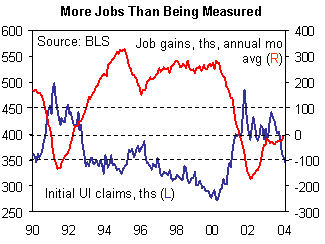
The payroll survey data also do not count (by design) self-employed workers. Based on the household survey of employment, it appears that self-employment has risen strongly since the end of the 2001 recession. Although the increase is likely overstated, due to numerous problems with the household survey that are substantially more serious than those in the payroll survey, it is consistent with the strong recent growth in proprietors� income. The rising number of self-employed reflects in part those workers who have lost their jobs at larger firms striking out on their own, but it also reflects heightened entrepreneurship.
Even if job growth is 100,000 per month, however, this is still insufficient to ensure that the expansion is self-sustaining. Job growth of 150,000 per month is necessary to absorb new workers entering the labor force and to generate enough wage income to fill the void that will eventually be left by fading tax benefits and reduced mortgage borrowing. Job growth near 200,000 per month is necessary to make substantive progress toward reducing unemployment and underemployment and engendering complete confidence in the expansion�s staying power.
Expectations are high that businesses will soon step up their hiring sufficiently to ensure a self-sustaining expansion. Fueling this optimism are surging corporate profits. Profits for all companies, publicly-traded and privately-held, have surged by over an astounding 20% in each of the past two years and now account for a record share of national income. Driving profits higher are stronger demand, firmer pricing, and, most importantly, falling costs. Labor costs, as measured by unit labor costs, or labor compensation per unit of output, have fallen more over the past two years than anytime on record. This has resulted from both slowing wage growth and resiliently robust productivity growth. Businesses are thus flush and have the wherewithal and motive to expand their operations more aggressively. If history is any guide, then this should include increased hiring.
The job market should continue to revive, but any revival will remain muted. Weighing on the job market is the growing prevalence of global offshoring. Offshoring, which describes the outsourcing of previously U.S.-based production and jobs to overseas enterprises, is gaining momentum. Businesses and their management consultants have effectively addressed the pitfalls involved in offshoring, ranging from tax and pricing issues to political, cultural and regulatory differences. Economy.com estimates that it is costing the U.S. economy as many as 500,000 jobs annually.
Offshoring is also increasingly prevalent outside of manufacturing. Vastly improved communication and computing technologies and the widening use of the Internet have allowed activities ranging from computer software development, to data processing, to call center based customer support and marketing to be performed overseas. Large numbers of English-speaking educated overseas workers make all of this possible. Indeed, many of the foreign workers who came to the U.S. in the boom times around Y2K and were immersed in the language and culture have returned to their native countries in the subsequent hard times and have become the seed corn for the foreign companies now sprouting up to service offshoring U.S. companies.
The impetus to offshore will only intensify until the Chinese revalue the yuan, allowing other Southeast Asian economies, including India and the Philippines , nations with large English speaking populations, to do the same. Most Southeast Asian currencies are as much as 25% undervalued vis-�-vis the U.S. dollar.
A stronger job market is also threatened by the relatively high cost of labor relative to capital. Labor costs are falling, but the cost of capital is falling even more.
Buoying overall labor costs are accelerating employee benefit costs. Benefit costs rose more last year on a real basis than during any year since benefit costs have been measured over the past 20 years. Fueling benefit cost growth are escalating healthcare and pension benefits. Employer healthcare premiums have surged at a double-digit annualized pace in recent years. These more quickly rising costs reflect the increased market power of healthcare providers, rising healthcare demand, and the waning constraint on costs previously provided by the shift toward managed care. Employers� pension costs have also soared, as those companies with defined benefit plans have been forced to scramble to fill in the shortfalls in their plans left by lower stock values and interest rates. Due to pension accounting rules, most companies had been able to avoid grappling with their pension problems until recently.
At the same time, the cost of equipment and software, particularly IT, is plunging, driven by the continued rapid pace of technological change. Capital costs have also fallen, albeit temporarily, by lucrative tax depreciation benefits provided to businesses as part of last summer�s fiscal stimulus plan. Large businesses that make an investment before the end of 2004 can immediately expense one-half of that investment. Depreciation schedules revert to their less attractive rules at the start of 2005. Small businesses also receive a tax benefit; they are able to expense $100,000 of investment, up from $25,000.
While offshoring and the relative cost advantage of capital are not enough to forestall a better job market, they are enough to ensure that job growth and the expansion will, even in the best of times, remain somewhat disappointing.
http://www.economy.com/home/article.asp?aid=2638
I dunno, it somewhat reaffirms my belief that fiscal policy has pretty much done all it can to give the economy the push it needs to get going. Now it's up to the economy and free markets to determine the rate of job growth.
Another good article, I thought, on the state of the US economy:
Smile, these are good times. Truly
Mar 11th 2004 | WASHINGTON, DC
From The Economist print edition
Anxiety is turning to paranoia about jobs. Take a deep breath: most Americans have rarely had it better.
ANOTHER month, another dismal set of job figures. America pulled out of its last economic recession way back in November 2001, yet the country's �jobs recession� finished only last autumn, by when 2.7m jobs had been lost since the start of the slowdown. Now, though economic growth has bounced back, new jobs refuse to do the same in this, the third year of recovery. In February, a mere 21,000 jobs were created, according to the official payroll survey, at a time when George Bush's economists forecast 2.6m new jobs for 2004. Mounting alarm at the White House, and increased calls for protection against what a growing number of Americans see as the root of most ills: the �outsourcing� of jobs to places like China and India. Last week the Senate approved a bill that forbids the outsourcing of government contracts�a curious case of a government guaranteeing not to deliver value-for-money to taxpayers. American anxiety over the economy appears to have tipped over into paranoia and self-delusion.
Too strong? Not really. As The Economist has recently argued�though in the face of many angry readers�the jobs lost are mainly a cyclical affair, not a structural one. They must also be set against the 24m new jobs created during the 1990s. Certainly, the slow pace of job-creation today is without precedent, but so were the conditions that conspired to slow a booming economy at the beginning of the decade. A stockmarket bubble burst, and rampant business investment slumped. Then, when the economy was down, terrorist attacks were followed by a spate of scandals that undermined public trust in the way companies were run. These acted as powerful headwinds and, in the face of them, the last recession was remarkably mild. By the same token, the recovery is mild, too. Still, in the next year or so, today's high productivity growth will start to translate into more jobs. Whether that is in time for Mr Bush is another matter.
As for outsourcing, it is implausible now, as Lawrence Katz at Harvard University argues, to think that outsourcing has profoundly changed the structure of the American economy over just the past three or four years. After all, outsourcing was in full swing�both in manufacturing and in services�throughout the job-creating 1990s. Government statisticians reckon that outsourced jobs are responsible for well under 1% of those signed up as unemployed. And the jobs lost to outsourcing pale in comparison with the number of jobs lost and created each month at home. Even here, the rate of job �churn� has, for unclear reasons, been falling since mid-2001.
Waiting for the job recovery might be a good time to take a broader measure of the material well-being of Americans. Their condition is widely held to be perilous. The economy, it is said, is being �hollowed out� by international competition and the connivance of business and political elites, creating �two Americas�, one rich, one poor. Median income of American households, commentators often say, has been stagnant, though census figures give a rise of one-fifth since 1980. Lou Dobbs, on CNN's �Lou Dobbs Tonight�, is just one media fabulist who makes his living by claiming that, as America is being �exported�, so the well-being of middle Americans is in a parlous state.
It is a good story, but false on many levels. For a start, this slow growth in median income overlaps with a scale of immigration into America outpacing all immigration in the rest of the world put together. Many immigrants have come precisely to take up the lowest-paid jobs. As a result, in the 20 years to 1999 some 5m immigrant households were added to those defined as below the poverty level. Yet among native-born Americans, poverty rates have declined steadily since the 1960s. In the case of black families, median incomes have recently been rising at twice the pace for the country as a whole.
Strip out immigrants, and the picture of stagnant median incomes vanishes. Indeed, for the nine-tenths of the population that is native-born, middle-income trends continue their improvement of the 1950s and 1960s. For these people, inequality is not rising, but falling. Gregg Easterbrook cheekily points out in his excellent recent book, �The Progress Paradox� (Random House), that if left-leaning Americans seriously want better statistics about middle-income gains, then they should simply close their borders.
Mr Easterbrook points to something else about the figures for median household income. A quarter-century ago a typical household had three members. Today, it has just 2.6 members. Simply by this effect, median households have seen their real incomes rise by a half.
Another measure of improved well-being is increased access to jobs. Between 1980 and 2002 Americans in work rose by over 40%, a far brisker pace than the 26% growth in the population. Some three-quarters of the adult population are now in work, close to a record and some ten percentage points higher than in Europe.
One reason is more teenagers in work: over the same period, teenage employment grew by nearly two-thirds. As Andrew Hacker points out in the New York Review of Books, teenagers are a significant source of low-paid labour in supermarkets, shopping malls and fast-food franchises. Exploitative? Hardly, since it helps them buy cars and independence.
Yet the chief reason for higher participation is more women in work, notably married women. Very roughly, in the past half-century the average weekly hours worked by married women have tripled, while hours worked by men and single women have stayed about constant. The usual reason given is that married women have had to work so that families can make ends meet. A recent study* by three economists, Larry Jones, Rodolfo Manuelli and Ellen McGrattan, published by the Federal Reserve Bank of Minneapolis, punctures that notion. They find that the tripling of married women's hours can be explained entirely by a gender wage-gap that has narrowed. That is, a smaller pay differential between men and women gives married women sufficient incentive to invest in education and careers.
Of course, many American households struggle to survive on minimum-wage jobs with employers who do them few favours. We will look at low-paid work in a future week. What this piece attempts to argue is that the middle is far from being hollowed out. As Mr Easterbrook emphasises, most Americans have at least two cars and their own house, and they send their children to college. Certainly a bigger share of household income is being spent on things that did not feature 50 years ago, such as high-tech health care. But it has brought the benefit of a longer and better life, and not just for the old: since 1980, infant mortality has fallen by 45%.
At the end of last year, America's household wealth, at $44 trillion, passed the previous peak set in early 2000. With Americans wealthier than ever, why are many so anxious? Perhaps they think prosperity will vanish in a puff of terrorist smoke or a housing-market collapse. Perhaps, tentatively, the suburbs, in which half of Americans live, are to blame. For the suburbs fulfil the American dream, but at a price. On the one hand comes greatly increased space: the typical American dwelling now has two rooms per person, double Europe's level or America's half a century ago. On the other hand, expectations grow for every family member to have her own computer, DVD player�and another car. Pile on top of that an annual family holiday by plane, a bass-fishing boat (Americans spend $25 billion a year on boats and jet-skis) and regular meals out (Americans now spend nearly half their food dollars in restaurants). The American dream may cost less than it used to, but it still comes dear. And in a sated society, there is less and less new to look forward to.
http://www.economist.com/world/na/d...tory_id=2501977
Week Ending Mar 14
RELEASE: Current Account [United States]: -$127.5 billion
FIRST TAKE: The balance on the U.S. current account increased during the fourth quarter on strong income flows into the U.S. According to the BEA, the fourth quarter current account registered a deficit of $127.5 billion after a $135.3 billion deficit during Q3. The improvement owed to a large increase in the surplus on income and an increase in the surplus on services. Both exports and imports improved during the quarter.
RELEASE: Business Inventories (MTIS) [United States]: 0.1%
FIRST TAKE: Business inventories posted a meek increase in January, below consensus expectations. This figure is not overly surprising, however, in light of the recent wholesale trade inventory report, which also was below consensus. The inventory-to-sales ratio remains at an all-time record low.
RELEASE: University of Michigan Consumer Sentiment Survey [United States]: 94.1
FIRST TAKE: The University of Michigan Consumer Sentiment Index preliminary value for March was 94.1, down just fractionally from 94.4 in February. A decline in the expectations component of the index offset a gain in the present situation component.
RELEASE: ECRI Weekly Leading Index [United States]: 134.2
FIRST TAKE: The six-month growth rate of the ECRI Weekly Leading Index (WLI) climbed to 11.1% during the week ending March 5. This came as the index�s level increased from 133.6 to 134.2.
RELEASE: Import and Export Prices [United States]: 0.4%
FIRST TAKE: U.S. import prices rose 0.4% in February, largely due to an equal increase in nonpetroleum imports. Export prices were also up strongly, rising 0.6%, suggesting that sustained dollar depreciation is beginning to have a larger impact on trade prices.
RELEASE: Retail Sales (MARTS) [United States]: 0.6%
FIRST TAKE: Total retail sales rose 0.6% in February, slightly above expectations due to strong sales at auto dealers. Excluding autos, sales were unchanged. January sales growth was revised up significantly. In February, department store sales led the way with declines at drug, grocery, sporting goods and furniture stores.
RELEASE: Jobless Claims [United States]: 341,000
FIRST TAKE: Initial jobless claims totaled 341,000 last week, just below the consensus estimate. This number confirms that layoff activity is quite low. The prior week�s number was revised up by 2,000, to 347,000. Meanwhile, continuing claims for the last week of February fell to a new post-recession low of 3.032 million.
RELEASE: Weekly Natural Gas Storage Report [United States]: 1,143 Bcf
FIRST TAKE: Underground storage of natural gas decreased by 28 billion cubic feet during the week ending March 5. The draw was smaller than expected. Markets had anticipated a draw of 38 Bcf. Thus, today�s report will have a modestly bearish impact on natural gas markets.
RELEASE: Treasury Budget [United States]: -$96.7 billion
FIRST TAKE: The unified deficit for February was $97 billion, close to CBO�s preliminary estimate of $96 billion. Through the first five months of fiscal year 2004, the federal government has run a cumulative deficit of $227 billion.
RELEASE: MBA Mortgage Applications Survey [United States]: 889.1
FIRST TAKE: Weak job growth is keeping mortgage rates on the decline, and low rates are helping the MBA index drift upward. As long as mortgage rates remain low, mortgage demand for purchase will be strong. Refi activity is also swelling, but not to the extent that it did last year.
RELEASE: International Trade (FT900) [United States]: -$43.1 billion
FIRST TAKE: The trade deficit widened during January. According to the BEA and Census Bureau, the trade balance fell $400 million to -$43.1 billion. Both exports and imports declined, with the former showing a sharper fall than the latter.
RELEASE: ABC News/Money Magazine Consumer Comfort Index [United States]: -18
FIRST TAKE: Consumer confidence continues to weaken, with the ABC News/Money Magazine consumer comfort index falling another two points in the first week of March. The index is now at a 17-week low.
RELEASE: Wholesale Trade (MWTR) [United States]: 0.6%
FIRST TAKE: Wholesale inventories posted a meek gain in January, well below expectations, even as sales matched consensus with a healthy gain.
RELEASE: Oil and Gas Inventories [United States]: 279.5 MB
FIRST TAKE: Commercial crude oil stocks recorded a sizable build during the week ending March 5. However, stocks of motor gasoline showed a sharp drop. Thus, today�s reports will provide little, if any, relief from the upward price pressures that have been dominating petroleum markets in recent weeks.
RELEASE: Chain Store Sales Snapshot [United States]: -0.3%
FIRST TAKE: Chain store sales dipped slightly for the third consecutive week. The ICSC-UBS chain store sales index fell 0.3% in the week ending March 6. Year-over-year growth remained strong at 7.0% as cold weather and anticipation of war depressed sales last year.
RELEASE: Richmond Fed Manufacturing Survey [United States]: 19
FIRST TAKE: Manufacturing activity in the Fifth Federal Reserve District continued to grow in February. Indices of orders utilization deteriorated while employment improved. Expectations weakened but remained bright with a significant increase in expectations for capital spending.
RELEASE: Kansas City Fed Manufacturing Survey [United States]: 27
FIRST TAKE: Manufacturing activity in the Tenth Federal Reserve District remained strong during February. Manufacturers� outlook remains upbeat despite increasing concerns over rising input costs. The net percentage of firms reporting year-over-year increases in production rose to 27 in February, up slightly from 24 in January but down slightly from the six-year high of 35 in December.
| quote: |
| Originally posted by Izzy occrider, could you add a US budget report, I'm curious how the budget levels shift, or how the treasurey looks like. and when is this going to become a sticky |
i knew this sticky would cause u to slakc.. I'm missing a week of the plug
| quote: |
| Originally posted by Yoepus i knew this sticky would cause u to slakc.. I'm missing a week of the plug |
Well, like I said, due to work demands I haven't been collecting data for the past two weeks so you'll have to make do with just Friday's data
Week Ending March 28th
RELEASE: Personal Income [United States]: 0.4%
FIRST TAKE: Personal income grew 0.4% in February, above consensus, and disposable income grew at the same rate. Spending rose 0.2%, below expectations, but spending was revised up slightly in January. Wages grew 0.5%. The saving rate rose to 1.9%.
RELEASE: University of Michigan Consumer Sentiment Survey [United States]: 95.8
FIRST TAKE: The University of Michigan Consumer Sentiment Index final value for March was 95.8, a small gain from both last month and the preliminary value. Both components were up from their preliminary March values, although the expectations index was nearly unchanged from February.
RELEASE: ECRI Weekly Leading Index [United States]: 134.1
FIRST TAKE: The six-month growth rate of the ECRI Weekly Leading Index (WLI) slipped to 10.9% during the week ending March 19. This came as the index�s level decreased from 134.2 to 134.1.
| quote: |
| Originally posted by occrider Well, like I said, due to work demands I haven't been collecting data for the past two weeks so you'll have to make do with just Friday's data |

Project is done and over with (relatively) ... updates should now be more regular. Euro data to come later this afternoon.
Week Ending April 5
RELEASE: Semiconductor Billings [United States]: 0.2%
FIRST TAKE: Global semiconductor sales edged up by 0.2% in February compared to the previous month. Gains were led by the Asia Pacific region. Growth in the chip industry has moderated slightly, but the rebound continues.
RELEASE: Employment Situation [United States]: 308,000
FIRST TAKE: Another surprising employment report that even the most optimistic economists had not anticipated. Payroll employment increased by 308,000 in March, well above the consensus estimate of 100,000. Gains were broad based and manufacturing losses ceased. The unemployment rate rose to 5.7% as more workers entered the labor force.
RELEASE: ECRI Future Inflation Gauge [United States]: 2.7%
FIRST TAKE: The U.S. future inflation gauge (FIG) rose sharply in March to 118.8, up from 115.7 in February. The index has been rising since December and is signaling an increase in inflation pressures. Most of the other FIGs, which trail the U.S. data by one month, showed little movement in February.
RELEASE: ECRI Weekly Leading Index [United States]: 133.9
FIRST TAKE: The six-month growth rate of the ECRI Weekly Leading Index (WLI) slipped to 10.4% during the week ending March 26. This came as the index�s level decreased from 134.0 to 133.9.
RELEASE: Vehicle Sales - AutoData [United States]: 16.6 Million
FIRST TAKE: Vehicle sales improved in March to an annualized seasonally adjusted pace of 16.6 million units, up from 16.3 million in February. Sales of both domestic and foreign brands improved though the market share of U.S. brand vehicles slipped below 60%.
RELEASE: PPI [United States]: 0.1%
FIRST TAKE: Producer prices for finished goods rose a modest 0.1% in February. This was well below expectations due primarily to a lack of inflation among finished energy products. Significant price appreciation was seen at earlier stages of processing, with prices for core intermediate goods (0.9%) and core crude goods (5.5%) having risen rapidly.
RELEASE: Jobless Claims [United States]: 342,000
FIRST TAKE: Last week, 342,000 displaced workers filed for jobless benefits, down from 345,000 in the prior week (revised up from 339,000). Continuing claims were filed by 3.062 million workers during the week ending March 20, up from 3.03 million during the prior week. The story remains the same: Jobless claims are at a level that is consistent with a strengthening labor market.
RELEASE: Construction Spending (C30) [United States]: -0.1%
FIRST TAKE: Construction spending fell 0.1% in February, matching consensus expectations. This marks the first back-to-back decline in total construction spending since last spring. January's preliminary estimate was revised downward from -0.3% to -0.8%.
RELEASE: ISM Index [United States]: 62.5
FIRST TAKE: The ISM index remained above the 60 mark for the fifth month in a row, at a reported 62.5 in March. The index is still signaling a brisk expansion in all aspects of manufacturing activity, including employment.
RELEASE: Risk of Recession [United States]: 9%
FIRST TAKE: Economy.com�s probability of recession rose in March to 9% from an upwardly revised risk of 8.9% in February. This is the fourth consecutive month of rising risks. Moderating gains in equity markets and the drop in consumer confidence are weighing on the economy. Falling unemployment insurance claims and rising weekly hours are helping support the economy.
RELEASE: Weekly Natural Gas Storage Report [United States]: 1,014 Bcf
FIRST TAKE: Underground storage of natural gas decreased by 18 billion cubic feet during the week ending March 26. The draw was slightly smaller than expectations, which had called for a draw of 26 Bcf. Thus, today�s report will have a marginally bearish impact on natural gas markets.
RELEASE: MBA Mortgage Applications Survey [United States]: 1,091.3
FIRST TAKE: The demand for mortgages slipped slightly last week with the MBA index declining by 2.1% to 1,091.3. Both components of the index fell, as mortgage rates ticked up. Nonetheless, purchase demand remains very strong and will stay highly elevated as long as mortgage rates remain low. This week�s decline in refi activity leaves it in reasonably sturdy territory.
RELEASE: ABC News/Money Magazine Consumer Comfort Index [United States]: -17
FIRST TAKE: Consumer comfort improved for the second straight week, an indication that confidence may be turning the corner after hitting a ten-month low earlier this month.
RELEASE: NAPM - NY Report [United States]: 271.8
FIRST TAKE: The recovery of the New York City economy continued in March, according to NAPM-NY. The Business Condition Index (BCI) inched higher for seventh consecutive month and now stands at 271.8, its highest level since June 2001.
RELEASE: Factory Orders (SIO or M3) [United States]: 0.3%
FIRST TAKE: February factory orders rose only 0.3%, below expectations. The previous estimate of durable goods orders was unchanged at 2.5%; the disappointment was nondurable goods orders which fell 2.0%.
RELEASE: Chicago PMI [United States]: 57.6
FIRST TAKE: As expected, the Chicago PMI slid in March, the index�s second straight monthly decline. The magnitude of the drop, a full six points, was larger than anticipated, however, and will likely lead to more modest expectations for tomorrow�s ISM index.
RELEASE: Oil and Gas Inventories [United States]: 294.3 MB
FIRST TAKE: Commercial crude oil stocks recorded a sizable gain during the week ending March 26, while motor gasoline stocks showed a small build. Thus, today�s inventory data will be bearish for petroleum markets.
RELEASE: Chain Store Sales Snapshot [United States]: -1.9%
FIRST TAKE: Higher gasoline prices and strong early spring sales reportedly were responsible for the disappointing chain store sales in the week ending March 27. The ICSC-UBS chain store sales index fell 1.9%, its biggest decline since last December. Year-over-year growth weakened, but remained strong at 6.6%, lifted by easy comparisons.
RELEASE: The Conference Board Consumer Confidence [United States]: 88.3
FIRST TAKE: The Conference Board index of consumer confidence was virtually unchanged in March. The 88.3 value was 0.2 points below the revised February level. However, the February value was revised up 1.2 points. The present situation component of the index rose less than a point while the expectations component fell just under a point.
RELEASE: Agricultural Prices [United States]: 5.2%
FIRST TAKE: Agricultural prices added on another month of gains in February, increasing 5.2% in March to close at a record high. Price gains were paced by cattle, soybeans, milk and eggs. By contrast, declines in prices were observed for a few miscellaneous fruit and vegetable products such as lettuce, strawberries, and broccoli.
RELEASE: Survey of Business Confidence: 35.2%
FIRST TAKE: Global business confidence has remained largely unchanged since early this year, although it is up substantially from a year ago during the middle of the Iraq war. The improvement in confidence over the past year has been driven primarily by better sales. Hiring and investment plans have improved in response, and businesses even appear to be finally adding office and other space. Confidence has leveled off so far this year largely due to less positive expectations regarding the economy�s performance six month hence. Confidence remains strongest in North America in Asia and among high-tech, healthcare, and real estate firms. It remains weakest in Europe, Latin America and among retailers, the travel industry and in government.
| quote: |
| Originally posted by occrider RELEASE: ISM Index [United States]: 62.5 FIRST TAKE: The ISM index remained above the 60 mark for the fifth month in a row, at a reported 62.5 in March. The index is still signaling a brisk expansion in all aspects of manufacturing activity, including employment. |
| quote: |
| RELEASE: Survey of Business Confidence: 35.2% FIRST TAKE: Global business confidence has remained largely unchanged since early this year, although it is up substantially from a year ago during the middle of the Iraq war. ... It remains weakest in Europe, Latin America and among retailers, the travel industry and in government. |
| quote: |
| Originally posted by Yoepus Refresh me, what does ISM mean? |
Last week's data ... wow good data for chain store sales (although they may be slightly skewed since they're year ago comparisons, which is when the Iraq war started, they're still very good numbers), looks like we got decent sales numbers, jobless claims, and manufacturing numbers:
Week Ending April 11
RELEASE: Chain Store Sales [United States]: 7.0%
FIRST TAKE: Chain store sales rose 7.0% in March according to the ICSC chain store index. Growth was the strongest since April 2000, just topping last month�s performance on the back of strong consumer demand and an easy comparison. Luxury retailers continued to outperform, though strength was broad-based.
RELEASE: Jobless Claims [United States]: 328,000
FIRST TAKE: A surprising fall in initial claims for unemployment insurance to 328,000 was reported for the week of April 3. This was a decline of 14,000 from an week earlier figure of 342,000, which has not been revised. The latest figure is the lowest since the week ending January 13, 2001 and is indicative of solid employment growth. Equity markets should respond positively to this report today.
RELEASE: Wholesale Trade (MWTR) [United States]: 1.3%
FIRST TAKE: The wholesale industry provided yet another piece of upbeat news for the U.S. economy, surprising on the upside with both sales and inventory growth.
RELEASE: Manufacturers Alliance/MAPI Survey [United States]: 78%
FIRST TAKE: The MAPI index of future business activity rose to 78 in March, setting a new record after beating the record-setting 77 recorded in December. Nearly all components of the survey remained near December levels, but significant improvement in the profit margins index pushed the overall index higher.
RELEASE: Weekly Natural Gas Storage Report [United States]: 1,034 Bcf
FIRST TAKE: Underground natural gas storage increased by 20 billion cubic feet during the week ending April 2. Expectations had called for flat storage. Thus, today�s data will have a slightly bearish impact on natural gas markets.
RELEASE: ECRI Weekly Leading Index [United States]: 135.5
FIRST TAKE: The six-month growth rate of the ECRI Weekly Leading Index (WLI) slipped to 10.3% during the week ending April 2. This came despite an increase in the index�s level from 133.9 to 135.5.
RELEASE: MBA Mortgage Applications Survey [United States]: 1,012.9
FIRST TAKE: The MBA index declined by 7.2% to 1,012.9 last week, as mortgage rates increased in anticipation of a positive jobs report. This increase likely marks the end of the recent slide in mortgage rates. The softening in mortgage demand, however, was limited to the refi component of the index. Purchase applications surged as buyers rushed to take advantage of financing that remains a bargain.
RELEASE: Import and Export Prices [United States]: 0.9%
FIRST TAKE: Import prices rose 0.9% in March even though nonpetroleum import prices increased just 0.2%, which was the smallest gain in the last three months. Export prices also rose 0.9%, which was the largest monthly increase in nine years. Nonagricultural export prices rose 0.6%, the third month in a row of gains in at least that amount.
RELEASE: ABC News/Money Magazine Consumer Comfort Index [United States]: -17
FIRST TAKE: The ABC News/Money Magazine consumer comfort index was unchanged this week after rising five points in the previous two weeks. Today�s report offers another indication that confidence is firming.
RELEASE: Oil and Gas Inventories [United States]: 292.2 MB
FIRST TAKE: Commercial crude oil stocks recorded an unexpected decline during the week ending April 2. Gasoline stocks were also lower. Thus, some bullish momentum should be seen in petroleum markets.
RELEASE: Consumer Credit (G19) [United States]: $4.2 billion
FIRST TAKE: Consumer credit outstanding rose a reported $4.2 billion in February. The growth rates for revolving and nonrevolving were both 2.5%.
RELEASE: Chain Store Sales Snapshot [United States]: 0.3%
FIRST TAKE: Higher gasoline prices, unfavorable weather and early spring buying continue to take a toll on chain store sales. The ICSC-UBS chain store sales index rose only 0.3% in the week ending April 3 after falling 1.9% in the previous week. Year-over-year growth bounced back to 7.5%, however, as comparisons remain very easy.
RELEASE: Challenger Report [United States]: 68,034
FIRST TAKE: The number of announced job cuts fell in March to 68,034, down from 77,250 in February. The total is the lowest figure since June 2003.
RELEASE: ISM Non-Mfg.Index [United States]: 65.8
FIRST TAKE: U.S. service-producing industries picked up a lot of momentum in March, as the ISM Non-Mfg Index climbed five points to 65.8%. This was well ahead of consensus expectations and Economy.com's forecast for a more modest gain. In all, this marks the seventh time in nine months the index has remained above the 60% threshold, which indicates a very strong pace of growth in services activity.
RELEASE: Survey of Business Confidence: 36.2%
FIRST TAKE: Global business confidence has taken on a bit brighter hue in early April. Confidence has remained largely unchanged since the beginning of the year, but it has tilted higher in the past two weeks. Sales continue to improve and businesses say they are hiring more aggressively. Confidence is strongest in North America and Asia and among high-tech, healthcare, and real estate firms. It remains weakest in Europe, Latin America and among retailers, the travel industry and government. Lack of pricing power is businesses� most significant concern.
The Monthly Budget Review for April from the CBO is out. Unfortunatley, it's only in pdf format. Whenever they come out with html I'll cut and paste the results.
ftp://ftp.cbo.gov/53xx/doc5363/04-2004-MBR.pdf
Week Ending April 18
RELEASE: New Residential Construction (C20) [United States]: 2.01 million
FIRST TAKE: Residential construction increased in March following two second consecutive declines. At 2.007 million annualized units, new residential construction activity is the strongest of the year. The increase was expected as mortgage rates dipped in March, but will not be sustained as rates are rising significantly.
RELEASE: Industrial Production [United States]: -0.2%
FIRST TAKE: After two months of substantial increases, industrial production fell 0.2% in March, pulled down by a substantial slowing in activity among utilities. Capacity utilization also fell 0.2% for the month to 76.5%.
RELEASE: University of Michigan Consumer Sentiment Survey [United States]: 93.2
FIRST TAKE: The University of Michigan Consumer Sentiment Index preliminary value for April was 93.2, unexpectedly down from last month. Both components fell from their March values and by nearly equal amounts.
RELEASE: ECRI Weekly Leading Index [United States]: 134.3
FIRST TAKE: The six-month growth rate of the ECRI Weekly Leading Index (WLI) slipped to 9.8% during the week ending April 9. This came amid a decrease in the index�s level from 135.5 to 134.3.
RELEASE: NY Empire State Manufacturing Survey [United States]: 36.1
FIRST TAKE: Manufacturing activity rebounded strongly in New York during April, with the general business conditions index reaching 36.1. This is a significant jump from the 25.3 reading in March and indicates manufacturing activity in the state remains robust.
RELEASE: Jobless Claims [United States]: 360,000
FIRST TAKE: Initial jobless claims rose more than expected last week, to 360,000. Claims for the prior week were revised up by 2,000, to 330,000. Continuing claims, however, continued to fall in the week ending April 3, to 2.98 million. Claims fell below 3.0 million for the first time since mid-2001. The decline in continuing claims is encouraging as it suggests that more displaced workers are being absorbed into the workplace.
RELEASE: Job Openings and Labor Turnover Survey [United States]: 4.3%
FIRST TAKE: The rate of job openings and hiring is somewhat stronger than the nadir value reached mid-2003, but is still weak. The job openings rate of 2.2% was unchanged in February compared to January, while the hire rate fell slightly to 3.1%, from 3.2%. Meanwhile, the layoff rate has fallen to 1.0% from 1.4%, although it is unchanged from a year ago.
RELEASE: Weekly Natural Gas Storage Report [United States]: 1,049 Bcf
FIRST TAKE: Underground storage of natural gas increased by 15 billion cubic feet during the week ending April 9, just in line with expectations. Thus, today�s inventory data should have a neutral impact on natural gas markets.
RELEASE: Philadelphia Fed Survey [United States]: 32.5
FIRST TAKE: With a general diffusion index reading of 32.5, April's Philadelphia Fed Business Outlook Survey indicates that manufacturing activity in the Third District continues to expand at a very robust pace. This compares to the consensus estimate of 26.1 and Economy.com's forecast of 30.0, which was upwardly revised after another stronger than expected result for the Empire State Survey earlier in the day.
RELEASE: NAHB Housing Market Index [United States]: 69
FIRST TAKE: The NAHB index jumped to 69 in April from March's 64. The current and expectations components of the index rose sharply. Traffic of potential buyers held steady.
RELEASE: MBA Mortgage Applications Survey [United States]: 788.6
FIRST TAKE: The MBA index tumbled last week to 788.6, as mortgage applications responded to the runup in mortgage rates that pushed the 30-year fixed rate to its highest point in several months. Both the refi and purchase component of the index declined. The housing market is set to slow in the coming quarters.
RELEASE: International Trade (FT900) [United States]: -$42.1 billion
FIRST TAKE: The trade deficit narrowed during February. According to the BEA and Census Bureau, the trade balance increased $1.4 billion to $42.1 billion during February. An increase in exports outpaced a gain in imports.
RELEASE: Consumer Price Index [United States]: 0.5%
FIRST TAKE: Consumer prices rose 0.5% in March as energy prices rose slightly faster than they had in February. Inflation over the last 12 months remained the same as February at 1.7%. Core inflation rose 0.4%, however, increasing the rate of core inflation to 1.6% over the last year, a significant increase from the 1.2% reported last month.
RELEASE: ABC News/Money Magazine Consumer Comfort Index [United States]: -14
FIRST TAKE: The ABC News/Money Magazine consumer comfort index rose another three points this week, the fourth straight week of either flat or improving confidence. The index is currently at a seven-week high.
RELEASE: Oil and Gas Inventories [United States]: 295.4 MB
FIRST TAKE: The inventory data provided by the Energy Information Administration are delayed until 2:00 p.m. today. Inventory data released by the American Petroleum Institute indicate that commercial crude oil stocks recorded a large build during the week ending April 9. The build far exceeded expectations for a moderate build and will have a markedly bearish effect on petroleum markets. Gasoline stocks showed a moderate decline against expectations for a small build.
RELEASE: Chain Store Sales Snapshot [United States]: 0.8%
FIRST TAKE: Easter merchandise lifted chain store sales in the latest week. The ICSC-UBS chain store sales index rose 0.8% in the week ending April 10. Year-over-year growth slipped to 6.9% as comparisons got somewhat more difficult.
RELEASE: Retail Sales (MARTS) [United States]: 1.8%
FIRST TAKE: Total retail sales rose 1.8% in March, far exceeding expectations. Sales were strong in most categories with building material store sales soaring 10.6% from February. Excluding autos, sales were up 1.7%. The only retailers reporting declining sales were department stores, sporting goods and hobby stores, and non-store retailers.
RELEASE: Business Inventories (MTIS) [United States]: 0.7%
FIRST TAKE: Business inventories jumped appreciably in February, well exceeding consensus expectations. This provides additional positive news for the economic recovery. The inventory-to-sales ratio remains at its record low, as the inventory gain was accompanied by a healthy sales increase as well.
RELEASE: Richmond Fed Manufacturing Survey [United States]: 30
FIRST TAKE: Manufacturing activity in the Fifth Federal Reserve District accelerated in March, with shipments and orders leading the way. Employment gained for the second month in a row. Expectations generally weakened but remained bright with an increase in expectations for hiring.
RELEASE: Treasury Budget [United States]: -$72.7 billion
FIRST TAKE: The unified deficit for March was $73 billion, greater than CBO�s preliminary estimate of $70 billion. Through the first six months of fiscal year 2004, the federal government has run a cumulative deficit of $299 billion.
RELEASE: Survey of Business Confidence: 36.2%
FIRST TAKE: Global business confidence held high and steady last week. While confidence has remained largely unchanged since the beginning of the year, it has been edging higher in recent weeks. Sales continue to strengthen and pricing has firmed. Hiring and investment in equipment and software are as strong as they have been since the survey began. Confidence is strongest in North America and Asia and among high-tech, healthcare, and real estate firms. It remains weakest in Europe, Latin America and among retailers, the travel industry and in government. Inventory investment has also recently weakened.
RELEASE: Kansas City Fed Manufacturing Survey [United States]: 31
FIRST TAKE: Manufacturing activity in the Tenth Federal Reserve District remained strong during March. The net percentage of firms reporting year-over-year increases in production rose to 31 in March, up slightly from 27 in February but down slightly from the six-year high of 35 in December.
Hey occrider, I'm gonna have a talk with "the Man" this afternoon and see if we can't get a little extra somethin in your paycheck this month for your efforts here.
...and whats this I hear about your TPS reports? Didn't you get the memo?
occrider, who do you work for?
...seems like someone in the thread was suggesting you were at a financial company. Considering your knowledge, though, I'd rather hear that you work for a bureau!
<<------ Economist here who also happens to love EDM but never noticed this section on this site before as I'm not on here that often anymore.
| quote: |
| Originally posted by occrider Heh, hey I just post the data and what the concensus among economists are. But if you ask me, the state of the economy is now "healthy" and Presidential policies are going to do relatively little to squat now that the economy has been stimulated ... one of the reasons why I am in favor of repealing portions of the tax cuts. Now, why would I characterize the economy as somewhat "healthy"? Well first of all, historically speaking, the unemployment rate is relatively low to average. Everybody keeps harping on the 2.4 million job losses figure or whatever, but in reality, it's simply hot air without any economic understanding. Of course it's a record breaking job loss, why? Well simply put, we were overemployed in the 90's ... c'mon 3% unemployment is not indicative of a normal economy. The labor market and the economy became overheated to the point where the bursting of the bubble became inevitable. And what happened when the bubble burst? The economy shed the excess of jobs until it reached relatively normal, healthy levels. So the 2.4 million lost jobs has very little meaning. Now looking at 5.6% unemployment, well guess what? That number is RIGHT around the figure considered standard for full employment: full employment: In principle, this is when all of our economy's resources are being used to produce output. This is one of the five economic goals, specifically one of the three macro goals (the other two are economic growth and stability). In practice, our economy is considered to be at full employment when the unemployment rate is around 5 to 5 1/2 percent and the capacity utilization rate is about 85 percent. This unemployment rate includes structural and frictional unemployment. http://www.amosweb.com/cgi-bin/gls....full+employment Furthermore, let's look to see what CNN had to say about 5.6% back during Clinton's years: An already low 5.6% ... low considering where it came from, but also because 5.6% is relatively close to the standard for full employment. Second, the lack of jobs are due to a structural reform of the labor market. More jobs are going offshore because american workers are simply not competitive enough. Remember how we all used to feel bad for the free trade agreements that allowed US products to bury uncompetitive foreign companies since they were so inefficient? Well guess what, their workers all of a sudden became very efficient compared to american workers. You get the good with the bad with free trade, and trust me ... trade protectionism is not the solution as its macro effects are far more detrimental than its micro gains. These basic facts aren't going to change under any other President ... workers need to become more competitive and retool their skills if they want to retain jobs. Blah ... 2pm meeting but quick summary: jobs very little to do with bush or fiscal policy. economy build up momentum in time to regain jobs. bush still needs to go cuz deficit. im late for meeting |
| quote: |
| Originally posted by DJ Fin occrider, who do you work for? ...seems like someone in the thread was suggesting you were at a financial company. Considering your knowledge, though, I'd rather hear that you work for a bureau! <<------ Economist here who also happens to love EDM but never noticed this section on this site before as I'm not on here that often anymore. |
. I double majored in college though and one of those majors happened to be economics. I'm actually starting to get sick of consulting, and I'm considering going back to economics. I've already applied to various government agencies (bea, irs, labor department, etc.) to see if I can get hired as a junior economist. Hehe of course it would be a drastic pay cut, but money isn't everything. As it is, I'm only funding my knowlede from college education, and various periodicals I've subscribed to (economist/business week/etc.) along with some online sources such as think tanks and what not. Unfortunately demands from my job have caused me to fall behind on reading up on some of the latest studies and analyses. Oh well, what can you do ... | quote: |
No need to add anything to most of what's been said in here thus far as it has been quality. There were a couple things I felt the need to comment on, even though I only suggest slight adjustments. This is one of them... I wouldn't say that 5.6% unemployment is close enough to full employment levels. The rest of the analysis surrounding this point (oversaturated in the 90s) I would have to agree with, though. I know I'm being nit-picky by pointing this out and suggesting we'd prefer it to be lower. Comparatively speaking, it is not bad at all, and it is relatively close to full. But I wouldn't say it actually is full or close enough. Even with adjustments, I'd like to see it closer to 4 than 6, speaking in broad terms. |
| quote: |
p.s. -- Economics rules! Great to find such an excellent discussion on a Trance music site! |

| quote: |
| Originally posted by occrider Hehe actually none of the above. I'm a consultant with a software company . I double majored in college though and one of those majors happened to be economics. I'm actually starting to get sick of consulting, and I'm considering going back to economics. I've already applied to various government agencies (bea, irs, labor department, etc.) to see if I can get hired as a junior economist. Hehe of course it would be a drastic pay cut, but money isn't everything. As it is, I'm only funding my knowlede from college education, and various periodicals I've subscribed to (economist/business week/etc.) along with some online sources such as think tanks and what not. Unfortunately demands from my job have caused me to fall behind on reading up on some of the latest studies and analyses. Oh well, what can you do ... Yes I'm somewhat leaning towards full unemployment being somewhere closer to the 4's than the 6's as well. I most certainly wouldn't be satisfied with unemployment until it breaches 5.5% ... there's always going to be some uncertainty between the payroll and household survey. Despite the latest spike in the CPI, I think we can afford to keep interest rates low and hopefully add a few more jobs before we have to seriously worry about inflation. Agreed Do you work for a think tank? Government? Anyway ... |

Powered by: vBulletin
Copyright © 2000-2021, Jelsoft Enterprises Ltd.