
TranceAddict Forums (www.tranceaddict.com/forums)
- Political Discussion / Debate
-- Stop Belittling the Theories About September 11
Pages (3): « 1 [2] 3 »
| quote: |
| Originally posted by josh4 yes, buuutt the military plane deal came out before this footage. and if she didn't pick the idea up from the news that day then it was an original thought. an original thought that she and someone else, in a different place with no connection to each other, had at the same time |


| quote: |
| Originally posted by Shakka So what's your point? That two people can be wrong about the same thing at different times in different places? FYI, I don't expect the average person to have a deep bench of knowledge on various military aircraft, but I can tell you with complete confidence that this is NOT a military aircraft. It is DEFINITELY a commcerial airliner. |
Looks like a remote controlled airplane to me 
OMG jdat thats so stupid, theres no way a plane that size could be remote controlled.  GAWD
GAWD
| quote: |
| Originally posted by josh4 OMG jdat thats so stupid, theres no way a plane that size could be remote controlled. GAWD |
| quote: |
# Destroying an unmanned drone masquerading as a commercial aircraft supposedly full of "college students off on a holiday". This proposal was the one supported by the Joint Chiefs of Staff. # Staging a "terror campaign", including the "real or simulated" sinking of Cuban refugees # "We could develop a Communist Cuban terror campaign in the Miami area, in other Florida cities and even in Washington. The terror campaign could be pointed at Cuban refugees seeking haven in the United States. We could sink a boatload of Cubans enroute [sic] to Florida (real or simulated). We could foster attempts on lives of Cuban refugees in the United States even to the extent of wounding in instances to be widely publicized." |
| quote: |
| Originally posted by josh4 OMG jdat thats so stupid, theres no way a plane that size could be remote controlled. GAWD |


| quote: |
| Originally posted by josh4 OMG jdat thats so stupid, theres no way a plane that size could be remote controlled. GAWD |
| quote: |
| Controlled Impact Demonstration From Wikipedia, the free encyclopedia The Controlled Impact Demonstration (or more colloquially the Crash In the Desert) was a joint project between NASA's Dryden Flight Research Center and the Federal Aviation Administration (FAA) to test the impact of a Boeing 720 aircraft using standard fuel with an additive designed to suppress fire. The additive FM-9, a high molecular-weight long chain polymer, when blended with Jet-A fuel, forms antimisting kerosene (AMK). AMK had demonstrated the capability to inhibit ignition and flame propagation of the released fuel in simulated impact tests. In addition to the AMK research the NASA Langley Research Center was involved in a structural loads measurement experiment which included having instrumented dummies filling the seats in the passenger compartment. Before the final flight on December 1, 1984, more than four years of effort passed trying to set-up final impact conditions considered survivable by the FAA. AMK cannot be introduced directly into a gas turbine engine due to several possible problems such as clogging of filters. The AMK must be restored to almost Jet-A before being introduced into the engine for burning. This restoration is called "degradation" and was accomplished on the B-720 using a device called a "degrader". Each of the four Pratt & Whitney JT3C-7 engines had a "degrader" built and installed by General Electric (GE) to break down and return the AMK to near Jet-A quality. Over a series of 14 flights, General Electric installed and tested four degraders (one on each engine); and the FAA refined AMK (blending, testing, and fueling a full size aircraft). During the flights the aircraft made approximately 69 approaches, to about 150 feet above the prepared crash site, under remote control. These flight were used to introduce AMK one step at a time into some of the fuel tanks and engines while monitoring the performance of the engines. During those same flights, NASA Dryden also developed the remote piloting techniques necessary for the B-720 to fly as a drone aircraft. On the morning of December 1, 1984, a remotely controlled Boeing 720 transport took off from Edwards Air Force Base, California, made a left-hand departure and climbed to an altitude of 2300 feet. The aircraft was remotely flown by NASA research pilot Fitzhugh (Fitz) Fulton from the NASA Dryden Remotely Controlled Vehicle Facility. All fuel tanks were filled with a total of 76,000 pounds of AMK and all engines ran from start-up to impact (the flight time was 9 minutes) on the modified Jet-A. It then began a descent-to-landing to a specially prepared runway on the east side of Rogers Dry Lake. Final approach was along the roughly 3.8-degree glideslope. The landing gear was left retracted. Passing the decision height of 150 feet above ground level (AGL), the aircraft was slightly to the right of the desired path. Just above that decision point at which the pilot was to execute a "go-around," there appeared to be enough altitude to maneuver back to the centerline of the runway. Data acquisition systems had been activated, and the aircraft was committed to impact. It contacted the ground, left wing low. It was planned that the aircraft would land wings-level and exactly on the centerline during the CID, thus allowing the fuselage to remain intact as the wings were sliced open by eight posts cemented into the runway. The Boeing 720 landed askew and caused a cabin fire when burning fuel was able to enter the fuselage. The fire and smoke took over an hour to extinguish. The CID impact was spectacular with a large fireball enveloping and burning the B-720 aircraft. From the standpoint of AMK the test was a major set-back, but for NASA Langley, the data collected on crashworthiness was deemed successful and just as important. |
| quote: |
| Originally posted by Nou PKC, PCK whatever your name is, STFU FOR THE LOVE OF GOD AND IGNORE THEM. |
| quote: |
| Originally posted by Trance Nutter you can't have it both ways. If people don't point out to people why they are wrong they'll just keep going spreading shit. And in the absence of people pointing out why people are worng other people will believe them "because theres nothing refuting them" When the threads stop, then people will stop arguing about it. I don't get why you are telling people who provide prood refuting these idiots to stop. Thats just stupid on your part. |
| quote: |
| Originally posted by shaolin_Z Ever heard of Operation Northwoods? EDIT: From wiki |
| quote: |
| Originally posted by Zild Because nobody is providing any sort of proof of anything. |
| quote: |
| Originally posted by DJ Shibby Thank you for this link... it was very interesting. Nothing is ever as it seems. |
| quote: |
| Originally posted by Zild Because nobody is providing any sort of proof of anything. |
| quote: |
| Originally posted by occrider To be frank, there is no aggregate, defendable scientific explanation for 9/11 that conspiracy theorists have been able to stand behind. Their tactics consist of creating doubts about a million little things, the vast majority of which, if not all, fail, and thus we are supposed to subscribe to their grandeoise, unsubstantiated theory which would not last half a second of the very same level of scrutiny that they apply towards the "official" explanation |
What other proof do I need than to read Rebuilding America's Defenses ?
| quote: |
| Originally posted by Zild What other proof do I need than to read Rebuilding America's Defenses ? |
| quote: |
| Originally posted by Zild What other proof do I need than to read Rebuilding America's Defenses ? |
| quote: |
| Originally posted by metalgearsolid [QUOTE]Originally posted by pkcRAISTLIN ^^ the figures ive seen are 550 mph. [/QUOTEso according to the theory of relativity the planes hit the buildings at 550mphs. HMMM wouldn't that not be enough force to knock a building down? So, the theory that there might have been some bombs in the building don't sould so far fetched..... |
if you keep doing this colonel im gonna have to ask you to marry me 
The only question I still have to this day is how the Pentagon plane was kept so low off of the ground. To impact such a low building at such a high speed means it must have started a gradual descent a long ways off aka some pretty slick flying.
| quote: |
| Originally posted by Swamper The only question I still have to this day is how the Pentagon plane was kept so low off of the ground. To impact such a low building at such a high speed means it must have started a gradual descent a long ways off aka some pretty slick flying. |
| quote: |
| Originally posted by Swamper The only question I still have to this day is how the Pentagon plane was kept so low off of the ground. To impact such a low building at such a high speed means it must have started a gradual descent a long ways off aka some pretty slick flying. |
| quote: |
| Originally posted by Theresa Not to mention it was incredibly convenient that they hit the part of the pentagon that had no one in it because it was under construction. |
| quote: |
| Originally posted by colonelcrisp come back to the right side of the force theresa............. |
| quote: |
| Originally posted by Theresa They're sucking me in!!!! No but seriously... that seems slightly fishy to me. |
| quote: |
| Originally posted by Swamper The only question I still have to this day is how the Pentagon plane was kept so low off of the ground. To impact such a low building at such a high speed means it must have started a gradual descent a long ways off aka some pretty slick flying. |
| quote: |
In the aftermath of 9/11, I have heard many claims that a 757 could not possible have hit the Pentagon because the plane cannot fly so low to the ground at speeds of 500 mph or more. The primary reason given is that ground effect prevents this from happening. Is there any truth to this claim? - Eric I am researching Flight 77 hitting the Pentagon. The aircraft was a Boeing 757-200 traveling 345 mph according to the flight data recorder. Because of damage to light poles about 1500 feet from the building, the leading edge of the wing was about 15-18 feet off the ground at this location. The impact damage at the building is contained below the slab of the second floor, which is 14 feet high. Nothing hit the lawn prior to the building facade. How would ground effect have been overcome for this scenario? - Russell Pickering Your article on ground effect says that it comes into play at a height equivalent to the wingspan of the aircraft, or about 125 ft for a 757. If a 757 tried to fly at low altitude at 500 mph, wouldn't ground effect force it up to at least 125 ft? And if the pilot tried to force the nose down at that speed, wouldn't the aircraft become unstable? I don't think any pilot could control an aircraft like that and hit the Pentagon. No 757 could fly like that, especially the terrorist supposedly flying Flight 11 who was an unskilled amateur pilot yet magically flew with total perfection. - S. R. We have previously explored one of the most common questions about the attack on the Pentagon on 11 September 2001 in an article about engine wreckage photographed at the site. Another popular question raised by many who doubt the official story of what happened that day concerns the aerodynamic phenomenon known as ground effect. Ground effect primarily affects the aerodynamic behavior of a conventional fixed-wing aircraft during landing. In order to understand what ground effect is and how it works, one must first understand the concept of trailing or tip vortices. A vortex is an energetic swirling mass of air or water like a tornado or whirlpool. All aircraft, and birds for that matter, generate vortices off their wingtips. These vortices form because of the difference in pressure that exists between the upper and lower surfaces of the wing. 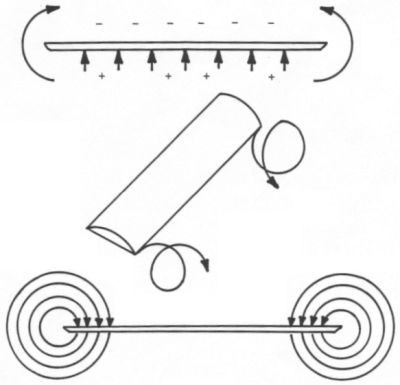 Creation of trailing vortices due to a difference in pressure above and below a lifting surface The Bernoulli theory of lift tells us that a wing creates lift because the air moving over the upper surface of the wing is at a lower pressure than the air beneath the wing. This difference in pressure creates a lift force that pulls the wing upward. Because of this difference in pressure, however, the high pressure air beneath the wing also tries to move outward and around the wingtip to escape to the low pressure region above the wing. As the wingtip flies forward, this motion of air creates a swirling vortex that trails behind. One of these vortices is left aft of each wingtip, swirling in opposite directions, to create a pair of trailing vortices behind the wing. 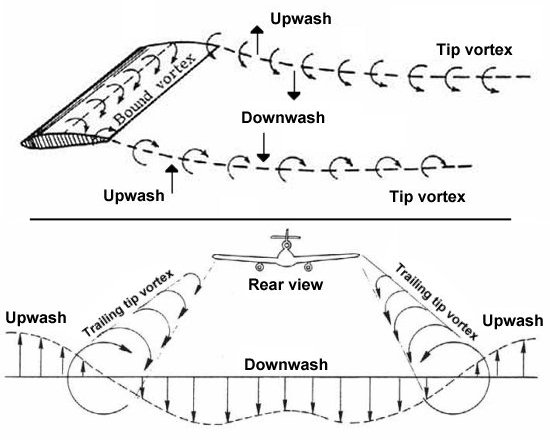 Regions of upwash and downwash created by trailing vortices Trailing vortices are undesirable primarily because they increase drag. Drag is the force that opposes an aircraft's forward motion and reduces its efficiency. While vortices do not directly increase the drag of a plane, they create a downwash that deflects the air behind a wing downward. This downwash decreases the lift generated by the wing. Effect of downwash in decreasing lift and increasing drag In order to make up for that lost lift, the wing's angle of attack must be increased. Angle of attack defines the angle at which the wing meets the oncoming air stream. Increasing this angle causes the lift generated by a wing to increase. The lift continues to increase until a particular angle of attack called the stall angle is reached. At this critical angle, the air flowing over the wing separates from the wing surface causing the lift to decrease. 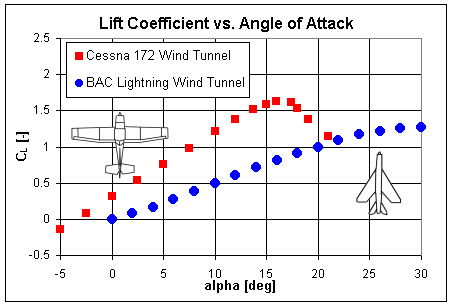 Examples of typical lift coefficient data for fixed-wing aircraft Now how does this interaction between downwash and lift cause drag to rise? The catch is that as lift increases with higher angle of attack, drag also increases at a faster rate. Therefore, as a wing's angle of attack is increased to compensate for the lift lost to downwash, the penalty is higher drag that reduces the efficiency of the wing. This form of drag is referred to as induced drag because it is induced by the generation of lift. Induced drag is the dominant type of drag acting on an aircraft at low speed, such as during takeoff and landing. It becomes considerably less significant at high speed during cruise flight where a different type of drag called parasite drag is dominant. 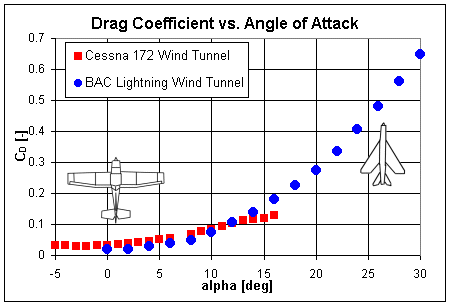 Examples of typical drag coefficient data for fixed-wing aircraft The amount of influence that trailing vortices have on the aerodynamic behavior of a wing depends on a number of factors. One of these is the distance of the wing from the ground. When operating very close to the ground, the vortices can become partially blocked and prevented from fully forming. This disruption of the trailing vortices reduces the magnitude of the downwash they create. A reduction in downwash results in higher lift and lower induced drag for a given angle of attack. As a result, ground effect increases the aerodynamic efficiency of a wing. 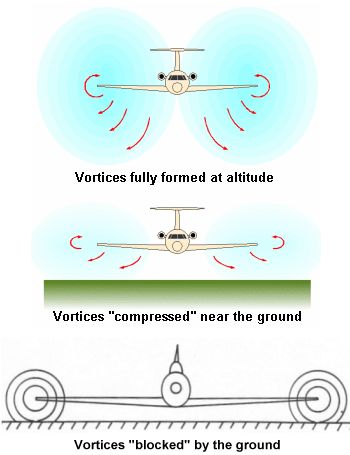 Ground effect and its influence on trailing vortices A second factor that influences the impact of trailing vortices on an aircraft is the speed at which it travels. A common misconception about ground effect is that a "bubble" or "cushion" of air forms between the aircraft and ground that somehow prevents the aircraft from landing or even forces the plane upward away from the ground. Furthermore, many believe that the strength of this cushion grows the faster an aircraft flies when near the ground. Both of these beliefs are wrong. First of all, there is no bubble of air that pushes an aircraft away from the ground. The true cause of ground effect is the influence of the ground on the wing's angle of attack as described above. Ground effect does nothing to force an aircraft upward from the ground, it only changes the relative amount of lift and drag that a wing will generate at a given speed and angle of attack. Second, we have seen that this effect actually decreases with speed since induced drag has increasingly less influence on an aircraft the faster it flies. This relationship can be better understood by studying the relationship between lift, speed, and angle of attack. As demonstrated in an article describing thin airfoil theory, lift is linearly proportional to angle of attack for angles below the stall angle. However, the lift equation says that lift is also proportional to the square of speed. These two relationships tell us that the faster a wing flies, the lower an angle of attack is required to generate sufficient lift to remain in flight. It is for this reason that an aircraft flying at high speed during cruise operates at a very low angle of attack. The cruise angle of attack for a large airliner like the Boeing 757, for example, is around 1� or 2�. Aircraft fly at a much higher angle of attack during takeoff and landing because it is during these stages of flight when speed is the lowest and a high angle of attack is required to generate the needed lift. This dependency is rather simple to remember--if speed is high, angle of attack is low. If speed is low, angle of attack must be high. Furthermore, when angle of attack is low, we have seen that induced drag is also low. If induced drag is low, the downwash generated by the wing must be small. If downwash is small, then the trailing vortices must be relatively narrow in diameter. If the trailing vortices are narrow, then the proximity of the ground can have little effect on their formation and ground effect will be minimal by definition. Given this explanation, it should come as no surprise that pilots most often report the influence of ground effect during a traditional landing. It is during the landing approach when a plane is at its lowest speed and highest angle of attack of any portion of its flight. In addition, the plane's slow speed provides less energy to spin the tip vortices, and the lower a vortex's rate of rotation, the wider in diameter it becomes. This combination of high angle of attack and low speed creates a large downwash and trailing vortices with a large diameter that have a significant influence over a plane's wing. These wide vortices are more likely to be blocked as the plane comes closer to the ground, so any reduction in their strength has a correspondingly significant impact on the aircraft's aerodynamic behavior. 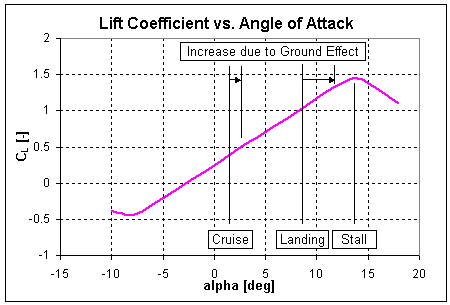 Relative impact of ground effect on lift at low versus high angle of attack The differences in the relative influence of ground effect on a wing are compared conceptually in the above diagram. This plot illustrates a typical lift curve for an aircraft showing how the lift coefficient varies with angle of attack. The lift coefficient required for cruise flight is rather low since the aircraft's speed is high, so the plane operates at a low angle of attack. The opposite occurs during landing when speed is low and a high lift coefficient is needed, so angle of attack must also be high. The impact of ground effect on a wing operating at a low angle of attack is quite small as indicated by the slight increase in angle of attack created by proximity to the ground. The same does not hold true at high angle of attack where ground effect has a much greater influence. Nevertheless, we do see that ground effect often does have some small effect on a wing even at low angles. Is it significant enough to somehow force the plane away from the ground or make it difficult, if not impossible, to control? The answer is again no since the pilot can easily reduce a plane's angle of attack to eliminate any excess lift and maintain a desired flight path. This feat is accomplished thanks to devices called control surfaces placed along a plane's wing and tail. Aircraft control surfaces and axes of motion The primary surface used to control the plane's angle of attack is the elevator located on the horizontal stabilizer. Deflecting the elevator up or down causes the nose of the plane to rotate up and down changing its angle of attack. This rotation is called pitch. The ailerons at each wingtip can also be used to influence the angle of attack on each side of the aircraft causing the plane to roll about its centerline. When an aircraft enters ground effect and goes to a higher effective angle of attack, the pilot simply pushes the control yoke forward. This adjustment causes the elevator to deflect downward and pushes the plane's nose downward to reduce its angle of attack. In so doing, the plane's lift is decreased. That brings us to the question of whether an essentially untrained pilot like terrorist Hani Hanjour could have made these adjustments to fly the Boeing 757 into the Pentagon. While such fine corrections do require some degree of finesse and familiarity with an aircraft's flight characteristics, the level of expertise required is not excessive. We have shown that any influence of ground effect would have been quite small on Flight 77 given its high rate of speed and small angle of attack. The 757 was apparently in a shallow dive as well, further reducing its angle of attack such that any impact of ground effect would have been extremely small. In addition, many modern airliners are not directly flown by the pilot but by automated systems. Most newer aircraft even use fly-by-wire (FBW) systems that take control inputs from the pilot, process them by computer, and automatically make adjustments to the control surfaces to accomplish the pilot's commands. Though the 757 is not equipped with a fully digital FBW system, it does carry a flight management computer system (FMCS), digital air data computer (DADC), and autopilot flight director system (AFDS) that provide sophisticated control laws to govern the plane's control surfaces. The AFDS not only controls the plane when the autopilot is enabled, but Boeing recommends that these computerized systems always be in operation to advise the pilots on how to best fly the aircraft. The primary advantage of computerized control systems is that they can make corrections to an aircraft's flight path and help prevent the pilot from accidentally putting the plane into an uncontrollable condition. The 757's flight augmentation system is also designed to damp out aerodynamic instabilities, and computerized control systems often automatically account for ground effect by making adjustments to the plane's control surfaces to cancel it out. These factors make it clear that ground effect could not have prevented a Boeing 757 from striking the Pentagon in the way that Flight 77 did on September 11. Nevertheless, we are still left with the claim that the pilot Hanjour flew a suspiciously "perfect" flight path on his approach to the Pentagon despite his lack of skill. It is unclear what has prompted this belief since very few eyewitnesses even describe how well the aircraft flew. The majority instead focus on the impact and aftermath. Even so, those few who did make statements regarding pilot ability indicate that Hanjour flew in a somewhat erratic manner as one would expect. 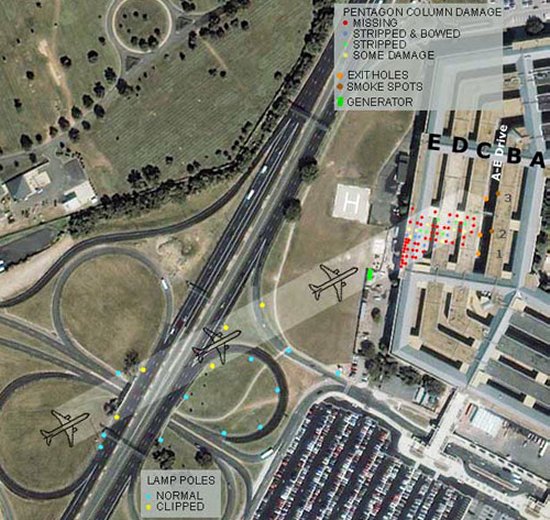 Probable path of Flight 77 as it approached the Pentagon One of the most interesting quotes comes from Afework Hagos who commented on the plane see-sawing back and forth, suggesting that the pilot was struggling to keep the plane level in either pitch or roll or perhaps both. Hagos was stuck in traffic near the Pentagon when the 757 passed overhead. He reported, "There was a huge screaming noise and I got out of the car as the plane came over. It was tilting its wings up and down like it was trying to balance." Another eyewitness named Penny Elgas also referred to the plane rocking back and forth while Albert Hemphill commented that, "He was slightly left wing down as he appeared in my line of sight, as if he'd just 'jinked' to avoid something." These observations were further confirmed by Mary Ann Owens, James Ryan, and David Marra who described the plane's wings as "wobbly" when it "rolled left and then rolled right" and the pilot "tilted his wings, this way and in this way." This question of whether an amateur could have flown Flight 77 into the Pentagon was also posed to a colleague who previously worked on flight control software for Boeing airliners. Brian F. (he asked that his last name be withheld) explained, "The flight control system used on a 757 can certainly overcome any ground effect. ... That piece of software is intended to be used during low speed landings. A high speed dash at low altitude like [Flight 77] made at the Pentagon is definitely not recommended procedure ... and I don't think it's something anyone specifically designs into the software for any commercial aircraft I can think of. But the flight code is designed to be robust and keep the plane as safe as possible even in unexpected conditions like that. I'm sure the software could handle that kind of flight pattern so long as the pilot had at least basic flight training skills and didn't overcompensate too much." Brian also consulted with a pair of commercial airline pilots who decided to try this kind of approach in a flight training simulator. Although the pilots were not sure the simulator models such scenarios with complete accuracy, they reported no significant difficulties in flying a 757 within an altitude of tens of feet at speeds between 350 and 550 mph (565 to 885 km/h) across smooth terrain. The only issue they encountered was constant warnings from the simulator about flying too fast and too low. These warnings were expected since the manufacturer does not recommend and FAA regulations prohibit flying a commercial aircraft the way Flight 77 was flown. These restrictions do not mean it is impossible for a plane to fly at those conditions but that it is extremely hazardous to do so, and safety was obviously not a concern to the terrorists on September 11. An aircraft flying at those high speeds at low altitude would also likely experience shaking due to the loads acting on it, but commercial aircraft are designed with at least a 50% safety margin to survive such extremes. One of the pilots summarized his experiences by stating, "This whole ground effect argument is ridiculous. People need to realize that crashing a plane into a building as massive as the Pentagon is remarkably easy and takes no skill at all. Landing one on a runway safely even under the best conditions? Now that's the hard part!" While he may have been exaggerating a bit for effect, he does raise a valid point that flying skillfully and safely is much more difficult than flying as recklessly as the terrorists did on September 11. - answer by Jeff Scott, 21 May 2006 |

Powered by: vBulletin
Copyright © 2000-2021, Jelsoft Enterprises Ltd.