
TranceAddict Forums (www.tranceaddict.com/forums)
- Chill Out Room
-- Conceptual Physics Question
Pages (3): « 1 [2] 3 »
Posted by Lunar Phase 7 on Dec-18-2006 09:43:
| quote: |
Originally posted by Sunsnail
nu uh. weight is the determining factor. if I drop a piece of paper and a piece of sheet metal, both the same dimension, you're telling me they'll reach terminal velocity at the same time? |
Same thickness and rigity then yes they will.
Weight has no effect.
Posted by astroboy on Dec-18-2006 10:41:
| quote: |
Originally posted by Lunar Phase 7
Both objects = Same shape so air resistance is not a deciding factor. So all this vacuum talk is bollocks. They both hit terminal velocity at the same time. |
If weight is irrelevant to calculating air resistance, then the only relevant measure would be surface area. In which case an elephant falling would encounter more air resistance than, say, a feather... This seems counter-intuitive..
Posted by Sunsnail on Dec-18-2006 12:52:
| quote: |
Originally posted by Lunar Phase 7
Same thickness and rigity then yes they will.
Weight has no effect. |
V= sqrt(2mg)/(� A Cd)) is the formula used to calculate terminal velocity... and it has weight right in the equation. 
Here's a projectile simulator... you can obviously see how much influence weight has on air resistance.
http://www.squadron13.com/games/projectile/projectile.htm
Posted by D-res on Dec-18-2006 16:45:
Re: Re: Conceptual Physics Question
| quote: |
Originally posted by Omega_M
For a heavier object, the force of gravity is significantly more than the lighter object |
Wording your sentence like this can be potentially misleading for those unfamiliar. While you're correct in saying heavier objects will exert more downward force than lighter objects, one must keep in mind that the downward acceleration of gravity (-9.8m/s^2) is the same for all objects, regardless of weight.
In regards to question 2...
Even though terminal velocity has already been defined in this thread, I'll explain it again for the sake of this post. An object is in free fall. Given it's mass and keeping in mind the constant downward acceleration of gravity, it's exerting say (hypothetically, of course) 1000N of downward force. When the air resistance, the upward force, reaches 1000N, downward acceleration stops and terminal velocity is reached.
Although the downward force exerted by objects with more mass will reach higher speeds than those with less mass before air resistance can equalize the forces, objects with less mass have lower terminal velocities because air resistance can equalize the forces quicker. It is because of this that it would seem object A would reach terminal velocity sooner. Two objects accelerating downward at the same velocity will travel neck and neck. One of the objects, however, has a lower terminal velocity than the other and in this sense, would seemingly reach terminal velocity while the other object continued accelerating. Because terminal velocity is affected by more factors than just an objects mass however, the amount of drag each object creates is the deciding factor in this problem.
The larger an object, the more drag it creates. We know theshapes of both objects are identical. However, their relevance to one another in regards to dimensions (L x W x H) is not addressed in the problem. Although various people have brought up the idea of a vacuum, we can disregard this possibility since the problem states that both objects are dropped from a high altitude.
Since air resistance affects the amount of time needed to reach terminal velocity by creating a positive, increasing upward force on both objects, it can be assumed that the object which creates more drag will equalize it's forces quicker, achieving terminal velocity, yet drag causes moderately rapid deceleration and in turn, terminal velocity requires more time to reach. Because air resistance is determined by multiple criteria, such the object's respective surface areas (larger objects create more drag than smaller ones), the speed the object is traveling (higher speeds = more air resistance), or changes in air pressure as the object falls (higher alt-> lower pressure, lower alt-> higher pressure) and because the information required to determine each objects drag wasn't included with the original problem, we can't accurately answer the question with ONLY the information provided.
A small object with very little mass may not require much drag to reach terminal velocity, but due to its small mass and size, wont create as much drag as, say, an object multiple times its size. ex: A 100k/g plastic cube measuring 5'x5'x5' will take longer to reach terminal velocity than a 105k/g plastic cube measuring 20'x20'x20' because the second cube, while having slightly more mass, creates a LOT more drag due to its much larger surface area. Of course if the larger cube were much denser and it's mass was significantly higher, we can assume once again that it would take longer to reach terminal velocity than the smaller cube.
If you'd like to assume that the object that has less mass is also, coincidentally smaller in size, we can assume it's terminal velocity is lower, but what if its mass is so small that the force of air disrupts its downward velocity and instead causes the object to bend and contort, changing both it's speed and its direction of travel? As someone else mentioned, a piece of paper would have a different terminal velocity than that of a piece of sheet metal, but there are a few factors we would have to consider first...
A. A piece of sheet metal has more mass than a piece of paper. Although the acceleration of gravity is unchanging and constant, the upward force of air resistance will have less effect on the sheet metal and would take longer to match the downward force of gravity with the upward force of air. But wait, an object with more drag will create more upward force and slow the objects acceleration quicker. The more drag an object creates, the lower its terminal velocity will be.
B. The piece of paper is less rigid, thus its more likely to bend as a direct result of air resistance. Changing shape will change the distribution of air resistance on the different surfaces of the object and in turn change its aerodynamic properties and its overall direction of travel. The more rigid piece of sheet metal would fall downward and probably wouldn't change direction as often, as easily, or as significantly as the paper, but because of its rigidity, it has the potential to create more air resistance, depending on what surfaces are facing downward. In the event the sheet metal became parallel with the ground, it would create more drag than the paper, which would bend and change shape as a direct result of air resistance.
A piece of paper, while having less mass, would probably "fly around in the wind" too much to reach terminal velocity because it's constant changes in velocity (keep in mind velocity is speed PLUS a direction) wouldn't allow it to continually accelerate downward towards terminal velocity. The rigidity of a piece of sheet metal could potentially cause similar problems. Although a piece of paper and a piece of sheet metal COULD potentially fit into this problem, due to their similar shapes but different masses, they're bad examples because their structural characteristics, especially their respective masses and rigidities, cause them to behave erratically in free fall, instead of maintaining a single, predominant direction of travel.
*sigh*
...that was a lot of thinking
Posted by Lunar Phase 7 on Dec-18-2006 23:08:
| quote: |
Originally posted by Sunsnail
V= sqrt(2mg)/(� A Cd)) is the formula used to calculate terminal velocity... and it has weight right in the equation.
Here's a projectile simulator... you can obviously see how much influence weight has on air resistance.
http://www.squadron13.com/games/pro.../projectile.htm |
And look at how small a difference it plays.
We are talking basic conceptual physics here, that equation is way to OTT for what this guy is after, but It's good you took the time to look it up.
The weight in that equation will come about due to things such as crosswind etc which will convert the vertical speed into some horizontal speeds.
Galileo prooved this centuries ago:
"One of the most famous stories about Galileo is that he dropped balls of different masses from the Leaning Tower of Pisa to demonstrate that their time of descent was independent of their mass (excluding the limited effect of air resistance)"
Source: http://en.wikipedia.org/wiki/Galileo#Physics
And about the guy who was on about elephant and Feather, don't be a clown. Those two examples are about as extreme as you can get and IN THIS INSTANCE, air resistance will play a part, but only due to the fact the feather is so rediculous lightweight, which is how it gives birds flight after all.
Posted by Caela on Dec-18-2006 23:16:
My Guesses :
1. A
(laser is smaller, light is more concentrated, less light particles = faster speed?)
2. C
(terminal velocity has a universal speed for every object...can't remember the exact number though)
3. B
(less air pressure at the bottom of the ball, since the top is leading the rest of it through the air, resulting with more velocity under the ball, since it is driving the ball in the direction it's moving).
Posted by astroboy on Dec-18-2006 23:19:
| quote: |
Originally posted by Lunar Phase 7
And about the guy who was on about elephant and Feather, don't be a clown. Those two examples are about as extreme as you can get and IN THIS INSTANCE, air resistance will play a part, but only due to the fact the feather is so rediculous lightweight, which is how it gives birds flight after all. |
Yes therefore weight always plays a part, no matter how small. Physics is about principles not ambiguous generalities. The question did not specify the materials for this very reason. It could be a ball made of Uranium and a ball made of polystyrene (or feathers for that matter).
Posted by Lunar Phase 7 on Dec-18-2006 23:26:
| quote: |
Originally posted by astroboy
Yes therefore weight always plays a part, no matter how small. Physics is about principles not ambiguous generalities. The question did not specify the materials for this very reason. It could be a ball made of Uranium and a ball made of polystyrene (or feathers for that matter). |
Did you even read my post?
Please check that wikipage, cause I can't be arsed typing anymore.
Posted by astroboy on Dec-18-2006 23:28:
| quote: |
Originally posted by Caela
My Guesses :
1. A
(laser is smaller, light is more concentrated, less light particles = faster speed?) |
Incorrrect. The speed of light is a constant, no matter what the source. He's asking for the rate at which the light spreads. Lasers beams hardly spread at all because laser light is made up of a single frequency of light. Sunlight has the widest spectrum of light and therefore spreads the fastest.
| quote: |
2. C
(terminal velocity has a universal speed for every object...can't remember the exact number though) |
Incorrect. For every object terminal velocity is the point at which the upward air resistance on an object (that is the force of the air molecules colliding with the falling object) is equal to the downward force on the object.
| quote: |
3. B
(less air pressure at the bottom of the ball, since the top is leading the rest of it through the air, resulting with more velocity under the ball, since it is driving the ball in the direction it's moving). |
others have already explained this well
| quote: |
| As the baseball moves through the air, the air pressure in the direction of motion is more than on the other side. Locally, the air molecules get compressed at the top and they create higher pressure in comparison to the pressure at the bottom. A small pocket of low pressure in the bottom of the baseball will be quickly filled in by the surrounding air, and this will result in higher velocities at the bottom. |
| quote: |
3, B - As the ball climbs into the air, more air molecules will be resisting its climb, as it has to push through the air to rise up. It will displace molecule below it creating the slip stream effect.
I agree it is worded awkwardly too, but from the choices it will have more velocity underneath it. |
Posted by Caela on Dec-18-2006 23:30:
| quote: |
| Originally posted by astroboy |
hehe...this is why I am not a physics major. Those were just guesses anyhoo 
Posted by Lunar Phase 7 on Dec-18-2006 23:31:
| quote: |
Originally posted by Caela
hehe...this is why I am not a physics major. Those were just guesses anyhoo |
It's okay mate, he balls it up too. 
Posted by Omega_M on Dec-18-2006 23:33:
| quote: |
Originally posted by Caela
My Guesses :
1. A
(laser is smaller, light is more concentrated, less light particles = faster speed?)
2. C
(terminal velocity has a universal speed for every object...can't remember the exact number though)
3. B
(less air pressure at the bottom of the ball, since the top is leading the rest of it through the air, resulting with more velocity under the ball, since it is driving the ball in the direction it's moving). |
Fail.
1)Speed of light is a fundamental constant (3 x 10^8 m/s)
2) Read the question again.
3) Vague.
Edit: Never mind, I didn't read Astroboy's post.
Posted by Nrg2Nfinit on Dec-18-2006 23:34:
| quote: |
Originally posted by Caela
hehe...this is why I am not a physics major. Those were just guesses anyhoo |
It also helps explain your hair color
Posted by astroboy on Dec-18-2006 23:47:
| quote: |
Originally posted by Lunar Phase 7
Did you even read my post?
Please check that wikipage, cause I can't be arsed typing anymore. |
Yes I did. Including the one that said "excluding the limited effect of air resistance)." That's a heck of a thing to exclude when you're answering a question about terminal velocity, a concept that depends on air resistance.
You first suggested that weight was immaterial to terminal velocity (ie air resistance met by a falling object). Then you implicitly conceded that it was relevant as demonstrated by my feather and elephant example (I chose an extreme example to demonstrate that in principle weight must be relevant as common sense would so dictate).
Crosswinds or "horizontal forces" are irrelevant in this case. Its a basic question of upward air resistance as opposed to downward force.
From basic principles look at it this way:
The upward force air resistance has on an object is proportional to A) the surface area of the object and B) the velocity of the object. A can be discounted because in our case the two objects are of the same shape.
Now terminal velocity is reached when the downward force of an object is equal to the upward force.
For simplicity's sake lets assume that the two objects are a polystyrene ball with a mass of 98 grams (downward force of 1 Newton) and a heavy metal ball of the same diameter with a mass of 10.2kg (downward force of 100 Newtons). Now assuming both begin to accelerate (gain velocity) at the same rate, and the upward air resistance begins to climb at the same rate - will it take the air resistance longer to climb to 1 Newton of upward force for object A or 100 Newtons of upward force for object B?
edit: looks like D-res has already explained all this in his post.
Looks like you're getting confused with Gallileos proof that objects accelerate at a constant speed of 9.8m/s/s if you exclude air resistance (ie in a vacuum.. it's precisely why in the wiki or wherever people talk about Gallileo they exclude air resistance). And the idea of terminal velocity to which weight is very relevant.
Posted by Lunar Phase 7 on Dec-18-2006 23:49:
| quote: |
Originally posted by astroboy
Yes I did. Including the one that said "excluding the limited effect of air resistance)." That's a heck of a thing to exclude when you're answering a question about terminal velocity, a concept that depends on air resistance.
You first suggested that weight was immaterial to terminal velocity (ie air resistance met by a falling object). Then you implicitly conceded that it was relevant as demonstrated by my feather and elephant example (I chose an extreme example to demonstrate that in principle weight must be relevant as common sense would so dictate).
Crosswinds or "horizontal forces" are irrelevant in this case. Its a basic question of upward air resistance as opposed to downward force.
From basic principles look at it this way:
The upward force air resistance has on an object is proportional to A) the surface area of the object and B) the velocity of the object. A can be discounted because in our case the two objects are the same.
Now terminal velocity is reached when the downward force of an object is equal to the upward force.
For simplicity's sake lets assume that the two objects are a polystyrene ball with a mass of 98 grams (downward force of 1 Newton) and a heavy metal ball of the same diameter with a mass of 10.2kg (downward force of 100 Newtons). Now assuming both begin to accelerate (gain velocity) at the same rate, and the upward air resistance begins to climb at the same rate - will it take the air resistance longer to climb to 1 Newton of upward force for object A or 100 Newtons of upward force for object B? |
Oksy, you've got your view, I got mine. Let's see the results when the guy takes the test.
Posted by Caela on Dec-18-2006 23:50:
| quote: |
Originally posted by Nrg2Nfinit
It also helps explain your hair color |
 Who said this is my natural hair color?
Posted by astroboy on Dec-19-2006 00:02:
| quote: |
Originally posted by Lunar Phase 7
Oksy, you've got your view, I got mine. Let's see the results when the guy takes the test. |
It's not my view, it's basic physics.
| quote: |
At low speeds the drag is much less than the gravitational force and so the object accelerates. As it speeds up the drag increases, until eventually it equals the weight.
...
Mathematically, terminal velocity is described by the equation
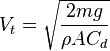
where
Vt is the terminal velocity,
m is the mass of the falling object,
g is gravitational acceleration,
Cd is the drag coefficient,
ρ is the density of the fluid the object is falling through, and
A is the object's cross-sectional area. |
Source:http://en.wikipedia.org/wiki/Terminal_velocity
| quote: |
| With all else (gravitational acceleration, density, cross-sectional area, drag constant, etc.) being equal, heavier objects fall faster. |
Source:http://en.wikipedia.org/wiki/Drag_(physics)#Velocity_of_falling_object
Posted by astroboy on Dec-19-2006 00:04:
| quote: |
Originally posted by Caela
hehe...this is why I am not a physics major. Those were just guesses anyhoo |
Yeah I'd probably suck at answering questions on what you're studying. But you shouldn't write yourself off. At least you attempted to answer the questions rationally, which is the main thing with maths/physics. If you wanted to you probably could major in physics.
Posted by Nrg2Nfinit on Dec-19-2006 00:05:
| quote: |
Originally posted by Caela
Who said this is my natural hair color? |
could have easily fooled me 
Posted by Caela on Dec-19-2006 00:07:
| quote: |
Originally posted by Nrg2Nfinit
could have easily fooled me |
At least I attempted to answer the questions...Where were your answers?
Posted by Omega_M on Dec-19-2006 00:12:
| quote: |
Originally posted by D-res
Wording your sentence like this can be potentially misleading for those unfamiliar. While you're correct in saying heavier objects will exert more downward force than lighter objects, one must keep in mind that the downward acceleration of gravity (-9.8m/s^2) is the same for all objects, regardless of weight. |
I don't quite understand how my statement is misleading. All I am doing is stating Newton's second law.
Infact, your statement that acceleration due to gravity is constant, is misleading for objects falling in air.
As the object starts falling down the force of gravity is dominant and initially, there is no drag.
As the object speeds up, drag acts upwards and starts to nullify the effect of gravity.
It implies that acceleration starts with a finite positive value and ends up being zero at the instant the body reaches terminal velocity.
After that, the object continues to fall with a constant velocity and zero acceleration.
If acceleration due to gravity is constant, it implies that the object always has a constant net downward force acting on it,
and that it always speed up. But that is just not the case in air or any medium except for vacuum.
Posted by Nrg2Nfinit on Dec-19-2006 00:14:
| quote: |
Originally posted by Caela
At least I attempted to answer the questions...Where were your answers? |
i have the second last calculus to worry about here! jesus. See my calculus thread add your contributions there
Posted by Lunar Phase 7 on Dec-19-2006 00:17:
| quote: |
Originally posted by astroboy
It's not my view, it's basic physics.
Source:http://en.wikipedia.org/wiki/Terminal_velocity
Source:http://en.wikipedia.org/wiki/Drag_(physics)#Velocity_of_falling_object |
I dont't wanna fall out about this, I respect the fact you have took time to think this through, and you do seem to know your stuff, but I still say you are wrong. Or at least, the least right.
http://www.physlink.com/Education/AskExperts/ae6.cfm
Might be interesting to read.
Posted by Omega_M on Dec-19-2006 00:23:
A feather and an elephant will fall at the same rate and hit the ground at the same if placed in vacuum.
A feather and an elephant will fall at different times with zero acceleration when placed in air because the drag force now comes into the picture.
The heavier an object, the more is the force of attraction, but more is the inertia. Hence, the assumption that heavier bodies fall faster and will hit the ground earlier than lighter ones is false because heavier bodies have more inertia, and inertia has a tendency to resist the motion. The two effects balance each other out, and as a result, bodies regardless of weight fall at the same rate. This is true only in vacuum.
Posted by astroboy on Dec-19-2006 00:48:
| quote: |
Originally posted by Omega_M
A feather and an elephant will fall at the same rate and hit the ground at the same if placed in vacuum.
A feather and an elephant will fall at different times with zero acceleration when placed in air because the drag force now comes into the picture.
The heavier an object, the more is the force of attraction, but more is the inertia. Hence, the assumption that heavier bodies fall faster and will hit the ground earlier than lighter ones is false because heavier bodies have more inertia, and inertia has a tendency to resist the motion. The two effects balance each other out, and as a result, bodies regardless of weight fall at the same rate. This is true only in vacuum. |
I agree with everything you said there. My only point with the elephant and feather example is that outside of a vacuum, weight IS relevant to terminal velocity.

Pages (3): « 1 [2] 3 »
Powered by: vBulletin
Copyright © 2000-2021, Jelsoft Enterprises Ltd.