
TranceAddict Forums (www.tranceaddict.com/forums)
- Political Discussion / Debate
-- Yet another scientist jumps off the Man-Made Global Warming© ship...
Pages (2): « 1 [2]
Cool!
It's a battle of the windbags! 


...you know I'm j/king.....I hope.... 
| quote: |
| Originally posted by occrider When the world's leading climatologists have 90% confidence with respect to the affects of global warming there's not much room to dance around on. |
| quote: |
| Originally posted by Fir3start3r Cool! It's a battle of the windbags! ...you know I'm j/king.....I hope.... |

| quote: |
| Originally posted by Fir3start3r What I don't understand is what is the appearance of the U.N.'s 180° about-face. Not too long ago (read a couple months ago) they were blaming cows and flatulence in this >THIS U.N. REPORT<  |
It's amazing how using the right words will make an argument that much more convincing....
| quote: |
You're Getting Warmer … The new statistical rhetoric of climate change. By Daniel Engber Posted Tuesday, Feb. 6, 2007, at 5:44 PM ET 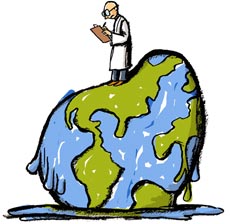 Global warming must be on a hot streak. Just a few months ago we watched polar bears drowning on the melting Arctic ice. In Washington, D.C., the cherry trees bloomed in January, and—wait, was Heaven boiling over?—the president himself warned Congress about the "serious challenge of climate change." But the biggest score came last Friday: A report from the United Nations' blue-ribbon international panel of climatologists declared global warming an "unequivocal" fact, "very likely" caused by human activity. This upgrades the panel's previous assessment from 2001, which tagged our poor behavior as the "likely" culprit. The words are selected to correspond to precise numerical assessments of our guilt. Six years ago, the authors calculated a 66 percent chance that we were behind the recent warming trend; today they peg it at more than 90 percent. (At one point, they proposed going as high as 99 percent.) This quantification of doubt is relatively new. For years, climate-change scientists relied on verbal expressions of chance instead of statistical ranges: Effects were "probable" or "possible"; they "could" or "might" be true. As a result, their language of uncertainty was easy to misinterpret, politicians threw up their hands, and skeptics seized on ambiguous phrases to argue that the science of climate change was based more on estimation than fact. But 10 years' worth of new data have emboldened the researchers, and now they've replaced their hazy equivocations with percentage values. This shift in rhetoric—at base, from words to numbers—has made their conclusions more comprehensible and compelling. It's also made them less honest. The change in strategy began when Richard Moss and Stephen Schneider—a pair of researchers dubbed the "uncertainty cops" by their peers—urged the U.N. panel of climate scientists to fortify their language with hard numbers. The mapping of phrases to percentages, they argued, would make it easier for policy-makers to apply the science and harder for skeptics to spin it. A footnote in the new report explains how their ideas have been applied: If the report says something is "virtually certain," it means there's a 99 percent chance that it's true."Very likely" refers to any probability between 90 percent and 99 percent, "more likely than not" refers to a chance greater than 50 percent, and "unlikely" is somewhere between 10 percent and 33 percent. (Click here for a PDF of Moss and Schneider's recommendations.) The new system makes it easier for policy-makers to think about global warming in terms of betting odds. You might determine the value of a card game by weighing the chance of winning against the potential payoff. Likewise, the politician can figure the risk of a global disaster by multiplying the chance of its occurrence by its potential costs. It might not be worth our time, for example, to hedge against the tiny possibility of a giant asteroid hitting the Earth, even though its effects would surely be catastrophic. (In gambling terms, betting on a deep impact would be like buying a lottery ticket.) Global warming, on the other hand, seems like a much safer bet. From a policy perspective, this sounds like a great idea. But when Moss and Schneider first made their recommendations, many members of the climate-change panel were justifiably reluctant to go along. As scientists, they'd been trained to draw statistical conclusions from a repeated experiment, and use percentages to describe their certainty about the results. But that kind of analysis doesn't work for global warming. You can't roll the Earth the way you can a pair of dice, testing it over and over again and tabulating up the results. At best, climate scientists can look at how the Earth changes over time and build simplified computer models to be tested in the lab. Those models may be excellent facsimiles of the real thing, and they may provide important, believable evidence for climate change. But the stats that come out of them—the percentages, the confidence intervals—don't apply directly to the real thing. That's why the climatologists had been using vague language about probability—they didn't feel they could draw on the rigorous language of percentages to describe what were essentially subjective judgments. At issue was our intuitive distinction between two kinds of probability, which might be described as "statistical" and "subjective." We might say, in the statistical sense, that the chance of rolling snake eyes on a pair of dice is about 3 percent; subjective probabilities, by contrast, come into play whenever we make a personal judgment based on available evidence. On Sunday morning I used my marginal knowledge of football to determine that the Bears would win the Super Bowl. Jurors use courtroom testimony to decide how likely it is that a defendant is guilty of a crime. And climatologists use scientific evidence to decide how likely it is that we're heating up the Earth. We haven't always been hung up on distinguishing between statistical judgments of chance and subjective ones. In the 18th century, magistrates were expected to assess the probability of a defendant's guilt by calculating the sum of the testimony against him. Meanwhile, a tribunal that convicted by a 2-to-1 margin could be taken to imply that the verdict had a 67 percent chance of being correct. The elements of probability weren't teased apart until 1837, when Siméon-Denis Poisson divided it into the dual concepts of statistical frequency (called "chance") and subjective judgment (sometimes referred to as "raison de croire"). Poisson's distinction has persisted, more or less, until today. In general, we use numbers and percentages when we're talking about statistical probability, and we use phrases like "doubtful" or "almost certain" when we're talking about subjective judgments. That doesn't mean you can't quantify belief. In fact, most of us have a pretty consistent intuition about how the language of uncertainty relates to numerical values. According to a famous study from 1990, if you ask people to translate the phrase likely or probable into a percentage, most will give a number between 63 percent and 78 percent. Very likely yields a rating of 80 percent to 90 percent. Something that's certain is 98 percent or 99 percent. But further research revealed that these meanings are stable only when the words are presented without context. In a report on climate change, by contrast, there's no reliable way to know if one policy-maker will ascribe the same percentage to the word likely as another. That's where the uncertainty cops come in. They tell the scientists to turn their opinions—as the best-informed experts in the world—into numbers. The process of mapping judgments to percentages has two immediate benefits. First, there's no ambiguity of meaning; politicians and journalists aren't left to make their own judgments about the state of the science on climate change. Second, a consistent use of terms makes it possible to see the uptick in scientific confidence from one report to the next; since 2001, we've gone from "likely" to "very likely," and from 66 percent to 90 percent. But the new rhetoric of uncertainty has another effect—one that provides less clarity instead of more. By tagging subjective judgments with percent values, the climatologists erode the long-standing distinction between chance and raison de croire. As we read the report, we're likely to assume that a number represents a degree of statistical certainty, rather than an expert's confidence in his or her opinion. We're misled by our traditional understanding of percentages and their scientific meaning. The uncertainty cops argue that in the face of global warming—and the spin campaign to discredit it—we must do whatever it takes to boost the credibility of the experts. If the public is more inclined to believe in percentages, then the experts should give them percentages. It's a reasonable argument and one that could help us to address the precipitous rise in greenhouse-gas emissions. But we have to acknowledge that the new headline-grabbing rhetoric of climate change has elements of propaganda. However valid its conclusions, the report toys with our intuitions about science—that a number is more precise than a word, that a statistic is more accurate than a belief. ---------------------------------------- sidebar A scientist might, for example, collect data from a pair of dice by rolling them over and over again in the lab. The results would form a frequency distribution; given enough data, it's possible to draw conclusions about which numbers are most likely to come up. |

| quote: |
| Originally posted by josh4 |
 ) source of C02 emissions in my opinion, not urban/industrial CO2 emissions. Destruction of environment is whats screwing up weather patterns, part of a huge ecological catastrophe. Cutting emissions will NOT stop this growth of CO2 ... Environment will continue to suffer. And carbon cycle will continue to take a beating. How are emissions cuts going to stop the damage? How? Using magic wand? I know time will prove my point ... I am certain ... when the world temperatures will start declining after 2015 or sooner, then we'll be talking. And by then idiots who fell for global warming will not believe anymore in any environmental talk, and environment, as always will continue to suffer.
| quote: |
| Originally posted by Magnetonium Though CO2 is very important for life, at the same time, we must must stop cutting down trees, damage to the environment - thats the sources of C02 emissions in my opinion, not urban/industrial CO2 emissions. Destruction of environment is whats screwing up weather patterns, part of a huge ecological catastrophe. Cutting emissions will NOT stop this growth of CO2 ... Environment will continue to suffer. And carbon cycle will continue to take a beating. How are emissions cuts going to stop the damage? How? Using magic wand? I know time will prove my point ... I am certain ... when the world temperatures will start declining after 2015 or sooner, then we'll be talking. And by then idiots who fell for global warming will not believe anymore in any environmental talk, and environment, as always will continue to suffer. |
| quote: |
| Originally posted by venomX I love it! The billions of tons of CO2 that we put into the atmosphere that comes from fossil fuels have nothing to do with it! We just cut down too many trees! I wonder if you really think that these scientists don't take into account all the different environmental changes we have subjected the earth to in their models. I mean, there just scientists with many years of experience, what would they know that Tom Hartmann or whatever his name is, the psychotherapist, doesnt know! |
| quote: |
| Originally posted by Magnetonium You dont know what Hartmann writes about, even wikipedia says he's global warming expert (am I supporting global warming???) I actually made a mistake in my previous post. I meant to say that most of CO2 released is through environmental damage, not through emissions - but both release CO2, no denial in that. I think that destabilization of natural carbon cycle from damage to the environment is the biggest culprit, which will not stop when we cut down emissions. |
| quote: |
| Originally posted by venomX Obviously there needs to be a comprehensive solution. It is silly that you think most of us are not aware that cutting down emissions is not the only thing that needs to get done, but it is one of the things, and a very important one at that. It is also a start. You seem to ignore the complexities of initiating and coordinating movements of this magnitude that affect so many interests and doing it on a worlwide scale. It is almost impossible to tackle everything at the same time. Space exists so that everything doesnt happen to just one person, and time exists so that everything doesnt happen at the same moment. |
| quote: |
| Originally posted by Magnetonium models suggest that changes in the Sun's energy output may have caused a small cooling at that time, but it is still unclear how these small changes in solar activity may have triggered such a widespread cooling" LOL, yeah, thats so confirmed. |
| quote: |
| Look - I am not going to waste hours digging up all the references, professor lectures, book links and their references - the point is, if you wish to not believe it you'll always find excuse for discrediting the information. So I wont bother. |
| quote: |
| The books I'll recommend you to read are EARTH IN THE BALANCE by Al Gore and LAST HOURS OF ANCIENT SUNLIGHT by Thom Hartmann, as well as ice core samples information, historic records, look for professor discussion evidence, etc. |
| quote: |
| Also, havent you noticed that rotation of the Earth, the spin / axis, which has its own cycle, "equinoxes", have a huge role in climate change, like like winter/summer transition. And thats proven. My points like these were previously ignored - |
| quote: |
| These are not small problems with the hypothesis. They are quite vast. These problems, especially the ~100kyr (95kyr+120kyr+400kyr) eccentricity problem are big enough to be disproven by the lack of their own merit. Furthermore, this paper by Muller and Macdonald: http://muller.lbl.gov/papers/nature.html demonstrates that there is little to no evidence of a 95kyr, 120kyr or a 400kyr frequency in the climate data. There is, however, a very narrow 100kyr frequency. Putting this together with the fact that the eccentricity cycle is the weakest of the Milankovitch cycles seemingly points rather convincingly that Milankovitch was not a cause of the ice ages. The 100kyr frequency, however, does point to another source, the sun's magnetic cycles: http://www.sciencedaily.com/release...20607073439.htm You'll notice in that paper that a correlation between Be10 and O18 in that above paper improves when it is corrected for geomagnetic variation, which gives more credence against a fallacious correlation. |
| quote: |
| I also like to add thatt global glaciation kills no less species of life than global warming - and global warming at least causes life explosion - its just claimed that its going to negatively affect our lifestyles. |
| quote: |
| With further CO2 cuts in our atmosphere, there will be increase of nitrogen and decrease of oxygen because less plants will convert CO2 to oxygen, which will eventually lead to unbreathable air and kill us all. Earth was used to be at one point made up of up to 35% oxygen. today's 0.4% CO2 content is way too low: "Earth's atmosphere is a layer of gases surrounding the planet Earth and retained by the Earth's gravity. It contains roughly 78% nitrogen, 21% oxygen, 0.93% argon, 0.04% carbon dioxide, and trace amounts of other gases, in addition to water vapor. This mixture of gases is commonly known as air." http://en.wikipedia.org/wiki/Earth%27s_atmosphere Buddy, here's another quote from that same link, all referenced and common sense, by the way: "Photosynthesising plants would later evolve and convert more carbon dioxide into oxygen. Over time, excess carbon became locked in fossil fuels, sedimentary rocks (notably limestone), and animal shells. As oxygen was released, it reacted with ammonia to release nitrogen; in addition, bacteria would also convert ammonia into nitrogen. But most of the modern day level of nitrogen are due mostly to sunlight-powered photolysis of ammonia released steadily over the aeons from volcanoes. As more plants appeared, the levels of oxygen increased significantly, while carbon dioxide levels dropped. At first the oxygen combined with various elements (such as iron), but eventually oxygen accumulated in the atmosphere, resulting in mass extinctions and further evolution. With the appearance of an ozone layer (ozone is an allotrope of oxygen) lifeforms were better protected from ultraviolet radiation. This oxygen-nitrogen atmosphere is the "third atmosphere". 200 - 250 million years ago, up to 35 percent of the atmosphere was oxygen (bubbles of ancient atmosphere were found in an amber). This modern atmosphere has a composition which is enforced by oceanic blue-green algae as well as geological processes. O2 does not remain naturally free in an atmosphere, but tends to be consumed (by inorganic chemical reactions, as well as by animals, bacteria, and even land plants at night), while CO2 tends to be produced by respiration and decomposition and oxidation of organic matter. Oxygen would vanish within a few million years due to chemical reactions and CO2 dissolves easily in water and would be gone in millennia if not replaced. Both are maintained by biological productivity and geological forces seemingly working hand-in-hand to maintain reasonably steady levels over millions of years." Come on, now, dont bullshit me. |
| quote: |
| Originally posted by Magnetonium Taking humans out of equation will solve all of Earth's problems. We are in the way. Earth has existed in equilibrium, co-existence and mutual benefit until some humans, who used to be part of this cycle, developed methods to control, destroy and manipulate nature, breaking the cycle, as David Suzuki points out in Sacred Cycle. WE are the problem, and we should immediately halt destruction. We've been talking and talking and talking while nothing''s being done and now we've figured out how easy it is to ignore the environmental problems if we pretend that emissions are the main problem. And the rest is history. Even the natives can clearly see how dumb we are. Great legacy for the future generations ... |
| quote: |
| Originally posted by MisterOpus1 And here's a post that I couldn't agree with you more on. I hope you don't think that I am arguing a position that emissions are the ONLY cause of our woes, and that they're the ONLY thing we should be concerned with. I agree wholeheartedly with your point that we should be addressing many other environmental issues as well. However, I think we cannot be dissmissive of emissions being a very serious culprit either. |

Stop going to McRaunchie's everyone...
| quote: |
from the February 20, 2007 edition - http://www.csmonitor.com/2007/0220/p03s01-ussc.html Humans' beef with livestock: a warmer planet American meat eaters are responsible for 1.5 more tons of carbon dioxide per person than vegetarians every year. By Brad Knickerbocker | Staff writer of The Christian Science Monitor As Congress begins to tackle the causes and cures of global warming, the action focuses on gas-guzzling vehicles and coal-fired power plants, not on lowly bovines. Yet livestock are a major emitter of greenhouse gases that cause climate change. And as meat becomes a growing mainstay of human diet around the world, changing what we eat may prove as hard as changing what we drive. It's not just the well-known and frequently joked-about flatulence and manure of grass-chewing cattle that's the problem, according to a recent report by the Food and Agriculture Organization of the United Nations (FAO). Land-use changes, especially deforestation to expand pastures and to create arable land for feed crops, is a big part. So is the use of energy to produce fertilizers, to run the slaughterhouses and meat-processing plants, and to pump water. "Livestock are one of the most significant contributors to today's most serious environmental problems," Henning Steinfeld, senior author of the report, said when the FAO findings were released in November. Livestock are responsible for 18 percent of greenhouse-gas emissions as measured in carbon dioxide equivalent, reports the FAO. This includes 9 percent of all CO2 emissions, 37 percent of methane, and 65 percent of nitrous oxide. Altogether, that's more than the emissions caused by transportation. The latter two gases are particularly troubling – even though they represent far smaller concentrations in atmosphere than CO2, which remains the main global warming culprit. But methane has 23 times the global warming potential (GWP) of CO2 and nitrous oxide has 296 times the warming potential of carbon dioxide. Methane could become a greater problem if the permafrost in northern latitudes thaws with increasing temperatures, releasing the gas now trapped below decaying vegetation. What's more certain is that emissions of these gases can spike as humans consume more livestock products. As prosperity increased around the world in recent decades, the number of people eating meat (and the amount one eats every year) has risen steadily. Between 1970 and 2002, annual per capita meat consumption in developing countries rose from 11 kilograms (24 lbs.) to 29 kilograms (64 lbs.), according to the FAO. (In developed countries, the comparable figures were 65 kilos and 80 kilos.) As population increased, total meat consumption in the developing world grew nearly five-fold over that period. Beyond that, annual global meat production is projected to more than double from 229 million tons at the beginning of the decade to 465 million tons in 2050. This makes livestock the fastest growing sector of global agriculture. Animal-rights activists and those advocating vegetarianism have been quick to pick up on the implications of the FAO report. "Arguably the best way to reduce global warming in our lifetimes is to reduce or eliminate our consumption of animal products," writes Noam Mohr in a report for EarthSave International. Changing one's diet can lower greenhouse gas emissions quicker than shifts away from fossil fuel burning technologies, Mr. Mohr writes, because the turnover rate for farm animals is shorter than that for cars and power plants. "Even if cheap, zero-emission fuel sources were available today, they would take many years to build and slowly replace the massive infrastructure our economy depends upon today," he writes. "Similarly, unlike carbon dioxide which can remain in the air for more than a century, methane cycles out of the atmosphere in just eight years, so that lower methane emissions quickly translate to cooling of the earth." Researchers at the University of Chicago compared the global warming impact of meat eaters with that of vegetarians and found that the average American diet – including all food processing steps – results in the annual production of an extra 1.5 tons of CO2-equivalent (in the form of all greenhouse gases) compared to a no-meat diet. Researchers Gidon Eshel and Pamela Martin concluded that dietary changes could make more difference than trading in a standard sedan for a more efficient hybrid car, which reduces annual CO2 emissions by roughly one ton a year. "It doesn't have to be all the way to the extreme end of vegan," says Dr. Eshel, whose family raised beef cattle in Israel. "If you simply cut down from two burgers a week to one, you've already made a substantial difference." |


Powered by: vBulletin
Copyright © 2000-2021, Jelsoft Enterprises Ltd.