TranceAddict Forums

TranceAddict Forums (www.tranceaddict.com/forums)
- Political Discussion / Debate
-- Are We Doing Enough For Africa?
Pages (3): « 1 [2] 3 »


Posted by Lebezniatnikov on Feb-29-2008 16:57:

quote:
Originally posted by jerZ07002
nice way of saying it's all europe's fault. a position that i clearly agree with.


I think Europe AND the US (mainly through neo-liberal economic policies coming from the IMF) certainly bear a responsibility for the depths of many problems in Africa.

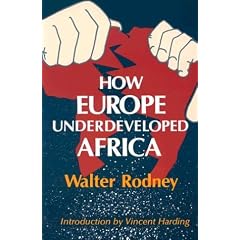
But then again, I'd count Walter Rodney as an influence:


Posted by sean5 on Feb-29-2008 17:02:

quote:
Originally posted by Lebezniatnikov
I think Europe AND the US (mainly through neo-liberal economic policies coming from the IMF) certainly bear a responsibility for the depths of many problems in Africa.

But then again, I'd count Walter Rodney as an influence:


blame white people more


Posted by Lebezniatnikov on Feb-29-2008 17:04:

quote:
Originally posted by sean5
blame white people more


You're an insightful little fella, aren't you?


Posted by sean5 on Feb-29-2008 17:06:

quote:
Originally posted by Lebezniatnikov
You're an insightful little fella, aren't you?


can you please layout all the things you have done personally to help out anywhere in africa?


Posted by jerZ07002 on Feb-29-2008 17:12:

quote:
Originally posted by sean5
can you please layout all the things you have done personally to help out anywhere in africa?


what does that have to do with being able to analyze the factors creating the problem?


Posted by sean5 on Feb-29-2008 17:18:

quote:
Originally posted by jerZ07002
what does that have to do with being able to analyze the factors creating the problem?


because how can you ask what 'we' are doing when you haven't done anything yourself? instead of crying on the internet that is the product of the european ancestry you so hate, you should go help your fellow humans suffering in the horrendous hell of africa (or so you say). the long silence after that post just shows that this guy has done nothing just as noone in this thread has done anything because no one really cares about africa. it looks good to say you do though which is why so many people do.


Posted by Lebezniatnikov on Feb-29-2008 17:27:

quote:
Originally posted by sean5
can you please layout all the things you have done personally to help out anywhere in africa?


I'm a graduate student in International Affairs with concentrations in International Development, Conflict Resolution, and sub-Saharan Africa area studies and have done a fairly decent amount of advocacy outreach on behalf of conflict issues.

Career-wise I haven't really gotten settled yet, though I hope to find something more permanent this summer.

And in regards to my "silence" - I was making lunch and not waiting for your reply. Sorry if that could be construed as feeling guilty about not doing enough or whatever you were implying.


Posted by sean5 on Feb-29-2008 17:33:

so in other words: nothing.


Posted by Lebezniatnikov on Feb-29-2008 17:36:

quote:
Originally posted by sean5
instead of crying on the internet that is the product of the european ancestry you so hate, you should go help your fellow humans suffering in the horrendous hell of africa (or so you say).


Hyperbole much?

I don't "hate" my European ancestry - I simply acknowledge and take responsibility for the fact that we are not blameless for the problems that currently exist in Africa. Where did I say that we should accept full responsibility and blame whitey for the world's ills? If you took the time to read my previous posts you would clearly see that I think blame for the current problems in Africa (which are indeed significant) should fall equally on the legacy of colonialism and the ill-advised leadership of African elites, who have in some cases squandered whatever opportunities for development and peace do exist on the continent.

I'm not about throwing around blame - I'm simply claiming a moral and historical responsibility for the culpability we do possess.

And I do plan on one day going to Africa to work on a project, but am waiting until I complete my MA so that I am marketable with the large development organizations.


Posted by sean5 on Feb-29-2008 17:39:

i'm guessing you are the one responsible for the facebook group: 100,000 people join this group and i will donate $100 to darfur crisis@!@!


Posted by Lebezniatnikov on Feb-29-2008 17:43:

quote:
Originally posted by sean5
so in other words: nothing.


ok bud. I've never once claimed that I've done these great and wondrous deeds in Africa in the past - I only noted that I am currently doing my best to prepare for a career in international development and conflict resolution in Africa in the hopes of doing my small part to make life a little better there.

So if that's nothing by you, I guess I can still sleep well at night.


Posted by sean5 on Feb-29-2008 17:59:

planning isn't doing and so you've done nothing.

/end of this sympathizer thread.


Posted by Lebezniatnikov on Feb-29-2008 18:05:

quote:
Originally posted by sean5
planning isn't doing and so you've done nothing.

/end of this sympathizer thread.


How is this whole non-sequitar exchange even relevant? Have you actually read any of this thread, or are you just in PDD to be annoying?


Posted by sean5 on Feb-29-2008 18:50:

http://biz.yahoo.com/bw/080214/20080214006251.html?.v=1


Posted by sean5 on Feb-29-2008 18:56:

http://news.yahoo.com/s/afp/2008021...tanzaniaaidsign


Posted by atbell on Feb-29-2008 19:34:

quote:
Originally posted by Krypton
My policy. . .

1. Stop wars of aggression.

Then and only then, can we concentrate on humanitarian issues with the majority of our focus.

2. Get people working.

Once people have jobs, they usually refrain from violent activity such as civil wars.

3. Help the people feed themselves.

These poor countries must learn how to produce their own food instead of rely on food imports. At the very least, these country's economies should be well enough to where they can at least buy food on the market, instead of always relying on donated food, which does force out domestic food producers.

4. US self-suffiency in energy.

The US must separate itself fundamentally from violent regions of the world which have no problem declaring the only good American is a dead American. This is the fundamental strategic dilema the US faces. It is because of this, that we have Islamist terrorists and hatred of America.


I like it.

Two questions though,

How do you deal with regions that have more people within thier borders then they can possibly feed?

When is a region considered to be hostile to Americans (or any nationality for that matter)? How could you evluate the number of people who delare "the only good member of country US is a dead member of country US" and at what point the number validates cutting ties with them?


Posted by atbell on Feb-29-2008 19:51:

Re: Are We Doing Enough For Africa?

quote:
Originally posted by Lebezniatnikov

Any thoughts? That opens up a whole lot of topics from HIV/AIDS prevention to conflict resolution/prevention efforts to international development topics.

What role should the West play in the future of Africa? What role should China?


I'll admit right off that I don't have time to read the articles you've posted, but I do have thoughts about your questions.

A fundamental problem that all of these questions lead to is the full debate on "intervention" in general.

The Chinese side of things is easy but is about to get more complex. The Chinese government has maintained a consistent "non-interference" policy for some time now with limited sucess. For better or worse this is changing though. Sudan's Darfur and Burma have draw international ire and the Chinese apear to be starting to take this into consideration.

Modern American policy (since disposing of the non-interventionist stance of pre-WWII) has been to act on any matter that is in America's interest. This is a form of "realpolitic" which I beleive Kissenger was most responsible for brining to life.

The problem with realpolitic is that it has only really been practiced by two people before Kissenger, one was a French religious offical (a bishop or something) who advised Louis XIV, France's "Sun King". The other person who put realpolitic into effect was Otto von Bismark. Both efforts led to disasterous wars and a quick dimise for each of those countries.

Although Louis XIV was called the Sun King it's likely that this was due more to the fact that he ruled as French colonialisim began in ernst and reaped the rewards of pilaging the new world. Soon after his dimise the young Louis XVI was beheaded in the French revolution. It apears that the realpolitic practiced on an international level was also practiced on a national level, each player calculating actions based purely on thier own best interest.

Otto von Bismark, who I don't know as well, was the leader of the Germans first or second reich and is the one who took the country into world war I.

What it looks like is that realpolitic is far to interventionalist where as a policy of non-intervention is just callous.

The mix of the two will have to be some form of enlightened realpolitic or enlightened non-interventionalisim.

Enlightened realpolitic would be nearly the same as US practices today but with very strict terms on when US self intrest must be forfit. A good starting point would be to ensure that signed international treaties are honoured instead of either discarded or abused to the point of irelevance.

Enlightened non-interventionalisim would be like current Chinese policy with strict rules about when to act, such as natural disasters, clear acts of genocide, or wars of aggression.


Posted by atbell on Feb-29-2008 19:56:

quote:
Originally posted by Arbiter

The goal of democratizing Africa is also one which has recieved great focus recently. It is clearly an important policy objective -- otherwise, the response to the disputed Kenyan election would have been much less tepid. It's pretty obvious that it is more to the strategic advantage of the U.S. for Kibaki to hold power, and that we did not overwhelmingly support him shows that the establishment of legitimate democracy (or at least, the appearance of legitimate democracy) is highly prioritized as well. Though well-intentioned, I am inclined to regard this as a mistake. The problem that I see, stated as simply as possible, is that the political institutions of a country must reflect the social and cultural reality of that country, and the social and cultural reality of most of Africa cannot be reflected by a democracy.

So instead, I will say that I am concerned about our apparent focus on the structure of government. Instead, we should be more concerned about the operational behavior of government (insofar as it contributes to regional stability and national development). It seems to be taken for granted that democratically elected leaders tend to behave better in those regards, but I am very skeptical of that premise and, consequently, the value of immediate democratization.


I completely agree.

Democracy can be great, but it is also quite easy to fake. Media control, as practiced in Russia and the US, can drastically affect the outcome of even the most free democratic elections. Brute force and intimidation are also clear methods of ensuring the public votes as perscribed, although it is much more visible then media (read: information) manipulation.


Posted by atbell on Feb-29-2008 19:59:

quote:
Originally posted by Fir3start3r
Fixed for a more legitimate question...


Who is Affrica?

Are you implying that Africans are lazy or freedom hating?

What more could they (African populations) do?


Posted by atbell on Feb-29-2008 20:04:

quote:
Originally posted by sean5
so in other words: nothing.


Or he's developed the background knowledge, credetials, and contacts to confront a pressing global issue.

Buy you see, some people don't know how to apply education so they don't think it's worth anything.


Posted by atbell on Feb-29-2008 20:11:

quote:
Originally posted by sean5
http://news.yahoo.com/s/afp/2008021...tanzaniaaidsign


Nice google work. I especially like how you used the "cut" function while applying the advanced "paste" right after it.

Why don't you tell us some of your personal highlights from those sources you clearly read in full?

How exactly do these links proove that Bush and his little fly by have helped the African continent?


Posted by Lebezniatnikov on Feb-29-2008 20:39:

Re: Re: Are We Doing Enough For Africa?

quote:
Originally posted by atbell

What it looks like is that realpolitic is far to interventionalist where as a policy of non-intervention is just callous.

The mix of the two will have to be some form of enlightened realpolitic or enlightened non-interventionalisim.

Enlightened realpolitic would be nearly the same as US practices today but with very strict terms on when US self intrest must be forfit. A good starting point would be to ensure that signed international treaties are honoured instead of either discarded or abused to the point of irelevance.

Enlightened non-interventionalisim would be like current Chinese policy with strict rules about when to act, such as natural disasters, clear acts of genocide, or wars of aggression.


I think you've hit on the crux of the debate - to what extent should some form of moral responsibility factor into the decision to intervene or not intervene? Sovereignty issues and worries about neo-imperialism are huge in African politics these days... there is an inherent distrust that the West is capable of intervening without the explicit promotion of its own self-interest. This discontent is leading a lot of African leaders to turn to China, who they at least know will not force democratization in exchange for monetary inflows.

It is interesting to follow the debate within international law on morality and interventionism vs. sovereignty and self-determination issues. The International Commission on Intervention and State Sovereignty published a report in 2001 that, while not being fully implemented as of yet, offers an interesting guideline as to the conduct of future interventionism.

Basically, it boils down international interventionism (a global Responsibility to Protect under the auspices of the UN Charter chapters 6 and 7) to incorporate three broad themes -
1. The Responsibility to Prevent
2. The Responsibility to React
3. The Responsibility to Rebuild

Wherever governments prove unwilling or unable to provide any of the three above services, the international community is not only authorized, but compelled under the moral authority of international law to intervene.

Operationally speaking, six basic thresholds must be met in order to necessitate a strictly military intervention (this is where international law gets wishy-washy and subject to interpretation):
1. Just Cause
2. Right Intention
3. Last Resort
4. Legitimate Authority
5. Proportional Means
6. Reasonable Prospect

Obviously the Responsibility to Protect (R2P) doctrine is only relevant in cases where the state is not a willing partner - when the international community is invited into a state on its own volition, it would take the form of a UN or regional body peacekeeping task force.

You can read the report in its entirety here:
http://www.iciss.ca/report2-en.asp

I'm actually researching for a paper on R2P, so this stuff is pretty interesting to me.

You can find more general info on how R2P is being applied here:
http://www.responsibilitytoprotect.org/index.php

They have quite a bit of info on Darfur if you are interested as well.


Posted by Lebezniatnikov on Feb-29-2008 20:48:

quote:
Originally posted by atbell
I completely agree.

Democracy can be great, but it is also quite easy to fake. Media control, as practiced in Russia and the US, can drastically affect the outcome of even the most free democratic elections. Brute force and intimidation are also clear methods of ensuring the public votes as perscribed, although it is much more visible then media (read: information) manipulation.


Yes, I agree as well.

This gets into Fareed Zakaria's delineation between liberal and illiberal democracies:

quote:
The American diplomat Richard Holbrooke pondered a problem on the eve of the September 1996 elections in Bosnia, which were meant to restore civic life to that ravaged country. "Suppose the election was declared free and fair," he said, and those elected are "racists, fascists, separatists, who are publicly opposed to [peace and reintegration]. That is the dilemma." Indeed it is, not just in the former Yugoslavia, but increasingly around the world. Democratically elected regimes, often ones that have been reelected or reaffirmed through referenda, are routinely ignoring constitutional limits on their power and depriving their citizens of basic rights and freedoms. From Peru to the Palestinian Authority, from Sierra Leone to Slovakia, from Pakistan to the Philippines, we see the rise of a disturbing phenomenon in international life -- illiberal democracy.

It has been difficult to recognize this problem because for almost a century in the West, democracy has meant liberal democracy -- a political system marked not only by free and fair elections, but also by the rule of law, a separation of powers, and the protection of basic liberties of speech, assembly, religion, and property. In fact, this latter bundle of freedoms -- what might be termed constitutional liberalism -- is theoretically different and historically distinct from democracy. As the political scientist Philippe Schmitter has pointed out, "Liberalism, either as a conception of political liberty, or as a doctrine about economic policy, may have coincided with the rise of democracy. But it has never been immutably or unambiguously linked to its practice." Today the two strands of liberal democracy, interwoven in the Western political fabric, are coming apart in the rest of the world. Democracy is flourishing; constitutional liberalism is not.

Today, 118 of the world's 193 countries are democratic, encompassing a majority of its people (54.8 percent, to be exact), a vast increase from even a decade ago. In this season of victory, one might have expected Western statesmen and intellectuals to go one further than E. M. Forster and give a rousing three cheers for democracy. Instead there is a growing unease at the rapid spread of multiparty elections across south-central Europe, Asia, Africa, and Latin America, perhaps because of what happens after the elections. Popular leaders like Russia's Boris Yeltsin and Argentina's Carlos Menem bypass their parliaments and rule by presidential decree, eroding basic constitutional practices. The Iranian parliament -- elected more freely than most in the Middle East -- imposes harsh restrictions on speech, assembly, and even dress, diminishing that country's already meager supply of liberty. Ethiopia's elected government turns its security forces on journalists and political opponents, doing permanent damage to human rights (as well as human beings).

Naturally there is a spectrum of illiberal democracy, ranging from modest offenders like Argentina to near-tyrannies like Kazakstan and Belarus, with countries like Romania and Bangladesh in between. Along much of the spectrum, elections are rarely as free and fair as in the West today, but they do reflect the reality of popular participation in politics and support for those elected. And the examples are not isolated or atypical. Freedom House's 1996-97 survey, Freedom in the World, has separate rankings for political liberties and civil liberties, which correspond roughly with democracy and constitutional liberalism, respectively. Of the countries that lie between confirmed dictatorship and consolidated democracy, 50 percent do better on political liberties than on civil ones. In other words, half of the "democratizing" countries in the world today are illiberal democracies.

Illiberal democracy is a growth industry. Seven years ago only 22 percent of democratizing countries could have been so categorized; five years ago that figure had risen to 35 percent. And to date few illiberal democracies have matured into liberal democracies; if anything, they are moving toward heightened illiberalism. Far from being a temporary or transitional stage, it appears that many countries are settling into a form of government that mixes a substantial degree of democracy with a substantial degree of illiberalism. Just as nations across the world have become comfortable with many variations of capitalism, they could well adopt and sustain varied forms of democracy. Western liberal democracy might prove to be not the final destination on the democratic road, but just one of many possible exits.


http://www.foreignaffairs.org/19971...-democracy.html

In other words, the focus on democratization is often misguided, as Arbiter suggests - de Tocqueville regarded American democracy so highly precisely because it was preceded by democratic norms and mores that inculcated the value of good governance - where no such values exist, should we be surprised that the governments fail to reflect them?

What I think is perhaps more promising is to focus on some of the structural problems within the African state. By increasing transparency and reducing corruption, fostering a wider space for civil society, and reducing patrimonial linkages betweens state and society, the values of civic participation and good governance can be cultivated over time.

There is a great deal of academic literature that suggests that the degree to which citizens are free to associate within civil society correlates to stability and overall standard of living. The World Bank and a number of other international organizations are re-tooling their efforts to focus more and more on civil society promotion. Perhaps this will generate more success than simply a democratic agenda has been able to thusfar.


Posted by Lebezniatnikov on Feb-29-2008 21:03:

quote:
Originally posted by Arbiter


Personally, I am rather skeptical that our recent policy towards Africa will yield long-term gains. PEPFAR, to me, represents part of the unordinate focus on AIDS which has characterized many of our health initiavites, and to make matters worse, its "conservative" methodology would appear to compromise its probable efficacy as well.


Somehow I missed your post in the discussion Krypton and I were having. But I have to say - I enjoy reading your thoughts on Africa and Kenya in particular, as I feel they often supplement and inform my own to a great extent.

You are very right to be cautious about PEPFAR... the focus on Abstinence+ funding is questionable at best, and I'm not convinced that the implementation has been very efficient. It seemed to me to be a big "hey gais look at this! i'm doing something about aids lulz". But I guess that begs the question of whether some effort, however inadequate, is better than nothing.

But you are also right to note that there are a plethora of other major health issues in Africa - many of which are far more treatable than HIV/AIDS, and affect more people as well.


Posted by Fir3start3r on Mar-01-2008 06:26:

quote:
Originally posted by atbell
Who is Affrica?

Are you implying that Africans are lazy or freedom hating?

What more could they (African populations) do?


Neither actually.

They need to somehow, get a handle on all the corruption and reign in their warlords.
They've been so despot for so long they have no idea what true freedom even means.
Until they get rid of the choking weeds, nothing solid is going to take root for them to build upon.

One only has to go so far as their own living room and look at their TV to see the same starving children in Africa commercials we've been seeing for over TWENTY YEARS now...

That's not to say that some children haven't been helped, however I'm a proponent of solving the problem, not just patching it.


Pages (3): « 1 [2] 3 »

Powered by: vBulletin
Copyright © 2000-2021, Jelsoft Enterprises Ltd.