
TranceAddict Forums (www.tranceaddict.com/forums)
- Chill Out Room
-- Massive Quake Hits Japan!
Pages (29): « 1 2 3 4 5 6 7 8 9 10 11 12 13 14 15 16 17 18 19 20 21 22 23 24 25 [26] 27 28 29 »
| quote: |
| Originally posted by jester Knowing Japan, most of the execs will commit suicide. I just wonder if they will pick and choose Seppuku. |

| quote: |
| Originally posted by LAdazeNYnights This guy is the fucking man. |

Fuck yea Japan!
6 days!
that's awesome
| quote: |
| Originally posted by Joss Weatherby Fuck yea Japan! 6 days! |
| quote: |
| Originally posted by stren nothing beats Japanese 12 hour work days! |
| quote: |
| Originally posted by emc^2 Unicorns, baby... Unicorns. |
| quote: |
| Originally posted by emc^2 Unions, baby... Unions. |
If you get time, really should have a look at this:
Link
| quote: |
| The Nelson Post reports on 22 March on the story of Mike Luzia, an English teacher from the town of Nelson in British Columbia, Canada, who was working in Onagawa at the time of the tsunami. Mike�s first-hand description of the destruction of Onagawa and his subsequent search over a period of days for his girlfriend is a harrowing read. |
| quote: |
| Originally posted by Jackson If you get time, really should have a look at this: Link |

Harrowing read.
FAO: All those who refuse to keep calm carry on!
| quote: |
| Fear of nuclear power is out of all proportion to the actual risks Pollution from coal-fired power plants is responsible for more than 100,000 deaths per year, whereas the crisis at the Fukushima nuclear plant is unlikely to kill a single person People are getting nervous about nuclear power in the wake of the problems at the Fukushima nuclear power plant in Japan, questioning whether nuclear power is a sensible option for energy production in light of the perceived risks. It has been three weeks since the earthquake and tsunami in Japan. There have been problems at the Fukushima plant with cooling, gas explosions (not nuclear), and radiation leaks � all serious issues, but so far no one has died. The earthquake and tsunami have killed more than 10,000 people. In fact, the disaster shows how safe nuclear reactors actually are. Reactors designed half a century ago survived an earthquake many times stronger than they were designed to withstand, immediately going into shut-down (bringing driven nuclear reactions to a halt). But the radioactive products in the reactor keep decaying, producing heat, so they must be cooled. The real problems began when the tsunami took out all the back-up generators that were meant to provide power to circulate the coolant. Loss of site power is the worst-case scenario for a nuclear power plant, so for Fukushima this was the worst crisis imaginable. New reactors have improved safety features, including passive systems that allow cooling to take place without power. Radiation leaks are undoubtedly serious. But it is worth remembering that we are subjected to background radiation every day as a result of natural processes � some people more than others. Those living in UK areas with a lot of granite rocks, such as Cornwall, will have higher exposure than those who live somewhere like the Thames Valley. People who take flights expose themselves to radiation from cosmic rays, and airline pilots flying high-altitude routes can receive doses that put them in the top 5% of all workers in terms of radiation exposure. People routinely and willingly expose themselves to large amounts of radiation for medical checks, with dental x-rays providing perhaps the highest doses, often for purely cosmetic reasons. Safety limits for nuclear facilities are necessarily stringent and contamination is taken extremely seriously. However, these precautionary limits can cause unnecessary alarm. For example, there were recommendations for restrictions on drinking water, which have now been lifted, but the radiation dose received by drinking Tokyo water for a year would have been less than that from moving to Cornwall and living there for a year. So far the releases from Fukushima have been relatively low, but continual monitoring is essential. Calls to widen the exclusion zone or to evacuate must be weighed against the risks of evacuation, which itself leads to many deaths, especially among the old and infirm. Also of concern is the breach of containment leading to the contamination of cooling water, and the reports of radioactive material leaking into the sea. While very serious, it is fortunate that the worst effects are contained on the site and that anything that flows into the ocean � either by accident or to relieve storage problems on land � will be greatly diluted. Clearly we should learn from the mistakes that have been made during the crisis. However, we should remember that Japan has few natural energy resources, so nuclear power is important for its self-sufficiency. The country has been generating nuclear power for 45 years and currently produces almost 30% of its electricity this way. Is it reasonable to decry nuclear power because of a crisis that has killed no one, caused by a natural disaster that killed thousands? Compared with other sources of energy, nuclear power is one of the safest. We worry about radiation but are happy to accept air pollution from fossil fuels. Coal-related air pollution from power plants is globally responsible for more than 100,000 deaths per year.1,2 The World Health Organisation estimates that indoor air pollution from biomass and coal causes 1.5m premature deaths per year.3 Coal mining accidents also kill thousands every year, but are seldom reported. I do not wish to trivialise the problems at Fukushima. I dislike the radioactive waste and safety issues of nuclear fission as much as anyone, which is why I work in research into a new form of nuclear energy � fusion. It's the energy source that powers the sun and has none of the downsides of fission. Fusion will produce abundant energy cleanly and safely, but it is not yet ready. With continued political and financial support we hope to have fusion power stations by the 2050s. However, I believe we cannot sideline nuclear fission because of Fukushima. We are in a critical situation. The threat of climate change is much greater than the threat of radiation, but no one is scared of carbon dioxide. Millions of people in the developing world still live in poverty, which access to energy can alleviate. Global energy demand will continue to rise, so energy will continue to get more expensive as fossil fuels become more and more difficult to extract. The use of renewables is increasing and will play an important part in the future energy mix, but it's questionable whether renewables alone will be able to satisfy rising energy demands. Technical advances in storage, transportation and efficiency are still required. In the meantime, if we want to provide sufficient carbon-free energy we will have to use nuclear fission. I don't think this is incompatible with an environmentalist attitude. People working in nuclear power often care deeply about the environment and the energy problem. Despite some obvious downsides, they see nuclear power as the best solution. Sitting back and doing nothing, or � worse still � cutting off possibilities, is not an option. |
this is depressing
NYT Article about above video
| quote: |
| 宮城県沿岸に津波警報 7日午後11時32分ごろ、宮城県沖で強い地震があり、気象庁は午後11時34分に宮城県の沿岸に津波警報を出しました。予想される津波の高さは、高いところで1メートルに達する見込みです。場所によっては津波はさらに数倍の高さになることがあります。海岸や川の河口付近、海に近い川沿いにいる方は直ちに高いところへ避難してください。このほか青森県から茨城県にかけての太平洋沿岸には津波注意報が出ています。 |
^^^^^^^^^^^^^^^^^^^^
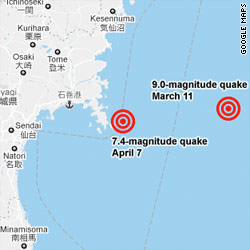
7.4-magnitude earthquake strikes off coast of Miyagi, Japan, Japan's meteorological agency says.
Apparently this one lasted a couple minutes like the 9.0 and was kinda freaky.
1-2m Tsunami warning
Another earthquake, wow.
I read that they're predicting a 1 metre high tsunami.
This is fucking crazy!
http://news.blogs.cnn.com/2011/04/0...-issued/?hpt=T2
| quote: |
A magnitude 7.4 earthquake struck Japan on Thursday, the Japan Meteorological agency said. The epicenter was off the coast of Miyagi Prefecture. Public broadcaster NHK reported a tsunami warning for Miyagi, saying people in the area should evacuate from the shore to a safe place. NHK also reported a tsunami advisory for Iwate Prefecture, saying a tsunami is expected to arrive in coastal regions there as well. |
There were so many earthquake warnings in Japan I don't even know if this one is worth the attention any more (there were also two false tsunami alarms).
I hope this is yet another false alarm because I feel bad for the people at the coast of Miyagi already
Jesus. :/
Fucking dolphins 
| quote: |
| Originally posted by Lira There were so many earthquake warnings in Japan I don't even know if this one is worth the attention any more (there were also two false tsunami alarms). I hope this is yet another false alarm because I feel bad for the people at the coast of Miyagi already |
So MR wetherby .. do you still believe that there is no risk of building Nuclear power plants in area's prone to Earthquake's and
doubled with the garuntee of being struck by a tsunami
http://www3.nhk.or.jp/daily/english/05_25.html
http://english.kyodonews.jp/news/2011/04/83228.html
| quote: |
| Originally posted by EarnYourKeep this ones kinda close but does this mean less of a tsunami? |
The issue isn't with having nuclear power plants in areas prone to earthquakes and/or tsunamis. The issue is that the nuclear power plants that are currently there may not have the adequate preventative measures to keep another nuclear disaster like the most recent one from happening. There are many nuclear reactors around the world, especially more recent designs, which are virtually impossible to meltdown. They have safeguards so that even if there is a complete power loss in the facility, there is still no danger of a meltdown due to the countermeasures in place.
Anyone arguing against nuclear energy because of all this is very misinformed.
| quote: |
| Originally posted by Lira Yes, because the quake was a lot milder. |
| quote: |
| Originally posted by srussell0018 Anyone arguing against nuclear energy because of all this is very misinformed. |
| quote: |
| The unpalatable truth is that the anti-nuclear lobby has misled us all I've discovered that when the facts don't suit them, the movement resorts to the follies of cover-up they usually denounce Over the last fortnight I've made a deeply troubling discovery. The anti-nuclear movement to which I once belonged has misled the world about the impacts of radiation on human health. The claims we have made are ungrounded in science, unsupportable when challenged, and wildly wrong. We have done other people, and ourselves, a terrible disservice. I began to see the extent of the problem after a debate last week with Helen Caldicott. Dr Caldicott is the world's foremost anti-nuclear campaigner. She has received 21 honorary degrees and scores of awards, and was nominated for a Nobel peace prize. Like other greens, I was in awe of her. In the debate she made some striking statements about the dangers of radiation. So I did what anyone faced with questionable scientific claims should do: I asked for the sources. Caldicott's response has profoundly shaken me. First she sent me nine documents: newspaper articles, press releases and an advertisement. None were scientific publications; none contained sources for the claims she had made. But one of the press releases referred to a report by the US National Academy of Sciences, which she urged me to read. I have now done so � all 423 pages. It supports none of the statements I questioned; in fact it strongly contradicts her claims about the health effects of radiation. I pressed her further and she gave me a series of answers that made my heart sink � in most cases they referred to publications which had little or no scientific standing, which did not support her claims or which contradicted them. (I have posted our correspondence, and my sources, on my website.) I have just read her book Nuclear Power Is Not the Answer. The scarcity of references to scientific papers and the abundance of unsourced claims it contains amaze me. For the last 25 years anti-nuclear campaigners have been racking up the figures for deaths and diseases caused by the Chernobyl disaster, and parading deformed babies like a medieval circus. They now claim 985,000 people have been killed by Chernobyl, and that it will continue to slaughter people for generations to come. These claims are false. The UN Scientific Committee on the Effects of Atomic Radiation (Unscear) is the equivalent of the Intergovernmental Panel on Climate Change. Like the IPCC, it calls on the world's leading scientists to assess thousands of papers and produce an overview. Here is what it says about the impacts of Chernobyl. Of the workers who tried to contain the emergency at Chernobyl, 134 suffered acute radiation syndrome; 28 died soon afterwards. Nineteen others died later, but generally not from diseases associated with radiation. The remaining 87 have suffered other complications, including four cases of solid cancer and two of leukaemia. In the rest of the population there have been 6,848 cases of thyroid cancer among young children � arising "almost entirely" from the Soviet Union's failure to prevent people from drinking milk contaminated with iodine 131. Otherwise "there has been no persuasive evidence of any other health effect in the general population that can be attributed to radiation exposure". People living in the countries affected today "need not live in fear of serious health consequences from the Chernobyl accident". Caldicott told me that Unscear's work on Chernobyl is "a total cover-up". Though I have pressed her to explain, she has yet to produce a shred of evidence for this contention. In a column last week, the Guardian's environment editor, John Vidal, angrily denounced my position on nuclear power. On a visit to Ukraine in 2006, he saw "deformed and genetically mutated babies in the wards � adolescents with stunted growth and dwarf torsos; foetuses without thighs or fingers". What he did not see was evidence that these were linked to the Chernobyl disaster. Professor Gerry Thomas, who worked on the health effects of Chernobyl for Unscear, tells me there is "absolutely no evidence" for an increase in birth defects. The National Academy paper Dr Caldicott urged me to read came to similar conclusions. It found that radiation-induced mutation in sperm and eggs is such a small risk "that it has not been detected in humans, even in thoroughly studied irradiated populations such as those of Hiroshima and Nagasaki". Like Vidal and many others, Caldicott pointed me to a book which claims that 985,000 people have died as a result of the disaster. Translated from Russian and published by the Annals of the New York Academy of Sciences, this is the only document that looks scientific and appears to support the wild claims made by greens about Chernobyl. A devastating review in the journal Radiation Protection Dosimetry points out that the book achieves this figure by the remarkable method of assuming that all increased deaths from a wide range of diseases � including many which have no known association with radiation � were caused by the Chernobyl accident. There is no basis for this assumption, not least because screening in many countries improved dramatically after the disaster and, since 1986, there have been massive changes in the former eastern bloc. The study makes no attempt to correlate exposure to radiation with the incidence of disease. Its publication seems to have arisen from a confusion about whether Annals was a book publisher or a scientific journal. The academy has given me this statement: "In no sense did Annals of the New York Academy of Sciences or the New York Academy of Sciences commission this work; nor by its publication do we intend to independently validate the claims made in the translation or in the original publications cited in the work. The translated volume has not been peer reviewed by the New York Academy of Sciences, or by anyone else." Failing to provide sources, refuting data with anecdote, cherry-picking studies, scorning the scientific consensus, invoking a cover-up to explain it: all this is horribly familiar. These are the habits of climate-change deniers, against which the green movement has struggled valiantly, calling science to its aid. It is distressing to discover that when the facts don't suit them, members of this movement resort to the follies they have denounced. We have a duty to base our judgments on the best available information. This is not only because we owe it to other people to represent the issues fairly, but also because we owe it to ourselves not to squander our lives on fairytales. A great wrong has been done by this movement. We must put it right. |

Powered by: vBulletin
Copyright © 2000-2021, Jelsoft Enterprises Ltd.