
TranceAddict Forums (www.tranceaddict.com/forums)
- Political Discussion / Debate
-- CIA destroyed interrogation tapes - who's to blame?
Pages (3): « 1 2 [3]
| quote: |
| Originally posted by Q5echo easy. the three prisoners that have been subjected to waterboarding...  Khalid Sheikh Mohammed  Zubaydah  Unkown Dude |


| quote: |
| Abu Zubaydah, his captors discovered, turned out to be mentally ill and nothing like the pivotal figure they supposed him to be. CIA and FBI analysts, poring over a diary he kept for more than a decade, found entries "in the voice of three people: Hani 1, Hani 2, and Hani 3" -- a boy, a young man and a middle-aged alter ego. All three recorded in numbing detail "what people ate, or wore, or trifling things they said." Dan Coleman, then the FBI's top al-Qaeda analyst, told a senior bureau official, "This guy is insane, certifiable, split personality." Abu Zubaydah also appeared to know nothing about terrorist operations; rather, he was al-Qaeda's go-to guy for minor logistics -- travel for wives and children and the like. That judgment was "echoed at the top of CIA and was, of course, briefed to the President and Vice President," Suskind writes. And yet somehow, in a speech delivered two weeks later, President Bush portrayed Abu Zubaydah as "one of the top operatives plotting and planning death and destruction on the United States." And over the months to come, under White House and Justice Department direction, the CIA would make him its first test subject for harsh interrogation techniques. ....."I said [Abu Zubaydah] was important," Bush reportedly told Tenet at one of their daily meetings. "You're not going to let me lose face on this, are you?" "No sir, Mr. President," Tenet replied. Bush "was fixated on how to get Zubaydah to tell us the truth," Suskind writes, and he asked one briefer, "Do some of these harsh methods really work?" Interrogators did their best to find out, Suskind reports. They strapped Abu Zubaydah to a water-board, which reproduces the agony of drowning. They threatened him with certain death. They withheld medication. They bombarded him with deafening noise and harsh lights, depriving him of sleep. Under that duress, he began to speak of plots of every variety -- against shopping malls, banks, supermarkets, water systems, nuclear plants, apartment buildings, the Brooklyn Bridge, the Statue of Liberty. With each new tale, "thousands of uniformed men and women raced in a panic to each . . . target." And so, Suskind writes, "the United States would torture a mentally disturbed man and then leap, screaming, at every word he uttered." http://www.washingtonpost.com/wp-dy...6061901211.html |
| quote: |
...were in the business and process of mass murder for Allah (praise be unto him). we are in the business and process of preventing that from happening. |
| quote: |
| Say we win against terrorism tomorrow. We wipe them out. We plant our American flag, beat our chests, and stand tall on their graves. But we did so by torturing the fuck out of them. We did it by terrorizing the enemy, the enemy's allies, the enemies' friends, the enemies' enemies, and of course, completely innocent people who haven't a fucking clue who we are or who we call our "enemies". Now, aside of the fact that we won and they lost, tell me the difference between us and them. And while you're at it, define to me our "way of life" and the justification on how we preserved it. Because defending democracy, liberties, and freedom by becoming the very evil of our enemies cannot possibly make us any greater than the enemies we are fighting against. We just became the enemy, and no matter how we justify our actions in order to "preserve our way of life", we cannot escape that underlying problem. |
| quote: |
| You support a war that is supposedly for the preservation of liberty, but you are not willing to die to preserve it? I find that highly odd - if you were consistent, you would acknowledge that the principles that make America what it is are far greater than any individual's life. That is the fundamental belief behind sacrificing your personal safety for the preservation of the state |
| quote: |
| people are afraid to make that distinction for whatever reasons, i'm sure there is a million of them, but make no mistake there IS a distinction... |
| quote: |
| Exhibit A is the torture-extracted confession of Ibn al-Shaykh al-Libi, an al Qaeda captive who told the CIA in 2001, having been "rendered" to the tender mercies of Egypt, that Saddam Hussein had trained al Qaeda to use WMD. It appears that this confession was the only information upon which, in late 2002, the president, the vice president, and the secretary of state repeatedly claimed that "credible evidence" supported that claim, even though a now-declassified Defense Intelligence Agency report from February 2002 questioned the reliability of the confession because it was likely obtained under torture. In January 2004, al-Libi recanted his "confession," and a month later, the CIA recalled all intelligence reports based on his statements. http://www.alternet.org/rights/28585/ |
| quote: |
| We strongly urge that you not send Mukasey's nomination to the full Senate before he makes clear his view on waterboarding. Otherwise, there is considerable risk of continued use of the officially sanctioned torture techniques that have corrupted our intelligence services, knocked our military off the high moral ground, severely damaged our country's standing in the world, and exposed U.S. military and intelligence people to similar treatment when captured or kidnapped. |
| quote: |
| As professional intelligence officers, however, we must point to a supreme irony-namely, that waterboarding and other harsh interrogation practices are ineffective tools for eliciting reliable information. Our own experience dovetails well with that of U.S. Army intelligence chief, Maj. Gen. John Kimmons, who told a Pentagon press conference on September 6, 2006: "No good intelligence is going to come from abusive practices. I think history tells us that. I think the empirical evidence of the last five years, hard years, tells us that." http://www.counterpunch.org/torture11062007.html |
| quote: |
| Aside from its immorality and its illegality, says Herrington, torture is simply "not a good way to get information." In his experience, nine out of 10 people can be persuaded to talk with no "stress methods" at all, let alone cruel and unusual ones. Asked whether that would be true of religiously motivated fanatics, he says that the "batting average" might be lower: "perhaps six out of ten." And if you beat up the remaining four? "They'll just tell you anything to get you to stop." Worse, you'll have the other side effects of torture. It "endangers our soldiers on the battlefield by encouraging reciprocity." It does "damage to our country's image" and undermines our credibility in Iraq. That, in the long run, outweighs any theoretical benefit. Herrington's confidential Pentagon report, which he won't discuss but which was leaked to The Post a month ago, goes farther. In that document, he warned that members of an elite military and CIA task force were abusing detainees in Iraq, that their activities could be "making gratuitous enemies" and that prisoner abuse "is counterproductive to the Coalition's efforts to win the cooperation of the Iraqi citizenry." Far from rescuing Americans, in other words, the use of "special methods" might help explain why the war is going so badly. http://www.washingtonpost.com/wp-dy...-2005Jan11.html |
| quote: |
| This resurrects the process of official cruelty under the Stuart monarchs in seventeenth century England. Persons accused of state crimes very frequently were interrogated with the use of specific techniques, including the rack, the thumbscrew, and waterboarding. King James I personally described the process in The Kings Booke (1606). He would, on the advice of his officers, �approve no new torture,� but he would certainly avail himself of the existing practices. In ascending order of severity they were: thumbscrews, the rack and waterboarding. That�s right. Waterboarding was considered the most severe of the official forms of torture. Worse than the rack and thumbscrews. http://www.harpers.org/archive/2007/12/hbc-90001917 |
| quote: |
| ...to believe there is no distinction, THAT IMO IS UN-AMERICAN! all the other "American way" righteous indignation can take a back seat |
This whole thread makes me think of this movie:
So good. 
Actually, the added context makes this a more effective clip:
| quote: |
| Originally posted by Q5echo no shit. waterboarding, by federal statute, is prohibited in the DoD. it isn't in the CIA, an entirely different Federal entity. if you don't like it change the law. change the law and we can all go on. |
| quote: |
| First, the MCA puts the President in an interesting position: the U.S. is still bound by Geneva, but there is no way for individuals to enforce violations of Geneva (except that grave breaches of Common Article 3 can still be prosecuted under the War Crimes Statute). However, Geneva's status as the law of the land (under Article VI) was not altered by the MCA. The United States has not withdrawn from the Geneva Conventions, and this fact was quite important to selling the bill to the public. So if the President orders procedures that are inconsistent with Geneva, he is still acting contrary to law even though there may be no way for an individual to enforce the law directly. Second, the President remains bound by the prohibitions against cruel, inhuman and degrading treatment found in the McCain Amendment, and the substantive tests of the Fifth, Fourteenth and Eighth Amendments, whether the conduct occurs in the United States our outside of it. Indeed, the MCA reaffirms these substantive standards and makes them applicable throughout the world. If the President violates these standards, or directs others to do so, he violates the law. That means if the President interprets these standards narrowly and tendentiously to permit certain interrogation practices, he also violates the law. There is just no judicial remedy for the violation. Let me repeat what I have just said: The MCA continues to recognize that certain conduct is illegal, but attempts to eliminate all judicial remedies for such violations. That means that if the President violates the MCA, he still fails to take care that the laws be faithfully executed, which is his constitutional duty under Article 2, section 3 of the Constitution. (And in case you are wondering, he might well be guilty of a high crime and misdemeanor, but don't hold your breath.) The President wanted it this way: He wanted to be able to say that he was following the law, but, just in case he wasn't, he didn't want to be held to account for it in any court proceeding. But the fact that the courts can't offer a remedy doesn't mean, I repeat, that the President has no duty to obey the law. And although he now has virtually conclusive authority to interpret non-grave breaches of Geneva, he does not have virtually conclusive authority to interpret either the Bill of Rights or the McCain Amendment. http://balkin.blogspot.com/2006/09/...th-wrought.html |
| quote: |
| "I do solemnly swear (or affirm) that I will faithfully execute the Office of President of the United States, and will to the best of my Ability, preserve, protect and defend the Constitution of the United States." |
Speaking of SERE techniques to interrogate prisoners (SERE = Survival, Evasion, Resistance, Escape), this NYTimes article from November 2005 was interesting to run across:
| quote: |
| SERE, for Survival, Evasion, Resistance, Escape. Based on studies of North Korean and Vietnamese efforts to break American prisoners, SERE was intended to train American soldiers to resist the abuse they might face in enemy custody. [...] The Pentagon appears to have flipped SERE's teachings on their head, mining the program not for resistance techniques but for interrogation methods. At a June 2004 briefing, the chief of the United States Southern Command, Gen. James T. Hill, said a team from Guant�namo went "up to our SERE school and developed a list of techniques" for "high-profile, high-value" detainees. General Hill had sent this list - which included prolonged isolation and sleep deprivation, stress positions, physical assault and the exploitation of detainees' phobias - to Secretary of Defense Donald Rumsfeld, who approved most of the tactics in December 2002. [...] the Pentagon cannot point to any intelligence gains resulting from the techniques that have so tarnished America's image. That's because the techniques designed by communist interrogators were created to control a prisoner's will rather than to extract useful intelligence. http://www.nytimes.com/2005/11/14/o...lochemarks.html |
| quote: |
| Originally posted by Lebezniatnikov Actually, the added context makes this a more effective clip: |
| quote: |
| Originally posted by MisterOpus1 I often think of that movie as well. I guess we shouldn't question their "patriotism" so much in the same manner....... |
Boy I really fell out of my chair in complete surprise when I read this article (/snark):
| quote: |
| December 19, 2007 Bush Lawyers Discussed Fate of C.I.A.Tapes By MARK MAZZETTI and SCOTT SHANE WASHINGTON � At least four top White House lawyers took part in discussions with the Central Intelligence Agency between 2003 and 2005 about whether to destroy videotapes showing the secret interrogations of two operatives from Al Qaeda, according to current and former administration and intelligence officials. The accounts indicate that the involvement of White House officials in the discussions before the destruction of the tapes in November 2005 was more extensive than Bush administration officials have acknowledged. Those who took part, the officials said, included Alberto R. Gonzales, who served as White House counsel until early 2005; David S. Addington, who was the counsel to Vice President Dick Cheney and is now his chief of staff; John B. Bellinger III, who until January 2005 was the senior lawyer at the National Security Council; and Harriet E. Miers, who succeeded Mr. Gonzales as White House counsel. It was previously reported that some administration officials had advised against destroying the tapes, but the emerging picture of White House involvement is more complex. In interviews, several administration and intelligence officials provided conflicting accounts as to whether anyone at the White House expressed support for the idea that the tapes should be destroyed. One former senior intelligence official with direct knowledge of the matter said there had been �vigorous sentiment� among some top White House officials to destroy the tapes. The former official did not specify which White House officials took this position, but he said that some believed in 2005 that any disclosure of the tapes could have been particularly damaging after revelations a year earlier of abuses at Abu Ghraib prison in Iraq. Some other officials assert that no one at the White House advocated destroying the tapes. Those officials acknowledged, however, that no White House lawyer gave a direct order to preserve the tapes or advised that destroying them would be illegal. The destruction of the tapes is being investigated by the Justice Department, and the officials would not agree to be quoted by name while that inquiry is under way. Spokesmen for the White House, the vice president�s office and the C.I.A. declined to comment for this article, also citing the inquiry. The new information came to light as a federal judge on Tuesday ordered a hearing into whether the tapes� destruction violated an order to preserve evidence in a lawsuit brought on behalf of 16 prisoners at Guant�namo Bay, Cuba. The tapes documented harsh interrogation methods used in 2002 on Abu Zubaydah and Abd al-Rahim al-Nashiri, two Qaeda suspects in C.I.A. custody. The current and former officials also provided new details about the role played in November 2005 by Jose A. Rodriguez Jr., then the chief of the agency�s clandestine branch, who ultimately ordered the destruction of the tapes. The officials said that before he issued a secret cable directing that the tapes be destroyed, Mr. Rodriguez received legal guidance from two C.I.A. lawyers, Steven Hermes and Robert Eatinger. The officials said that those lawyers gave written guidance to Mr. Rodriguez that he had the authority to destroy the tapes and that the destruction would violate no laws. The agency did not make either Mr. Hermes or Mr. Eatinger available for comment. Current and former officials said the two lawyers informed the C.I.A.�s top lawyer, John A. Rizzo, about the legal advice they had provided. But officials said Mr. Rodriguez did not inform either Mr. Rizzo or Porter J. Goss, the C.I.A. director, before he sent the cable to destroy the tapes. �There was an expectation on the part of those providing legal guidance that additional bases would be touched,� said one government official with knowledge of the matter. �That didn�t happen.� Robert S. Bennett, a lawyer for Mr. Rodriguez, insisted that his client had done nothing wrong and suggested that Mr. Rodriguez had been authorized to order the destruction of the tapes. �He had a green light to destroy them,� Mr. Bennett said. Until their destruction, the tapes were stored in a safe in the C.I.A. station in the country where the interrogations took place, current and former officials said. According to one former senior intelligence official, the tapes were never sent back to C.I.A. headquarters, despite what the official described as concern about keeping such highly classified material overseas. Top officials of the C.I.A�s clandestine service had pressed repeatedly beginning in 2003 for the tapes� destruction, out of concern that they could leak and put operatives in both legal and physical jeopardy. The only White House official previously reported to have taken part in the discussions was Ms. Miers, who served as a deputy chief of staff to President Bush until early 2005, when she took over as White House counsel. While one official had said previously that Ms. Miers�s involvement began in 2003, other current and former officials said they did not believe she joined the discussions until 2005. Besides the Justice Department inquiry, the Congressional intelligence committees have begun investigations into the destruction of the tapes, and are looking into the role that officials at the White House and Justice Department might have played in discussions about them. The C.I.A. never provided the tapes to federal prosecutors or to the Sept. 11 commission, and some lawmakers have suggested that their destruction may have amounted to obstruction of justice. Newsweek reported this week that John D. Negroponte, who was director of national intelligence at the time the tapes were destroyed, sent a memorandum in the summer of 2005 to Mr. Goss, the C.I.A. director, advising him against destroying the tapes. Mr. Negroponte left the job this year to become deputy secretary of state, and a spokesman for the director of national intelligence declined to comment on the Newsweek article. The court hearing in the Guant�namo case, set for Friday in Washington by District Judge Henry H. Kennedy Jr. over the government�s objections, will be the first public forum in which officials submit to questioning about the tapes� destruction. There is no publicly known connection between the 16 plaintiffs � 14 Yemenis, an Algerian and a Pakistani � and the C.I.A. videotapes. But lawyers in several Guant�namo cases contend that the government may have used information from the C.I.A. interrogations to identify their clients as �unlawful combatants� and hold them at Guant�namo for as long as six years. �We hope to establish a procedure to review the government�s handling of evidence in our case,� said David H. Remes, a lawyer representing the 16 detainees. Jonathan Hafetz, who represents a Qatari prisoner at Guant�namo and filed a motion on Tuesday seeking a separate hearing, said the videotapes could well be relevant. �If the government is relying on the statement of a witness under harsh interrogation, a videotape of the interrogation would be very relevant,� said Mr. Hafetz, of the Brennan Center for Justice at New York University law school. In addition to the Guant�namo court filings, the American Civil Liberties Union has asked a federal judge to hold the C.I.A. in contempt of court for destroying the tapes. The A.C.L.U. says the destruction violated orders in a Freedom of Information Act case brought by several advocacy groups seeking materials related to detention and interrogation. David Johnston contributed reporting. http://www.nytimes.com/2007/12/19/w...&hp&oref=slogin |
This article seemed more closer to that Siege movie than ever, Lebez. Turns out an FBI agent threatened to arrest CIA interrogators in 2002:
| quote: |
| The videotapes, made in 2002, showed the questioning of two high-level Qaeda detainees, including logistics chief Abu Zubaydah, whose interrogation at a secret cell in Thailand sparked an internal battle within the U.S. intelligence community after FBI agents angrily protested the aggressive methods that were used. In addition to waterboarding, Zubaydah was subjected to sleep deprivation and bombarded with blaring rock music by the Red Hot Chili Peppers. One agent was so offended he threatened to arrest the CIA interrogators, according to two former government officials directly familiar with the dispute. http://www.newsweek.com/id/74317 |
| quote: |
| Tensions came to a head after FBI agents witnessed the use of some harsh tactics on Abu Zubaida, including keeping him naked in his cell, subjecting him to extreme cold and bombarding him with loud rock music. "They said, 'You've got to be kidding me,' " said Coleman, recalling accounts from FBI employees who were there. " 'This guy's a Muslim. That's not going to win his confidence. Are you trying to get information out of him or just belittle him?' " Coleman helped lead the bureau's efforts against Osama bin Laden for a decade, ending in 2004. FBI Director Robert S. Mueller III eventually ordered the FBI team to withdraw from the interrogation, largely because bureau procedures prohibit agents from being involved in such techniques, according to several officials familiar with the episode. http://www.washingtonpost.com/wp-dy...ml?hpid=topnews |
| quote: |
| Bush has sided publicly with the CIA's version of events. "We knew that Zubaida had more information that could save innocent lives, but he stopped talking," Bush said in September 2006. "And so the CIA used an alternative set of procedures," which the president said prompted Abu Zubaida to disclose information leading to the capture of Sept. 11, 2001, plotter Ramzi Binalshibh. ad_icon But former FBI officials privy to details of the case continue to dispute the CIA's account of the effectiveness of the harsh measures, making the record of Abu Zubaida's interrogation hard for outsiders to assess. There is little dispute, according to officials from both agencies, that Abu Zubaida provided some valuable intelligence before CIA interrogators began to rough him up, including information that helped identify Khalid Sheik Mohammed, the alleged mastermind of the Sept. 11 attacks, and al-Qaeda operative Jose Padilla. Footnotes in the 9/11 Commission report attribute information about a variety of al-Qaeda personnel and activities to interrogations of Abu Zubaida beginning in April 2002 and lasting through February 2004. Former CIA officer John Kiriakou -- who participated in Abu Zubaida's capture, was present for the next three days and later saw classified reports of the agency's harsh interrogations -- attracted attention last week when he said that information obtained from Abu Zubaida under measures that Kiriakou now regards as torture "probably saved lives." Former CIA director George J. Tenet, in his book recounting his tenure at the agency, also said claims that Abu Zubaida's importance was overstated were "baloney." Tenet wrote: "Abu Zubaydah had been at the crossroads of many al-Qaida operations and was in position to -- and did -- share critical information with his interrogators." But FBI officials, including agents who questioned him after his capture or reviewed documents seized from his home, have concluded that even though he knew some al-Qaeda players, he provided interrogators with increasingly dubious information as the CIA's harsh treatment intensified in late 2002. In legal papers prepared for a military hearing, Abu Zubaida himself has asserted that he told his interrogators whatever they wanted to hear to make the treatment stop. Retired FBI agent Daniel Coleman, who led an examination of documents after Abu Zubaida's capture in early 2002 and worked on the case, said the CIA's harsh tactics cast doubt on the credibility of Abu Zubaida's information. "I don't have confidence in anything he says, because once you go down that road, everything you say is tainted," Coleman said, referring to the harsh measures. "He was talking before they did that to him, but they didn't believe him. The problem is they didn't realize he didn't know all that much." .....Coleman, a 31-year FBI veteran, joined other former law enforcement colleagues in expressing skepticism about Abu Zubaida's importance. Abu Zubaida, he said in an interview, was a "safehouse keeper" with mental problems who claimed to know more about al-Qaeda and its inner workings than he really did. Abu Zubaida's diary, which Coleman said he examined at length, was written in three distinct personalities -- one younger, one older and one the same age as Abu Zubaida. The book was full of flowery and philosophical meanderings, and made little mention of terrorism or al-Qaeda, Coleman said. Looking at other evidence, including a serious head injury that Abu Zubaida had suffered years earlier, Coleman and others at the FBI believed that he had severe mental problems that called his credibility into question. "They all knew he was crazy, and they knew he was always on the damn phone," Coleman said, referring to al-Qaeda operatives. "You think they're going to tell him anything?" Tenet disagreed, writing in his book that CIA psychiatrists concluded that Abu Zubaida "was using a sophisticated literary device to express himself" in the diary, which was "hundreds of pages" long. Coleman said reports of Abu Zubaida's statements during his early, traditional interrogation were "consistent with who he was and what he would possibly know." He and other officials said that materials seized from Abu Zubaida's house and other locations, including names, telephone numbers and computer laptops, provided crucial information about al-Qaeda and its network. But, Coleman and other law enforcement officials said, CIA officials concluded to the contrary that Abu Zubaida was a major player, and they saw any lack of information as evidence that he was resisting interrogation. Much of the threat information provided by Abu Zubaida, Coleman said, "was crap." "There's an agency mind-set that there was always some sort of golden apple out there, but there just isn't, especially with guys like him," Coleman said. |
Given the evidence of its imperfection and the fact that it goes against everything we stand for, I really struggle more and more to understand how people can justify the use of torture.
(CNN) � Republican presidential hopeful Rudy Giuliani said Wednesday that waterboarding should not be used regularly in interrogations, but might be called for in a �once in a lifetime, once in a decade situation.�
"Having looked at this, it certainly should not be a practice that should go on generally,� the former mayor of New York said in an interview in Columbia, Missouri.
But Giuliani told CNN�s Wolf Blitzer that there may be situations where waterboarding � a technique where a person undergoes simulated drowning � would be warranted to obtain critical information from an alleged terrorist, such as the location of a nuclear bomb about to explode.
Many human rights organizations consider waterboarding to be torture.
"I don't think you can write this out as a procedure that should be write out for all situations,� Giuliani said. �I think the president and the appropriate officials should have some discretion here.�
�CNN.com Senior Political Producer Scott Anderson
| quote: |
| Originally posted by Lesbianosaur (CNN) � Republican presidential hopeful Rudy Giuliani said Wednesday that waterboarding should not be used regularly in interrogations, but might be called for in a �once in a lifetime, once in a decade situation.� "Having looked at this, it certainly should not be a practice that should go on generally,� the former mayor of New York said in an interview in Columbia, Missouri. But Giuliani told CNN�s Wolf Blitzer that there may be situations where waterboarding � a technique where a person undergoes simulated drowning � would be warranted to obtain critical information from an alleged terrorist, such as the location of a nuclear bomb about to explode. Many human rights organizations consider waterboarding to be torture. "I don't think you can write this out as a procedure that should be write out for all situations,� Giuliani said. �I think the president and the appropriate officials should have some discretion here.� �CNN.com Senior Political Producer Scott Anderson |
| quote: |
| Originally posted by Lesbianosaur Given the evidence of its imperfection and the fact that it goes against everything we stand for, I really struggle more and more to understand how people can justify the use of torture. |
| quote: |
| CIA withheld al Qaeda tapes from 9/11 panel-paper NEW YORK, Dec 22 (Reuters) - The Sept. 11 commission asked the CIA in 2003 and 2004 for information on the interrogation of al Qaeda suspects, only to be told the agency provided all that was requested, The New York Times reported on Saturday. The CIA said on Dec. 6 it destroyed hundreds of hours of videotape in 2005 showing interrogations of al Qaeda suspects Abu Zubaydah and Abd al-Rahim al-Nashiri, prompting former members of the commission to review classified documents. The taped interrogations were believed to show a simulated drowning technique known as waterboarding that rights activists have condemned as torture. The Sept. 11 commission's chairmen, Lee Hamilton and Thomas Kean, said their reading of the review, a copy of which the newspaper obtained, convinced them the CIA made a conscious decision to impede the panel's inquiry, the Times said. A memo prepared by Philip Zelikow, the panel's former executive director, concluded that "further investigation is needed" to determine whether the CIA's withholding of the interrogation tapes from the commission violated U.S. law, the paper reported. CIA spokesman Mark Mansfield on Saturday said the CIA gave the commission "a wealth of information" and did not destroy the tapes while the commission was active. "The 9/11 commission certainly had access to, and drew from, detailed information that had been provided by terrorist detainees," Mansfield said in an e-mail. "That's how they reconstructed the plot in their comprehensive report." "Because it was thought the commission could ask about tapes at some point, they were not destroyed while the commission was active. As Director Hayden pointed out in his December 6th statement, the tapes were destroyed only when it was determined they were no longer of intelligence value and not relevant to any internal, legislative or judicial inquiries," Mansfield said. The CIA said it destroyed the tapes lawfully to protect the agents involved in the interrogations, but the news prompted an outcry from rights activists and Democrats in Congress, as well as investigations by the Bush administration and Congress. The commission investigated what went wrong before and after al Qaeda militants used hijacked commercial airliners to attack the United States on Sept. 11, 2001. The panel's report called for an overhaul of the U.S. intelligence community. Kean, a Republican and former New Jersey governor, said the panel would give the memo to federal prosecutors and lawmakers looking into the destruction of the tapes. A CIA spokesman told the Times the agency had been prepared to provide the Sept. 11 commission with the tapes, but was never asked to do so. "I don't know whether that's illegal or not, but it's certainly wrong," Kean said of the CIA's decision not to disclose the existence of the tapes. Hamilton, a Democrat and former Indiana congressman, said the agency "clearly obstructed" the commission's investigation. NOT HOLDING BACK Among statements that the memo suggested were misleading was a June 2004 assertion by John McLaughlin, deputy director of central intelligence, that the CIA had "taken and completed all reasonable steps necessary to find the documents in its possession, custody or control" in response to the panel's requests and "has produced or made available for review" all such documents, the Times said. Kean and Hamilton expressed anger once it was revealed the tapes had been destroyed, the paper said. The Times said Zelikow's report provides more evidence to bolster their views about the CIA's actions and was likely to put more pressure on the Bush administration over its handling of the matter. McLaughlin told the Times that agency officials had always been candid with the commission and that information from the CIA proved central to their work. "We weren't playing games with them, and we weren't holding anything back," the paper quoted him as saying. The memo draws no conclusions about whether the withholding of the tapes was unlawful, but notes that federal law penalizes anyone who knowingly withholds or covers up a material fact from a federal inquiry or makes a false statement to investigators, the Times reported. (Editing by John O'Callaghan)  LOL LOL |
Navy JAG Resigns Over Torture
Seems this Navy JAG had enough of this insane bullshit, especially when Brigadier General Thomas W. Hartmann, the legal adviser at Guantanamo Bay, refused to call waterboarding torture:
| quote: |
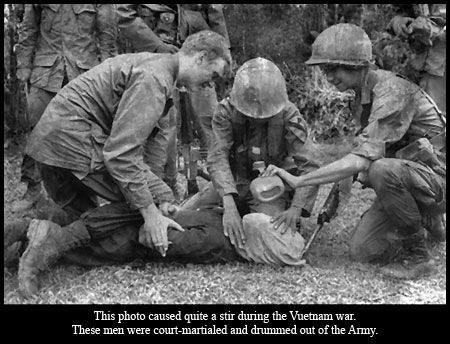
| It was with sadness that I signed my name this grey morning to a letter resigning my commission in the U.S. Navy. There was a time when I served with pride, knowing that by serving with the finest men and women in the country, we were part of an organization whose core values required us to �do the right thing,� and that we were far different from the Soviet Union and its gulags, the Vietcong with their torture camps and a society of surveillance and informers like Nazi Germany. We were part of the shining light on the hill who didn�t do those things. Sadly, no more. The final straw for me was listening to General Hartmann, the highest-ranking military lawyer in charge of the military commissions, testify that he refused to say that waterboarding captured U.S. soldiers by Iranian operatives would be torture. His testimony had just sold all the soldiers and sailors at risk of capture and subsequent torture down the river. Indeed, he would not rule out waterboarding as torture when done by the United States and indeed felt evidence obtained by such methods could be used in future trials. Thank you, General Hartmann, for finally admitting the United States is now part of a long tradition of torturers going back to the Inquisition. In the middle ages, the Inquisition called waterboarding �toca� and used it with great success. In colonial times, it was used by the Dutch East India Company during the Amboyna Massacre of 1623. Waterboarding was used by the Nazi Gestapo and the feared Japanese Kempeitai. In World War II, our grandfathers had the wisdom to convict Japanese Officer Yukio Asano of waterboarding and other torture practices in 1947, giving him 15 years hard labor. Waterboarding was practiced by the Khmer Rouge at the infamous Tuol Sleng prison. Most recently, the U.S. Army court martialed a soldier for the practice in 1968 during the Vietnam conflict. General Hartmann, following orders was not an excuse for anyone put on trial in Nuremberg, and it will not be an excuse for you or your superiors, either. Despite the CIA and the administration attempting to cover up the practice by destroying interrogation tapes, in direct violation of a court order, and congressional requests, the truth about torture, illegal spying on Americans and secret renditions is coming out. Andrew Williams, Gig Harbor http://www.gateline.com/opinion/story/295.html |
Judge demands to know why CIA tapes trashed
Associated Press
January 25, 2008
WASHINGTON -- A federal judge said Thursday that CIA interrogation videotapes may have been relevant to a case he's presiding over, and he gave the Bush administration three weeks to explain why they were destroyed in 2005 and say whether other evidence was destroyed.
Several judges are considering wading into the dispute over the videos, but U.S. District Judge Richard W. Roberts was the first to demand a written report on the matter. The order is a legal setback for the Bush administration, which has urged courts not to get involved.
The tapes showed harsh interrogation tactics used by CIA officers questioning Al Qaeda suspects Abu Zubaydah and Abd al Rahim al Nashiri in 2002. The Justice Department and Congress are investigating the destruction of the tapes.
When they were destroyed, the government was under various court orders to retain evidence relevant to terrorism suspects at the U.S. detention center at Guantanamo Bay, Cuba. After it became public in December that the tapes had been destroyed, lawyers for several detainees went to court demanding to know more.
"There's enough there that it's worth asking" whether other videos or documents were also destroyed, said attorney Charles H. Carpenter. "I don't know the answer to that question, but the government does know the answer, and now they have to tell Judge Roberts."
The Justice Department has warned that a judicial inquiry could jeopardize the criminal investigation.
http://www.latimes.com/news/nationw....story?ctrack=1

Powered by: vBulletin
Copyright © 2000-2021, Jelsoft Enterprises Ltd.