
TranceAddict Forums (www.tranceaddict.com/forums)
- Chill Out Room
-- Haha, God.
Pages (6): « 1 2 [3] 4 5 6 »
Posted by Moral Hazard on May-21-2008 20:31:
| quote: |
Originally posted by Yan
The way I see it, I feel it more of a pseudo-religion than anything else. It really is a way of life that fits in unusually well with the basic nature of the universe, as odd as this sounds. Haha. |
Depending on how liberally one interprets Hinduism and the Abrihamic faiths they also fit well with our understanding of the basic nature of the universe. Additionally, all religions are "a way of life". I think you're seeing only what you want to, Yan. Holy shit, this may be the first time I've ever actually addressed you on anything... wow.
Posted by iammesol on May-21-2008 20:31:
I enjoyed Joe Rogan's rant/joke about evolution. It's on his myspace.
Posted by RJT on May-21-2008 20:33:
| quote: |
Originally posted by iammesol
I enjoyed Joe Rogan |

Posted by Enigmatic XTC on May-21-2008 20:35:
this thread needs more acid
Posted by Moral Hazard on May-21-2008 20:35:
| quote: |
Originally posted by RJT
|
Enjoying Joe Rogan is an abomonation! (Leviticus something:something)
Posted by Yan on May-21-2008 20:35:
| quote: |
Originally posted by Moral Hazard
In what way is Buddhism not an organized religion? Additionally, how exactly does re-incarnation go hand in hand with what science has taught us? Finally, in what way does our not being unique negate any other religion? |
For the first question, read my reply to Lira.
Secondly, it's not the concept of re-incarnation that a normal person would think of. At its most basic, we are created from atoms that all have uniform "pieces" that make us who we are. Only a handful of elements make organic matter (not exceeding 10). Many of these elements will, even after our death, become part of some sort of life via one of many paths. So, in essence, it's this "re-incarnation" that makes so much sense to me (and quite a few scientists that I've interviewed over the past few months). Buddhism (at least one form) also believes in nondualism, the idea that there is not many nor one (form = emptiness, emptinessm = form) and here's where science really grabs you: What are we but energy in its most basic state? The entropic universe is an amazing thing and, hidden under layers of what many would see as "religious meaning", Buddhism finds a great way of relaying the nature of everything.
Don't follow what you're asking with the third question. Could you possibly rephrase?
Posted by Moral Hazard on May-21-2008 20:35:
| quote: |
Originally posted by Enigmatic XTC
this thread needs more acid |
We all need more acid
Posted by MrJiveBoJingles on May-21-2008 20:35:
Personally, I believe that each thing that exists was created by its very own god.
Screw Occam's Razor! 
Posted by Clovis on May-21-2008 20:36:
Joe Rogan's DMT experience report = awesome
Posted by iammesol on May-21-2008 20:37:
| quote: |
Originally posted by RJT
|
Watch/listen to the sketch, h8er
Posted by hooknife on May-21-2008 20:38:
I'm going with Einstein!
Einstein dismissed belief as product of human weakness, called Bible 'childish'
http://www.msnbc.msn.com/id/24668015/
Einstein FTW
Posted by Yan on May-21-2008 20:40:
| quote: |
Originally posted by Moral Hazard
Depending on how liberally one interprets Hinduism and the Abrihamic faiths they also fit well with our understanding of the basic nature of the universe. Additionally, all religions are "a way of life". I think you're seeing only what you want to, Yan. Holy shit, this may be the first time I've ever actually addressed you on anything... wow. |
I honestly don't think anything relates to the nature of the universe best. Hence why I ended up choosing Buddhism. I double majored in college (Biochemistry and Asian American Studies [area of interest - Japan, topic - Religion]) so I had plenty of time to do a significant amount of research (wish I could do more by going to a normal grad school but med school beckons). It just... clicked with me, I guess.
Once again, "way of life" is meant to be taken from a non-layman's terms perspective. I'm odd like that.
Believe what you will, I tried to eliminate as much bias as possible.
Posted by Moral Hazard on May-21-2008 20:40:
| quote: |
Originally posted by Yan
For the first question, read my reply to Lira.
Secondly, it's not the concept of re-incarnation that a normal person would think of. At its most basic, we are created from atoms that all have uniform "pieces" that make us who we are. Only a handful of elements make organic matter (not exceeding 10). Many of these elements will, even after our death, become part of some sort of life via one of many paths. So, in essence, it's this "re-incarnation" that makes so much sense to me (and quite a few scientists that I've interviewed over the past few months). Buddhism (at least one form) also believes in nondualism, the idea that there is not many nor one (form = emptiness, emptinessm = form) and here's where science really grabs you: What are we but energy in its most basic state? The entropic universe is an amazing thing and, hidden under layers of what many would see as "religious meaning", Buddhism finds a great way of relaying the nature of everything.
Don't follow what you're asking with the third question. Could you possibly rephrase? |
What I don't buy with your concept of reincarnation is that it is at odds with the idea that one can carry memories from past lives forward. I agree, the energy that comprises us most definately lives on after our deaths and is used to make up other living things; however, the Buddhist concept of reincarnation requires that the consciousness of the dead carry forward to the next incarnation of that consciousness... this does not go hand in hand with science, it is faith.
Your initial post suggested that because of what you have learned in your scientific education (specifically pertaining to our lack of uniqueness) precipitated your discounting of organized religion. Thus I'm interested to know why a lack of uniqueness would convince you that religion is flawed.
Posted by Enigmatic XTC on May-21-2008 20:42:
| quote: |
Originally posted by Moral Hazard
We all need more acid |
also true
Posted by Moral Hazard on May-21-2008 20:43:
| quote: |
Originally posted by Yan
Once again, "way of life" is meant to be taken from a non-layman's terms perspective. I'm odd like that.
Believe what you will, I tried to eliminate as much bias as possible. |
You mean it's a system of thought and disipline? That's what I meant as well.
I'm not trying to challenge the validity of your beliefs, just trying to understand your stated position (read; trying to reconsile your view of Buddhism with my own).
Posted by Lira on May-21-2008 20:48:
| quote: |
Originally posted by Yan
The way I see it, I feel it more of a pseudo-religion than anything else. It really is a way of life that fits in unusually well with the basic nature of the universe, as odd as this sounds. Haha. |
I don't disagree with you, having studied Buddhism for a while myself, but I was just referring to the idea that something created the world. Because of its pragmatism, Buddhism is not particularly concerned with this aspect of the problem of creation...
Posted by Yan on May-21-2008 20:49:
| quote: |
Originally posted by Moral Hazard
What I don't buy with your concept of reincarnation is that it is at odds with the idea that one can carry memories from past lives forward. I agree, the energy that comprises us most definately lives on after our deaths and is used to make up other living things; however, the Buddhist concept of reincarnation requires that the consciousness of the dead carry forward to the next incarnation of that consciousness... this does not go hand in hand with science, it is faith.
Your initial post suggested that because of what you have learned in your scientific education (specifically pertaining to our lack of uniqueness) precipitated your discounting of organized religion. Thus I'm interested to know why a lack of uniqueness would convince you that religion is flawed. |
The entire idea of Samsara and the karmic cycle is one element of Buddhism that doesn't quite click. However, from all I've learned regarding Buddhism, I'm not so sure memories of previous lives are ever supposed to be reborn. The only people that "remember" their past lives claim to have been Buddha, himself. But since Buddhism argues that we are all Buddha, in simplest form, it wouldn't make sense that these particular people would remember and not the rest of us. You can make reference to stuff like Amida Buddha's 18th (Primal) Vow and all that but I just can't take scriptures of old all too seriously (they were pretty biased and limited practitioners). So you might be a little bit misled to believe that we remember past lives... This doesn't happen. Since dead matter can't save the neuronal pathways that make up who we are, it's truly impossible that a "re-incarnated" being could have memory, obviously.
Ho-ho. I never said that we weren't unique. On the contrary, the chances of our little planet existing where it is and it being acted upon as it is, shows that we (from what we know so far) are a HUGE improbability.
Posted by Yan on May-21-2008 20:53:
| quote: |
Originally posted by Moral Hazard
You mean it's a system of thought and disipline? That's what I meant as well.
I'm not trying to challenge the validity of your beliefs, just trying to understand your stated position (read; trying to reconsile your view of Buddhism with my own). |
Definitely the best way of phrasing it.
I'm just so used to talking about this topic to others around various campuses in NY (even gone into debates with heads of some religious clubs) that I feel like I need to tack on the "believe what you will". Haha.
| quote: |
Originally posted by Lira
I don't disagree with you, having studied Buddhism for a while myself, but I was just referring to the idea that something created the world. Because of its pragmatism, Buddhism is not particularly concerned with this aspect of the problem of creation... |
Oh yeah. It doesn't make sense that nothing comes from something. Big Bang... from what, amirite? Haha.
Very true! Made that aspect easier for me, actually. Although once I started dabbling with Pure Land, it did seem like there was suddenly an "end" that the old Buddhist masters spoke of.
Posted by Scottaculous on May-21-2008 20:53:
| quote: |
Originally posted by Moral Hazard
What I don't buy with your concept of reincarnation is that it is at odds with the idea that one can carry memories from past lives forward. I agree, the energy that comprises us most definately lives on after our deaths and is used to make up other living things; however, the Buddhist concept of reincarnation requires that the consciousness of the dead carry forward to the next incarnation of that consciousness... this does not go hand in hand with science, it is faith.
|
Reincarnation in Buddhism does not carry forward memories only karma.
Posted by Moral Hazard on May-21-2008 20:57:
| quote: |
Originally posted by Yan
The entire idea of Samsara and the karmic cycle is one element of Buddhism that doesn't quite click. However, from all I've learned regarding Buddhism, I'm not so sure memories of previous lives are ever supposed to be reborn. The only people that "remember" their past lives claim to have been Buddha, himself. But since Buddhism argues that we are all Buddha, in simplest form, it wouldn't make sense that these particular people would remember and not the rest of us. You can make reference to stuff like Amida Buddha's 18th (Primal) Vow and all that but I just can't take scriptures of all too seriously (they were pretty biased and limited practitioners). So you might be a little bit misled to believe that we remember past lives... This doesn't happen. Since dead matter can't save the neuronal pathways that make up who we are, it's truly impossible that a "re-incarnated" being could have memory, obviously.
Ho-ho. I never said that we weren't unique. On the contrary, the chances of our little planet existing where it is and it being acted upon as it is, shows that we (from what we know so far) are a HUGE improbability. |
Interesting, so you pretty much disregard the karmic cycle? I always thought that was petty much a pillar of the faith.
I misunderstood you, I thought you point was that humans were not unique in comparason to other living things. Just veering off topic a bit here; there is an equasion used in Astronomy that more or less suggests that at any given moment there are as many earthlike civilizations in the universe as the amount of years that such a civilization can exist. It all kind of comes down to the believe that where life is possible it will exist and that natural selection will result in life evolving to and past a point equal to our own on all worlds where life exists provided it is not prematurely destroyed. I cannot remember it now but it does make sense to me. Given the there is an infinit number of stars there must be an enourmous amount of life. Sure, we are an improbability but life is not, given the law of large numbers, it's a certainty.
Posted by Moral Hazard on May-21-2008 21:01:
| quote: |
Originally posted by Scottaculous
Reincarnation in Buddhism does not carry forward memories only karma. |
reincarnations of the Buddha do (this is how they recognize the next Dali Llama). Additionally, is karma not a cosmic memory?
Note, other then the Buddha I was not suggesting the belief is that we are aware of specific memories from our past lives; however, if the karmic journey is one toward enlightenment that takes many lives to complete then memory, in some form, of what one learned in the past lives must carry over to the next... the entire belief breaks-down otherwise.
Posted by Lira on May-21-2008 21:02:
| quote: |
Originally posted by Moral Hazard
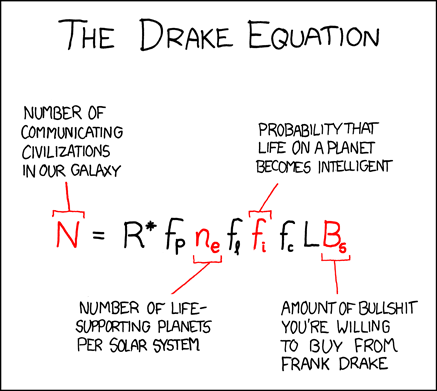
there is an equasion used in Astronomy that more or less suggests that at any given moment there are as many earthlike civilizations in the universe as the amount of years that such a civilization can exist. |
The Drake Equation?

Posted by RJT on May-21-2008 21:04:
One hell of a good tune though. 
Posted by Moral Hazard on May-21-2008 21:07:
No, that's not the one; however, it is similar. The equasion I'm thinking of was to determine the amount of advanced civilizations in the universe. Ultimately, all the parameters ended up equalling 1 x the amount of years a earthlike civilization could last.
Posted by Yan on May-21-2008 21:12:
| quote: |
Originally posted by Moral Hazard
Interesting, so you pretty much disregard the karmic cycle? I always thought that was petty much a pillar of the faith.
I misunderstood you, I thought you point was that humans were not unique in comparason to other living things. Just veering off topic a bit here; there is an equasion used in Astronomy that more or less suggests that at any given moment there are as many earthlike civilizations in the universe as the amount of years that such a civilization can exist. It all kind of comes down to the believe that where life is possible it will exist and that natural selection will result in life evolving to and past a point equal to our own on all worlds where life exists provided it is not prematurely destroyed. I cannot remember it now but it does make sense to me. Given the there is an infinit number of stars there must be an enourmous amount of life. Sure, we are an improbability but life is not, given the law of large numbers, it's a certainty. |
Actually, the karmic cycle is downplayed in quite a few of the variations/sects on Buddhism. Possibly the best example would be comparing Dogen (Zen) and Shinran's (Shin) ways (the latter would argue that a killer rather than a saint is closer to the perfect enlightenment).
I see...
The numbers provided by the course I made reference to was something along these lines:
The probability of the solar system with the same makeup that ours has: 1 in 10^3
The probability of an Earth/Moon system like ours: 1 in 10^9
Multiplying those, one finds that those alone give us a huge number to work with (1 in 10^12 - Note: There are 10^11 stars in a typical galaxy). Now, this is before we can even begin to consider the probability of the the galaxy being where it is in the universe, let alone the universe existing as it is (which is unfathomable, really). The number would already be PHENOMENAL. On top of that, you'd have to include the various probabilities of the Earth being unaffected by various external forces that could have changed its makeup, location or whatnot... and only THEN can one factor in this idea of organic materials forming and the whole concept of things evolving as they did. It's soooo damn interesting when you think about it. Haha. Astronomy, huh? Hmm!
But yes, we are definitely a certainty in this universe of amazing things.

Pages (6): « 1 2 [3] 4 5 6 »
Powered by: vBulletin
Copyright © 2000-2021, Jelsoft Enterprises Ltd.