
TranceAddict Forums (www.tranceaddict.com/forums)
- Canada - Toronto & Southern Ont.
-- Capitalism is evil?
Pages (4): « 1 2 [3] 4 »
Posted by DigiNut on Sep-07-2009 18:55:
| quote: |
Originally posted by MarkT
doesn't capitalism fail in real life for precisely the same reason as #1?  |
It can, in a totally naive implementation that essentially amounts to anarchy. But capitalists are generally pragmatists and realize that people with power will inevitably end up abusing that power. That is why the majority of capitalist systems are constitutional systems - they are set up specifically to limit the amount of power that any one person or group can have.
It's hard to have the same divisions in a socialist system because it's simply the "state" that owns and runs everything. If you divide up the power and allow each operation to run autonomously, which also implies imposing a hard budget and making some sort of competitive provisions, then it just starts to look like capitalism again, like any old big publicly-traded company. If you don't do that, and everything is technically traceable up to the same entity, then there is no accountability in the system.
That is why capitalism fails sometimes and socialism fails always. In capitalism, businesses can be held accountable but often aren't due to consumer apathy, laziness, or perceived helplessness. In socialism, there is no accountability at all (and don't tell me people can vote, that's slap-worthy).
| quote: |
| whether its the heads of state who are corrupt or whether its big business unduly influencing gov't policy...the effect is that the people suffer as a result of greed and corruption by a relative few. |
You've neglected to ask the most important question: How is it that these corrupt few are able to influence government policy in a capitalist system? Isn't the real problem here that the government is actually able to do what's being asked of them?
| quote: |
| as for #2...bullshit. profit and personal gain is not 'the human condition' ... if you grew up in a socialist society (pure socialism...not some poverty-stricken abomination), you'd likely see your motivation not being tied to profit or individual gain. |
I can only assume that by "pure socialism" you are referring to the utopian ideal that's been shown countless times to be completely impossible in real life, and it's impossible because people are selfish. The society you imagine could only exist if all its citizens and leaders, without exception, behaved altruistically all of the time. In other words, you've left us with a classic chicken-and-egg problem.
Anyway, even if you could resolve that, it's still an untenable position; decades of psychological research AND political experiments have proven beyond a shadow of a doubt that imposing rules on the way people are allowed to behave does not change the fundamental way that they think. If anything, rules erode the intrinsic motivation behind most actions and behaviours; they never, ever create it.
Posted by Jayx1 on Sep-07-2009 19:04:
| quote: |
Originally posted by MarkT
doesn't capitalism fail in real life for precisely the same reason as #1?
power and capital is held/controlled by the few with a gross % of population living in poverty due to corruption.
same shit. whether its the heads of state who are corrupt or whether its big business unduly influencing gov't policy...the effect is that the people suffer as a result of greed and corruption by a relative few. |
Not the same shit. In socialism the government controls all. There is no competition and there for no incentive to do better. Throw a dictatorship in the mix and this theme becomes even more apparent. Yes, capitalism does put a lot of power in a few hands also. But the important difference is that these entities are still competing against each other and the end user has a choice in the end of who to deal with. The competing interests keep a check on each other. This is why in a true capitalist society, the governments role is to ensure healthy competition.
| quote: |
as for #2...bullshit. profit and personal gain is not 'the human condition' and I'd suggest our striving for a better lifestyle is because that's what we've personally known and been taught to think. since when does socialism mean that everyone gets 'the same'? it's well documented that financial incentive alone does not influence motivation. if you grew up in a socialist society (pure socialism...not some poverty-stricken abomination), you'd likely see your motivation not being tied to profit or individual gain.
this is *hardly* meant as a defense of socialism. I'm just pointing out the flaws in those two points. |
Personal gain doesnt have to be monetary. But humans are no different than any other animal when it comes to the carrot and stick philosophy. We NEED a carrot to dangle in our face in order to run after it. If we just end up getting the carrot automatically without even a hope in hell of eating apples in the future, then whats the point of running?
Human nature requires motivational factors. Socialism fails to recognize that.
And TRUE socialism is communism. And true communism is that everyone has the same. No one owns property and that they are taken care of cradle to grave. Hence the commune in communism.
Posted by Jayx1 on Sep-07-2009 19:06:
digi and i basically said the same thing heheh
Posted by Spam on Sep-07-2009 19:07:
| quote: |
Originally posted by VDub
That's one of the most retarded comments I've heard to date... |
You gotta look on the bright side. With that missing appendage, they can start collecting disabilities payments from the Government. Welfare + Disabilities pay = MORE CIGARETTES AND BINGO! YAYYYYYYYYYYYYYY!
Posted by Jayx1 on Sep-07-2009 19:08:
| quote: |
Originally posted by Spam
You gotta look on the bright side. With that missing appendage, they can start collecting disabilities payments from the Government. Welfare + Disabilities pay = MORE CIGARETTES AND BINGO! YAYYYYYYYYYYYYYY! |
LOL
You must have been to Keswick hahahah
Posted by Spam on Sep-07-2009 19:11:
| quote: |
Originally posted by Jayx1
LOL
You must have been to Keswick hahahah |
Hamilton.
Posted by Jayx1 on Sep-07-2009 19:13:
| quote: |
Originally posted by Spam
Hamilton. |
A fine bastion of socialism if ive ever seen one.
Posted by MarkT on Sep-07-2009 19:36:
there is no merit to debating capitalism vs. socialism here and that's not my intention. neither system is without flaws, neither system exists as intended, and there IS merit to extracting beneficial elements from each in shaping our own system. that's it 
it's the 'same shit' from the perspective of much of the general population. the end result is that wealth is controlled be a privileged few and not enjoyed by all of the people. it makes no difference to the average person if that wealth is controlled by the state or a handful of citizens (or foreigners, as the case is quickly becoming in the U.S.)
socialism doesn't fail to recognize motivation. it fails to assign personal wealth as the primary motivation. believe it or not (even in a capitalist system), people choose to pursue jobs that result in things other than wealth accumulation...like social status/privilege, personal satisfaction, or simply because they feel it's 'good work' and perhaps even that they 'ought' to do it if they have an aptitude for it. if that can be done *within* the context of a capitalist society, it's not a stretch to think that those motivations would become more prominent in a socialist one. is that utopian, idealistic...yes. so take what you can and apply it to reality instead of just dismissing it. there ARE beneficial elements that can be extracted.
my point is simply that the criticism of corruption presented against socialism exists in our current capitalist society and that the end result for a large % of the population is the same...and that motivation could take other forms, even on a large scale.
competition and wealth distribution are not inherently mutually exclusive.
Posted by DigiNut on Sep-07-2009 19:39:
| quote: |
| Originally posted by Anton |
As for you, I don't have the patience anymore to respond to most of this rhetorical blather. I'm only going to respond to the two things resembling facts:
| quote: |
| 40+ million people without insurance in the U.S. is not slipping through the cracks. You talk about euphemisms and employ a pretty large one here. |
I hear this parroted often, and always out of context. What people need to recognize about this statistic is that the majority of uninsured are aged 18-35 and especially 18-25. Almost all in this age group are uninsured by choice and become insured as they age, before they develop any health problems (if they develop any at all).
So while 40+ million may sound like a lot, the number of those who actually run into financial difficulties as a result of health problems would be in the thousands, if it's even that high. Definitely no worse than any other part of the world.
| quote: |
| What about Enron arbitrarily shutting the power down in california just to make a profit? |
Another example I hear quoted often, probably because it's the only one that socialists can think of. But if you ask me, Enron is a perfect example of how a capitalist system really does work. Investors started getting suspicious of Enron early on and basically drove their stock into the ground. Coupled with massive customer complaints and legal action, the company was dust in a matter of weeks.
If this had happened in the government, the same people would still be around, doing the same things. Our "accidental" blackouts due to insufficient power and antiquated grids are no less detrimental to individual residents than Enron's "arbitrary" shutdowns were. And how do you know - I mean how do you really, really know that all our power quality problems are really an accident?
| quote: |
| And Yes, you do hear politicians clamoring to loosen those up - Republicans. |
Sadly, that's not the case anymore with the "compassionate conservatives". The ideal of smaller government left the Republican party around the same time Reagan did.
Posted by MarkT on Sep-07-2009 19:46:
| quote: |
Originally posted by DigiNut
...I hear this parroted often, and always out of context. What people need to recognize about this statistic is that the majority of uninsured are aged 18-35 and especially 18-25. Almost all in this age group are uninsured by choice and become insured as they age, before they develop any health problems (if they develop any at all).
So while 40+ million may sound like a lot, the number of those who actually run into financial difficulties as a result of health problems would be in the thousands, if it's even that high. Definitely no worse than any other part of the world.
.... |
some less skewed numbers would be interesting...though I suspect 'the thousands' is underestimating
similar to unemployment figures. I imagine that it's difficult to pinpoint the # of people who choose to be unemployed, have temporarily exited the employment sector, work outside fo the legal one, etc.
Posted by DigiNut on Sep-07-2009 19:51:
| quote: |
Originally posted by MarkT
believe it or not (even in a capitalist system), people choose to pursue jobs that result in things other than wealth accumulation...like social status/privilege, personal satisfaction, or simply because they feel it's 'good work' and perhaps even that they 'ought' to do it if they have an aptitude for it. if that can be done *within* the context of a capitalist society, it's not a stretch to think that those motivations would become more prominent in a socialist one. |
Trouble is that these secondary motivations are random and often fleeting. Many people start a career because they enjoy it or feel a responsibility but don't continue for very long. Others leave, or don't go into the field in the first place, because it doesn't pay well enough to give them the quality of life they want.
You also make the mistake of looking entirely at wage-based work, which is relatively unimportant to society's function. The people that matter are the people who start businesses. As Jay pointed out earlier, there's little to no risk in having a "job", so people are often willing to make the tradeoffs you describe. It's different as an entrepreneur; you're taking a much bigger risk and nobody will do this unless they can reap the corresponding rewards upon success.
Is cold hard cash the ONLY thing that motivates people? Hell no. But it's measurable, and it's still the most reliable. You have to think about the jobs that people don't want to do, which, honestly, is most of them; or the ones that are intensely stressful or require years and years of training and up-front investment. You aren't going to get the best people for those jobs unless you pay them well.
The only way to stop society at large from going exclusively into the easy/fun fields is to offer them a concrete incentive to do something else. In order for society to function, a lot of people have to do things that they don't really enjoy that much, and paying them to do it is more reliable than forcing them to do it.
Posted by Jayx1 on Sep-07-2009 19:55:
| quote: |
Originally posted by MarkT
it's the 'same shit' from the perspective of much of the general population. the end result is that wealth is controlled be a privileged few and not enjoyed by all of the people. it makes no difference to the average person if that wealth is controlled by the state or a handful of citizens (or foreigners, as the case is quickly becoming in the U.S.) |
So most people in capitalist countries are not wealthy? Am i missing something? I guess wealth is subjective because from what i can see, most of us here are beyond wealthy. Even those of us who think we are poor are wealthy. Capitalism creates a wealthy society where there are some who are extremely wealthy.
| quote: |
| socialism doesn't fail to recognize motivation. it fails to assign personal wealth as the primary motivation. believe it or not (even in a capitalist system), people choose to pursue jobs that result in things other than wealth accumulation...like social status/privilege, personal satisfaction, or simply because they feel it's 'good work' and perhaps even that they 'ought' to do it if they have an aptitude for it. if that can be done *within* the context of a capitalist society, it's not a stretch to think that those motivations would become more prominent in a socialist one. is that utopian, idealistic...yes. so take what you can and apply it to reality instead of just dismissing it. there ARE beneficial elements that can be extracted. |
See your summations here are lovely on paper. If only the human mind could think like that. People are less compelled to do things for others and more compelled to look out for themselves. Even the most altruistic person is greedy. The reason they give is because it makes them feel good. But there is ALWAYS a motivation.
Even in cuba where i find that people are extremely friendly and neighbourly, there is still no motivation to do any more than you need to to survive. Becuase doing MORE work results in the same outcome.
I spent 3 weeks in a cuban village. I can tell you that most of the people there are bored shitless and sit around all day doing nothing. Why? because they tell me that there is no work and when there is it doesnt pay much more than what they get from the government to sit around all day anyways. So they spend their time hanging out with neighbours and helping them out. They are somewhat happy but wish they had something to work for. They all pretty much have the same which is not much at all. The government controls their money, their housing, their work (if there is any) and even how much and what type of food they can eat. Most start illegal black market business when they can by stealing from the government and reselling by either bartering or selling. If you are cuban and are caught selling ANYTHING its jail time.
How many cubans broke down to me and admitted that they dreamed of one day being able to have the ability to advance themselves in order to help themselves and their family? If the wrong people even heard these conversations they would disappear and id be jailed and hopefully deported. Why do you think these folks risk their lives to go to a place where they can earn money for their starving families?
The cuban diet is pork (special occasions) rice, corn and water. maybe the odd chicken and THATS it.
Cuba is the closest to pure socialism we have on the planet at the moment and look how well thats working out.
BTW i hear Micheal Moore is a big fan of Cuba. 
Posted by DigiNut on Sep-07-2009 20:39:
| quote: |
Originally posted by MarkT
similar to unemployment figures. I imagine that it's difficult to pinpoint the # of people who choose to be unemployed, have temporarily exited the employment sector, work outside fo the legal one, etc. |
It's possible that I've exaggerated slightly, but as for the age distribution, the numbers are available:
http://www.census.gov/hhes/www/hlth...oric/index.html
I took the 2007 data and made a chart for the tl;dr types:
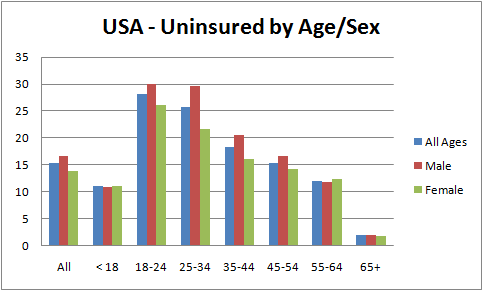
I think what's going on here is incredibly obvious. Parents get insurance for their kids, and as soon as those kids turn 18 and are no longer eligible as dependents, the insurance drops off the map until about age 35. It's even more dramatic with the men than the women.
Look at the data for yourself; I think it's almost safe to say that virtually ALL uninsured in any age group in excess of about 10% are uninsured by choice, and this cuts the number down by a huge amount, to well under 10 million by my estimate. And even then it's hard to say how many really can't get insurance, when you look at how high a percentage are insured at 65+.
And out of 10 million, do your own little back-of-the-envelope estimate of how many you think will become gravely ill, and of that number, how many are genuinely poor and don't have anything saved up for a rainy day (i.e. "self-insured"). That number has got to be less than 1 million; even ignoring the financial aspect, less than 1 in 10 people are going to get that sick.
So really, just how big a problem are we talking about here? And how does it really stack up against other countries? I'm willing to bet that the U.S. actually has better statistics than most because those people can still get the care they need, unlike in a European two-tiered system where they may not be able to go to a private hospital at all, and may become even more sick on some public waiting list.
Any questions?
Posted by Jayx1 on Sep-07-2009 20:44:
I have one... wheres Mccarthy when you need him?
LOL jokes....
Posted by miketg23 on Sep-07-2009 21:40:
| quote: |
Originally posted by DigiNut
It's possible that I've exaggerated slightly, but as for the age distribution, the numbers are available:
http://www.census.gov/hhes/www/hlth...oric/index.html
I took the 2007 data and made a chart for the tl;dr types:
Any questions? |
Is it not at all disturbing that 10% of children do not have any medical coverage?
Posted by DigiNut on Sep-07-2009 22:00:
| quote: |
Originally posted by miketg23
Is it not at all disturbing that 10% of children do not have any medical coverage? |
I hope this isn't another "think of the children!" appeal. That 10% seems to be the part that's relatively constant across the board (except 65+). A contextless number really shouldn't disturb or alarm anybody; you need to interpret that number.
Whatever the specific proportions are, that number will comprise people who:
- "Self-insure", i.e. have net assets or social connections that makes 3rd-party insurance unnecessary;
- Make a conscious choice not to insure because they perceive it as low-risk (includes the parents of some children);
- Make a conscious choice not to insure because of financial ineptitude (i.e. they can afford it but can't budget / think it's too expensive);
- Make an unconscious choice not to insure (disorganized, absent-minded);
- Cannot obtain insurance because of medical history or high-risk activities;
- Are only temporarily uninsured, i.e. they were insured through their employer and recently lost or quit their job;
- Are living below the poverty line and cannot afford any kind of insurance.
Now I won't pretend to know the exact proportions of all of those possibilities, but it is safe to say that low income is just one reason among many why an individual or family might not be insured, and without more information, we really can't simply assume that any one reason is the dominant one.
So my short answer is no, I am not "disturbed" by that statistic. I would say that the number warrants concern, and perhaps further investigation, but it is not a reason to panic and demand nationalization of the health care system.
Posted by Kellyboop on Sep-08-2009 10:30:
I love how Michael Moore bashes capitalism yet offers no solution to the issues he brings up.
Excellent job douche!
Posted by Flec on Sep-08-2009 18:09:
Politics Explained
FEUDALISM: You have two cows. Your lord takes some of the milk.
PURE SOCIALISM: You have two cows. The government takes them and puts them in a barn with everyone else's cows. You have to take care of all of the cows. The government gives you as much milk as you need.
BUREAUCRATIC SOCIALISM: You have two cows. The government takes them and put them in a barn with everyone else's cows. They are cared for by ex-chicken farmers. You have to take care of the chickens the government took from the chicken farmers. The government gives you as much milk and eggs as the regulations say you need.
FASCISM: You have two cows. The government takes both, hires you to take care of them and sells you the milk.
PURE COMMUNISM: You have two cows. Your neighbors help you take care of them, and you all share the milk.
RUSSIAN COMMUNISM: You have two cows. You have to take care of them, but the government takes all the milk.
CAMBODIAN COMMUNISM: You have two cows. The government takes both of them and shoots you.
DICTATORSHIP: You have two cows. The government takes both and drafts you.
PURE DEMOCRACY: You have two cows. Your neighbors decide who gets the milk.
REPRESENTATIVE DEMOCRACY: You have two cows. Your neighbors pick someone to tell you who gets the milk.
BUREAUCRACY: You have two cows. At first the government regulates what you can feed them and when you can milk them. Then it pays you not to milk them. Then it takes both, shoots one, milks the other and pours the milk down the drain. Then it requires you to fill out forms accounting for the missing cows.
PURE ANARCHY: You have two cows. Either you sell the milk at a fair price or your neighbors try to take the cows and kill you.
LIBERTARIAN/ANARCHO-CAPITALISM: You have two cows. You sell one and buy a bull.
SURREALISM: You have two giraffes. The government requires you to take harmonica lessons.
(Original source unknown . . . this version expanded and Illuminated by SJ.)
Posted by MarkT on Sep-14-2009 20:05:
| quote: |
Rather than relying on capitalism to save them during the recession, Moore said, major U.S. corporations actually turned to socialism in the form of taxpayer-funded bailouts.
"The true believers of socialism in the United States of America are Wall Street and corporate America. They want the safety net there for themselves and they have very willingly taken...trillions (of dollars) of our money," Moore said. |
http://www.thestar.com/entertainmen.../article/695446
hahaha...he's got a point there 
Posted by DigiNut on Sep-15-2009 00:00:
| quote: |
Originally posted by MarkT
hahaha...he's got a point there |
Hardly. His point actually demonstrates the biggest problem with corporate welfare, namely that as soon as you start offering handouts, everyone will want one. How can Citigroup compete with Bank of America if BAC has $20 billion in free money and C doesn't?
We have the same thing in Canada on a smaller scale with programs like SRED. You'd be amazed at who applies for - and gets - those grants. If you're a small business working in the tech sector and you're not drinking from that well, then you're putting yourself at a disadvantage.
It's not as if company execs walked up to their congressmen and asked for billions of dollars in bailouts (except for GM, but forget about their useless asses). The government offered it to practically anyone who was big enough and wanted some. What did you think that the CEO of JP Morgan was going to say? "No, thank you, we're doing just fine, you go ahead and send that $25 billion to Goldman Sachs instead, we really don't need it." Right.
What a goddamn idiot Moore is, doesn't even bother to do a shred of research. And the long-term effects of these bailouts have yet to be seen. With markets trending up, these companies are now making money hand over fist, but the moral hazard that's been created could cause them to lose even more if the economic climate changes.
Posted by exraver on Sep-15-2009 00:15:

Yeah, US of A is doing great:

http://www.brillig.com/debt_clock/
Posted by Jayx1 on Sep-15-2009 02:50:
Capitalism isnt perfect... But its a hell of a lot better than the alternative which i have seen and experienced first hand.
Posted by MarkT on Sep-15-2009 03:05:
| quote: |
Originally posted by DigiNut
Hardly. His point actually demonstrates the biggest problem with corporate welfare, namely that as soon as you start offering handouts, everyone will want one. How can Citigroup compete with Bank of America if BAC has $20 billion in free money and C doesn't?
We have the same thing in Canada on a smaller scale with programs like SRED. You'd be amazed at who applies for - and gets - those grants. If you're a small business working in the tech sector and you're not drinking from that well, then you're putting yourself at a disadvantage.
It's not as if company execs walked up to their congressmen and asked for billions of dollars in bailouts (except for GM, but forget about their useless asses). The government offered it to practically anyone who was big enough and wanted some. What did you think that the CEO of JP Morgan was going to say? "No, thank you, we're doing just fine, you go ahead and send that $25 billion to Goldman Sachs instead, we really don't need it." Right.
What a goddamn idiot Moore is, doesn't even bother to do a shred of research. And the long-term effects of these bailouts have yet to be seen. With markets trending up, these companies are now making money hand over fist, but the moral hazard that's been created could cause them to lose even more if the economic climate changes. |
TARP money is not a 'grant' though. some of these companies were mortgaging the future to survive now. The feds currently own a THIRD of Citigroup, do they not? I think 'hand-over-fist" is a bit of an exaggeration on the profits too...at least not industry-wide. Citi has apparently reported two quarters of positive earnings (the first seemingly due to accounting) and hardly out of the woods.
a few of the investment banks, like Goldman Sachs, have profited from the whole thing...but that's not true of everyone. and they still have to pay back the TARP money. it's just shady that they even received any, isn't it?
Posted by DigiNut on Sep-15-2009 04:19:
| quote: |
Originally posted by MarkT
TARP money is not a 'grant' though. some of these companies were mortgaging the future to survive now. The feds currently own a THIRD of Citigroup, do they not? I think 'hand-over-fist" is a bit of an exaggeration on the profits too...at least not industry-wide. Citi has apparently reported two quarters of positive earnings (the first seemingly due to accounting) and hardly out of the woods.
a few of the investment banks, like Goldman Sachs, have profited from the whole thing...but that's not true of everyone. and they still have to pay back the TARP money. it's just shady that they even received any, isn't it? |
What you're talking about in the first paragraph is precisely the kind of moral hazard I was describing. Although the money isn't "free", the expectation has been set with all of these financial groups that if they screw it up, they can count on another bailout, and so they're taking risks that a financial would normally never take. If it pans out - great, they pay back the TARP money. If not, the shareholders and taxpaying public are collectively left holding the (empty) bag.
I didn't say, or at least didn't intend to say that the TARP funds are actually helping all of the financials the way they were intended to. I was one of the few here against the bailouts, even before the actual pork-barrel bill was produced. My point was that if you're giving away free money - and to an investment bank, "interest-free loan" is practically a synonym for "free money" - then by definition everybody is going to want a piece of the pie. That's not hypocrisy, it's a classic tragedy-of-the-commons that so often becomes a manifestation of ham-fisted socialist policies.
(Yes, I'm aware that it's not "interest-free" either, just very low-interest... same thing)
And I won't even delve into all the problems with the government accepting stock as collateral - fortunately the fed is finally buckling under the pressure and looking for ways to unwind those positions.
Personally, I don't think you could ask for a clearer demonstration of corporate welfare's slippery slope. This doesn't reveal the supposed hypocrisy of capitalists, it reveals the debilitating effects of government interference - even "good" government interference - on a functioning capitalist system.
Posted by TheVrk on Sep-15-2009 14:09:
thread as usual

Pages (4): « 1 2 [3] 4 »
Powered by: vBulletin
Copyright © 2000-2021, Jelsoft Enterprises Ltd.