
TranceAddict Forums (www.tranceaddict.com/forums)
- Political Discussion / Debate
-- Was the lunar landing fake?
Pages (5): « 1 2 3 [4] 5 »
| quote: |
| Originally posted by Q5echo "lol I find it hilarious when discussions get down to aruguments over the "spirit of the word" and I can cite people but I have no fucking clue what they are saying." forget about it, dude  |
William Ashley: The only force known to man with the capabilities of uniting the rest of the PDD.
| quote: |
| Originally posted by DJ Damerchi William Ashley: The only force known to man with the capabilities of uniting the rest of the PDD. |
 Finally, the right and left wingers are reconciled!
| quote: |
| Originally posted by Q5echo "lol I find it hilarious when discussions get down to aruguments over the "spirit of the word" and I can cite people but I have no fucking clue what they are saying." forget about it, dude |
| quote: |
| Originally posted by pkcRAISTLIN Have you never encountered ******** before? He takes crazy to a whole new level. |


Well, someone has to play devil's advocate here. 
Once again, simply because of ********'s, shall we say, eccentricities, the points he makes are ruthlessly and unfortunately swept aside as mad ravings by the rest of the "normal" populace in PDD.
One point I'd like to bring up is that ******** is often making sociological/philosophical statements that literal-minded, strictly-scientific people are dismissing out of hand, especially when they're presented in slightly cryptic & occasionally grammatically incorrect English.
E.g., Krypton, I believe you completely missed the whole point of the USENET issue. He was not using a USENET post to back up a scientific claim. He was bringing up USENET in a sociological context to illustrate social truths -- basically showing how it is a tool of a socially constructed reality. That what people will take as true more often than not comes from these kinds of sources, which includes news reports, hearsay, and so on.
The notion of scientific research as a source of truth is a very recent newcomer, historically speaking, and is an odd fit to our cognitive capacities, which have evolved to construct a reality based on what our fellow tribesmen/women reported to us, as well as to folk notions of biology, astronomy, etc., which are basically "hacks" in our minds to try to understand the world around us, in a very un-scientific way -- using the strict meaning of the concept. ("Folk" here used in the sense of folk psychology).
I understand that as a forum for debate, the PDD has a very heavy emphasis on citing sources and so on, but this often misses the philosophical/historical side that ******** refers to. His talk about social truth versus scientific truth is very much in the vein of serious debates in the HPS field (History and Philosophy of Science). Basically, the study of science and how it operates, what it actually is, the nature of its claims, its limits, etc.
I wouldn't be surprised if many people here didn't know that the notion of "scientific reality" is heavily disputed in such areas of academia worldwide -- including such famous places as the London School of Economics (weird place to be an HPS hotspot, I know, but there's history behind that) where the famous Karl Popper made his mark. I.e., the notions of "realism" versus "anti-realism", e.g., whether atoms can be really said to be real. Of course, the literal minded (and philosophically unsophisticated) "scientific" person might think, "Of course atoms are real!!11" but upon reflection on history (hence the emphasis of history in the HPS field), the scientific notion of an atom has gone through very large shifts, unrecognizable to each other. E.g., from the Bohr model of an atom with discrete subatomic particles physically circling around a nucleus, to the current quantum mechanic notion of a probability cloud with no certain location for any particle. With this in mind, what on earth are we referring to when we talk about "atoms"? Are we referring to the theories? In which case we're not talking about "reality". Are we referring to the atoms "out there"? But what do these look like, if we keep changing our minds about them? Perhaps the most we can say is that we can only talk about atoms, with regards to their properties or how they interact with with each other and with the laws of nature -- which is the only thing that science can uncover. But we can't talk about what they actually are, since we don't really know. This is the position of the "structural realist" as opposed to the "entity realist" (who believes atoms are really real as depicted in their theoretical descriptions).
But aside from the position of realism is the whole other realm of anti-realism. One point that is naturally hinted at from the discussion of atomic theory changes is that of the so-called Pessimistic Induction -- that is, that since each and every scientific theory in the past has been eventually shown to be incorrect (history presents a "graveyard" of scientific theories), so, by induction, our current theories will eventually be shown to be wrong, and replaced by "better" and "more accurate" theories which will themselves, eventually, be displaced as well. In light of this, how can we seriously talk about the objects that science discusses as actual, "real" things, if our ideas about their very existence or natures will drastically change in the future? This is the position of the anti-realist.
Then there are sociological considerations to the philosophy of science, the sub-field called the Sociology of Scientific Knowledge or SSK. This part of the article will undoubtedly shed light on ********'s approach on "social truth" (the quote discusses the arguably more interesting form of SSK called the "strong programme"):
| quote: |
| ...strong sociology/ the strong programme does not deny the existence of a human-independent reality. Neither does it affirm that all knowledge claims are 'really true' just because the relevant community accepts them as true. The position of strong sociology is that sociologically interesting knowledge (e.g. institutionalised forms of knowledge) are human products even when they have been formulated as a result of interaction with a human-independent physical world as is the case in the so-called natural sciences. Such sociologically interesting knowledge is not given with the physical world but is a product of group/social processes. Passively observing the world will not convince 'rational' individuals to assent to such knowledge. |
oooooOooooOOooo.. im gonna take my time reading this 
| quote: |
| Originally posted by Alccode |
How mystical! How do we know we'r not in some video game being ruthlessly manipulated by THE PROGRAMMER!?
| quote: |
| Originally posted by Alccode Well, someone has to play devil's advocate here. Once again, simply because of ********'s, shall we say, eccentricities, the points he makes are ruthlessly and unfortunately swept aside as mad ravings by the rest of the "normal" populace in PDD. One point I'd like to bring up is that ******** is often making sociological/philosophical statements that literal-minded, strictly-scientific people are dismissing out of hand, especially when they're presented in slightly cryptic & occasionally grammatically incorrect English. E.g., Krypton, I believe you completely missed the whole point of the USENET issue. He was not using a USENET post to back up a scientific claim. He was bringing up USENET in a sociological context to illustrate social truths -- basically showing how it is a tool of a socially constructed reality. That what people will take as true more often than not comes from these kinds of sources, which includes news reports, hearsay, and so on. The notion of scientific research as a source of truth is a very recent newcomer, historically speaking, and is an odd fit to our cognitive capacities, which have evolved to construct a reality based on what our fellow tribesmen/women reported to us, as well as to folk notions of biology, astronomy, etc., which are basically "hacks" in our minds to try to understand the world around us, in a very un-scientific way -- using the strict meaning of the concept. ("Folk" here used in the sense of folk psychology). I understand that as a forum for debate, the PDD has a very heavy emphasis on citing sources and so on, but this often misses the philosophical/historical side that ******** refers to. His talk about social truth versus scientific truth is very much in the vein of serious debates in the HPS field (History and Philosophy of Science). Basically, the study of science and how it operates, what it actually is, the nature of its claims, its limits, etc. I wouldn't be surprised if many people here didn't know that the notion of "scientific reality" is heavily disputed in such areas of academia worldwide -- including such famous places as the London School of Economics (weird place to be an HPS hotspot, I know, but there's history behind that) where the famous Karl Popper made his mark. I.e., the notions of "realism" versus "anti-realism", e.g., whether atoms can be really said to be real. Of course, the literal minded (and philosophically unsophisticated) "scientific" person might think, "Of course atoms are real!!11" but upon reflection on history (hence the emphasis of history in the HPS field), the scientific notion of an atom has gone through very large shifts, unrecognizable to each other. E.g., from the Bohr model of an atom with discrete subatomic particles physically circling around a nucleus, to the current quantum mechanic notion of a probability cloud with no certain location for any particle. With this in mind, what on earth are we referring to when we talk about "atoms"? Are we referring to the theories? In which case we're not talking about "reality". Are we referring to the atoms "out there"? But what do these look like, if we keep changing our minds about them? Perhaps the most we can say is that we can only talk about atoms, with regards to their properties or how they interact with with each other and with the laws of nature -- which is the only thing that science can uncover. But we can't talk about what they actually are, since we don't really know. This is the position of the "structural realist" as opposed to the "entity realist" (who believes atoms are really real as depicted in their theoretical descriptions). But aside from the position of realism is the whole other realm of anti-realism. One point that is naturally hinted at from the discussion of atomic theory changes is that of the so-called Pessimistic Induction -- that is, that since each and every scientific theory in the past has been eventually shown to be incorrect (history presents a "graveyard" of scientific theories), so, by induction, our current theories will eventually be shown to be wrong, and replaced by "better" and "more accurate" theories which will themselves, eventually, be displaced as well. In light of this, how can we seriously talk about the objects that science discusses as actual, "real" things, if our ideas about their very existence or natures will drastically change in the future? This is the position of the anti-realist. Then there are sociological considerations to the philosophy of science, the sub-field called the Sociology of Scientific Knowledge or SSK. This part of the article will undoubtedly shed light on ********'s approach on "social truth" (the quote discusses the arguably more interesting form of SSK called the "strong programme"): This is saying that "scientific facts" are not necessarily just objective truths that we are discovering about the world, but are largely accurate and tentative notions (which we shall loosely call "truth") that are heavily influenced and shaped by the sociological forces that they arise in. Science is, after all, a human pursuit, made by humans with all our flawed and evolutionarily hacked cognitive systems, not the product of some Uber-rational perfect beings that make no mistakes (regarding mistakes, think back to the considerations from the pessimistic induction). Thus, "scientific facts" are human products as the article states, not Dictates from Reality. Obviously this is not claiming that all our scientific knowledge is worthless -- far from it. I fully trust science whenever I use my computer or step on a plane or -- while we're at it -- when the question of the moon landings comes up. And if it seems that this is what is being claimed, then I think that's just because my knowledge of HPS/SSK is very rusty (it's been a few years). So note that I'm just presenting HPS/SSK at a very brief/incomplete/inaccurate level, in order to try to show that ******** is making interesting points that people are completely overlooking in their blindness caused by mouth-frothing demands for citations, coupled with a prejudicial contempt for ******** as a person. For shame!! Mind you, it doesn't help that ******** himself doesn't address some of these things directly, so in the end, each "side" speaks over the head of the other, and it all gets reduced to ad hominem nonsense, with most people ganging up on ********. I've noticed this unfortunate pattern with most threads ******** gets involved in, and I at least would be very happy if it all stopped (even if I'm just mostly a lurker and rarely participate directly). There's too much ad hominem on these boards anyway, which sours the otherwise interesting discussions. P.S. If anyone is intrigued at all by the talk of philosophy of science -- and I don't see how anyone interested in science here wouldn't be! -- I heartily recommend you read up on it in Wikipedia and other "trusted" sources, then follow their references. Reading an introductory textbook is even better, and auditing or sitting in on a local university/college introductory course on Philosophy or History of Science is ideal (with the instructor's permission of course). [EDIT: for clarification] |
| quote: |
| Originally posted by Q5echo right, but we're not debating the remotely tangible or the intangible here. a man landed on the moon or he didn't. |
I hope the next post isn't going to be: "yeah fine, but the issue is either a man DID land on the moon or DIDN'T." 
| quote: |
| Originally posted by pkcRAISTLIN who the fuck are you? that was an awesome post, and if ******** would express himself that coherently i suspect the ad hominems would be much, much rarer. |


| quote: |
| Originally posted by Krypton How mystical! How do we know we'r not in some video game being ruthlessly manipulated by THE PROGRAMMER!? |

| quote: |
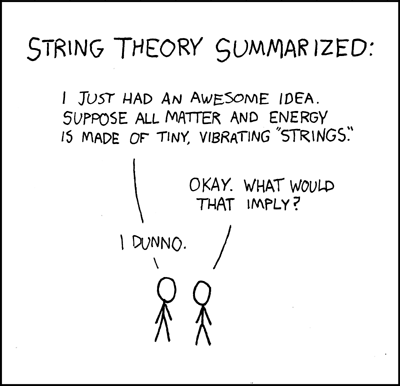
| Originally posted by Alccode The same considerations seem to apply. I agree that the factual possibilities are either a man landed or not, but our belief that it did occur, as outsiders to the actual event, is socially created through news reports, interviews, etc. "Outsiders" in the sense of space -- we weren't there when it occured, and time -- it was 40 years ago. Basically, you are implicitly trusting the whole patchwork of information sources that have come to you regarding the moon landings and concluding that they did really occur, but in actual fact you yourself have no way of knowing for sure. Even if you were around at the time and watched it live on TV, you still wouldn't know for sure. Unless you were the actual astronauts themselves, or the folks in mission control, or the engineers who built it all, or the direct friends and family of all those people, etc., in decreasing order of certainty of knowledge. Well now we also have that Japanese probe that photographed the landing sites too, but again this is all being filtered through the societal lens. I think it would be less filtered for the operators controlling the probe, but even for them, what they're seeing is contingent on assuming that the engineers made an "accurate" camera, which then boils down to a scientific theory of optics which may or may not hold water 50 years from now. How much more uncertain for us, who learn about it third-hand (or even further removed). And then when something about the news reports or the info we're given doesn't make sense or is inconsistent, I would claim we see there the effects of the distortions of the societal lens. (Unfortunately, this is where people who are prone to think in terms of conspiracy theories find the fodder for their beliefs, when more often than not it all boils down to the messiness of the transmission of knowledge.) In the case of the moon landings the sheer variety and volume of information about it indicates pretty positively that they did in fact occur. It's akin to the status of a scientific theory like evolution through natural selection. It, too, is uncertain and prone to change (it probably won't look entirely the same in the future), but the basic concept is pretty much indisputable given the sheer volume of evidence. On the other hand, a scientific theory that has much less evidence going for it, like string theory, would be much more doubtful in its facticity, and this is even reflected in popular culture: (source: http://xkcd.com/171/) So, going back to the moon landings, the analogous situation is if ALL we knew about the moon landings was ONE single news report with one photo and a muffled recording of the radio communications, naysayers would be more justified in doubting that the landing occured. I think the fact that we (and yourself, I hope) would agree with this shows that we implicitly understand "societal truth" versus "scientfic" or "actual" truth. If we didn't, we would have taken that one news report on face value and believed. (We would also believe tabloids.) OK, at this point I think the effort gone into explaining this totally outweighs the importance of the issue. It's a very simple but subtle point. Here's a one sentence summary. Yes, I agree a man landed on the moon, but not because I know the truth of it but because, weighing the evidence, I feel it is reasonable to say that the social truth of the matter corresponds with the actual fact, though I can't know for sure. The same can be said about scientific theories. I think it's important, and healthy, to have this kind of viewpoint. If we don't, then we are liable to become like Thomas Kuhn's "old guard", the influential people in science who are so attached to an outdated or overthrown theory, that real progress is hindered due to their rigidity, and can only proceed when they (literally) die off. The analogous situation in society is the "you're either with us or against us" mentality. Not recognizing the "softness" and uncertainty of what we think we know, even if we're pretty sure some things are true, jeopardizes our welfare in the future when we are unable to change our beliefs to fit the changing reality. Sometimes, even something that we know "for sure" turns out to be false, and we have to be ready to let go of the old belief. |
| quote: |
| Originally posted by Alccode I hope the next post isn't going to be: "yeah fine, but the issue is either a man DID land on the moon or DIDN'T." |
I couldn't tell it if was or wasn't. If you believe they put a man -- on the moon? Doubt it. If anything the public lexicon could never be the same.
| quote: |
| Originally posted by thedoggyworld I couldn't tell it if was or wasn't. If you believe they put a man -- on the moon? Doubt it. If anything the public lexicon could never be the same. |
If tehy wuz on teh moon? NOOOOO
How cud teh flag WAVE?!!11!
| quote: |
| Originally posted by Q5echo actually my post was going to be, where do you stand on climate issues? seeing as how this thread was over in about 3 pages i was curious to know how you feel about the current "scientific consensus" on anthropogenic global warming theory |
| quote: |
| Originally posted by pkcRAISTLIN There is an astronomically huge difference between healthy scepticism and enquiry, and the anti-intellectual, anti-science, anti-logic mantra of the conspiracy mindset. The simple fact of the matter is that none of these BS positions have anywhere near the levels of evidence or insight necessary to create doubt concerning �socially constructed� norms. So while I agree that some things should never be taken for granted, I think its extraordinarily disingenuous to equate that position with the crazies that proffer exactly the kind of �group-think� you�re criticising here. |
| quote: |
Indeed, in the current example re the moon, it isn�t a debate about the validity of science at all. It�s an argument wholly created around conspiracy without any evidence. Im not sure how often you poke your nose in here but some of us are just fatigued from the pure, unadulterated bullshit being spewed by the usual suspects, and ad hominems seem to be the natural response to such a disregard for logic, deduction and established scientific knowledge. I don�t think it is unreasonable to arbitrarily dismiss such absurdities in favour of discussing topics that actually matter. |

| quote: |
| Originally posted by Alccode The simple question of human activity affecting the climate is, I think, probably beyond dispute (with the answer being in the affirmative). |
| quote: |
| Originally posted by pkcRAISTLIN stick that in your pipe Q5. |
| quote: |
| Originally posted by Q5echo "I think, probably beyond dispute" is the first indication of dogma and the famous last words of a follower. *puffs* |
| quote: |
| Originally posted by pkcRAISTLIN one of the biggest examples of "dogma" in action is the disproportionate number of centre-right conservatives who are global warming deniers. |

Powered by: vBulletin
Copyright © 2000-2021, Jelsoft Enterprises Ltd.