
TranceAddict Forums (www.tranceaddict.com/forums)
- Political Discussion / Debate
-- Do you believe there is a U.S. government cover-up surrounding 9/11?
Pages (162): « 1 2 3 4 5 6 7 8 9 10 11 12 13 14 15 16 17 18 19 20 21 22 23 24 25 26 27 28 29 30 31 32 33 34 35 36 37 38 39 40 41 42 43 44 45 46 47 [48] 49 50 51 52 53 54 55 56 57 58 59 60 61 62 63 64 65 66 67 68 69 70 71 72 73 74 75 76 77 78 79 80 81 82 83 84 85 86 87 88 89 90 91 92 93 94 95 96 97 98 99 100 101 102 103 104 105 106 107 108 109 110 111 112 113 114 115 116 117 118 119 120 121 122 123 124 125 126 127 128 129 130 131 132 133 134 135 136 137 138 139 140 141 142 143 144 145 146 147 148 149 150 151 152 153 154 155 156 157 158 159 160 161 162 »
| quote: |
| Originally posted by culorut Yes it is true and thermate was used in bringing down the towers. |
hey, whattaya know. fire can melt steel
fire melted part of the I-580 overpass in Oakland yesterday.


all you have to do is crash a trailer truck filled with 8600 gallons of gasoline underneath it. amazing.
I know you're joking around, but just for the sake of clarity, a fire would have to be around 1500 C to melt most commercially used steel alloys. What happened with the highway is similar to what happened at the WTC as the steel was heated up enough (somewhere around 500-750 C depending upon alloy) to undergo a crystalline structure change (at those temps steel morphs to a metal more like brass) and pretty significant thermal expansion (more typically called warping). It didn't actually melt anything, but it obviously didn't need to in order to do the damage seen there.
| quote: |
| and where is your evidence young man? thermate isn't used in demolitions. and i would like to know how you believe any substance that can be ignited with heat withstood the fires that raged in the WTCs? |
| quote: |
| I know you're joking around, but just for the sake of clarity, a fire would have to be around 1500 C to melt most commercially used steel alloys. What happened with the highway is similar to what happened at the WTC as the steel was heated up enough (somewhere around 500-750 C depending upon alloy) to undergo a crystalline structure change (at those temps steel morphs to a metal more like brass) and pretty significant thermal expansion (more typically called warping). It didn't actually melt anything, but it obviously didn't need to in order to do the damage seen there. |
| quote: |
| Originally posted by culorut Point is it was found and it can cut through metal beams very easily, the stuff gets up to 4500F in seconds. |
| quote: |
| Originally posted by culorut The fires in the WTC towers where up much higher and did not last too long, they where practically out. Charges containing Thermate where planted much further below on the support beams and electronically detonated. |
| quote: |
Thermite in general makes an ugly hole with molten metal drips/blobs. It doesn't make clean cuts. It's a powder that undergoes a violent chemical reaction as seen in the video below. http://www.guzer.com/videos/thermite_car.php Note how much thermite is used. The pot is about a liter, but how much thermite is that? Stoichiometric thermite requires 2 moles of Al per 1 mole of Fe2O3 2Al + Fe2O3 = Al2O3 + 2Fe 2 moles of Al weigh 54 g 1 mole of Fe2O3 weighs 160 g density of Al=2.64 g/cc density of Fe2O3=5.24 g/cc 54 grams of Al is equivalent to 20.5 cc of Al. 160g of Fe2O3 is equivalent to 30.5 cc of Fe2O3 Therefore, 51 cc of fully dense powder of 20.5 cc Al and 30.5 cc Fe2O3 weighs (54+160) g = 214 g. A volume of 1000 cc would weigh (1000/51)*214 = 4.2 kg For a powder packing density of 50%, the powder would weigh: 0.5*4.2 kg = 2.1 kg = 4.8 lb That much just to burn a small hole in a small car engine. I bet it's even an aluminum block but lets say it isn't. How much do you think it would take to burn a massive core column? Then add enough to burn for 6 weeks! You see where we're going. You'd need tons. |
| quote: |
| Originally posted by culorut How else would they have been able to bring down the engineering marvels which the World Trade Towers where? |
| quote: |
| no, it wasn't found. no evidence of thermite. and no, thermite doesn't "cut" through anything very easily. it certainly isn't capable of cutting through steel in a nice uniform way to bring about collapse of a building. it just doesn't work that way. |
| quote: |
| practically out? why was there smoke still billowing into the air when they started to collapse? where exactly were these thermite charges placed? its impossible to collapse a building the way you believe it occured. certainly impossible to coordinate thermite to the degree you believe. its an incindiary, not a demolition explosive. |
| quote: |
| the particular structural design of the WTCs is what brought down these "engineering marvels". the WTCs had a very specific design, completely unlike most modern buildings, and this had a very large part to play in their collapse. |
Molten Metal
| quote: |
| Originally posted by culorut Wrong again, Thermate not thermite. Thermate is military grade thermite which gets up to 4500F and cuts through metal beams like butter. |
| quote: |
Thermate, or Thermate-TH3, is an incendiary compound primarily used for military applications. Because of the similarity in names, thermate is sometimes confused with one of its components, thermite. Thermate is a mixture of thermite and pyrotechnic additives which have been found to be superior to standard thermite for incendiary purposes. Its composition by weight is generally thermite 68.7%, barium nitrate 29.0%, sulphur 2.0% and binder 0.3%. Addition of barium nitrate to thermite increases its thermal effect, creates flame in burning and significantly reduces the ignition temperature. Thermate is used in incendiary hand grenades. |
| quote: |
It cannot be used to melt vertical structures, because the molten iron simply flows past the target |
| quote: |
| Originally posted by culorut Smoke means the fires are going out and therefore not hot, not hot enough to weaken or come even close to melting steel that is. Thermate used in conjunction with other explosives can and did bring down the WTC towers. |
| quote: |
| Originally posted by culorut The particular design of the WTC towers where unique correct but they did not fail because of the airplanes crashing into them. They where built to withstand multiple airline impacts including their fuel. |
| quote: |
| Originally posted by culorut The Empire State Building was hit by a B-25 bomber near the end of WW2, it destroyed 19 floors and guess what? It's still standing to this very day. |

| quote: |
The size of a B-25 bomber is much smaller than a Boeing 767, with smaller wingspan and smaller fuel capacity. A B-25 bomber has a wingspan of 67 feet, compared with 156 feet for a Boeing 767. The fuel capacity of the B-25 bomber was 1,000 gallons, as compared with 24,000 gallons for a Boeing 767. As well, the speed at which a B-25 bomber travelled was far less than the ~500 mph than the speed that the two Boeing 767's were travelling when they hit the World Trade Center. The World Trade Center was designed to withstand the force from the impact of a Boeing 707, lost in the fog and travelling at a relatively slow speed of 180 miles per hour. The Boeing 767 aircraft that hit the World Trade Center were significantly heavier, with fuel for transcontinental flights. American Airlines Flight 11 was travelling at 470 miles per hour when it crashed into the North Tower at 8:46 a.m. United Airlines Flight 175 was travelling at 590 miles per hour when it crashed into the South Tower. The energy contained in an airplane or other moving object is proportional to the velocity. |
| quote: |
| Originally posted by culorut No plane hit WTC7 but it fell symmetrically, how did the fires slice through the support columns at the same time to cause it to collapse the way it did at almost free fall speed? |
| quote: |
Seismograph trace of the collapse of WTC 7 indicates that parts of the building were hitting the ground for 18 seconds. This means the collapse took at least 18 seconds, of which only the last approximately 15 seconds are visible in videos: 8 seconds for the penthouses and 7 seconds for the north wall to come down. |
| quote: |
Firehouse: Was there heavy fire in there right away? Hayden: No, not right away, and that�s probably why it stood for so long because it took a while for that fire to develop. It was a heavy body of fire in there and then we didn�t make any attempt to fight it. That was just one of those wars we were just going to lose. We were concerned about the collapse of a 47-story building there. We were worried about additional collapse there of what was remaining standing of the towers and the Marriott, so we started pulling the people back after a couple of hours of surface removal and searches along the surface of the debris. We started to pull guys back because we were concerned for their safety. Firehouse: Chief Nigro said they made a collapse zone and wanted everybody away from number 7� did you have to get all of those people out? Hayden: Yeah, we had to pull everybody back. It was very difficult. We had to be very forceful in getting the guys out. They didn�t want to come out. There were guys going into areas that I wasn�t even really comfortable with, because of the possibility of secondary collapses. We didn�t know how stable any of this area was. We pulled everybody back probably by 3 or 3:30 in the afternoon. We said, this building is going to come down, get back. It came down about 5 o�clock or so, but we had everybody backed away by then. At that point in time, it seemed like a somewhat smaller event, but under any normal circumstances, that�s a major event, a 47-story building collapsing. It seemed like a firecracker after the other ones came down, but I mean that�s a big building, and when it came down, it was quite an event. But having gone through the other two, it didn�t seem so bad. But that�s what we were concerned about. We had said to the guys, we lost as many as 300 guys. We didn�t want to lose any more people that day. And when those numbers start to set in among everybody� My feeling early on was we weren�t going to find any survivors. You either made it out or you didn�t make it out. It was a cataclysmic event. The idea of somebody living in that thing to me would have been only short of a miracle. This thing became geographically sectored because of the collapse. I was at West and Liberty. I couldn�t go further north on West Street. And I couldn�t go further east on Liberty because of the collapse of the south tower, so physically we were boxed in. |
| quote: |
| Originally posted by culorut Molten Metal |
Thermate is useless? It can cut through steel like butter and it's useless? You forgot to explain how the fires cut the columns of WTC7 at the same time which caused it to fall so perfectly in it's own footprint. Nice dodge from that one.
Forget drawing links, the molten metal was there what ever caused it.
Your common sense makes no sense.
| quote: |
| Originally posted by culorut Thermate is useless? It can cut through steel like butter and it's useless? You forgot to explain how the fires cut the columns of WTC7 at the same time which caused it to fall so perfectly in it's own footprint. Nice dodge from that one. Forget drawing links, the molten metal was there what ever caused it. Your common sense makes no sense. |
| quote: |
"But the building doesn't look like it fell over, it fell "in its own foot print" you might say. That's because it is impossible for a 47 story steel building to fall over like that. It's not a small steel reinforced concrete building like the ones shown as *Examples* of buildings which fell over. Building 7 is more like the towers, made up of many pieces put together. It's not so much a solid block as those steel reinforced concrete buildings. To put it simply, the building DID fall over backward and to the south-east. Just not like a steel reinforced concrete building would. Another telling photo is this one taken closer to the event date.  Note just past building 7 is a small amount of debris on the white building behind it. (Building 7 is pile in the upper center-left of the photo. The white building is at the top center-left of the photo.) That building is to the north east corner of building 7. Note about 1/3rd of the east side of the building falling to the north in the photo below. Here is another photo from over Building 7. The white building is on the left. Note the debris from building 7 which crossed the street and landed on top of the white building.  This suggests the building was split by the penthouse collapses most of the way down. One section went to the south-east while a smaller section went to the north. It wasn't that symmetrical. |
| quote: |
| Originally posted by pkcRAISTLIN sorry, but thermate is practically thermite. from wiki |

| quote: |
| Originally posted by Philby hmm i dunno pkc, referencing wiki, you could be slipping a little |
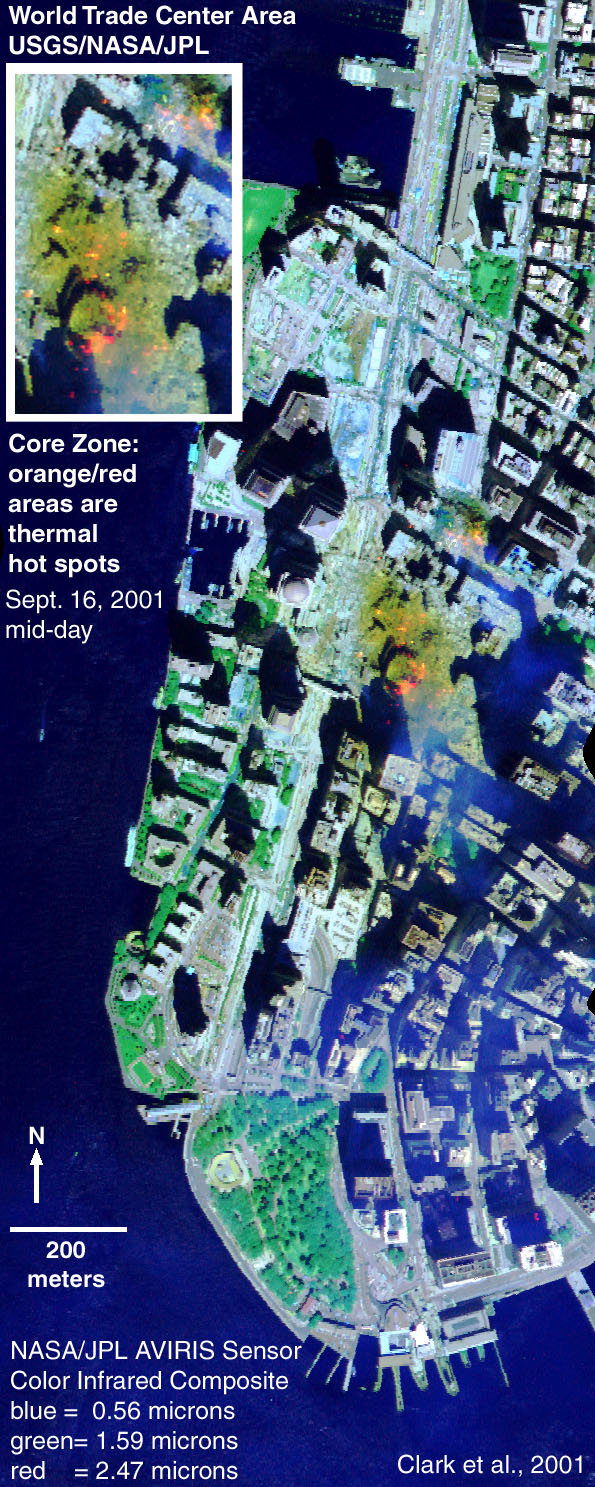
Um, those hot spots you showed at the site were fires. There were fires that didn't go out for quite a few days.
I don't know what you are on, boy.
| quote: |
| Originally posted by Marc Summers Um, those hot spots you showed at the site were fires. There were fires that didn't go out for quite a few days. I don't know what you are on, boy. |
| quote: |
| Originally posted by culorut Fires do not get that hot, especially when they poured tons upon tons of water over the hot spots the weeks following. |
| quote: |
Oxidation of iron by air is not the only EXOTHERMIC reaction of iron (= structural steel which is about 98 % Fe, 1 % Mn, 0.2 % C, 0.2 % Si.....). There is at least one additional reaction of iron with the capability of keeping the rubble pile hot and cooking! The reaction between IRON AND STEAM is also very EXOTHERMIC and fast at temperatures above 400 deg C. This reaction produces Fe3O4 AND HYDROGEN. It is the classic example of a REVERSIBLE REACTION studied in Chemistry labs at high school. But believe it or not, back at the turn of the century, the reaction of iron and steam was used as an industrial process for the manufacture of hydrogen. I think iron and steam could have reacted in this way (at least for a while) and generated a lot of heat. What is more, the hydrogen released would have been converted back to water by reaction with oxygen, thereby generating even more heat. In this case spraying water on the rubble pile was like adding fuel to a fire! Now add in gypsum reactions with H2 and CO and we have a great source of SO2 and/or H2S to sulfide the steel! Perhaps the endless spraying of water on the rubble pile was not such a good idea! |
| quote: |
| Originally posted by pkcRAISTLIN lol philbs. no, i knew that thermite/thermate are practically identical (ive done so much explosive-related reading in the last year its just not funny) but grabbed wiki coz it was easiest to find |
| quote: |
| of course, you (still) haven't explained why explosives would leave such heat. no demolition ive ever heard of ever caught fire! |
| quote: |
| Originally posted by culorut You can start around 9 mins in. If this is asking to much your obviously ignoring the truth about this fact. |
ooooh! molten metal. metal wouldnt melt at all in a massive building fire would it?! molten metal wasn't pouring out of the windows before the collapse was it?! nope!
your arguments are getting more and more vague and your tenuous connections between "evidence" more and more ridiculous.
im STILL waiting for you to refute any of my other arguments. come on boy, put a little more effort it, tsk tsk.
| quote: |
| Next time actually watch the videos of the rescue workers who where there right after the controlled demolitions say there was molten metal present. They did not even start to pour water yet moron. |
| quote: |
| Originally posted by culorut Fuck you cannot even read properly, no wonder you cannot understand that 9/11 was an inside job. Ignorance is one thing but you are just plain stupid. |

| quote: |
| Originally posted by culorut Fuck you cannot even read properly, no wonder you cannot understand that 9/11 was an inside job. Ignorance is one thing but you are just plain stupid. |
| quote: |
| Originally posted by Marc Summers You haven't explained anything yourself, so far in this thread. When we ask you to explain, you just throw a video at us, or some article. |
| quote: |
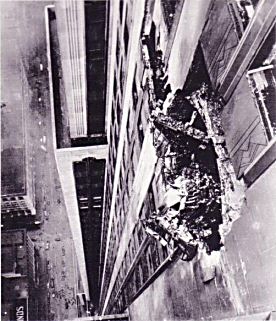
| Originally posted by cretinrot The Empire State Building was hit by a B-25 bomber near the end of WW2, it destroyed 19 floors and guess what? It's still standing to this very day. |
| quote: |
Less structural damage meant no real issues in terms of supporting the load of the building above (which was constructed entirely differently from the WTC anyway). The considerably reduced fuel load meant fire was less of an issue, and the blaze that did arise was brought under control without much difficulty: The 4-alarm fire brought every available piece of fire-fighting apparatus to the scene. As the building was evacuated, firemen spent about an hour extinguishing the flames. |
| quote: |
| Originally posted by pkcRAISTLIN yeah, whatever you reckon mate. you're the one perpetuating poor research, lies & halftruths. you're the ignorant highschool student that doesn't have the intellectual capacity nor commitment to properly analyse the information you're spewing. once again i am faced with a "truther" that brings up point after point that i stomp into the ground, so they bring up the next point. and then the next. never staying long enough to actually defend their stupid position. credit to you child, you keep up your internet detective work. those that DO have a capacity to understand my arguments and are following this thread know you've had your arse soundly handed to you. good luck with school, you are definitely going to need it. perhaps with time you will gain a little experience in assessing argument and information, and there'll be no need to make a fool of yourself on TA ever again |

Powered by: vBulletin
Copyright © 2000-2021, Jelsoft Enterprises Ltd.