
TranceAddict Forums (www.tranceaddict.com/forums)
- DJ Promotion
-- The Oldskool Series: history of EDM (1964-2004)
Pages (5): « 1 2 3 4 [5]
This episode would actually go to the beginning of the series...
Episode #0A - Futuristic Method [1917-1964]

DOWNLOAD: http://2rip.podomatic.com/enclosure...18_52-07_00.mp3
�Ancient life was all silence. In the nineteenth century, with the invention of the machine, Noise was born. Today, Noise triumphs and reigns supreme over the sensibility of men. For many centuries life went by in silence, or at most in muted tones. The strongest noises which interrupted this silence were not intense or prolonged or varied. If we overlook such exceptional movements as earthquakes, hurricanes, storms, avalanches and waterfalls, nature is silent.
Amidst this dearth of noises, the first sounds that man drew from a pieced reed or streched string were regarded with amazement as new and marvelous things. Primitive races attributed sound to the gods; it was considered sacred and reserved for priests, who used it to enrich the mystery of their rites.� - Luigi Russolo, Art of Noises Manifesto
In 1913, Italian composer Luigi Russolo wrote a letter to a friend who was a Futurist Composer known as Francesco Balilla Pratella. The letter argues that the human ear has become accustomed to the noise of the urban industrial landscape and concludes that electronics and other new technology will help composers & futurist musicians to substitute for the limited sounds available through traditional orchestras.
An instrument known as the Theremin was used in the twenties by composers like Honegger, Messiaen, and Verese. The instrument was known for an eerie high pitched wailing sound that was often used in horror films in the fifties. Another early pioneer was Oskar Sala who, along with Dr. Trautwein, built the Trautonium. The instrument was later altered into the Mixturtrautonium which was used to compose the music for Alfred Hitchcock�s �The Birds.�
With the proliferation on musical tools, the musicians of the day were inspired to think about music in a different way. In 1939 John Cage�s �Imaginary Landscape #1� became the first piece of electronic music to be reproduced. When he was in college, John Cage studied at UCLA with the classical composer Arthur Schoenberg. Cage had demonstrated in his lessons that he had no skill in creating harmony and Schoenberg insisted that Cage would not be able to create music. Schoenberg told Cage, �You�ll come to a wall and won�t be able to get through it.� Cage replied, �Then I will beat my head against the wall.� Cage soon found others who were interested in challenging the concepts of art forms of the past.
Cage�s early experiments involved altering standard instruments, such as putting plates and screws between a piano�s strings before playing. As his alterations became more drastic he realized that he needed entirely new instruments. Pieces such as �Imaginary Landscape Vol. 4� used twelve radios played at once and depended entirely on the chance broadcasts at the time of the performance for it�s actual sound.
With the invention of the Moog synthesizer in 1964, the golden age of electronic music was born. The rock musicians of the sixties were already experimenting wildly with both instrumentation and form and had no hesitation embracing these new tools. Shortly after, the Mellotron was invented. This instrument was capable of playing samples. Sampling is the act of taking a portion, or sample, of one sound recording and re-using it as an instrument or different sound recording of the song.
This recording features the oldest electronic records in my collection and was recorded on July 21, 2009. It was imperative for me to do this recording because there was so much more that led to the rise of electronic dance music and it really began with experimental music and avant garde prior to becoming synchronized in a fashion that could be used on danceflooors. The songs on this session are very raw and will have an odd composure to most listeners, however it was these records that helped break the boundaries in standard classical music production to give way to the sampling and beat creation that we now take for granted.
Charles Dodge - He Destroyed Her Image
Oskar Sala - Elektronische Impressionen, Nr 2
Tod Dockstader - Eight Electronic Pieces #8
Tod Dockstader - Assembly
Laurie Spiegel - Appalachian Grove
Vladimir Ussachevsky - Wireless Fantasy
Oskar Sala - Elektronische Impressionen, Nr 1 (scratch in reverse)
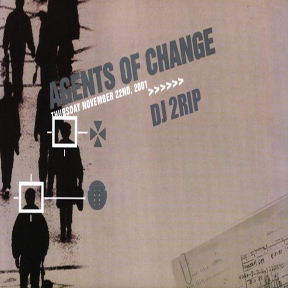
Episode #38: Agents of Change [2001 Minimal + Ambient]
DOWNLOAD: http://2rip.podomatic.com/enclosure...29_07-07_00.mp3
Underground Resistance was a musical collective from Detroit, Michigan. They were the most militantly political example of Detroit Techno with a grungy sound and an anti-mainstream business strategy. The collective formed near the end of the 80's and related their music to the President Reagan era inner-city economic recession. Robert Hood joined the group after the cross-over into the nineties.
As rave music began to flourish in the early nineties and techno had turned into gabber, Robert Hood felt that the soul of techno was becoming lost. He disagreed with the notion of techno transforming to be geared to ravers. When people complained that techno did not have enough feeling, producers began to add vocals with a piano on top of the music so that it would appeal to more people. Robert Hood wanted to bring techno back to the way it was meant to be and make it more underground again. This notion brought about the concept of minimalism in techno and house music.
At the time Robert Hood described minimal techno as "Stripped down. It's just drums, basslines, and only what is essential to make people move." The concept caught on a few years afterward in house music, creating the genre known as microhouse. It also similarly helped to inspire a style called glitch.
The origins of the glitch aesthetic can be traced back to noise music. In a Computer Music Journal article published in 2000, composer and writer Kim Cascone used the term post-digital to describe various experimentations associated with the glitch aesthetic. Glitch is characterized by a preoccupation with the sonic artifacts that can result from malfunctioning digital technology, such as those produced by bugs, crashes, system errors, hardware noise, CD skipping, and digital distortion.
Minimal techno had not become widely popular throughout the many peaks of the rave scene. During the year 2001 there was a final insurgence of new ravers and new clubbers. Every new wave of partygoers often resulted in a more closed-minded approach to music, ignoring lesser known genres or more underground genres.
The Detroit Electronic Music Festival (DEMF) continued to give Detroit and its overlooked history of electronic music major exposure both locally and nationally. Each festival has been held at Hart Plaza in downtown Detroit, and has been sanctioned and financially supported by the City of Detroit. The city's support for the festival has been seen by many as the first high-profile acknowledgment and celebration of the city as the birthplace of techno music.
This mix incorporates a mixture of deep minimal techno paired with ambient & downbeat - all were selections from between the years 2000-2001.
Markus Guentner - Aepfel & Birnen
Sutekh - Dumpster
Betrieb - Gobe Landschaft Mit Kuh
Peter F. Spiess - Symbol Shift
Goldfish Und Der Dulz - Couch Legere
Bjoern Stolpmann - Being So Nice
Audision - Gamma Limit
Dick Richards - Breathe
Savvas Ysatis - On The Hook
Hakan Lidbo - Wiretripping
holy how did I miss this?
[u]Episode #39: Down 2 Earth [2001]

DOWNLOAD: http://2rip.podomatic.com/enclosure...47_31-07_00.mp3
During the mid-nineties the sound of Northern California�s raves helped received it�s mold by DJs like Jeno, Galen, Solar and Spun. The scene in San Francisco was able to expand rapidly because there were no curfew laws and venues like Homebase and 85th & Baldwin were making it possible to host larger events. In the late nineties venues like Soma Art Museum, �Where The Wild Things Are� museum on top of the Sony metreon, and Maritime Hall were popular.
At the end of the nineties, promoters had a variety of venues at their disposal ranging from warehouses to upscale nightclubs or illegal outdoor areas. San Francisco was booming as artists from around the world were eager to play in San Francisco and the city was seeing multiple events on a given night. In the year 2000 much of that began to change when the city began to place curfews on granted permits. The imposed curfew for parties was 2am which slowly halted all night massive rave events, however many promoters changed their plan to host longer daytime events that lasted through the night until curfew.
Two of San Francisco�s largest venues closed their doors not long after the new curfews had been imposed. There was diminishing momentum to host parties that drew tens of thousands of people. In the year 2000 the Homebase venue was beginning to see less usage and many parties opened in smaller, more intimate venues.
In 2001, San Francisco had a large host of weekly dance music events. As with most parties around the country, the scene had an increased momentum towards nightclubs because they had existing liquor licenses and existing sound & lighting. Nightclubs also did not require special permits.
On Sundays alone, partygoers could find nearly 15 events taking place throughtout San Francisco. "Freebeats" was held at An Sibin at 1176 Sutter St and featured an early lineup of dj�s playing music from 6pm-9pm. Stargate was hosted at 715 Harrison Street and charged $20 for a Sunday night lineup which featured 3 rooms of sound.
Spundae was one of the largest nights to pop up around this time. While Spundae began back in 1993 it was able to withstand the times as it was held at 1015 Folsom, a superclub that was used previously for raves in the early nineties. This nightclub was featuring the world�s biggest dj�s on a regular basis and became a known staple for electronic dance music worldwide.
During 2001 a plethora of other venues were utilitzed in San Francisco for rave events. Peacock Gap Country Club hosted �Heaven Eleven� by ANON SALON, Infected Mushroom played at 550 Barneveld St on June 8th 2001, and �Harmony Festival� was held at Sonoma Country Fairgrounds in Santa Rosa. �Metropolis� was a larger event hosted at 3COM Park on June 16th 2001 and featured Donald Glaude, Terry Mullan, Gene Ferris, Eddie Amador, Roy Davis Jr, Joey Mazola, Danny The Wildchild and Aphrodite.
Halfway across the country in the Midwest, the scene in New Orleans had become under attack after the indictment of rave promoters who hosted a party on June 12th, 2001. The DEA & New Orleans Police conducted a joint investigation called �Operation Rave Review.� The 1986 crack-house law that was used to combat crack cocaine was designed to punish operators of the houses for the manufacturing and storage of illegal drugs. Violators under this law faced a maximum of 20 years in prison. That year the DEA attempted to classify Vicks VapoRub, pacifiers and glowsticks as drug paraphernalia. An article on July 20th, 2001 from salon.com quoted a promotional video distributed by the DEA which states that �raves are just a venue for drug purchases. They are no more than analogous to a crack house in which you go to buy the drugs and go out the back door.�
Government attempts such a these led to a continued uphill battle for electronic dance music and raves. The fight lingered on for years to come, suppressing some of the most successful regions of the rave movement around the United States.
This mix was made shortly after I purchased a brand new pair of Technic 1200mk2 turntables. It was a major upgrade from the Gemini Battlemaster decks I was using. I can specifically recall making this set in the basement of my parent's house while they slept. It took me about 10 different attempts to finally be satisfied with the turnout. After it was finished I intended to finish the mixtape as this was only the first side. The tape went unfinished and I never gave it out as a demo.
Jurgen Driessen - Counter Culture
Sleepfreaks - PHB
Pako & Frederik - Hidden Obsession
Cevin Fisher - Love You Some More
POB & Boyd - Luna
Max Graham - Bar None
Salt Tank - Eugina
Goldenscan - Sunrise (Ronski Speed Remix)
Episode #40: New Frontiers [2001]

DOWNLOAD: http://2rip.podomatic.com/enclosure...07_02-07_00.mp3
On April 9, 2001 in Houston, Texas the owner of Club Waxx at 101 Leeland began receiving pressure from the local sports authority. The owner, Mike Jacksis, was advised to shut down Club Waxx to make way for a new basketball arena parking garage. Jacksis had intentions of keeping the club open, however an agreement was reached that relinquished his lease of the hip-hop & underground club. Club Waxx featured techno, trance and jungle since 1997. After the demolition of the club, Jacksis teamed up with Neil Heller who owned Club Hyperia at 2001 Commerce Street. Together they continued to host a variety of music from house, trance and drum & bass to hip-hop.
Outside of the club scene in 2001, raves in Houston continued with fairly minimal disruption. Production companies like the KAOS crew hosted events like Revolution, KAOS Thursdays, and Mystery Machine. Bigtyme Productions hosted a massive on July 7, 2001 called �Audiotitstic.� The event was hosted in Audio Park at 2550 Reed Road in Houston. This party drew thousands of people and featured talent like Green Velvet, Mark Grant, Donald Glaude, Q-Bert, P-Trix, Dieselboy and DJ Brian.
The Houston electronic dance music scene originally began to flourish as early as many other cities with disco and gay nightlife. At the start of the 1990s, there was a huge buzz over house music and the �party �til dawn� lifestyle that it fostered. JD Arnold and Michael DeGrace, both established DJs pushed house music in clubs like Rich�s, Therapy and Club Some.
DJs that were not fully established in nightclubs had begun to host their own parties near the break of 1992. These were Houston�s first raves. The first full scale rave in Houston was called �Unity� which came later that year. Shortly after this first event a DJ named Chris Anderson of the Matrix Crew began hosting events, his first party was called "Brain Machine" and took place in October of 1992. The next year he started a radio show which was titled "Transmissions" on 91.7FM KTRU.
Another DJ named Chris Sill had also created major waves for the Houston scene. He began his career playing nightclubs in Austin, Texas, moved to Houston to work for the legendary Rich�s nightclub, and left for San Diego to open a second Rich�s club in 1991 He was the co-host of a Thursday night event called �Hedonism� which was promoting house music events in San Diego. The weekly event became so well known and the nights were so memorable that in 1994 he moved back to Houston and opened the second installment of �Hedonism" events.
In 1995, Albert Rowan aka DJ Bizz hosted his first rave in a Montrose club called Attica shortly after he was released from a short prison sentence for distribution of LSD. The party was called �Resurrection� and drew approximately 550 people. DJ Bizz�s event became popular and he began to work together with Chris Anderson who was still hosting parties as Matrix Crew. In 1998 the two became partners in Chemistry Records in Houston. Chemistry Records was a place for ravers to find party fliers and where dj's congregated to listen to and purchase new music. The operation became an epicenter of the city�s rave scene.
While raves in the city snowballed in frequency and size since �Resurrection�, there have been some bumps in the road as had been seen elsewhere in the world. On November 24, 1996, DJ Bizz & Chris Anderson became a target of a Houston police initiative as officials attempted to put an end to the growing rave culture in the city. Authorities raided a party called �Reach� by Bizz�s crew Good Vibe Tribe which was hosted at a nightclub called Middle Earth. The raid included local TV coverage and 59 people were taken into custody and most juveniles were cited for violating curfew laws.
The bust made it�s way onto news networks around the city while the nation was simultaneously receiving negative news regarding raves. For a short time the scene had diminished in Houston as parties shrank in size and less in frequency. Promoters during this time learned to become more thorough with their events by acquiring necessary permits and covering their bases legally.
From this point and leading up to the year 2001, a wide range of venues was used for events hosting electronic dance music in Houston. Some events were weekly events while others were one time parties. DJ Dizzy hosted �Suave� at Slider�s, Gotta Move Productions hosted �Soul Phusion� at Waxx, Sundance & Mercury hosted �Dragonfly� at Power Tools at 709 Franklin, Ducttape Productions hosted �Digital Interface� at 1815 Washington, and Protoculture hosted �Rhythmatic Technology� at International Ballroom.
The featured mix was a practice session that was recorded in 2001. This was a period where I was heavily involved in the trance scene. While I no longer have the recordings, some similar mixes that I released at the time played a major role in the acquiring the bookings that were offered to me nationwide.
Joker Jam - Innocence (Chillout Intro)
Shine - Feelings (DJ Tandu Remix)
Lillian - You Give Me Music (Jaimy & Kenny D remix)
Hardy Heller & Ray Boye - Lovin' (Fred Numf & Five Point-O remix)
Matt Darey - Liberation (Deep Mix)
Agnelli & Nelson - Vegas (Fear & Loathing Mix)
Mark Norman - Return 2 Eden
Patrick Reid - Splat
Free State - Release (Dirt Devils Remix)
Members of Mayday - 10 in 01 (Paul Van Dyk Club Mix)
Ralphie B - Massive
Cygnus X - Superstring (Rank 1 Remix)
Insigma - Open Our Eyes (Odyssey One Mix)
Episode #41: E-Tard [Hardhouse 1996-2001]
DOWNLOAD: http://2rip.podomatic.com/enclosure...18_14-07_00.mp3
In 1986 the Music Factory Mastermix DJ Service was organized, creating megamixes through a special license. These megamixes were for DJ use and were only available through very strict channels. Some of the earliest mixes were created by Andy Pickles and Martin Smith. A few years after, Amadeus Mozart and Guy Garrett joined the Mastermix team. Their duo was called The Two Little Boys. Their series known as "Hit The Decks" was later to become a massive influence on two young producers called Ben Keen and Nick Sentience.
By 1993 Amadeus Mozart had developed a strong friendship with Andy Pickles. This would be the start of what would later be known as The Tidy Boys. Their first release together was titled "Only Me" under the name Hyperlogic in 1994 which was the turning point in their career. The song used chord structure from U2's "New Years Day" and the vocals from Alison Williams "Sleep Talk." The song became a massive club anthem and was supported by every major club DJ in the UK, even Pete Tong. Red Jerry's label, Hooj Choons, created the buzz on this song by putting it out as a limited release.
In the meantime, a dj named Tony De Vit was on the rise. In 1993 he received a residency at a gay house music club called Trade. At this time he was also approached by the Fantazia crew to mix one of the discs on the second album of the Fantazia House Collection series. The mix went on to be a huge UK hit and sold over 100,000 copies.
By 1995 both Tony De Vit and The Tidy Boys were pushing a sound different from most other dj's. This sound combined vocal samples from hardcore tracks over up-tempo house beats with some trance aspects. The first release on Tidy Trax was released under the moniker The Handbaggers and was titled "U Found Out." To make the release look like it came from a dj's bedroom, Amadeus put his phone number on the disc as a contact detail. This was a move he later regretted due to late night phone calls and sexual harassment.
In 1996 a label titled Nukleuz was formed as an offshoot from an Italian record labeled known as UK Media Records. The label first produced funky, house driven tracks but shortly jumped into the hardhouse sound. During this same year a night called Sundissential started happening in Birmingham at a club called The Pulse with Tony De Vit regularly behind the decks. By the end of 1996, Tony De Vit had recorded the first Global Underground mix, GU001: Tel Aviv.
Some would consider 1997-1998 to be the breakthrough year of hardhouse. Artists like Baby Doc took to the scene and began to add new styles to the mix of hardhouse releases. The overall flavor of the genre was becoming harder and faster and in some senses, tougher. This could be seen in releases like Nuclear Shower which was released under UK Gold. Tony De Vit had, in 1998, joined the Tidy team after having a fallout with his previous sound engineer, Simon Parkes. He came to Tidy with six of Trade's main resident dj's to release songs on a 3 disc vinyl called the Trade EP. Tony De Vit worked with Paul Janes for his track titled "The Dawn." As they finalized the track Tony, Paul Janes, Amadeus and Andy Pickles listened to it. As it finished Tony De Vit took a deep breath and said "I can't go on from here without telling you something that may affect all of our future plans, especially mine... I have been diagnosed as HIV positive. But this new track has inspired me - it means a lot to me." The reason he titled his track "The Dawn" was because he wanted it to be the dawn of a new era in his life. He was diagnosed just six months prior to the release of this track. Sadly, Tony De Vit passed away on July 2nd of that year.
In 1999, The Tidy Girls was founded by Rachel Auburn, Lisa Pin Up, and Anne Savage. Other dj's like Paul Glazby and Mark Grey were rising in the scene. Superclubs in Europe were becoming the next big thing and the concept was spreading in the United States.
In the United States rave scene through the nineties, most rave production companies promoted mainly house, breaks and drum & bass talents. You would often find one or two trance, hardhouse or hardcore dj's on a lineup of 8-15 dj's. Around the crest of 1999 there was an uprising within the United States scene where harder or faster was better. The new generation of dj's started grabbing for hardhouse, hard trance, and hardcore records in their local record shops. This would soon pave the way for the rest of the rave scene.
This mix was recorded live sometime in 2001. I have no recollection of what party I recorded this at. This was dubbed from a cassette tape so the quality is not as crisp as I had hoped, but it's not bad. Some fun tunes on there which I have identified as the following:
Klubbheadz - Discohopping (Dub Foundation Mix)
Reverend Mike Crawley - Pow!
Klubbheadz - Work This Pussy
Soulman - Put Your House
The Ultimate Seduction '96 - Organ Seduction
The Difference - Funny Walker (Da Techno Bohemian Remix)
Club It - Real Stuff
Lords Of House - The Beat Is Back
Pulzemaster - U Got To Be There (Damon O'Conner Remix)
Episode # 40 . An absolute belter .Must get through these, great work mate. Respect.
Episode #42: Psilocybin [2002 Psy-trance]

DOWNLOAD: http://2rip.podomatic.com/enclosure...51_41-08_00.mp3
Gil The DJ aka Goal Gil grew up in California through the sixties and was attracted to the San Francisco concert scene �s sound & light shows. By 1969 he grew fed up with the number of junkies who had crowded into San Francisco so he moved to India, where he encountered the sadhus � Hinduism�s wandering holy men. Gil followed them around to live in caves and he even wore the same robes. He continued to make his way to Goa every winter where he banged on acoustic guitars at drum circles. Eventually a man named Alan Zion smuggled a Fender PA to Goa and live guitar and pre-recorded band music became the soundtrack.
The crucial transition from guitars to electronic dance music came in 1983 when two French DJs named Fred & Laurent got sick of rock & reggae music. This was around the same time that �techno� had been proclaimed as well as �house music.� These two French dj�s used two cassette decks to cut and paste nightlong journeys of industrial music, electronic rock, Euro-disco and house. The mixes were designed to amplify the experience for psychedelic partygoers. Soon these dj�s were able to acquire underground music from the west. Sven Vath, a German trance producer/dj, showed up in Goa as one of the first booked nationally known dj�s.
Unfortunately the partygoers were not transitioning entirely well to full-on techno. They were very attached to Bob Marley and Santana and The Rolling Stones. The dj�s who were playing primarily techno were often assaulted by people demanding rock music. Goa DJ�s were soon able to plug the functional needs of heavy psychedelic trance dancers into the musical picture. Within a few years a distinct sound emerged. DJ Laurent admitted in an interview that people took a very strong disliking to electronic dance music in Goa, but once a formula was conceived for producing music that catered to people on psychedelic drugs there was a better response.
Towards the end of the 1980s the tracks played at Goa parties were produced primarily in the West with the colony of Goa in mind. Some trance records were made in Goa but not many. As time went on the evolution of the Goa trance state of mind continued as the word spread about the parties in this tiny state. Artistic developments began to emerge as visual artists displayed tapestries and paintings at events. Such art was visually stimulating to those who delved into the entire experience of �psy-trance.� The hypnotic, pulsing melodies & rhythms of psytrance mixed with lights, visual artwork displays and the hallucinations caused by psychedelic drugs created a blend created out of this world experiences for those who succumbed to the experience.
In 1993, Juno Reactor released their first single titled �Laughing Gas.� Shortly following this came a full on release titled �Transmissions� which is considered to be one of the first official goa trance releases. They also remixed a tune which became the theme for the Mortal Kombat movie in 1995.
By the end of the nineties, the psytrance culture had developed a large following worldwide. The music was not considered maintstream and often events were hosted which catered specifically to psytrance. By the year 2000 an Israeli group called Infected Mushroom became one of the most widely known acts of this nature. Their breakthrough album came just a year earlier titled �The Gathering.� Other artists such as Astral Projection, Hallucinogen, Man With No Name and Shpongle had become popular. Around that same time frame a record label named Tip World was pressing releases by artists like Logic Bomb, Yahel, Bio-Tonic, and Absolum.
While psytrance had gained much popularity, the genre was not a major feature at raves in Europe or America. It was also very rare to find a club that catered to psytrance. The genre was very limited to festivals, however this was not the case for countries like Brazil, Israel, and India. Psytrance in those countries became part of the majority of genres featured at events, if not the most widely represented by dj�s and show promoters of their regions.
The visual artwork at these events which included paintings and tapestries were often created using fluoro (fluorescent paint). The fluorenscent paint was used to reflect off of blacklights. The artwork often associated topics like aliens, Hinduism, or other religious images. The religious images were often eastern traditions. Mushrooms, Shamanism, and technology were also other topics used in the artwork.
Investigating deep into the spiritual realm of psychedelic drugs such as mushrooms indicates that human beings have been combining music and hallucinogenics since the Paleolithic Period. The oldest representation of mushrooms were produced as rock paintings in the Sahara Desert which date back to about 5000 BC. Images of enormous mythological beings of human or animal form were often depicted side by side with a host of small horned and feathered beings in dancing poses. One of the most important rock painting scenes was found in the Tin-Tazarift rock art site at Tassili, depicting a series of masked figures in line and dressed as dancers currounded by geometrical designs. Each dancer in the painting is holding mushroom-like objects with parallel lines extending from the mushroom into the head of the dancer.
In modern tribal areas the concept of shamanism is still prevalent. Shamanism is an ancient form of healing but shamans also excercise using hallucinogens to invoke shamanic spiritual journeys. The connection that we have in modern times at festivals and parties where hallucinogens are prevalent is that we are carrying on a tradition that dates back to prehistoric times. The psytrance methodology encompasses both musical and spiritual aspects of the rave scene, taking it to a level that is not necessarily the norm for other genres.
This mix was recorded sometime in 2002. In early 2001 a dj named Swayd from my hometown introduced me to psytrance at a rave I hosted called "Let's Roll." Since then I followed many psytrance parties and collected records. My aspiration was to become a psytrance dj around that time but my collection remained fairly limited. I made several mixes just for fun but never followed through. This is one of the better compilations that I put together.
Walhalla - Beathe In
Talamasca - Telepathic Atmospheres
Logic Bomb - Frequent Flyers
Opus Magnum - Three Elements (Mental Remix)
Delirious - Mushroom God
Alien Project - Artificial Beings
Atomic Pulse - Psychoactive
Absolum - Recovery
Twister - Venom
POTS & Chris Organic - Tuna Salad
Pixel - Black In, Black Out
Episode #43: Battlebots
DOWNLOAD: http://2rip.podomatic.com/enclosure...32_05-08_00.mp3
Having learned about the beginnings of the rave scene around the United States the story always seems the same. House music was getting some play throughout the eighties but not quite catching on to the level where it could be played exclusively. Around the turn of the decade at the beginning of the nineties raves began to flourish around the United States and clubs that were playing a mixture of music began to hire dj�s that played strictly house music and techno. This story can be revisited in almost every major area city in the country; however it is important to recognize that each of these cities still tells their own story. It�s also a very difficult notion to capture & combine into a short, concise and effective write-up.
The earliest underground parties in Nevada were hosted in the Black Rock Desert about 100 miles from Reno. The first of these parties was hosted in 1990. The surviving members of the Suicide Club of San Francisco started a newsletter which publicized these first underground Black Rock Desert events as �Zone Trip #4.� The organizers of Zone Trip#4 were Kevin Evans & John Law. Other events were also hosted in the Black Rock Desert at this time featuring house music dj�s. In 1991 a team made up of John Evans, John Law, Michael Mikel, Larry Harvey and Jerry James got a legal permit from the Bureau of Land Management to host an annual gathering in the desert, planting the seeds of Black Rock City LLC � the group that created the Burning Man Festival.
Another early party in Nevada was hosted in Reno and was titled �Stretcheads� which was hosted in 1990, around the same time as the Black Rock Renegades. Stretcheads was a chance for dj�s to come together and play music while party people dressed up, danced and had fun. The notion of a �rave� had not yet been publicized much throughout the United States at the time. The venue was hosted at the Grange Hall located at the base of Mt. Rose Highway between Reno & Carson City. One of the first major parties that was thrown inside Reno was in 1991. This rave was titled �Rise Again� and was held at the Livestock Events Center on N. Wells Ave. A small collective of house music dj�s at this time in Reno consisted of Christophe, Olivier Desmet, and Richy Rich to name a few.
Things began to pick up for Reno by 1992 as the nearby San Francisco scene continued to flourish. In Reno, DJ Christophe started Brilliant Productions and hosted monthly events outside of Spark, NV in the warehouses near Stanford Way. Monday night parties popped up around this same time frame which were held at the Visions gay bar which was located on Kietzke Lane.
DJ Sulli hosted his first party on Sunday April 25, 1992 which was titled �Micro-cosm.� The party was hosted near Tahoe City and featured Christophe. Sulli was also on this lineup and spinning his first set in front of people. Other parties during this era ranged from being hosted in farmland on the outskirts of Reno which is now known as the Double Diamond to the Town Center Mall.
Between 1993 & 1995 a venue called �The Fallout Shelter� which often hosted punk shows became a popular spot in Reno. This venue was located in the basement of a gay bar called Alley Cats. The dj�s primarily spun house music at this time and The Fallout Shelter was pulling at least 400 party people on a weekly basis. When compared to other areas during this time period, 400 people was a nice size but still considered small. Cofa Margarita on Virginia Ave was a popular venue as well as Icehouse at 310 Spokane St.
Some would argue that the first peak in the Reno scene came around 1996 & 1997. A party called Ultra which was hosted in February of 1997 at a skate warehouse was busted for violating firecode & capacity laws. The party was off to an amazing start but was shut down by 1:30am by the police and fire marshall. From 1997 to 2000 house dj�s began moving into nightclubs while underground rave dj�s were playing breaks, trance, drum & bass, and happy hardcore. The dj scene had begun to unfold from a few smaller collectives to large numbers of dj�s that were hard to keep track of.
In 2000 the Eskador crew of dj�s came together. They eventually changed their name to Annpro which consisted of DJ Poindexter and David Aaron to name a couple. They hosted one of the biggest parties that Reno had ever seen. The event was called Mission To Mars and drew 1600 people to the main showroom of the Ramada. That same year the Burning Man festival saw it�s first wave of law enforcement activity where more than 50 people were arrest for minor drug charges and the Bureau of Land Management issued citations. That number rose in 2001 when over 100 BLM citations were given out as well as several arrests.
By 2002, Burning Man received it�s first FAA approved airport and the festival was progressively gaining more news coverage. This is a testament to how much the festival had grown from it�s roots at the start of the nineties. In the Reno rave scene, newer dj�s and party promoters began to establish themselves. Music styles began to change and a large majority of event information was being communicated through a discussion forum called www.renoraves.com. [there is much mor einfo to cover, which will be posted soon...stay tuned!]
This mix was recorded live in December 2001. It was initially distributed as "Love Of Life Mix 1." The entire set is 2 hours long.
Benedictus - Nightmare
JS-16 - Stompin' To My Beat
Jaydee - Plastic Dreams 2000
Sil - Windows 98
Commander Tom - Eye Bee Em
SM Trax - Ignition!
DJ Quicksilver - Timerider
Baby Doc? - Higher
Tony De Vit - I Don't Care
Where the hell was this thread? These look fantastic.

Powered by: vBulletin
Copyright © 2000-2021, Jelsoft Enterprises Ltd.