
TranceAddict Forums (www.tranceaddict.com/forums)
- Chill Out Room
-- A universe from nothing... (for space/science nerds)
Pages (6): « 1 2 3 4 [5] 6 »
| quote: |
| Originally posted by Lira Hey, I want to play this game too! |
| quote: |
Unless properly understood, science is fairy tales, and there's nothing wrong with it: Fairy tales serve the purpose of explaining the world, and science does a marvellous job at that. |
| quote: |
Science is able to explain loads of things no other human enterprise ever even intended to know, no one here is disputing that. But, science is not the report of scientists - it's their practice. If you take what they say at face value, you're much better off than following a priest most of the time, but that does not make you smarter than a religious believer. You're believing what you're told, pure and simple. |
| quote: |
Do you really think I just pick up a book on linguistics and take everything as facts because other people made some experiments? Well, screw them, I want to have some of the fun myself! |
| quote: |
Yeah, dismiss him. Darwinism is sacred, how can he lump it together with these puny beliefs barbarians hold? |

| quote: |
Oh, yeah, because the world is divided between science and religion! If I don't blindly trust one, I must blindly the other, right? How naïve are Egos and I to believe people should actually bother to know more about the things they believe, do their own research and not take anything for granted, instead of relying on others for everything! I guess that makes us religious fanatics. And I thought I was an atheist scientist  |
not exactly what i was thinking. i profoundly agree with Nrg2Nfinit, however i can see your points and both agree/disagree with some of your points...
im not religious and i don't think bashing religion is correct, but i do believe Darwin has an upper hand when placed side by side with religion, no one is calling religion a puny barbarian belief  however, at least Darwin and science is based on theories that are based on FACTS.. so i can see you use of the word 'fairytale' but i don't agree it's a good way of describing what science is at all.. i could see 'fairytale' being used for religion however, the only 'proof' a religious person has is their book & blind faith.. how could an old book have leverage with science?
im a very skeptical person and i think blind faith just doesn't cut it. we can define all the words we want and tie them to beliefs and try to make a point here, but what it comes down to is pure fact and knowledge (imo) that sways my perspective. i'm open to listening to religious point of views yet they must at least be well-constructed points, not garbage:
| quote: |
| Originally posted by yukii however, at least Darwin and science is based on theories that are based on FACTS.. so i can see you use of the word 'fairytale' but i don't agree it's a good way of describing what science is at all.. i could see 'fairytale' being used for religion however, the only 'proof' a religious person has is their book & blind faith.. how could an old book have leverage with science? |
| quote: |
| Originally posted by Lira Unless properly understood, science is fairy tales |
| quote: |
| Originally posted by Domesticated |
| quote: |
| Originally posted by yukii unless all of science were theory, then yes, you can call it fairytale. religion = no proof = fairytale |
| quote: |
| Originally posted by Lira Unless properly understood |
dude, you won't be able to, what is not properly understood in science ffs? maybe im fucking tired & missing something. 
| quote: |
| Originally posted by yukii dude, you won't be able to, what is not properly understood in science ffs? maybe im fucking tired & missing something. |
ah, i see that i am tired.
okay, i suppose i now see his point, but aren't we assuming that people who are religious know at least the basic concepts of their religion? just as i think anyone knows the basics of science? my point is, sure we can have blind faith on religion, and science.. i don't see how far the point goes other than that person him/herself for making that religion/science a 'fairytale'.. what i would find more relevant is which has hard evidence?
| quote: |
| Originally posted by yukii ah, i see that i am tired. okay, i suppose i now see his point, but aren't we assuming that people who are religious know at least the basic concepts of their religion? just as i think anyone knows the basics of science? my point is, sure we can have blind faith on religion, and science.. i don't see how far the point goes other than that person him/herself for making that religion/science a 'fairytale'.. what i would find more relevant is which has hard evidence? |
None of you are scientists, therefore you all suck 
| quote: |
| Originally posted by Fledz None of you are scientists, therefore you all suck |

| quote: |
| Originally posted by Domesticated Ugh. Lira was saying that if you don't understand science yet believe in it, then you are basing your assertions on blind faith, just as with religion. Thus science would be a 'fairy tale' if you didn't understand the fundamentals behind it. |
| quote: |
| Originally posted by yukii okay, i suppose i now see his point, but aren't we assuming that people who are religious know at least the basic concepts of their religion? |
| quote: |
| Originally posted by yukii just as i think anyone knows the basics of science? my point is, sure we can have blind faith on religion, and science.. i don't see how far the point goes other than that person him/herself for making that religion/science a 'fairytale'.. what i would find more relevant is which has hard evidence? |
| quote: |
| Originally posted by Nrg2Nfinit Let me stop you right there and look no further. One does not need to know the introcate details of a system, science in this case, in order to trust or give it weight. As long as the definitions of the system are understood, Principles that lie within that system may be taken as affirmatives. |
| quote: |
| Originally posted by Nrg2Nfinit When we are dealing with such broad context i think it is necessary to play semantics. It is safe to say thus that religion, myth, fable etc may fall into the category of mental masturbation which hold little to know bearing of testable results and cannot be challenged as they are proclaimed to be the word of dietie and immaculate. Science falls under the category of testable observations. Repetitiveness giving accuracy to findings and in a way shaping the ingenuity of the society we have structured up til today. It may have been religion which motivated the ancient egyptians to build the pyramids, but it was science that actually constructed them. |
| quote: |
| Originally posted by Nrg2Nfinit If you wish to believe in ancient tales developed by unsophisticated methods of analysis which hold no room for modification or change and instead shoddy interpretation to have them make sense of todays world by all means. A closed system will always be closed and thus there is no room for change. Here i am talking about relgion and mythology. |
| quote: |
| Originally posted by Nrg2Nfinit For science, there is always room for change and modification, there is no real constant until something more accurate is discovered that leaves old findings simply as stepping stones for advancement in theory. One does not need to understand everything to have trust in the findings (sure it would be fun but thats not the argument here) . You can hold trust in these findings simply because the scientific community (remember how i defined the system before) agrees with it. |
| quote: |
| Originally posted by Nrg2Nfinit Sure but i know what i am being told has been verified by a comittee of scientists who have a more introcate knowledge of the specific subject and thus peer reviewed. Slightly different then fairy tales if you ask me. |
| quote: |
| Originally posted by Nrg2Nfinit linguistics is a different category all together. With science your more limited to pick and choose between your theories with regards to a specific subject. For instance, there is no alternative towards evolution. sure cladistics are not constant but the general idea is a widely accepted theory (the only prominent one). |
| quote: |
| Originally posted by Nrg2Nfinit Good show lira |
| quote: |
| Originally posted by Fledz None of you are scientists, therefore you all suck |

| quote: |
| Originally posted by Lira I'd like to remind you that linguistics is a social science, and social sciences are 67% a science. Therefore, roughly speaking, I'm two thirds a scientist, one third an anarchist, and one third a smart-arse |
I think the extra third was because he is a smart-arse.
| quote: |
| Originally posted by Capitalizt and 100% shitty mathematician. |
| quote: |
| Originally posted by MrJiveBoJingles I think the extra third was because he is a smart-arse. |

| quote: |
| Originally posted by EgosXII as stated a million times above, we're talking about the PEOPLE pushing the beliefs, NOT the actual beliefs. i havn't been talking about science, but about the people who DON'T understand science, but claim to! the point of what i was saying, and the point of the safran clip is that many people are annoying because they boast evolutionary theory, or denounce religion, but have no basis for their beliefs... in this way lay-scientists and religious followers could be compared because they both rely on belief structures to find them truth, NOT empirical evidence. |

"ve believes zen nothing!, Lebowski. Nothing!"
"He's a nihilist."
"Ah. That must be exhausting."
I'm sure you're playing devil's advocate to an extent here Lira, but I can't in good faith let all this slip by unopposed.
| quote: |
| Originally posted by Lira Some do. Craig (Moral Hazard) knows his theology very well, for example, and it'd be an unfair mistake to say he's clueless when compared to a passive atheist that dismisses religions "because they're all wrong whereas science is sound and swell". |
| quote: |
| I hate to break it to you but religion is based on facts too. How do you think a religion that preached that humans breathe underwater and fly would fare? |
| quote: |
| Religion (and science, for that matter) is an answer to a problem. And it must be related to the facts in a way or another. Christians think miracles happen because of what they perceive as facts: an unlikely cure, a fluke you prayed for, and so on. The difference between science and religion is not that science alone is based on facts. Science is just more reliable. |
| quote: |
| By the way, since we're bashing "mental masturbation" (of which philosophy seems to be a member) |
| quote: |
| Religions aren't closed... and they change |
| quote: |
| That's a very very very bad idea. Scientists are not infallible, and the scientific community is not always the apex of rationality: Phrenology had got almost everything wrong (their idea that some parts of the brain had specific functions proved to be useful though), and Lysenkoism had disastrous effects. |
| quote: |
| Originally posted by Renegade I'm sure you're playing devil's advocate to an extent here Lira, but I can't in good faith let all this slip by unopposed. |
| quote: |
| Originally posted by Renegade Of course. I'd be worried if the average theist were not more familiar with theology than the average atheist, but that's beside the point. I'm sure that the average numerologist knows more about numerology than the average non-numerologist, but that surely tells us nothing about the efficacy of numerology as applied to the world we all share? The failure of theology is not that it is incapable of sophistication, but that it lacks any real application to the world-in-itself - what can theology teach us that any other system of thought cannot teach us in a far more parsimonious (or - better yet - more accurate) way? |
| quote: |
| Originally posted by Renegade Fwiw, I'm actually quite capable of appreciating theology on its own terms. For reasons I don't really understand, I actually enjoy reading scholarship concerning - say - what the Biblical authors thought concerning the nature of Jesus. |
| quote: |
| Originally posted by Renegade Did they consider him the Son of God? If so, what was their understanding of when this "sonship" was "appointed"? What it with his resurrection (Rom 1:3-4), his baptism (Mk. 1:11), his conception (Mt. 1:18, Lk. 1:26-35) or was he the logos that pre-exists existence itself (John 1:1-2)? These are interesting debates on their own terms, but they still have ultimately no bearing on anything meaningful: deciding in which sense we can call Jesus the "Son of God" surely won't change our understanding of the universe or the means by which we should live our lives. Theology has the potential to be sophisticated and interesting, but let's call a spade a spade: it's still bullshit from top to bottom. |
| quote: |
| Originally posted by Renegade Well, religion is ultimately based on "minimally counterintuitive" facts - i.e. facts that are slightly incredible, but not so incredible as to defy all belief (see this link - I've posted it before but it deserves to be reposted). You won't find religions predicated on the fact that humans can breathe underwater, but you will find religions which assert that certain, special human beings can walk on water, or survive in the belly of a large fish underwater for three days. You won't find religions predicated on the fact that human beings can fly, but you will find religions predicated on the fact that the human soul can fly to certain places under certain circumstances, say in a dream or after death. In any case, the fact that certain beliefs are universally present within all theologies - and others universally absent - is surely evidence of their cognitive origins. I can think of no other way that supposedly ineffable truths would have made themselves known to such a distinct array of religious traditions. |
| quote: |
| Originally posted by Renegade I think you're giving theology more credit than it deserves here. The universal inefficacy of prayer is not hard to demonstrate, nor is the universal non-violation of natural laws - can differences in perception really account for that fact? |
| quote: |
| Originally posted by Renegade Haha, steady... Philosophy often lends itself to "insights" that scarcely improve our understanding of the world or our capacity to engage with it, but at least there's a certain intellectual rigour behind it. The analogy that Dan Dennett used - and that I'm going to badly paraphrase because I can't be bothered looking it up - is that if philosophy is a game of tennis, then theology is a game of tennis with the net removed and all the court lines scrubbed off: they're both playing by a set of somewhat arbitrary and self-contained rules, but at least there are ways of "losing" at philosophy. Can you think of a theological idea that was ever rejected for anything other than decretal or otherwise arbitrary reasons? |
| quote: |
| Originally posted by Renegade Religious practice changes quite fluidly, but theology really doesn't - at least not once a central dogma's been laid down. One can trace the trajectory of Christian thought almost by the decade for the first century or so, but it comes to a standstill pretty soon after that. I mean, can you find me a Christian who disagrees strongly with anything St. Augustine had to say in the 4th century? Can you find me a scientific discipline that looks to 4th century ideas as an equivalent source of inspiration? |
| quote: |
| With the scriptures it is a matter of treating about the faith. For that reason, as I have noted repeatedly, if anyone, not understanding the mode of divine eloquence, should find something about these matters [about the physical universe] in our books, or hear of the same from those books, of such a kind that it seems to be at variance with the perceptions of his own rational faculties, let him believe that these other things are in no way necessary to the admonitions or accounts or predictions of the scriptures. In short, it must be said that our authors knew the truth about the nature of the skies, but it was not the intention of the Spirit of God, who spoke through them, to teach men anything that would not be of use to them for their salvation. � De Genesi ad literam, 2:9, nicked from Wikipedia due to lack of time |
| quote: |
| Originally posted by Renegade Well I agree with you about placing unwarranted faith in any epistemic method (scientific or otherwise), but Lysenkoism isn't an example of what happens when you place to much faith in the scientific method, it's an example of what happens when you completely ignore the scientific method and go off searching for whatever method happens to validate your world view. Millions of people died basically because the Marxists couldn't accept the fact that Lamarckism is bullshit - science can't justly wear the blame for that one. |
| Utility | Traditional truthfulness |
| Very Useful Fairly useful Useful Not much useful Utterly useless | True False |
| quote: |
| Originally posted by Domesticated He answered that. "If you were to go "up" or "down" you wouldn't travel to any of our planets. You would come out of the planetary disk and sort of look at them from above or below. There are however galaxies "above" us and "below" us and all around us. The "flat coins" are distributed all around us" |
Look at the bottom image on this picture: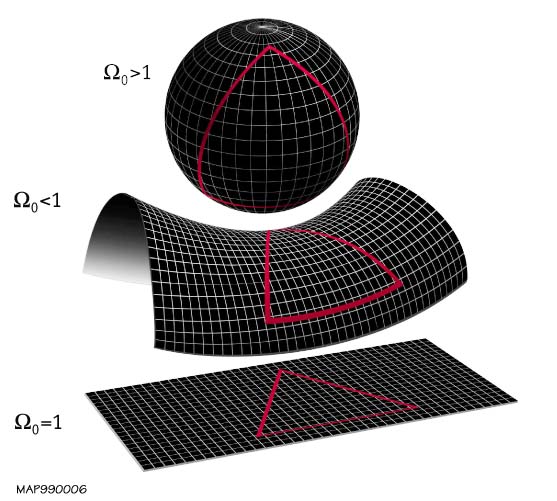
| quote: |
| Originally posted by Gauss If space were shaped like that, you could move in only 2 dimensions, length and width, but not height. What would happen if you turned up or down and moved forward in that case? |
It's copy n paste time..| quote: |
| When one says that "space is flat", one doesn't mean that the universe is flat like a "skin of a balloon" as you say, rather "flat spacetime" refers to what is know as Minkowski space. In relativity, the three spacial dimensions are combined with a time-like to create the four dimensional spacetime, which in special relativity is described by Minkowski space. However, one can only use Minkowski space to describe the universe where it is locally flat, that is where there is not significant gravitation. Where there is significant gravitation, we say that spacetime has become curved. Four dimensional space is very difficult to visualize since we are intuitively only aware of the three dimensions, however one can 'draw' a 3D projection of spacetime. See here: 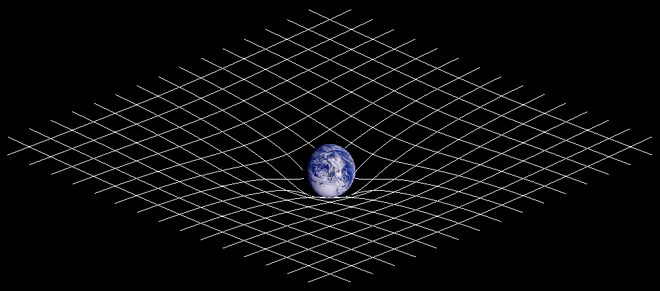 You can see space can be curved by mass and energy in local areas..but the amount of matter in the universe is practically invisible compared to the amount of empty space. Planets, suns, and galaxies barely register in the grand scheme of things..so on the whole, spacetime is not curved. Calling it "flat" is not 100% accurate, but it is a very good approximation because curvature only occurs around a few rare clusters of matter floating through massive amounts of empty (flat) space. |
| quote: |
| Now for the abstract bit. As I understand, the universe's 'shape' isn't like a real shape, but corresponds to the average distribution of energy in spacetime throughout the universe. So a 'flat' universe doesn't correspond to flatness like a flat surface, but instead means that on the average the energy distribution throughout a "flat" universe is almost the same everywhere when you look at the whole universe. To help you understand this, think of how light REALLY curves as it passes a black hole, which is REALLY dense. In fact, it is said light gets 'trapped' within black holes, which is a consequence of this curvature, which is itself a consequence of high energy density. On the average, the whole universe is not curved because the density everywhere is about the same. So the bottom line: flat spacetime on a universe size scale really refers to a pretty uniform (meaning everywhere about the same) energy density (meaning anything causing spacetime to curve). Curvature only occurs in insignificant local areas of the universe where matter is gathered and doesn't register at all on large scales. |
| quote: |
| Originally posted by Gauss I think you misunderstood me. Look at the bottom image on this picture: If space were shaped like that, you could move in only 2 dimensions, length and width, but not height. What would happen if you turned up or down and moved forward in that case? |

Space is 3D. Why planets are arrayed the way they are around a star has already been explained a couple of times in this thread. It's to do with gravity and the way the solar systems formed.
| quote: |
| Originally posted by Lira Oi, I'd like to remind you that linguistics is a social science, and social sciences are 67% a science. Therefore, roughly speaking, I'm two thirds a scientist, one third an anarchist, and one third a smart-arse |


Powered by: vBulletin
Copyright © 2000-2021, Jelsoft Enterprises Ltd.