
TranceAddict Forums (www.tranceaddict.com/forums)
- Political Discussion / Debate
-- So, evolution or creationism - the poll
Pages (7): « 1 2 3 4 5 [6] 7 »
| quote: |
| Originally posted by Ondrayce My original response was to the idea of cycling universes that have no beginning or end. I interpreted this cycling as either: [ Universe A dies, then creates Universe B; B dies then creates C. C dies then creates Universe A again. Time travel would be required for C to create A again. To go back to a point where A never existed in the first place. Then a paradox comes into play. How can C create an A, that doesn't exist yet, when C can't exist itself without A. You know the "Kill your Great Grandmother" time travel paradox. But without time travel, Universe C would only be able to create Universe D. Then infinately expand that way, which I do think is possible. This would make a long, linear, string of cycles, or dimensions, that exist in something even larger than our universe. And there's probably something even larger than that. My point is that no matter how large we are thinking, we cannot escape the grasp of time. ] or: [ Universe A dies then creates Universe A again. And so on... The same pardox as above would occur between the death of A and the creation of A. So a linear string of different Universe A's would infinately expand just like above. ] |
| quote: |
| I've just been trying to say that these strings should have a beginning. Created by something outside of where these infinate dimensions are held. Then that will lead to more questions. Where did the "something" that created the string come from? And so on. The further outside you think from, the more Linear things are going to look. |
| quote: |
| That is what I meant too. Didn't think there was a difference between considering "zero" as the origin of the sound wave and considering the origin of the sound wave as "zero." |
| quote: |
| I'm TRYING to be simple. I'm not using exponential, logorithmic equations as source for a reason. They are not applicable because, when talking about the size, age, or origin of the universe, there is no scientific data to apply them to. Everything is speculation. |
| quote: |
| Kind of like God then, I guess. And you say I'm the one thinking religiously. |
| quote: |
| I believe that we came from somewhere, maybe the Giant Cookie Monster, and we continue to move forward. I believe its impossible to move backwards and end up where we started. Quantum Mechanics doesn't seem to refute that in any way. |
| quote: |
| Again, as shown above, to have the future affect the past would create a paradox in which none of us would exist. Since I believe that we do exist, I think looping time is extremely illogical. You don't have to travel to the end of the universe to figure that out. Not when talking about time. And whether people thought the world was flat in the past has no barring. |
| quote: |
| Then there was a designer of the designer, and a designer of that designer, and so on... |
| quote: |
| But under the cycling universe theory, the pitcher would throw the ball to the catcher, the ball would instantly be in the pitcher's hand again. He will not have memory of throwing it in the first place and throw it again, and again, forever. That seems much more likely. Right. |
| quote: |
| Take a comet. Probably a piece something that was projected off of something else. Who knows how? Explosion, ricochette, Giant being from from Giant planet hurls Giant rock into space towards our sun. Whatever. The comet moves toward our sun. Doesn't hit it, but passes it, gets caught by the sun's gravity, and gets hurled in a different direction. During this the comet's speed is decreased by the gravity of the sun. So it moves away slower than it came. Say that comet's speed was affected so much that it didn't have enough speed to escape the sun's gravity then gets locked into a decaying orbit around the sun. Such is our planets. They are not in a perfectly stationary, circular orbit around the sun. We are, very slowly, actually falling into the sun. This is a recent NAS finding, I'll try to find the article. Cool stuff. But our planet is not in the same place it was a million years ago. And it isn't moving on its own. It could very well have been thrown here. |
| quote: |
| I'm not going to even touch on how gravity is formed. You say if we didn't create it, then there's no reason to assume that anyone created it. But you might as well say that if we didn't create it, then there's no reason to assume it even exists at all. Everything outside of ourselves is just our imagination. We're all trapped in The Matrix. Possible...but The Matrix sucked. |
| quote: |
| Thats what preists say to their followers too. Funny. |
I think he considers these to be "deep philosophical questions", like:
- Are cucumbers really so different from auto exhaust?
- Can you imagine life without a left shoulder?
- Why don't badgers wear long pants?
It really doesn't take a genius to ask a question that makes no sense, nor does it take a lot of wit to say that these questions are "deep" because nobody knows the answer.
Imagination has no place in scientific discourse. Creativity is a great asset, but "imagine" is a word that you want to use sparingly.
| quote: |
| Originally posted by DigiNut I think he considers these to be "deep philosophical questions", like: - Are cucumbers really so different from auto exhaust? - Can you imagine life without a left shoulder? - Why don't badgers wear long pants? It really doesn't take a genius to ask a question that makes no sense, nor does it take a lot of wit to say that these questions are "deep" because nobody knows the answer. Imagination has no place in scientific discourse. Creativity is a great asset, but "imagine" is a word that you want to use sparingly. |
Oh yeah, I would also like a perspective on a couple of theories on what may have occurred or what "caused" the Big Bang.
Ekpyrotic Universe:
http://feynman.princeton.edu/~steinh/npr/
The Many Worlds Theory:
http://www.station1.net/DouglasJones/many.htm
http://www.hep.upenn.edu/~max/everett.html
Now my brain is officially leaking out my ears.
Cripes, man!
14 Followers and counting!!!!!!!!!!!
Woohoo!
I miss the theists. Where did they go? When does the next bumper crop get in? Anyway, I posted this in the chill out room hoping to offend someone but no luck  ... might as well post it here for the amusement of atheists.
Fark did a photoshop contest on jesus a while ago and the theme was: "To celebrate the opening of Mel Gibson's The Passion of the Christ, add a little Jesus to your favorite movie"
Here are some of my favorites (die you 56kers):



http://www3.telus.net/newmane/jesus.jpg very big so click on the link


http://idisk.mac.com/johnkamowski/P...earandjesus.jpg Really big but a must see. Click.


ohhhhh those are great. The fear and loathing one was hi-larious same goes for American History X and Momento. Good post.
+1
| quote: |
| Originally posted by occrider Here are some of my favorites (die you 56kers): |

| quote: |
| Originally posted by DigiNut I think he considers these to be "deep philosophical questions", like: - Are cucumbers really so different from auto exhaust? - Can you imagine life without a left shoulder? - Why don't badgers wear long pants? |
| quote: |
| Originally posted by DigiNut It really doesn't take a genius to ask a question that makes no sense, nor does it take a lot of wit to say that these questions are "deep" because nobody knows the answer. Imagination has no place in scientific discourse. Creativity is a great asset, but "imagine" is a word that you want to use sparingly. |
| quote: |
| Originally posted by Ondrayce Imagination absolutely has a significant place in scientific discourse. Without it, Christophopher Columbus wouldn't have guessed that the world was round. Galileo wouldn't have shown us that the Earth moved around the sun, instead of the other way around. Neither of them had a scientific reason to make those claims. They were just willing to explore all possibilities. And an explorer would need an imagination to do so. Or you can just except everything that is handed to you. Like sheep. |
| quote: |
| But when all is said and done, I could oppose the existance of my keyboard, and you still wouldn't be able to prove, 100%, that it, or your own keyboard, exists. |
| quote: |
| Anyway, since you never witnessed a matter-antimatter pair being created from nothing, how can you be sure that its true. Because someone else says they witnessed it. Because they put it in a book. Oh...Then it must be true. Praise Jesus!!! You may have read a lot on the subject, being an engineer and all, but you really have no imagination, do you? |
| quote: |
| how can you be sure that its true. Because someone else says they witnessed it. Because they put it in a book. Oh...Then it must be true. Praise Jesus!!! |
momento jeebus looks the best
| quote: |
| Originally posted by MisterOpus1 Incorrect. Galileo made observations and calculations that were not compatible to modern religious dogma that pervaded into science at that time, and he tested and retested those calculations accordingly which gave him conclusions on the earth's orbital nature. Hence, no imagination was needed, just good old scientific questioning and observation. I'm not a very good history buff, but I don't believe Columbus was out on a voyage as a result of his imagination. |
| quote: |
| [i][b]I was sincerely going to give you the benefit of the doubt, but this is absolute illogical crap. You have a difficult time grasping observed, tested, retested, and falsified phenomena that's written down in primary literature? With all due respect, tough shit. Either learn it or don't comment on it. But showing us your willful ignorance on the subject and your baseless skepticism on the matter because you have troubles understanding what observed and measured phenomena has conclusively shown in the primary literature (and secondary literature which gives overall summaries) gives you little credibility to have a coherent arguement at all, let alone with those like Diginut that actually have a f$cking clue as to what the hell they are talking about. |
Okay, let's clarify a few things:
| quote: |
| Originally posted by Ondrayce Imagination is needed to question what is given to you. |
| quote: |
| For Galileo to assume that thousands of years of religious belief may be wrong, takes an imagination. |
| quote: |
| He made observations and calculations based on that assumption, or theory. |
| quote: |
| A theory is an educated guess. Calculations and testing occur after that is made. He then arrived to the conclusion that Earth is not the center of the universe. |
| quote: |
| Observed phenomena. Observed by who? You? Then if you have all the answers, why can't you prove me wrong? Only a thousand years ago, the Bible was considered primary literature. But keep reading, I'm sure we humans have found all of the answers. |
| quote: |
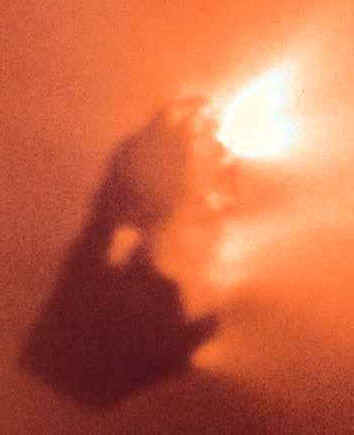 The picture of Halley's comet (center) shows dust particles blasting antimatter off the comet's surface. As comets approach the sun, comets develop a coma around the nucleus and tails that bend in the direction of the solar wind. The coma and tails are a plasma of matter and antimatter ions and dust particles. The matter and antimatter annihilations on the comet's surface, and in the plasma coma and tails produce light, x-rays and gamma-rays from rather than reflecting light from the sun. Scientists have discovered that comets are natural sources of antimatter. The announcement was made at April 2002 joint meeting of American Physical Society and American Astronomical Society. Antimatter is a mirror image of matter. The update Periodic Table Elements has 109 matter and 109 antimatter elements. Each antimatter element�s nuclear, physical, and chemical properties have been defined to such an extent that people know almost as much about antimatter as matter. The discovery is as important as man's discovered and used of fire thousands of years ago. Antimatter from comets has collided with the Earth, Jupiter and Sun. On June 30, 1908, a comet fragment collided with Earth's atmosphere over Russian Siberia and produced an explosion equal to a 30 Megaton of TNT. In July 1994, Shoemaker-Levy 9 comet broke into fragments that collided with Jupiter. The 21 explosions were equivalent to over 200 million Megatons of TNT. On July 23, 2002, an antimatter sungrazer comet collided with the Sun and released enough energy to supply the world's energy needs for 10,000 years. Energy equals mass time speed of light squared or E = mc2. http://www.matter-antimatter.com/ |
See MisterOpus, I knew it was coming.  I know that giving people the benefit of the doubt is the *right* thing to do, but eternal cynicism has led me in the right direction far more often.
Overall I'd say your explanation a few posts up was a pretty good one, couldn't have put it much better myself.
Let's play with a little analogy (my favourite teaching tool):
Picture one of the old-style balances, you know, the ones with a bin on the right and a bin on the left that tips to one side if it's unbalanced. And for simplicity's sake, let's say we put only blue marbles in the left bin and red marbles in the right bin, and that all marbles - red or blue - weigh exactly the same.
Now let's make just a few small changes. Let's say this balance has a digital display in the middle that will tell you exactly how many more marbles are on one side than on the other. And let's say that you can't see what's in these bins - you can press a button to either add one to the left and one to the right, or drop one from the left and one from the right (always done in pairs), but you can't see what's inside.
Now, the blue marbles on the left and the red marbles on the right are analogous to matter and anti-matter. And the display in the middle is analogous to the mass (or energy) of our universe. It's obvious that for an equal number of red and blue marbles, the display in the middle will be zero. This is true of the physical world; we say that the mass and energy of the universe is constant and that neither can be created or destroyed (although they can be converted from one form to another). Moreover, on the quantum level, the net mass and energy of a "vacuum" is always zero.
So if we look at this system, when we're measuring the mass of empty space, we're measuring the difference between these red and blue marbles. We can add a pair or take away a pair, but that display in the middle is always going to say zero. That is what we know about the space - it has zero net mass. We don't know how many red marbles or blue marbles there are, and in fact it really doesn't matter. They could have 10 marbles each. Maybe 100 marbles. Maybe an infinite number.
Maybe they were even empty at one point; does it matter? Do we care? We can press a button to drop a pair, so we know they're not empty now, something is in there. Theoretically we could probably keep pressing the button until we run out, but it might take forever. The exact number of marbles - or the exact mass of JUST the positive energy in the universe - simply isn't relevant to us, it might have been zero at some point but who cares? It's not "significant" in terms of the universe. We can add new marbles or take them away at any point and it won't affect the balance - the structural integrity of the universe we live in, as long as we're restricted to adding and taking away pairs.
Okay, now let's say we drop about 1000 pairs of marbles, and let them roll around on the floor. They may or may not stick together in those pairs after they've been "ejected". It's entirely possibly that a big group of blue marbles will end up in a cluster and a big group of red marbles will end up in a cluster somewhere else. And if we find a cluster somewhere, which has maybe lots of blue ones and only a few red ones, and we put it into a different scale, next to our first one, we're going to get a reading on that digital display that isn't zero. It's not empty space. There is net mass. This is fine - somewhere else, on the floor, or in another scale, the "opposite" mass is around. We don't have to know or care exactly where it is to know that it exists. And we can still eject more marble pairs out of the "main" device and add mass to our "unbalanced" one by just throwing in the blue marbles or take mass away by just throwing in the red ones. All of this isn't breaking any laws scientifically, because if you took all the marbles you could find and threw them all back into the bins on the "main" scale, you'd get zero.
Is anybody getting this here? If there was ever a time when the universe had no mass or no energy, we don't care about it. Quantum fluctuations allow for matter and antimatter to appear and disappear at any given moment, totally at random. Those fluctuations - or oscillations - may have started somewhere, but who really knows? Maybe it was always oscillating. The point is, we can't prove that there was ever a time for which those bins were empty, because we don't have data on how much is in each one. We might have data on how many are on the floor, or how many are in separate scales, but we really don't know how many are in the "big" one.
And if we can't prove that it was ever empty, then why speculate about how it got filled up?
That's the basis for oscillation. And those oscillations don't necessarily have to be caused, unless you are very narrow-minded. They may have just always been happening.
We need more Muppet Worshippers!!!!
That is all...
MrS
| quote: |
| Originally posted by Ondrayce Imagination absolutely has a significant place in scientific discourse. Without it, Christophopher Columbus wouldn't have guessed that the world was round. Galileo wouldn't have shown us that the Earth moved around the sun, instead of the other way around. Neither of them had a scientific reason to make those claims. They were just willing to explore all possibilities. And an explorer would need an imagination to do so. Or you can just except everything that is handed to you. Like sheep. |
| quote: |
| But when all is said and done, I could oppose the existance of my keyboard, and you still wouldn't be able to prove, 100%, that it, or your own keyboard, exists. |
| quote: |
| Anyway, since you never witnessed a matter-antimatter pair being created from nothing, how can you be sure that its true. Because someone else says they witnessed it. Because they put it in a book. Oh...Then it must be true. Praise Jesus!!! You may have read a lot on the subject, being an engineer and all, but you really have no imagination, do you? |
| quote: |
| Imagination is needed to question what is given to you. For Galileo to assume that thousands of years of religious belief may be wrong, takes an imagination. He made observations and calculations based on that assumption, or theory. A theory is an educated guess. Calculations and testing occur after that is made. He then arrived to the conclusion that Earth is not the center of the universe. |
| quote: |
| Observed phenomena. Observed by who? You? Then if you have all the answers, why can't you prove me wrong? Only a thousand years ago, the Bible was considered primary literature. But keep reading, I'm sure we humans have found all of the answers. |
You guys get so into this stuff. Its a good thing you're all just figments of my imagination.
Realistally, I'm completly aware of the ass kicking I've recieved. It's just funny to see you guys reply so passionatley to nonsense. Good for you.
all thats needed is someone to read it all.
PS. is it just me that skips huge posts?
| quote: |
| Originally posted by ProDiGaL all thats needed is someone to read it all. PS. is it just me that skips huge posts? |
Im not fkn whining 
I know what to expect here........... 
long posts are a good read
but i believe in a cookie monster that wears a white robe and holds a lightening bolt thats bears a striking resembelance to a football....
I generally like reading long posts if they're written well. Unless they're about Israel, that is.
Excellent analogy Diginut! Many thanks. That's by far the best analogy I have heard in regards to an explanation of quantum fluctuation in relation to the Big Bang.
| quote: |
| Originally posted by Ondrayce You guys get so into this stuff. Its a good thing you're all just figments of my imagination. Realistally, I'm completly aware of the ass kicking I've recieved. It's just funny to see you guys reply so passionatley to nonsense. Good for you. |
| quote: |
| Originally posted by OLi_A long posts are a good read but i believe in a cookie monster that wears a white robe and holds a lightening bolt thats bears a striking resembelance to a football.... |
there will be enough TA'rs in hell in a 100 years for a nice party
| quote: |
| Originally posted by rainbow_marble there will be enough TA'rs in hell in a 100 years for a nice party |

Powered by: vBulletin
Copyright © 2000-2021, Jelsoft Enterprises Ltd.