
TranceAddict Forums (www.tranceaddict.com/forums)
- Political Discussion / Debate
-- Bush's National Economic Policies
Pages (3): [1] 2 3 »
 Bush's National Economic Policies
I think credit should be given to Bush and his team of economic advisors. Because of his two tax cuts and various other policies he has been able to turn around the recession that gripped america 3 years ago.
The two tax cuts have shown to do exactly what they intended which was to give people there money back so they could spend and restart the economy. The Consumer Spending index has shown that over the last year there has been a steady increase.

http://story.news.yahoo.com/news?tm...ec_fi/economy_8
this consumer index gives much needed security to stock market investors. It has improved their confidence and thus help create a strong bull market
| quote: |
Since the lows in mid March, the Standard and Poor's index of the top five hundred firms has risen almost 30%. Meanwhile the Nasdaq index of leading hi-tech shares has gained a huge 50% after three years of big stock market falls. It seems investors are back buying America again. http://news.bbc.co.uk/1/hi/business/3119804.stm |

I think a lot of the needless spending can be attributed to congressmen who are unwilling to ratchet in their own careless spending. I admit that Bush has spent A LOT of money, however I believe that it has been mostly on big ticket items that have merit. The lionshare of the frivolous spending always occurs in congress. They are the ones who approve spending, and they are the spenders who always manage to squander their tax receipts.
Izzy, have you listened to the news lately??? .. Poverty is crambling America now, if you didnt know.. its up tp 43 million people, whom are now in poverty lebel, and consumer spending is once again falling to what it was prior to the sudden rise of consumer spending. Therefore, knowing that the poverty level has rise to such levels, among the spendings, or better said, money that the bush administration is now asking, among other spendings, the economy is no good. Ive heard some analysts today talking about the economy ( on the NPR radio ) .. and said that the unempleyment is the worst in decades.. and the sign of the economy improving its not even the tip of the iceberg. There are many things currently happening that will keep the economy from going up. The stocks are up and down, up up and down down down down down down.. no good. Even if lets say, tehre was a small chance that Bush could justify the economy in improving, the poverty levels will keep anything from that happening.
Poverty rate:
12.1% currently or 34.6 million people that is for 2002 - the last time the Census burea did estimates for poverty (http://www.kentucky.com/mld/kentuck...ess/6868055.htm).
Still Bush's wasn't an economic plan to "stop poverty" it was to increase consumer spending, and it did achieve that. So I think prompts to him.
As a supported of Keynsian economy, I support the large budget deficit in periods of recision, and commend Bush for his unpopular tax cut (I think I could have done a better tax cut, but still thats a boat load of money coming back to consumers in fairly small and un inflation sparking distributions).
The only other angel that might have been worth looking the one that democrates are now touting is "Job creation" - but I don't exactly know what that means to be honest. Isn't the government creating jobs by supporting a large military....?
| quote: |
| Originally posted by Yoepus Poverty rate: 12.1% currently or 34.6 million people that is for 2002 - the last time the Census burea did estimates for poverty (http://www.kentucky.com/mld/kentuck...ess/6868055.htm). Still Bush's wasn't an economic plan to "stop poverty" it was to increase consumer spending, and it did achieve that. So I think prompts to him. As a supported of Keynsian economy, I support the large budget deficit in periods of recision, and commend Bush for his unpopular tax cut (I think I could have done a better tax cut, but still thats a boat load of money coming back to consumers in fairly small and un inflation sparking distributions). The only other angel that might have been worth looking the one that democrates are now touting is "Job creation" - but I don't exactly know what that means to be honest. Isn't the government creating jobs by supporting a large military....? |
 . I dont know why are those figures of consumer spendings so encouraging, really. First of all, id like to point out that Bush's tax cut went back to the more wealthy families.. more to those with an income of 200,000 and up, and those under it may have gotten some 200-300 dollar checks, and the middle class, well, lets say the upper middle class. My uncle who gets around 100,000 recieved a miserable check.. it was as if he was getting back a tip. But back to topic. I found this helpfull, up-to-date links.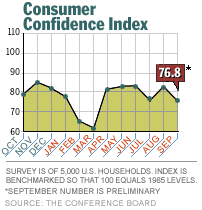
 in the ass..
| quote: |
| Originally posted by LiquidX *Jobs- More than 13 million Americans are out of work. |
Don't let anybody fool you. The current state of the economy is that we are in a jobless recovery. Meaning that although we are making significant marked improvements in economic performance, the labor market is still stagnant. The manufacturing sector has been expanding consistently, the ISM index has been above 50 for several months, durable goods orders have been relatively buoyant, consumer spending has been superb (aided by the tax cuts which increased personal income by .2%). Consumer spending and GDP are HUGE indicators of economic performance, far more than consumer confidence. Consumer confidence always has wide variability and in the past even when consumer confidence has been low, consumer spending still rose despite a drop in confidence. Anyway I have all of the last month�s primary indicators if anybody wants the complete list to form their own opinions.
That being said, does this mean that everything is fine and dandy? Absolutely not, a jobless recovery does not have sustained growth. If unemployment remains high, than the huge gains in consumer spending will not sustain itself. Eventually the layoffs will drive down personal income, drive down consumer spending, and will have a negative impact on GDP. Ironically enough, one of the reasons for the slump in manufacturing jobs has been the dramatic increase in productivity. Since the second quarter of 2001, productivity has grown by 3.1% a year. Since companies can now produce more with fewer workers, this has partly influenced the stubborn lack of growth in payrolls.
| quote: |
At the worst point it was the worst unemployment rate since Hoover :P |
| quote: |
| Originally posted by occrider Don't know where you got that data from. http://www.businessweek.com/@@CHrnY...51050_mz007.htm |
| quote: |
| Originally posted by Yoepus Also it is not nescessary as you imply that less ppl out of jobs mean income levels will go down - as those that are working are much more efficient. What this does mean however is that it will injure the middle class, and create wider disparity between poor and rich. And one thing I really liked about the US is the fact that everyone is in the middle-class. |
 .
. 
Does it have something to do with WWIII?
| quote: |
| Originally posted by Yoepus Does it have something to do with WWIII? |
2 guess ouch.
The current line I'm thinking is by past-war you probably mean Iraq, and then either you don't see Bush in office by 2011 but a democrate instead (in which case this was a cheap political joke), or that you actually think the mid-east will produce jobs for the US ---- ahh yes cheap oil, of course!
Cheap oil should always spurs growth (and employment?)
| quote: |
| Originally posted by Yoepus 2 guess ouch. The current line I'm thinking is by past-war you probably mean Iraq, and then either you don't see Bush in office by 2011 but a democrate instead (in which case this was a cheap political joke), or that you actually think the mid-east will produce jobs for the US ---- ahh yes cheap oil, of course! Cheap oil should always spurs growth (and employment?) |
what you can't count??!! Of course that was one 
No hints this time either huh? 
| quote: |
| Originally posted by Yoepus what you can't count??!! Of course that was one No hints this time either huh? |
So first you say it has to do with a past-war, and now you say it has nothing to do with geo-political events - talk about confusing.
You've made it so clear, I'm left with only one option - It must be that damn 2.011k bug everyone is talking about!
Nope! I said it kind of has something to do with a war . And that war was World War 2. The year 2011 is when all those baby-boomers turn 65. Economists are predicting a huge shortage in the labor market as all these people begin to retire.
| quote: |
| Originally posted by occrider Nope! I said it kind of has something to do with a war . And that war was World War 2. The year 2011 is when all those baby-boomers turn 65. Economists are predicting a huge shortage in the labor market as all these people begin to retire. |
| quote: |
| Originally posted by MisterOpus1 Hey Occ, are you interested in reading Krugman's new book? From what I hear, he's pretty sound on analysis on what's wrong (Bush's fiscal and economic policies), but comes up short in giving good solutions (yeah, I know, typical Democrat, right?). |

- The downturn now to that babyboomers retirement, which im pretty scared to what will happen to all this people, is the very poor health insurance and medicare that this country has for them, besides spending all that social security money, which currently I dont know whats the state of that, but I heard not so long ago that if the money is not recovered for it, it will be on jeopardy in just a few years. The stocks went down yesterday ( heavent seen them today ) because of that economic warning-among other things.
- Back to the topic. Even though, as you may claim that Bush's tax cut have worked, lets look at what were the purposes of Bush's tax cut, which he actually said over and over again.. and parts of the things that I can remember were :.. My tax cut will give people money to spend, therefore, more jobs, therefore, more revenues and profits, therefore the economy gets back to where it was ... well, even though you pointed out consumer spending has risen, this is far from been the actual purpose of Bush's tax cut, which as of now, has done NOTHING to activate the economy, really..I saw some of Occrider things, and I agree on many of the things he said. So.. if there is so much consumer spending, why are companies still getting rid of thousands of workers?? .. lets take for example Car companies, they've had a great year in terms of selling cars, yet, today Chrysler and Ford will be laying out workers in the 50,000 thousands .. some abroad and a gret number inside.. dont remember the numbers quite much now. My point with this is, although there seems to be more consumer spending, which I think its somewhat parallel to consumer confidence ( which I pointed out earlier, has gone down ).. is that its not serving the purpose for what this Tax Cut were ment to, more when considering the amount of money that was returned, especially to those riiches, in times when there are more poors ( theres a report about coming out, if it didnt come out yet, which will hit hard the administration ) .. and ironically, more riches. ( Look at that link I posted about it earlier ).
Some of the reasoning for why unemployment is still lagging was explained in the article I posted:
| quote: |
Although we clearly can reject the claim that the current labor market is the worst since the Great Depression, we still want to know why employment growth has remained negative despite the recent pickup in gross domestic product growth. One common explanation is that employment growth and the jobless rate are lagging indicators. There's some truth to this. When the GDP changes, some of the shift in employment shows up only after one or two quarters. But most of the change usually occurs within the same quarter as the change in GDP. Moreover, even a one- to two-quarter lag would not explain why employment growth has remained sluggish for 2 1/2 years now. Given the historical link between GDP growth and employment, job growth has been lower than expected in the last nine quarters. This extremely unusual pattern suggests that some basic change may have occurred in the relation between employment and GDP growth. One way to look at the change is that the GDP growth required to get positive employment growth has risen substantially. In the long-term relationship, employment growth tended to be positive whenever GDP growth was mildly positive -- only something less than 1% GDP growth was required. Since 2001, however, GDP growth apparently has had to exceed 2.5% to 3% for employment to begin climbing. That's why employment is still decreasing. The other way to look at the numbers is that, since GDP growth has been positive and employment growth has been negative, the economy has been able to produce more goods with fewer workers. In other words, productivity measured by GDP per worker has been rising strongly. (An adjustment for hours worked strengthens this scenario.) Since the second quarter of 2001, productivity has grown by 3.1% a year, compared with the long-term average of 1.4%. The key question is how long this high productivity growth will last. If the high productivity gains continue, the economy will benefit tremendously for many years to come. In the longer term, employment growth corresponds to increases in the labor force, which depends on trends in population and labor-force participation. If the labor force expands at its long-term average of 1.5% to 2% per year, employment growth will be about the same. To determine long-term GDP growth, we have to add the productivity growth rate. Thus, if productivity grows at 3.1%, the GDP growth rate would be around 5%, compared with the historical average of 3.3%. That would be very nice. For Republicans, an important question is whether this pleasantness will materialize by election time in 2004. That is a question I cannot answer. |
| quote: |
U.S.: Consumers Will Keep Carrying the Ball True, jobs aren't back. But tax cuts and refinancings are doing the trick The surprising deterioration of the labor markets in August would seem to throw a wrench into increasing expectations of strong economic growth in the second half. After all, consumers can't possibly keep leading this recovery without a pickup in job growth, can they? Yes, they can in the short run. Despite last month's job losses, back-to-school sales and vehicle buying were strong, and September is looking busy for retailers, too. Consumers are reaping the benefits of tax cuts and low interest rates, policy moves that give households extra income. Plus, rising stock prices are adding to wealth. These positive trends provide a bridge for consumers to cross until demand gets another boost when businesses start hiring once more. The spurt comes at an opportune time. Businesses are buying new equipment again, inventories need rebuilding, and the economy in general shows signs of renewed vigor. The Institute for Supply Management's business activity index for the nonmanufacturing sector has risen for five months in a row, with the August index at a high of 65.1%. Also, factory orders rose 1.6% in July, while inventories fell 0.5%. The mix suggests factories will have to increase production to meet new demand. And the National Federation of Independent Business said its small-business optimism index jumped a record 4.1 points in August, to 104.7. These upbeat reports suggest the economy in the second half could post the best back-to-back quarterly growth rates since early 2000. The strong performance underscores the notion that, with the right policy and accommodative financial conditions in place, consumers will keep shopping despite concerns over jobs. OF COURSE, LABOR MARKETS MATTER. That's why the news of 93,000 more jobs lost in August was a head-turner. Economists had expected a small gain in jobs. Instead, the August decline brought the number of layoffs this year to 437,000. All of the recent job losses have been in manufacturing. Since the recovery began in November, 2001, factory payrolls have shrunk by 1.2 million, while employment elsewhere has grown by 97,000. Also, the dip in the unemployment rate, to 6.1% from July's 6.2%, was not a signal of labor-market improvement. The drop was caused by more people leaving the labor force. The percentage of the U.S. adult population working or looking for work stayed at 66.2%, the lowest participation rate in a decade. One bit of good news came from the continued advance in temporary-help positions. Businesses usually take on contingent workers until they feel confident enough to add permanent positions. And temp help has grown strongly for four months in a row. Moreover, although the Labor Dept.'s survey of businesses shows continued layoffs, its survey of 60,000 households shows an increase of 868,000 jobs over the past year. About 140,000 of those jobs were in nonfarm industries, while 558,000 jobs reflected people listing themselves as self-employed. It might be easy to dismiss the rise in self-employment as merely a way for some to deny their unemployed status. But the trend in proprietors' income -- earnings derived mostly from privately owned businesses -- supports the idea that this jobless recovery is pushing more people to become successful entrepreneurs. Nonfarm proprietors' income was up 9.1% in the year ended in July, a pace equal to the gains posted in the 1990s boom. These earnings, while 10% of all personal income, have accounted for nearly a quarter of the increase in overall income over the past year. Those gains partly explain why consumer demand is strong even while businesses are reluctant to hire. THE TWO BIGGEST REASONS, though, are the July tax cuts and mortgage refinancings. The tax cuts, along with the child-credit rebate checks, should provide $35 billion in extra cash in the second half. The boost can already be seen in the July data on personal income. Real income was flat, but aftertax pay jumped 1.3%. That was the largest gain since the earlier Bush tax cuts were implemented in January, 2002. Meanwhile, homeowners are improving their finances by refinancing their mortgages. When long-term interest rates fell to 45-year lows in late spring, refi applications hit a record. As these loans close, millions of homeowners will lower their house payments or liquefy thousands of dollars of their homes' net equity. Federal Reserve Chairman Alan Greenspan has focused on the boost that refinancings give to current spending. But the refi madness of the past year has come at a cost. For the first time in a decade, housing wealth fell in the second quarter. According to the latest Fed data, owners' net equity in real estate fell by $45 billion, the biggest drop since the first quarter of 1993. Back in the early 1990s, the drop was caused by a flattening-out in home values. This time, the decline can be traced to the growth in mortgages overwhelming the increase in home values. With refi activity slowing, housing equity should turn up in coming quarters. That suggests wealth should remain on the rise for the rest of the year, especially since balance sheets will also get a boost from the ongoing gains in the stock market. INDEED, THE STOCK MARKET RALLY was mainly responsible for last quarter's advance in household wealth. According to the Fed, net worth -- personal assets minus liabilities -- edged up by $1.7 trillion in the second quarter from the first. Personal holdings of stocks and mutual funds increased by $944 billion. Consumers also boosted the amount of money in their savings accounts. After the bear stock market caused wealth to shrink from 2000 to mid-2002, consumer balance sheets are on the mend. At $41.2 trillion in the second quarter, total household wealth is just 5% shy of equalling its record of 2000. If the equity gains continue and refis slow, net worth should overtake the old peak within the next year. That's another plus for future spending, since households tend to use a small percentage of their long-held wealth to finance current outlays. Taken together, the latest data on wealth, refinancings, and tax cuts mean consumers will increase their purchases throughout the second half. But those supports can last only so long. By early 2004, the lift from tax cuts will peter out, and cashouts from refinancings will be much lower. As any economist can tell you, job and wage growth are the prime movers of consumer spending in the long run. Businesses must start hiring if the economy is to maintain its new momentum. Nascent signs, from the rise in temp jobs to the surprise strength in demand, suggest that help-wanted signs will soon be appearing in greater numbers. That's good news for the 2004 outlook -- and for the millions of job-seekers around the country. http://www.businessweek.com/@@fSr17...50028_mz010.htm |
| quote: |
The misery of manufacturing Sep 25th 2003 | BRUSSELS, CHICAGO, LONDON, NEW YORK, TOKYO From The Economist print edition Why there is a new panic over manufacturing in the rich world RICH-COUNTRY manufacturing has supposedly been in decline for so long that it is surprising that the politicians, unions and journalists who leap so nobly to its defence find much left to save. But they do: after years of silence on this hoariest of economic fallacies�that manufacturing is something special�the alarm bells are now ringing louder than ever. American politicians are rushing to aid the manufacturing lobby. In Britain the rebranded engineering workers union, Amicus, is raising the issue to embarrass the government at the Labour Party conference next week; it is asking for a minister for manufacturing and loads of government help. Politicians love manufacturing because it provides lots of visible, reasonably well-paid jobs. That is why American states fight each other with subsidies to land each new Japanese car-assembly plant, and central European countries do the same, knowing that no new car factories will be built in western Europe. In Japan, politicians decry the �hollowing out� of Japanese manufacturing, as large-firm production seems to flee offshore. In Europe, the French are normally stoutest in defence of their national champions. But Germany is newly fierce; its chancellor, Gerhard Schr�der, has picked a fight with the European Commission, denouncing its �anti-industrial bias� as it seeks to stop subsidised state loans and other favours for German industry. Maybe this onslaught on the commission explains why its president, Romano Prodi, wrote plaintively in Le Monde this week of the �deindustrialisation of Europe�. But at least another Italian economist, the competition commissioner Mario Monti, is questioning yet another French bail-out, this time of an engineering giant, Alstom, where around 100,000 French jobs are at risk (see article). Made (too much of) in America But the clamour is loudest in America. In the 1980s, the enemy was Japan: now it is China. �Walk around Wal-Mart,� says Jack Smith, until this spring chairman of General Motors, �and it looks as if everything is made in China.� This week, America's National Association of Manufacturers (NAM) resolved to press Congress to sanction China for �manipulating� its currency markets (ie, keeping its exchange rate low). Protectionist bills may begin to proliferate in Washington DC. John Snow, the treasury secretary, jawbones the Chinese about the yuan. George Bush has a raft of initiatives to keep manufacturers afloat, including a new office at the Commerce Department to monitor unfair trade, and an assistant secretary to co-ordinate manufacturing policies. The anti-Japan campaign in the 1980s wreaked havoc on international trade relations and currency markets. What will happen in the China row? One minor obstacle, then as now, is the awkwardness of facts. Manufacturing has only recently, and with unusual lethargy, emerged from a global recession. (From a peak in June 2000 to a trough in December 2001, manufacturing output shrank by 7.6% in America.) But, on a longer view, rich-world manufacturing is in terrific shape (see chart). Amicus may have a point that Britain under-performs its peers in manufacturing. But that is only because Britain's competitors�particularly America�have done so well. Since 1970, America's manufacturing output has more than doubled. Even after the recession, American manufacturing output is almost 50% higher than in 1992. What really animates the China-bashers, of course, is not the decline of manufacturing, but the loss of rich-world manufacturing jobs, as firms cut payrolls by using more sophisticated processes. In 1947, according to the Federal Reserve Bank of Chicago, 35% of America's workforce were employed in manufacturing. By 2002, this figure had fallen to just 12%. With employment falling and output rising, America has enjoyed soaring manufacturing productivity, a feat repeated to some extent elsewhere in the rich world. On the one hand, NAM suggests that �manufacturing's future in America is now in jeopardy�. On the other, NAM boasts that American manufacturing is �innovative, productive and efficient�. Which is it? The Chinese facts are even more awkward. What alarmists really hear when they tune into the �giant sucking sound� (or whatever) of American factories disappearing into China is mostly the continuing stampede of its firms into other rich countries' markets. Though growing rapidly, American manufacturing investment in China is still a trickle compared to the far larger flows into other rich countries. Despite the pull of China's cheap labour, firms find lots of reasons to keep lots of manufacturing at home. One is that, as rich-country factories employ fewer workers, labour costs no longer make or break decisions about where to put a factory. Frank Vargo of NAM, for instance, calculates that payroll costs account for just 11% of overall manufacturing costs in America. Because shipping costs and speedy distribution are more important than relative wages, Dell builds its computer-assembly plants near to its customers, both in rich and poor countries. Moreover, Mike Kilgore, a consultant with Chainalytics in Atlanta, says firms often underestimate the cost of overseas manufacturing, particularly those associated with transportation, extra inventory, and political and security risks. Meanwhile, growing demand for prompt delivery from retailers such as Wal-Mart in America and Carrefour in France also pulls manufacturing home. Primitive mercantilist views about the piling up of foreign currency by a nation selling more than it buys from abroad still rule in parts of Europe, notably Paris. In Britain, on the other hand, the unions may find their latest campaign tough going. The Labour government of Tony Blair has, at least until now, cast off its old pro-manufacturing socialist bias and embraced the mostly neutral policies towards manufacturing of its Conservative predecessor. Amicus's pleas over the 2,500 manufacturing jobs it claims are lost in Britain every week will probably fall on deaf ears in Britain, which despite slow economic growth still has more or less full employment�unlike America or Japan. In Japan China is a favourite bugbear of nationalist politicians�and Japanese racists in general. Yet the ruling Liberal Democratic Party finds some of its baser instincts leavened by its desire to please big Japanese manufacturers, such as the car companies and electronics firms, which are finding both selling to and investing in China so attractive. Hopefully, similar common sense will prevail in America, where big firms are indeed worried about growing protectionist sentiment towards China. But it may not. America's presidential elections next year will follow a recession that has cost 2.7m jobs. Politicians will feel the sharp anger of thousands of smaller American manufacturers, from furniture firms in North Carolina to car-parts makers in the Midwest. These firms really are taking a beating from China. An early test of Mr Bush's mettle will be how he handles a review of America's steel tariffs, slapped on 18 months ago at the behest of its ailing foundries. Expect more fireworks. http://www.economist.com/business/displayStory.cfm?story_id=2087788 |
| quote: |
| Originally posted by occrider Sorry for all the long economics articles |

| quote: |
| Originally posted by Yoepus Ya and I thought you said you don't read economics! Liar... |
LiquidX, consumer spending does make up a very important role in the economy. consumer spending accounts for two-thirds of US economic activity (source). Infact this was what bush intended to happen with the tax cuts. seeing as there has been a steady increase for 12 months straight (maybe longer, i didnt check) then he's already remidied 2/3rds of the economy some credit is due. increased spending and investing can also be thanked to the Greenspan for keeping interest rates low.
i agree that the job market slump is still the holding back economic recovery, however this is probably the last hurdle to overcome. Indications show that it is not in a downward slope but rather stuck in neutral with workers no longer losing their jobs at the rapid pace of 2001 but with relatively few new job opportunities popping up. In the last three months of 2002, 7.8 million jobs were eliminated, while 7.7 million were created, according to the results coming from a survey that the Bureau of Labor Statistics published for the first time yesterday (source)
I also wanted to add my personal observations on the job market here localy. (this in no way reflects the entire US). Judging by the engineering career fair we had recently at our college it seems like the civil engineering sector is on a huge boom, they seem to be hiring like made. this is probably due to low interest rates that allow for many contracts to go through. Everyone in the Electrical Engineering sector talks about the looming end to the hiring freeze that is in effect at many companies. Both Dell and HP are starting a big bactch of recruiting in spring, TI is already in the midst of starting one. Aerospace Engineers have also seen a resurgance in job offers due to Boeing and Lockheed going head to head on many US contracts for military equipment (mainly missles). and from what you point out occrider, i've seen that mechanical/manufacturing/industrial engineers are not faring well. agian i want to stress that this is only for what i observed here.
Ah the wonderful rosy USA economy. The tax cuts are only forstalling the inevitable crunch caused by the fact the US spends too much and its assets are overvalued. Eventually the Chinese and Japanese central banks are going to get sick and tired of buying the US Treasuries which pay for the tax cuts and when that day comes, a lot of people are going to seriously suffer, not just in the USA.
I wont reiterate why the US, and probably global economy is headed for a crash because either 1) you dont believe it or 2) you dont care.
I am willing however to make a serious bet that in a years time the US economy will be worse than it is today. To measure whether the economy is better or worse I suggest using the S and P 500.
Of course a bet isnt interesting unless there are stakes

Powered by: vBulletin
Copyright © 2000-2021, Jelsoft Enterprises Ltd.