
TranceAddict Forums (www.tranceaddict.com/forums)
- Political Discussion / Debate
-- The reason we have deficits
Pages (2): [1] 2 »
The reason we have deficits
I keep saying that tax cuts don't cause deficits, rather reckless, pork barrel spending does. Just a sample of tax-payer money being wasted in droves. I really wish Bush would step up and use the power to say "no" to some of this pointless BS.
WSJ Editorial
| quote: |
| Riding the Omnibus The Senate finally passed that $820 billion "omnibus" spending bill last week, and omnibus is certainly the word for it. According to an analysis by Taxpayers for Common Sense, this bill to finance much of the government for Fiscal Year 2004 contains an unprecedented 7,931 "earmarks" at a cost of $10.7 billion. Put another way, that's 15 sweetheart projects per Member. There's $500,000 for a water taxi in Pittsburgh, $225,000 for the Wheels Museum in New Mexico, and $100,000 for "streetscaping" a tony Salt Lake City neighborhood. In the cholesterol-subsidy category is $2 million to market specialty Wisconsin cheeses and goods. Alaska alone, home of Senate Appropriations Kingpin Ted Stevens, got 296 earmarked expenditures. Among cutting-edge research grants are $450,000 to study "Sudden Oak Disease Syndrome" and $90,00 for an olive fruitfly study. . . in France. Some lucky folks at the University of Hawaii bagged $200,000 to produce "Primal Quest," a film about Kalahari Bushmen who pursue their prey until either man or animal drops from exhaustion. Which sounds a lot like the appropriations process. Congress is now entering a brave new budget year, with President Bush promising to restrain spending, for a change. Word is that his budget proposal, due next week, will cap domestic non-defense discretionary spending growth at 1%, except for homeland security, which will grow by 10%. Congressional veterans know what that means: All of those earmarks will have to be stuffed into the homeland security basket. Unless, of course, Mr. Bush breaks type and exercises his veto power. Failing that, we see that this year's omnibus bill contained $500,000 for the University of Akron to finance its "Exercise in Hard Choices" program -- a simulation of the federal budget process. Maybe Congress should enroll. |
Yes well if Bush wants to pay for everything he's asked for he's going to have to raise taxes. But the man has writer's block when it comes to vetoing any spending package. Hmmmmm curb the deficit ... or spend $1.5 billion to promote marriage??? I've adopted the viewpoint that most of the democratic candidates would be signifcantly more fiscally conservative than bush has been.
| quote: |
| Originally posted by occrider Yes well if Bush wants to pay for everything he's asked for he's going to have to raise taxes. But the man has writer's block when it comes to vetoing any spending package. Hmmmmm curb the deficit ... or spend $1.5 billion to promote marriage??? I've adopted the viewpoint that most of the democratic candidates would be signifcantly more fiscally conservative than bush has been. |
I await Bush's proposal in Feb. to cut the deficit. I honestly don't know how he'll be able to do it. Here's an article that shows some possibilities, none seem very truthful:
http://money.cnn.com/2004/01/26/new...dex.htm?cnn=yes
Or he could just cut more programs, thus losing more jobs.
Either way it's a pickle that he helped contribute with.
Cutting taxes with big deficits is always bad economics. Why did he think he could get away with it?
| quote: |
| Originally posted by MisterOpus1 Or he could just cut more programs, thus losing more jobs. Either way it's a pickle that he helped contribute with. Cutting taxes with big deficits is always bad economics. Why did he think he could get away with it? |
Reagan engaged in deficit spending at a time when America was going through crises domestically and abroad when one could argue that deficit spending was truly necessary. The economy was in far worse condition and competition with the Soviet Union was immeasurable. Now, although I was for the tax cuts to stimulate the economy ... it is now stimulated. We are nowhere near recessionary conditions. True job growth is lagging, but hey ... full employment is considered 5.5%, we're used to being spoiled with 3% unemployment and that's not going to happen. It is time to reign in the spending and cut costs while we can before we start seeing upward pressures on interest rates.
NYCTrancefan will probably like this ... it appears that everybody is in the spend spend spend mood!
I love the economists' subtle humor at times ...
http://www.economist.com/agenda/dis...tory_id=2367033
One Europe, united in fiscal misrule
Jan 23rd 2004
From The Economist Global Agenda
In the realm of public spending, many of the European Union�s new entrants are faithfully living up to the standards of the union�s founding members. Oh dear

IN MAY of this year, the European Union (EU) will take in ten new members. Four of the biggest, Poland, Hungary, the Czech Republic and Slovakia, are all struggling with mounting budget deficits and contemplating awkward spending cuts. As such, they will fit right in among the union�s existing members. France, Germany, Italy and Portugal all have their own fiscal troubles. When it comes to fiscal imprudence, Europe, old and new, is in perfect harmony.
As members of the EU, the new entrants must strive towards membership of the single currency. Unlike Britain, they do not have a formal opt-out and most are eager to opt in as soon as possible. But to qualify for membership, the EU�s new countries must show that their economies have �converged� with those of the euro area. Convergence must be fiscal as well as monetary. Public debt must be kept under 60% of GDP and budget deficits held to 3% or less. Maastricht is moving east. Unfortunately, central Europe is not yet ready to meet its standards. Poland�s deficit was reckoned to be 4.2% of GDP in 2003. Slovakia�s was 5%. Hungary�s might be anything from 5.6% to 6%. And the Czech Republic, with a deficit of 7.6%, is displaying a positively bohemian attitude to fiscal responsibility.
The European Commission's economics and financial affairs department rules on the breaches of the stability and growth pact. The European Central Bank provides monetary-policy information. The Centre for European Reform, a think-tank, publishes research and policy briefs on EU economic policy.
Need they worry? After all, the founding members of the euro have themselves conspicuously failed to live by the single currency�s fiscal rules. Last November, finance ministers from the 12 euro member states voted by a majority to suspend the stability and growth pact, which enshrines the rules of the Maastricht treaty in EU law. Their insouciance is now being challenged by the European Commission at the European Court of Justice. But as with many clubs, once you are inside the door with your feet under the table, the rules can be relaxed or fudged.
For those waiting at the door, it's a different story. Hungary had hoped to get past the velvet rope and enter the euro in 2008. The new finance minister, Tibor Draskovics, may now concede that this is unrealistic. His predecessor was ousted earlier this month after admitting a massive fiscal overshoot: the deficit for 2003 was not 4.5% of GDP as planned, but 5.6%. Even that career-ending confession failed to disclose several large outstanding bills for motorways, jet fighters and farm subsidies which will drain another 100 billion forints ($480m) from state coffers.
Mr Draskovics does not have much time to re-establish the credibility of his office. The forint is struggling and yields on government bonds are punishingly high. The finance minister announced cuts worth 120 billion forints last week, but is still casting around for ways to save money. Indeed, he has invited anyone with a suggestion for trimming public spending to call a free phone-line.
In Poland, the public has had three months to offer their two-zloty�s-worth on the government�s fiscal plans. Jerzy Hausner, the economics minister, wants to cut the deficit from 5-6% in 2004 to 3% or less in 2007. But the country goes to the polls next year. His plans are therefore vulnerable to disgruntled unions, willing to strike to protect their subsidies, and disloyal coalition partners, unwilling to take the electoral heat for unpopular cuts. The timing of many of his schemes reflects this political reality. Enacted this year, they will not begin to hurt for several years. The retirement age of women, for example, will be raised to match that of men, but not until 2014.
The Czechs do not even pretend they will be ready to join the euro before 2010. Their deficit has widened from a troubling 4.4% in 2000 to an alarming 7.6% last year. If left unchecked, the budget gap could reach 9% within a year or two. The government is hiking duties on alcohol, fuel and cigarettes (the former president, Vaclav Havel, famous for his chain-smoking, is no longer in a position to protect the rights of smokers). It will also raise VAT. The government hopes to cut the number and pay of public servants, �re-index� (ie, cut) pensions, and �rationalise� (ie, cut) sickness benefits. But the governing coalition rules by a majority of just one. Not all of the coalition partners are happy with the package on offer, and the current president, who must sign off on the plan, is no great fan either.
The Slovaks to the east are putting their faith in the solutions of the right. Taxes, both personal and corporate, have been flattened to a uniform 19% rate. The flat-taxers hope this will discourage tax evasion and attract foreign investment. But just in case the much-touted Laffer curve lets them down (as it let Ronald Reagan down before them) they also propose to postpone retirement, cut sickness benefits and tighten eligibility for unemployment benefits. New Europeans indeed.
Despite these fiscal heroics, the Maastricht criteria remain daunting and distant. They are also quite arbitrary, plucked out of the air more than a decade ago for the sake of political convenience not economic logic. There is no magic in the deficit-to-GDP figure of 3%. Willem Buiter, chief economist at the European Bank for Reconstruction and Development, dismisses the deficit and debt limits as �fiscal numerology�.
The accession countries need to get to grips with their budgets for their own sakes. They do not really need to curb them for the euro�s sake. Central Europe�s deficits are worryingly large as a percentage of their GDP. But they are still small as a percentage of the euro area�s total output. Deficits of 5% or 6% in a country as small as Slovakia hardly threaten the monetary stability of Europe.
Nonetheless, it is this fiscal numerology that will determine when and whether new members join the euro. The four central European countries celebrating EU membership this year will probably have to wait until next decade to celebrate entry into the single currency.

09/30/2003--------$6,783,231,062,743.62
09/30/2002--------$6,228,235,965,597.16
09/28/2001--------$5,807,463,412,200.06
09/29/2000--------$5,674,178,209,886.86
09/30/1999--------$5,656,270,901,615.43
09/30/1998--------$5,526,193,008,897.62
09/30/1997--------$5,413,146,011,397.34
09/30/1996--------$5,224,810,939,135.73
09/29/1995--------$4,973,982,900,709.39
09/30/1994--------$4,692,749,910,013.32
09/30/1993--------$4,411,488,883,139.38
09/30/1992--------$4,064,620,655,521.66
09/30/1991--------$3,665,303,351,697.03
09/28/1990--------$3,233,313,451,777.25
09/29/1989--------$2,857,430,960,187.32
09/30/1988--------$2,602,337,712,041.16
09/30/1987--------$2,350,276,890,953.00
http://www.publicdebt.treas.gov/opd/opdint.htm
hehe funny how there is NO year with a decreasing dept...
Deficits Eroding Our World Standing
by John Tanner, Guest Columnist
The (Memphis) Commercial Appeal
October 18, 2003
Some Republicans have long tempted to characterize Democrats as fiscally irresponsible big spenders � at times with merit. However, the Republicans� budget plan now endangers our economy and our security.
Over the past 2 � years, the Bush administration and the Republican Congress have pursued fiscal policies that have resulted in a colossal increase in the federal debt. Increased interest payments mean higher taxes on Americans next year and every year thereafter.
This reckless increase in federal debt has exposed another troubling aspect of the administration�s budget plan, passed by a Republican House and Senate: Asian countries are purchasing our debt in record amounts, and China has registered the most rapid increase. These developments not only adversely affect our economy, they also leave our country susceptible to a potential national security threat.
According to the Treasury Department, major foreign holdings of U.S. Treasury securities total $1.35 trillion. Over the first seven months of 2003, mainland China and Hong Kong accumulated $177 billion of U.S. debt.
Currently, China is the world�s second-largest buyer of our debt, exceeded only by Japan. Furthermore, China�s purchases of U.S. government securities rose 20 percent over the first half of this year and have more than doubled since 2001.
It is a dangerous situation when the administration funds the federal government in part by selling our debt to the Chinese. The Congressional Budget Office (CBO) has estimated that the federal government accumulated a $374 billion deficit in fiscal 2003, not including the President�s $87 billion request for Iraq.
Foreign investment in the United States is financing the U.S. budget deficit and the war in Iraq. We need to borrow approximately $1.5 billion a day from foreign investors to meet these deficits. Increasingly, foreign investors, not U.S. residents, will be beneficiaries of the interest paid by us, our children, and our grandchildren.
The high level of foreign holdings of U.S. securities could have a debilitating impact on our economy and foreign policy. How would our economy respond if China threatened to sell large volumes of U.S. Treasury securities? This action could easily fuel higher inflation and put pressure on the Federal Reserve to increase interest rates, putting our economy at risk of a large-scale recession.
The United States does not always see eye to eye with Beijing on foreign affairs. The mere threat by China to sell U.S. debt could reduce our negotiating position on long-standing issues of disagreement such as national security and trade. The United States should not be put on the defensive when conflicts arise with China simply because the Chinese government can hold the U.S. dollar hostage.
Chinese officials are purchasing U.S. Treasury securities in an attempt to keep the value of their currency, the yuan, artificially low. The yuan has been pegged to the U.S. dollar for almost 10 years, despite record growth in the Chinese economy. Such growth should have increased the value of the yuan if it were a free-floating currency.
Economists estimate China is undervaluing its currency by as much as 40 percent. By purchasing U.S. debt, China can manufacture products that cost 40 percent less to make than they do in the United States. This currency manipulation has contributed to the loss of millions of manufacturing jobs in the United States.
The Republican borrowing program, unless it is quickly reversed, will devastate our economy and diminish our role in the world. We cannot be the world�s leading economic and military power if our government�s financing depends on money from foreign countries, many of which oppose our policies.
A former official of China�s central bank, now a private economist, recently told The Washington Post: �The U.S. dollar is now at the mercy of Asian governments.� The only way to get this problem under control is to stop deficit spending.
Interest payments on the national debt will soon surpass all domestic discretionary spending, including defense, health care, education and infrastructure. Unlike those expenditures, interest is a tax on the American people that cannot be repealed.
The �Blue Dog� Democrats proposed a plan that would have reversed this catastrophic borrowing but it was defeated on a largely party-line vote. We will continue this fight, but to succeed we will need the help of citizens outside Congress.
http://www.house.gov/tanner/press108-oped101803.htm
In my opinion, the reason we have such a debt/defecit today, is because our governement (and many governements of the world) have become large, uncontrolled beaurocracies where the cost to "make it run," is as much or more than the services it provides. Our government spends a dollar on paperwork for every 1 dollar spent on a government program. This to me is rediculous and the true cause of the nations fiscal woes. We are a country (and world) so consumed with the fear of litigation, making sure all the "t's are crossed and i's dotted," and the absurd hope of having a regulation or manual for everything, that we have let our madness poison our economy.
This paperwork insanity also leaks over to health care. Today, 31 cents of every dollar spent on health care goes towards administration and paperwork. That's twice what it is in Canada. Just think if we could reduce that by even ten cents. So much more of our money would actually go towards our health instead of in a filing cabinet.
I know I'm sounding like a mad man but this issue goes quiet and I see it as the real reason for our financial troubles. We spend no more today of our GNP on actual government programs than at any other time in our history. What we do spend more on is the paperwork that goes on behind it. It's like we're paying for everything twice, once for the action, and once of the paper trail that comes after it.
Excessive specialization is a product of a highly developed country...
Why don't you keep those programs, as ridicule as they are, and cut your defense spending by half? US military spending is as big as the other 25 countries which spend the most in the world together!
Country 2002 Budget
United States $350.7 billion
Canada $7.6 billion
Czech Republic $1.16 billion
Denmark $2.4 billion
France $29.5 billion
Germany $24.9 billion
Greece $3.5 billion
Hungary $1.08 billion
Iceland No defence budget
Italy $19.4 billion
Luxembourg $180 million
Netherlands $6.6 billion
Norway $3.8 billion
Poland $3.5 billion
Portugal $1.3 billion
Spain $8.4 billion
Turkey $5.8 billion
United Kingdom $38.4 billion
Nato military spending compared
| quote: |
| Originally posted by Trancer-X Deficits Eroding Our World Standing by John Tanner, Guest Columnist The (Memphis) Commercial Appeal October 18, 2003 Some Republicans have long tempted to characterize Democrats as fiscally irresponsible big spenders � at times with merit. However, the Republicans� budget plan now endangers our economy and our security. Over the past 2 � years, the Bush administration and the Republican Congress have pursued fiscal policies that have resulted in a colossal increase in the federal debt. Increased interest payments mean higher taxes on Americans next year and every year thereafter. This reckless increase in federal debt has exposed another troubling aspect of the administration�s budget plan, passed by a Republican House and Senate: Asian countries are purchasing our debt in record amounts, and China has registered the most rapid increase. These developments not only adversely affect our economy, they also leave our country susceptible to a potential national security threat. According to the Treasury Department, major foreign holdings of U.S. Treasury securities total $1.35 trillion. Over the first seven months of 2003, mainland China and Hong Kong accumulated $177 billion of U.S. debt. Currently, China is the world�s second-largest buyer of our debt, exceeded only by Japan. Furthermore, China�s purchases of U.S. government securities rose 20 percent over the first half of this year and have more than doubled since 2001. It is a dangerous situation when the administration funds the federal government in part by selling our debt to the Chinese. The Congressional Budget Office (CBO) has estimated that the federal government accumulated a $374 billion deficit in fiscal 2003, not including the President�s $87 billion request for Iraq. Foreign investment in the United States is financing the U.S. budget deficit and the war in Iraq. We need to borrow approximately $1.5 billion a day from foreign investors to meet these deficits. Increasingly, foreign investors, not U.S. residents, will be beneficiaries of the interest paid by us, our children, and our grandchildren. The high level of foreign holdings of U.S. securities could have a debilitating impact on our economy and foreign policy. How would our economy respond if China threatened to sell large volumes of U.S. Treasury securities? This action could easily fuel higher inflation and put pressure on the Federal Reserve to increase interest rates, putting our economy at risk of a large-scale recession. The United States does not always see eye to eye with Beijing on foreign affairs. The mere threat by China to sell U.S. debt could reduce our negotiating position on long-standing issues of disagreement such as national security and trade. The United States should not be put on the defensive when conflicts arise with China simply because the Chinese government can hold the U.S. dollar hostage. Chinese officials are purchasing U.S. Treasury securities in an attempt to keep the value of their currency, the yuan, artificially low. The yuan has been pegged to the U.S. dollar for almost 10 years, despite record growth in the Chinese economy. Such growth should have increased the value of the yuan if it were a free-floating currency. Economists estimate China is undervaluing its currency by as much as 40 percent. By purchasing U.S. debt, China can manufacture products that cost 40 percent less to make than they do in the United States. This currency manipulation has contributed to the loss of millions of manufacturing jobs in the United States. The Republican borrowing program, unless it is quickly reversed, will devastate our economy and diminish our role in the world. We cannot be the world�s leading economic and military power if our government�s financing depends on money from foreign countries, many of which oppose our policies. A former official of China�s central bank, now a private economist, recently told The Washington Post: �The U.S. dollar is now at the mercy of Asian governments.� The only way to get this problem under control is to stop deficit spending. Interest payments on the national debt will soon surpass all domestic discretionary spending, including defense, health care, education and infrastructure. Unlike those expenditures, interest is a tax on the American people that cannot be repealed. The �Blue Dog� Democrats proposed a plan that would have reversed this catastrophic borrowing but it was defeated on a largely party-line vote. We will continue this fight, but to succeed we will need the help of citizens outside Congress. http://www.house.gov/tanner/press108-oped101803.htm |
Just thought I'd throw in some interesting figures as far as defense spending.
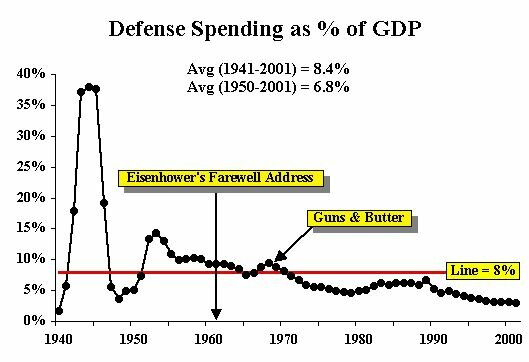
Interesting
Also Interesting
Discuss...
| quote: |
| Originally posted by NeoPhono In my opinion, the reason we have such a debt/defecit today, is because our governement (and many governements of the world) have become large, uncontrolled beaurocracies where the cost to "make it run," is as much or more than the services it provides. Our government spends a dollar on paperwork for every 1 dollar spent on a government program. This to me is rediculous and the true cause of the nations fiscal woes. We are a country (and world) so consumed with the fear of litigation, making sure all the "t's are crossed and i's dotted," and the absurd hope of having a regulation or manual for everything, that we have let our madness poison our economy. This paperwork insanity also leaks over to health care. Today, 31 cents of every dollar spent on health care goes towards administration and paperwork. That's twice what it is in Canada. Just think if we could reduce that by even ten cents. So much more of our money would actually go towards our health instead of in a filing cabinet. I know I'm sounding like a mad man but this issue goes quiet and I see it as the real reason for our financial troubles. We spend no more today of our GNP on actual government programs than at any other time in our history. What we do spend more on is the paperwork that goes on behind it. It's like we're paying for everything twice, once for the action, and once of the paper trail that comes after it. |

| quote: |
| Originally posted by NeoPhono Just thought I'd throw in some interesting figures as far as defense spending. Interesting Also Interesting Discuss... |

| quote: |
| Originally posted by occrider Well the factbook puts US spending on defense at 3.2% ... in 1999. What is it now after 2 years of war? It's still bigger than most comprable european nations. |
| quote: |
| Originally posted by occrider Well the factbook puts US spending on defense at 3.2% ... in 1999. What is it now after 2 years of war? It's still bigger than most comprable european nations. |
| quote: |
| Originally posted by Yoepus I saw the author of "Of Paradise and Power" the other day on CSPAN2, he spoke very nice and I'll think all put an order after I'm done with my current tiles -- the argument is European nations are inconcievably weak militarily, they couldn't even collectively muster enough forces to put out the little forest fire right in their own backyards, in the Balkans. The Europeans live in a state of Paradise - they don't have to spend anything on the military, they have no threat to worry about, but it is only for one reason ---- because of the power of the USA. The military power of the USA and the understanding that the USA will intervene against any threat to peaceful Europe affords them the abilit to use the valuable % of their military budget into benifical social services instead. I think there is a lot of truth for that, Europe is in paradise due to the power (or the expense) of the USA. |

| quote: |
| If it wasn't for the USA, maybe half of europe was german now, but then again, there would be no Israel. |
| quote: |
| Originally posted by borron OH THANK YOU USA! THANK YOU FOR KEEPING EUROPE SAFE!!!! |

Interesting Rebuttal from the Left
Krugman sets out a rebuttal to those Conservatives who don't admit that taxes play a role in deficits:
| quote: |
| January 27, 2004 OP-ED COLUMNIST Red Ink Realities By PAUL KRUGMAN ven conservatives are starting to admit that George Bush isn't serious when he claims to be doing something about the exploding budget deficit. At best � to borrow the already classic language of the State of the Union address � his administration is engaged in deficit reduction-related program activities. But these admissions have been accompanied by an urban legend about what went wrong. According to cleverly misleading reports from the Heritage Foundation and other like-minded sources, the deficit is growing because Mr. Bush isn't sufficiently conservative: he's allowing runaway growth in domestic spending. This myth is intended to divert attention from the real culprit: sharply reduced tax collections, mainly from corporations and the wealthy. Is domestic spending really exploding? Think about it: farm subsidies aside, which domestic programs have received lavish budget increases over the last three years? Education? Don't be silly: No Child Left Behind is rapidly turning into a sick joke. In fact, many government agencies are severely underfinanced. For example, last month the head of the National Park Service's police admitted to reporters that her force faced serious budget and staff shortages, and was promptly suspended. A recent study by the Center on Budget and Policy Priorities does the math. While overall government spending has risen rapidly since 2001, the great bulk of that increase can be attributed either to outlays on defense and homeland security, or to types of government spending, like unemployment insurance, that automatically rise when the economy is depressed. Why, then, do we face the prospect of huge deficits as far as the eye can see? Part of the answer is the surge in defense and homeland security spending. The main reason for deficits, however, is that revenues have plunged. Federal tax receipts as a share of national income are now at their lowest level since 1950. Of course, most people don't feel that their taxes have fallen sharply. And they're right: taxes that fall mainly on middle-income Americans, like the payroll tax, are still near historic highs. The decline in revenue has come almost entirely from taxes that are mostly paid by the richest 5 percent of families: the personal income tax and the corporate profits tax. These taxes combined now take a smaller share of national income than in any year since World War II. This decline in tax collections from the wealthy is partly the result of the Bush tax cuts, which account for more than half of this year's projected deficit. But it also probably reflects an epidemic of tax avoidance and evasion. Everyone who wants to understand what's happening to the tax system should read "Perfectly Legal," the new book by David Cay Johnston, The Times's tax reporter, who shows how ideologues have made America safe for wealthy people who don't feel like paying taxes. I was particularly struck by Mr. Johnston's description of the carefully staged Senate Finance Committee hearings in 1997-1998. Senators Trent Lott and Frank Murkowski accused the I.R.S. of "Gestapo"-like tactics, and Congress passed new rules that severely restricted the I.R.S.'s ability to investigate suspected tax evaders. Only later, when the cameras were no longer rolling, did it become clear that the whole thing was a con. Most of the charges weren't true, and there was good reason to believe that the star witness, who dramatically described how I.R.S. agents had humiliated him, really was engaged in major-league tax evasion (he eventually paid $23 million, insisting he had done no wrong). And this was part of a larger con. What's playing out in America right now is the bait-and-switch strategy known on the right as "starve the beast." The ultimate goal is to slash government programs that help the poor and the middle class, and use the savings to cut taxes for the rich. But the public would never vote for that. So the right has used deceptive salesmanship to undermine tax enforcement and push through upper-income tax cuts. And now that deficits have emerged, the right insists that they are the result of runaway spending, which must be curbed. While this strategy has been remarkably successful so far, it also offers a big opportunity to the opposition. So here's a test for the Democratic contenders: details of your proposals aside, which of you can do the best job explaining the ongoing budget con to the American people? http://www.nytimes.com/2004/01/27/opinion/27KRUG.html |
| quote: |
| Originally posted by NeoPhono Holy shit! You're saying that Israel is comparable to Nazi Germany? I've heard it all now. I know people can be a little fanatical about the whole Israel/Palestine debate, but I've never heard anyone go that far. Get a grip, man. |
Leave the Israeli/Pal crap out of this thread ... it already has about 4 or 5 threads on the main page 
Now back to the topic at hand.
| quote: |
| Originally posted by NeoPhono 3.3%, at least according to this professor before congress. LINK |
| quote: |
| Originally posted by occrider Leave the Israeli/Pal crap out of this thread ... it already has about 4 or 5 threads on the main page |

| quote: |
| Now back to the topic at hand. |
| quote: |
Hmmm well that's definetely a lot less than I thought it would be which is a good thing. Perhaps at a time like this (when involved in two semi-wars) such a high budget is needed to sustain the occupation while ensuring that modernization efforts are maintained. However, I would pose that in peacetime, such a high budget would be completely unnecessary regardless of its comprable expenditures in gdp to other nations. Keep in mind that I am first in line to advocate a strong military, but I think much of military is still a cold war military. Rumsfeld has accomplished some efforts into making it a more mobile army but a lot more can be done. The new seawolf and virginia class subs are a huge drain on the navy budget while one can question the the number of orders for f-22 and f-35 class fighters. Already the fighters they are designed to replace have nearly unmatched air superiority ... meanwhile, very few other countries are pursuing third generation fighters to the degree we are. Anyway, I think there are a number of programs such as that are not needed to the degree that we have and we can cut costs significantly. Basically, I think that we can have just as much effectiveness with our fighting forces with defense spending capped at around 2.5% as we do now. |

Powered by: vBulletin
Copyright © 2000-2021, Jelsoft Enterprises Ltd.