
TranceAddict Forums (www.tranceaddict.com/forums)
- Political Discussion / Debate
-- America's Military Industrial Complex - A Warning From Dwight D. Eisenhower
America's Military Industrial Complex - A Warning From Dwight D. Eisenhower
NeoPhono's post in another thread just had me thinking about this.
| quote: |
| Originally posted by NeoPhono Just thought I'd throw in some interesting figures as far as defense spending. 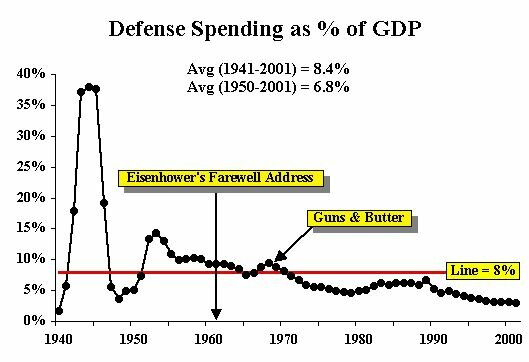 |
| quote: |
| Originally addressed by Dwight D. Eisenhower Until the latest of our world conflicts, the United States had no armaments industry. American makers of plowshares could, with time and as required, make swords as well. But now we can no longer risk emergency improvisation of national defense; we have been compelled to create a permanent armaments industry of vast proportions. Added to this, three and a half million men and women are directly engaged in the defense establishment. We annually spend on military security more than the net income of all United States corporations. This conjunction of an immense military establishment and a large arms industry is new in the American experience. The total influence -- economic, political, even spiritual -- is felt in every city, every State house, every office of the Federal government. We recognize the imperative need for this development. Yet we must not fail to comprehend its grave implications. Our toil, resources and livelihood are all involved; so is the very structure of our society. In the councils of government, we must guard against the acquisition of unwarranted influence, whether sought or unsought, by the military-industrial complex. The potential for the disastrous rise of misplaced power exists and will persist. We must never let the weight of this combination endanger our liberties or democratic processes. We should take nothing for granted. Only an alert and knowledgeable citizenry can compel the proper meshing of the huge industrial and military machinery of defense with our peaceful methods and goals, so that security and liberty may prosper together. (...) Disarmament, with mutual honor and confidence, is a continuing imperative. Together we must learn how to compose differences, not with arms, but with intellect and decent purpose. Because this need is so sharp and apparent I confess that I lay down my official responsibilities in this field with a definite sense of disappointment. As one who has witnessed the horror and the lingering sadness of war -- as one who knows that another war could utterly destroy this civilization which has been so slowly and painfully built over thousands of years -- I wish I could say tonight that a lasting peace is in sight. (...). |
the best exposition/monologue on the military-industrial remains Matt Damon's bit in Good Will Hunting during one of his job interviews -- just as learned as Ike 
(for another example of ignored presidential warnings peep george washington's mindfulness "of the danger of foreign entaglements" in his farewell address...)
From what I've heard the "military-industrial complex" is very sick at the moment. The free-spending days post Vietnam to the Regan era have stopped and now these arms manufacturers are having a hard time making ends meet. I'm not trying to be sympathetic or empathetic but I don't think the military-industrial complex is what it used to be or has the merit on a political or economic scale that it once had.
For me, the primary role of a central government is to provide for the common defense. Without a stable, safe nation the other roles of government are a mute point. Have we gone overboard as far as military spending? Maybe, but in terms of how much our nation makes in relation to how much we spend in defense, we are on par with most other nations. You also have to look at our track record as far as defense goes. In our almost 230 years of existance, we have had no major conflicts on our own soil (save the civil war, which was a domestic, not international conflict). We have had Pearl Harbor and 9/11, but I think the events afterward have or are speaking for themselves.
Do we spend too much on our military? Maybe. However, our military has kept the United States and argueably the world safe from major military conflict for the past 50 years, and I would rather be debating its over-funding than its under-funding as we worry about our security.
why worry about the military-industrial complex, when you have the healthcare-industrial complex, and the welfare-industrial complex, and the infastructure-industrial complex, and the corporate-industrial complex, and the news-media-industrial complex....
| quote: |
| -- Excerpt from a speech delivered in 1933, by Major General Smedley Butler, USMC. War is just a racket. A racket is best described, I believe, as something that is not what it seems to the majority of people. Only a small inside group knows what it is about. It is conducted for the benefit of the very few at the expense of the masses. I believe in adequate defense at the coastline and nothing else. If a nation comes over here to fight, then we'll fight. The trouble with America is that when the dollar only earns 6 percent over here, then it gets restless and goes overseas to get 100 percent. Then the flag follows the dollar and the soldiers follow the flag. I wouldn't go to war again as I have done to protect some lousy investment of the bankers. There are only two things we should fight for. One is the defense of our homes and the other is the Bill of Rights. War for any other reason is simply a racket. There isn't a trick in the racketeering bag that the military gang is blind to. It has its "finger men" to point out enemies, its "muscle men" to destroy enemies, its "brain men" to plan war preparations, and a "Big Boss" Super-Nationalistic-Capitalism. It may seem odd for me, a military man to adopt such a comparison. Truthfulness compels me to. I spent thirty- three years and four months in active military service as a member of this country's most agile military force, the Marine Corps. I served in all commissioned ranks from Second Lieutenant to Major-General. And during that period, I spent most of my time being a high class muscle- man for Big Business, for Wall Street and for the Bankers. In short, I was a racketeer, a gangster for capitalism. I suspected I was just part of a racket at the time. Now I am sure of it. Like all the members of the military profession, I never had a thought of my own until I left the service. My mental faculties remained in suspended animation while I obeyed the orders of higher-ups. This is typical with everyone in the military service. I helped make Mexico, especially Tampico, safe for American oil interests in 1914. I helped make Haiti and Cuba a decent place for the National City Bank boys to collect revenues in. I helped in the raping of half a dozen Central American republics for the benefits of Wall Street. The record of racketeering is long. I helped purify Nicaragua for the international banking house of Brown Brothers in 1909-1912 (where have I heard that name before?). I brought light to the Dominican Republic for American sugar interests in 1916. In China I helped to see to it that Standard Oil went its way unmolested. During those years, I had, as the boys in the back room would say, a swell racket. Looking back on it, I feel that I could have given Al Capone a few hints. The best he could do was to operate his racket in three districts. I operated on three continents. http://www.fas.org/man/smedley.htm |
| quote: |
| "Why don't these damned oil companies fly their own flags on their personal property - maybe a flag with a gas pump on it." - Brigadier General Smedley D. Butler (1937) |
Military Industrial Complexes
by Karen Kwiatkowski
LINK TV�s "Active Opposition" aired a show last Wednesday discussing the military industrial complex. It featured a panel discussion, opening with Dwight D. Eisenhower�s famous farewell speech of 43 years ago.
In preparation for this panel, I re-read War Is a Racket, by two-time Congressional Medal of Honor recipient Lieutenant General Smedley Butler. Butler�s post-World War I, pre-World War II assessment is far more direct than Ike�s speech. Marines often tend to tell it like it is.
I wonder what Butler or Ike, generals who had served in several brutal wars, would have thought about the latest news from Abu Ghraib prison in Baghdad.
Smedley Butler noticed how defense industries carefully nurtured politicians for war. Like good cops, they emphasized the job creation benefits and their own outstanding ability to produce needed armaments and supplies. All you want, and then some, yessiree! If that didn�t do the trick, the bad cop defense industrial establishment worried that without war, vast debts owed them by allies or opponents might never be collected, and domestic economic collapse would follow. Politicians, unchanging from the time of Plato, knew exactly what to do.
Ike was concerned that the average American did not really understand the sycophantic and co-dependent relationship between the defense industries, the military leadership, and the Congress. He noted "This conjunction of an immense military establishment and a large arms industry is new in the American experience. �We recognize the imperative need for this development. Yet we must not fail to comprehend its grave implications."
Ike advised America to stay vigilant, observant, "alert and knowledgeable." Smedley Butler, more of a realist I suppose, simply advised that when talk of war raged, all of the industrialists and politician be conscripted first, then their children, and lastly, the rest of us. Butler conceived a simple democratic plan that would require a decision for war be approved by a majority of all those who would be sent to fight. Draftable young men would vote yea or nay for the next war. No votes by older folks or politicians and industrialists would be considered. Such a system would ensure that truly defensive wars would be fought, and all other wars rejected.
American soldiers today are quite familiar with the military industrial complex and outsourcing. They see inedible food, an extra burden of providing security, and shocking pay inequities. They see inscrutable accountability mysteries.
Some Iraqis held at Abu Ghraib Prison have met the modern American military industrial complex up close and personal. Contractors from CACI International and Titan Corporation, as well as members of our own military, are under investigation for "mistreating" prisoners.
CACI International and Titan Corporatio represent numbers 63 and 35, respectively, of the Pentagon�s top 100 contractors for 2002. These companies are small fry, as out-sourcing goes.
Rational people may debate whether America�s occupation of Iraq is purely defensive, a Republic behaving imperially, or the blueprint for a new kind of empire. But underlying the debate is a fact � that by its very existence � undermines the Constitution, American traditions of justice, and the laws of armed conflict.
We have today over 15,000 military contractors in Iraq, doing not just the cooking and cleaning, but the fighting, the guarding, the strategizing, and even some of the dying. After the U.S. and the U.K. militaries, this third largest "force" outnumbers the entire remaining coalition of the paid for.
The military industrial complex lobbies Congress on a daily basis, costs the taxpayer billions each year, chips away at the credibility of the United States as a force for justice and good will, exists in a hazy legal wasteland unaccountable to domestic or international law, and serves to embarrass the country periodically with overcharges, technology leaks to other countries, and human rights abuses.
Outsourcing contracts for everything from toilet paper to bullets to guards and interrogators have become the Soylent Green of the military industrial complex, an "artificial nourishment whose actual ingredients are not known by the public." The top 100 CEOs and Vice Presidents cheerfully move from government circles into defense industries, and sometimes back again.
This third-generation spawn of Smedley Butler�s racketeers go where we pay them to go and do what they are told. They can hardly complain later that they were forced into anything, or misled by faulty intelligence, or didn�t know what they were getting into. You see, it�s all in their contracts. This makes them worth far more to Washington than our all-volunteer force of American soldiers, sailors, airmen and marines.
When we consider the American military, we don�t think about contracts or contractors, and we don�t worry about the parasitical military industrial complex. Smedley Butler and Dwight D. Eisenhower thought we should. America at war, circa 2004, proves them to be not only patriots, but prophets as well.
May 3, 2004
Karen Kwiatkowski is a retired USAF lieutenant colonel, who spent her final four and a half years in uniform working at the Pentagon. She now lives with her freedom-loving family in the Shenandoah Valley, and writes a bi-weekly column on defense issues with a libertarian perspective for militaryweek.com.


| quote: |
| Smedley Butler noticed how defense industries carefully nurtured politicians for war. Like good cops, they emphasized the job creation benefits and their own outstanding ability to produce needed armaments and supplies. All you want, and then some, yessiree! If that didn�t do the trick, the bad cop defense industrial establishment worried that without war, vast debts owed them by allies or opponents might never be collected, and domestic economic collapse would follow. Politicians, unchanging from the time of Plato, knew exactly what to do. Ike was concerned that the average American did not really understand the sycophantic and co-dependent relationship between the defense industries, the military leadership, and the Congress. He noted "This conjunction of an immense military establishment and a large arms industry is new in the American experience. �We recognize the imperative need for this development. Yet we must not fail to comprehend its grave implications." |
http://www.maps.com/reference/geosh...r/2034rank.html
Rank Country Military expenditures - percent of GDP(%)
1 Korea, North 22.90 2003
2 Jordan 20.20 2003
3 Eritrea 11.80 2003
4 Oman 11.40 2003
5 Qatar 10.00 NA
6 Saudi Arabia 10.00 2002
7 Israel 8.70 FY02
8 Maldives 8.60 2003
9 Yemen 7.90 2003
10 Bahrain 7.50 2003
11 Armenia 6.50 FY01
12 Burundi 6.00 2003
13 Macedonia, The Former Yugoslav Republic of 6.00 NA
14 Brunei 5.90 2003
15 Syria 5.90 NA
16 Kuwait 5.80 2003
17 New Caledonia 5.30 FY96
18 Turkey 5.30 2003
19 Ethiopia 5.20 2003
20 Singapore 4.90 NA
21 Lebanon 4.80 NA
22 Morocco 4.80 2003
23 Bosnia and Herzegovina 4.50 NA
24 Djibouti 4.40 2003
25 Greece 4.30 2003
26 Chile 4.00 2003
27 Libya 3.90 NA
28 Tajikistan 3.90 FY01
29 Pakistan 3.90 FY02/03
30 United States 3.90 2001
31 Cyprus 3.80 NA
32 Mauritania 3.70 2003
33 Botswana 3.60 2003
34 Egypt 3.60 2003
35 Algeria 3.50 2003
36 Colombia 3.40 FY01
37 Turkmenistan 3.40 NA
38 Iran 3.30 2003 est.
39 Sri Lanka 3.20 2003
40 United Arab Emirates 3.10 NA
41 Cambodia 3.00 NA
42 Comoros 3.00 2003
43 Rwanda 2.90 2003
44 Australia 2.80 2003
45 Guinea-Bissau 2.80 2003
46 Congo, Republic of the 2.80 2003
47 Benin 2.70 2003
48 Korea, South 2.70 FY03
49 Taiwan 2.70 2003
50 Azerbaijan 2.60 NA
51 Bulgaria 2.60 2003
52 France 2.60 2003
53 Lesotho 2.60 2003
54 Equatorial Guinea 2.50 2003
55 Sudan 2.50 NA
56 Vietnam 2.50 NA
57 Namibia 2.50 2003
58 Romania 2.47 2002
59 Ecuador 2.40 2003
60 United Kingdom 2.40 2003
61 India 2.40 2003
62 Croatia 2.39 2002 est.
63 Portugal 2.30 2003
64 Fiji 2.20 FY02
65 Mozambique 2.20 2003
66 Mongolia 2.20 FY02
67 Burma 2.10 NA
68 Brazil 2.10 2003
69 Uganda 2.10 2003
70 Sweden 2.10 FY01
71 Chad 2.10 2003
72 Czech Republic 2.10 FY01
73 Malaysia 2.03 NA
74 Belize 2.00 2003
75 World 2.00 NA
76 Finland 2.00 FY98/99
77 Gabon 2.00 2003
78 Uzbekistan 2.00 NA
79 Uruguay 2.00 2003
80 Estonia 2.00 2002 est.
81 Angola 1.90 2003
82 Togo 1.90 2003
83 Norway 1.90 2003
84 Lithuania 1.90 FY01
85 Italy 1.90 2003
86 Bhutan 1.90 2003
87 Slovakia 1.89 2002
88 Cuba 1.80 2003
89 Kenya 1.80 2003
90 Seychelles 1.80 2003
91 Swaziland 1.80 2003
92 Thailand 1.80 2003
93 Hungary 1.75 2002 est.
94 Poland 1.71 2002
95 Guinea 1.70 2003
96 South Africa 1.70 2003
97 Zimbabwe 1.70 2003
98 Slovenia 1.70 FY00
99 Bolivia 1.60 2003
100 Nepal 1.60 2003
101 Burkina Faso 1.60 2003
102 Denmark 1.60 2003
103 Netherlands 1.60 2003
104 Cape Verde 1.50 2003
105 Tunisia 1.50 NA
106 Sierra Leone 1.50 2003
107 Senegal 1.50 2003
108 Philippines 1.50 NA
109 Honduras 1.50 2003
110 Germany 1.50 2003
111 Albania 1.49 FY02
112 Belarus 1.40 FY02
113 Papua New Guinea 1.40 FY02
114 Kyrgyzstan 1.40 FY01
115 Congo, Democratic Republic of the 1.40 2003
116 Ukraine 1.40 FY02
117 Cameroon 1.40 2003
118 Argentina 1.30 FY00
119 Belgium 1.30 2003
120 Venezuela 1.30 2003
121 Peru 1.30 2003
122 Mali 1.30 2003
123 Liberia 1.30 2003
124 Indonesia 1.30 NA
125 Bangladesh 1.20 2003
126 Cote d'Ivoire 1.20 2003
127 Spain 1.20 2003
128 Panama 1.20 2003
129 Nicaragua 1.20 2003
130 Madagascar 1.20 2003
131 Latvia 1.20 FY01
132 Canada 1.10 2003
133 El Salvador 1.10 2003
134 Dominican Republic 1.10 1998
135 Niger 1.10 2003
136 Central African Republic 1.10 2003
137 Afghanistan 1.00 2003
138 Switzerland 1.00 FY01
139 Japan 1.00 2003
140 New Zealand 1.00 FY02
141 Ireland 0.90 FY00/01
142 Zambia 0.90 2003
143 Somalia 0.90 2003
144 Paraguay 0.90 2003
145 Nigeria 0.90 2003
146 Mexico 0.90 2003
147 Haiti 0.90 2003
148 Luxembourg 0.90 2003
149 Kazakhstan 0.90 FY02
150 Austria 0.80 FY01/02
151 Sao Tome and Principe 0.80 2003
152 Guatemala 0.80 2003
153 Guyana 0.80 2003
154 Malawi 0.70 2003
155 Suriname 0.70 2003
156 Malta 0.70 2003
157 Ghana 0.60 2003
158 Trinidad and Tobago 0.60 2003
159 Georgia 0.59 NA
160 Laos 0.50 2003
161 Costa Rica 0.40 2003
162 Jamaica 0.40 2003
163 Moldova 0.40 FY02
164 Gambia, The 0.30 2003
165 Mauritius 0.20 2003
166 Tanzania 0.20 2003
167 Bermuda 0.11 NA
also refer to page 22 of:
http://www.fas.org/man/crs/RL32209.pdf
Okay, but does this really have anything to do with the thread topic?
The US has the highest GDP of any country in the world so obviously it's expenditures are going to be low in regards to the %age, but even that is irrelevant to this thread.
I don't really understand where you're trying to take this, that's all.
| quote: |
| Originally posted by Izzy http://www.maps.com/reference/geosh...r/2034rank.html Rank Country Military expenditures - percent of GDP(%) 1 Korea, North 22.90 2003 2 Jordan 20.20 2003 3 Eritrea 11.80 2003 4 Oman 11.40 2003 5 Qatar 10.00 NA 6 Saudi Arabia 10.00 2002 7 Israel 8.70 FY02 8 Maldives 8.60 2003 9 Yemen 7.90 2003 10 Bahrain 7.50 2003 11 Armenia 6.50 FY01 12 Burundi 6.00 2003 13 Macedonia, The Former Yugoslav Republic of 6.00 NA 14 Brunei 5.90 2003 15 Syria 5.90 NA 16 Kuwait 5.80 2003 also refer to page 22 of: http://www.fas.org/man/crs/RL32209.pdf |
| quote: |
| Originally posted by Trancer-X Okay, but does this really have anything to do with the thread topic? The US has the highest GDP of any country in the world so obviously it's expenditures are going to be low in regards to the %age, but even that is irrelevant to this thread. I don't really understand where you're trying to take this, that's all. |
| quote: |
| Originally posted by Izzy well you opened up with an image of military spending as % of GDP. I just wanted to put it in reference and say its not that out of the norm in comparision to other contries. I believe that the goverments first and most important priority is to protect the lives of its citizens. From outside factors such as other countries (hence military), natural disasters (hence national gaurd) to inside dangers (hence police and fire departments). I dont think there is anything to fear about the American military complex because at the end of the day it can only do what is decided upon by the president and congress (ie, we the people). |
respoonse to trancer x
"won't fault you for your naivety. You just fail to realize how much of a dominant role the Military Industrial Complex plays in our current administration. As Bush has stated many times, he is "The War President!"
Yes, they are a big role in our current administration. What would youo expect of a president from TEXAS!
oops
i misspelled "response"

Powered by: vBulletin
Copyright © 2000-2021, Jelsoft Enterprises Ltd.