
TranceAddict Forums (www.tranceaddict.com/forums)
- Political Discussion / Debate
-- Greenspan: Cut Social Security
Pages (2): [1] 2 »
Greenspan: Cut Social Security
Hey, whadya know? It's early Christmas for Conservatives! You Rebubs. might just eventually get your wish after all! Instead of actively dealing with the deficit by cutting a great many of Bush's ridiculous washed-up programs, and instead of stopping the tax cuts which are contributing greatly to the deficit, let's just consider ridding of that old Social Security program!
What New Deal?
http://money.cnn.com/2004/02/25/new...dex.htm?cnn=yes
Regardless of who's in the whitehouse, it's going to happen and it's got to be done. The tax burden on the working population is going to be too much when the baby boomers retire. I'll comment more on this tonight when I can break out my public finance econ book and crunch some numbers 
First off, Greenspan is right. The funding mechanism does need to change. The ratio of current workers who provide for the retired is far too low. Partial privatization is a reasonable option, but when you try and take control out of Washington, the lefties scream. (Even though my dog could do better than the 2% annual return the government gives us on our money.) If anything is a "washed-up" program, it's social security.
And dumping more money into it will not solve the problem, because in the end, you still have systemic problems. The government trying to spend its way through the coming crisis will cost, literally, trillions. The mechanism has to change. The only good thing about the impending problems is that the US doesn't have it nearly as bad as some European pension systems, which are already on the verge of collapse, and are destined to get worse. Their ratios of workers to retired are even lower.
Re: Greenspan: Cut Social Security
| quote: |
| Originally posted by MisterOpus1 ...and instead of stopping the tax cuts which are contributing greatly to the deficit, let's just consider ridding of that old Social Security program! |
Re: Re: Greenspan: Cut Social Security
I'm tired of hearing the excuse that tax cuts do not cause deficits. Without looking at numbers, it simply seems common sense to see that the return is significantly less as a result of less taxes to the government. But when we do look at numbers:
February 13, 2003
Tax Cuts a Major Factor in Return of Deficits
The Center on Budget and Policy Priorities has released Are Tax Cuts a Minor or Major Factor in the Return of Deficits?, which examines this question using data the Congressional Budget Office issued in late January. Mitchell Daniels, the Director of the President�s Office of Management and Budget, has said that the tax cuts of the past two years have played only a �minor� role in the return of budget deficits and that the budget would be in deficit even without them. The Center�s analysis finds that:
A third of the deterioration in the budget is due to the tax cuts. Since 2000, the budget has deteriorated by an amount equal to 4.0 percent of GDP. One-third of this deterioration has been caused by tax cuts enacted in the last two years, making the tax cuts one of the principal factors behind the budget deterioration.
The CBO data do not reflect the possible economic stimulus effects of recent tax or spending measures. The President�s Council of Economic Advisers argues that the tax cuts have stimulated economic growth and has estimated how much worse the economy would have been without them. Yet even using the CEA estimates, the net cost of the tax cuts would still turn out to have caused almost 30 percent of the budget deterioration since 2000. Moreover, other studies suggest the CEA estimates likely overstate the tax cuts� effect on the economy.
Without the tax cuts, surpluses would return in 2004. The recession, along with defense, homeland security, and other spending increases already enacted, would have driven the budget into deficit in 2002 and 2003 even without the tax cuts. But the budget would be back in surplus in 2004 and stay there for the rest of the decade were it not for the tax cuts. In contrast, the Administration itself says the budget will remain in deficit every year for the next 75 years under its budget, which would make the 2001 tax cut permanent, add further tax cuts, and increase spending in areas like a prescription drug benefit.
More than half of 2003 and 2004 budgetary costs are due to tax cuts. Over the last two years, Congress has enacted legislation costing an annual average of $260 billion in 2003 and 2004. Some 58 percent of this cost is due to tax cuts, more than all other legislation � including increases for the military and homeland security, last year�s farm bill, and other legislation � combined. (Using the favorable CEA assumptions to factor in the supposed economic benefits of the tax cuts reduces that 58 percent figure only slightly, to 54 percent.)
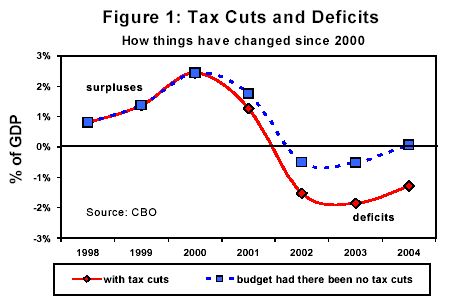
http://www.cbpp.org/2-13-03bud-fact.htm
Here's a nice projection seemingly beginning to take shape:
| quote: |
| January 26, 2004 CBO DATA CONFIRM THAT EXTENDING TAX CUTS WOULD MORE THAN DOUBLE THE SIZE OF ITS OWN OFFICIAL DEFICIT PROJECTIONS The new Congressional Budget Office budget projections show deficits of $1.9 trillion over the next ten years, fiscal years 2005 � 2014. As CBO has acknowledged, however, the baseline projections are unrealistically optimistic, since they do not include the costs of continuing various existing policies, such as the recent tax cuts and relief from the Alternative Minimum Tax. Table 1-3 on page 6 of CBO�s new report, along with footnote 13 of the report, show that extending the tax cuts and AMT relief would themselves add another $2.9 trillion to deficits over the next ten years � bringing the total ten-year deficit to $4.8 trillion. In recent months, four different analyses have been conducted of deficits over the decade from 2004 � 2013 if current policies � such as the tax cuts and AMT relief � are continued. All four analyses � a joint analysis by the business-backed Committee for Economic Development, the Concord Coalition, and the Center on Budget and Policy Priorities, as well as analyses by the Brookings Institution, Goldman Sachs, and Decision Economics (a Wall Street forecasting firm), found deficits of $5 trillion or more. The Brookings analysis, issued earlier this month, also includes a projection for the years 2005 � 2014. It projects deficits of $5.3 trillion over this period. The Center on Budget and Policy Priorities is currently preparing a new analysis of projected deficits for 2005 � 2014, based on the CBO projections issued today and incorporating the costs of continuing current policies, as noted above. This analysis will be completed later on January 26 or on January 27. But the bottom line is clear � a more realistic projection shows actual deficits over the next ten years will be about $3 trillion above CBO�s official $1.9 trillion figure and will be roughly $5 trillion. http://www.cbpp.org/1-26-04bud2.htm |
Re: Re: Greenspan: Cut Social Security
| quote: |
| Originally posted by MisterOpus1 Hey, whadya know? It's early Christmas for Conservatives! You Rebubs. |

| quote: |
| Originally posted by MisterOpus1 I'm tired of hearing the excuse that tax cuts do not cause deficits. |
| quote: |
| Originally posted by Shakka How 'bout this. Reverse the structure. Congress gets a lump sum of tax receipts, out of which they can try to pursue whatever programs they like. At the end of the day, whatever is left can be divied up among them and that will be their salary. Seriously--these guys are supposed to be the ones who work for the public good, yet they are the ones most guilty of sapping the public treasury for all it's worth and then bitching that there's not enough in the end, so therefore Mr. & Mrs. John Doe must cough up another 10% of their own hard earned money to pay for the latest entitlement program du jour. Congressmen should work for public sector wages, yet they are some of the wealthiest criminals in this country. |


Here is the report:
http://msnbc.msn.com/id/4372995/
| quote: |
Senators' stocks often outperform market Study supports belief elected officials have advantageBy Deborah Brewster Updated: 2:43 p.m. ET Feb. 25, 2004NEW YORK - U.S. senators' personal stock portfolios outperformed the market by an average of 12 percent a year in the five years to 1998, according to a new study. advertisement "The results clearly support the notion that members of the Senate trade with a substantial informational advantage over ordinary investors," says the author of the report, Professor Alan Ziobrowski of the Robinson College of Business at Georgia State University. He admits to being "very surprised" by his findings, which were based on 6,000 financial disclosure filings and are due to be published in the Journal of Financial and Quantitative Analysis. "The results suggest that senators knew when to buy their common stocks and when to sell." First-time senators did especially well, with their stocks outperforming by 20 percent a year on average � a result that very few professional fund managers would be able to achieve. "It could be argued that the junior senators most recently came out of private industry, so may have better connections. Seniority was definitely a factor in returns," says Prof. Ziobrowski. There was no difference in performance between Democrats and Republicans. A separate study in 2000, covering 66,465 U.S. households from 1991 to 1996 showed that the average household's portfolio underperformed the market by 1.44 percent a year, on average. Corporate insiders (defined as senior executives) usually outperform by about 5 percent. The Ziobrowski study notes that the politicians' timing of transactions is uncanny. Most stocks bought by senators had shown little movement before the purchase. But after the stock was bought, it outperformed the market by 28.6 per cent on average in the following calendar year. Returns on sell transactions are equally intriguing. Stocks sold by senators performed in line with the market the year following the sale. When adjusted by the size of stocks, the total portfolio returns outperformed by 12 percent a year on average. The study used a total market index as the benchmark for comparison. The study took eight years to complete because there was no database of information and the documents had to be gathered and examined manually. Stocks held in blind trusts are not included in the disclosure documents. � The Financial Times Ltd 2004. "FT" and "Financial Times" are trademarks of the Financial Times. |
| quote: |
| Originally posted by DaveSZ Here is the report: http://msnbc.msn.com/id/4372995/ |
| quote: |
| Originally posted by occrider At any rate, I have virtually no time to go into the social security debate, so I'll simply refer to the CATO institute who have done extensive analysis of the problems and possible solutions. www.socialsecurity.org |

| quote: |
| Originally posted by MisterOpus1 Oh sure, post the beloved Conservative CATO institute research will ya Dick? Geez, I should have known. |
By the way, a word of advice to all of us younguns. You better start planning your own individual retirements now instead of relying upon social security. For our generation it's a virtual gaurantee that social security insolvency is going to significantly reduce the benefits we get. Therefore, I recently attended a financial planning seminar where they presented two Individual Retirement Account scnearios:
Person A and Person B both open IRA accounts compounded at 9% interest. Person A puts in his account $3000 a year starting at age 22 until age 30 for a total of $27,000 then stops all savings. Person B puts in $3000 a year starting at age 31 until age 65 for a grand total of $105,000 in savings. However, the value of account A at age 65 is $869,202 while the value of account B at age 65 is only $705,385. Something to think about ...
Some interesting tidbits I overheard on NPR:
The total % of GDP:
Social Security - ~.75%
Bush's Tax Cuts - ~2%
Another interesting tidbit on taxes:
Since Bush's tax cuts-
Ave. U.S. city sales taxes have increased 8%
Ave. U.S. county sales taxes increased 5%
Ave. U.S. state sales taxes increased 4%
Are we really getting less taxes?
Also, consider that those who earn $200,000 or more annually benefited the most from Bush's tax cuts. Everyone is taxed the same in sales taxes, regardless of income. A $500 TV costs a low income worker the same amount as a high income worker. So I don't think the question should be who's benefiting the most from Bush's tax cuts - rather, who's getting screwed the most overall?
How can one not classify this as class warfare?
Tax Cuts helping small businesses my ASS!
| quote: |
| washingtonpost.com Bush Assertion on Tax Cuts Is at Odds With IRS Data By Jonathan Weisman Washington Post Staff Writer Tuesday, February 24, 2004; Page A04 President Bush defended his tax cuts yesterday as economic fuel for the small-business sector in response to mounting criticism from Democratic presidential candidates that the cuts chiefly benefited the wealthiest Americans. But the president's contention that upper-income tax cuts primarily benefit entrepreneurs conflicts with some of the government's own data. Democratic Sens. John F. Kerry (Mass.) and John Edwards (N.C.) have pledged to restore the top two income tax rates to a maximum of 39.6 percent if elected president, but Bush and Republican allies say such a move would disproportionately punish small businesses, most of which pay individual income tax rates on their profits. "If you're worried about job growth, it seems like it makes sense to give a little fuel to those who create jobs, the small-business sector," Bush told a gathering of the nation's governors at the White House. "So I'll vigorously defend the permanency of the tax cuts, not only for the sake of the economy, but for the sake of the entrepreneurial spirit." Internal Revenue Service statistics cited by a Democratic senator this month show that the vast majority of small businesses do not earn nearly enough money to fall into the highest income tax bracket. According to IRS data from the 2001 tax year, 3.8 percent of the 18.2 million business tax returns filed that year reported taxable income of $200,000 or more. The top tax bracket last year kicked in at $311,950 of taxable income. In contrast, 62 percent of business filers reported incomes of less than $50,000, putting them at most in the 15 percent tax bracket, the second lowest. Nearly 88 percent of business filers reported income of less than $100,000, keeping them comfortably below the top two tax brackets of 33 percent and 35 percent, which Kerry and Edwards propose to raise. Republicans point to a different statistic: Of the 750,000 tax filers that pay the top rate, more than two-thirds receive some small-business income from sole proprietorships, partnerships or small businesses incorporated as S corporations, according to the Treasury Department and the Republican staff of the congressional Joint Economic Committee. Last week, the Republican National Committee cited that statistic in charging that Kerry "doesn't realize tax increases would hurt small businesses and farmers." Treasury officials asserted yesterday that about 75 percent of top-bracket tax returns are from "small-business owners." One official said the IRS was limiting its definition of small businesses to sole proprietorships, leaving out huge numbers of S corporations and partnerships. But under Treasury's definition, both Bush and Vice President Cheney are members of the entrepreneurial class. In his 2002 tax return, the president reported $1,549 from rental real estate, royalties, partnerships, S corporations and trusts, including income from GWB Rangers Corp., a remnant of his days as co-owner of the Texas Rangers. Of the Cheney household's $1.2 million income, $238,682 was from business ventures within the White House's definition of small business. Economists say the broad Republican definition of "small-business man" includes not only doctors, lawyers and management consultants but also chief executives who earn $3,000 renting out their chalets in Aspen or report $10,000 in speaking fees. An aide on the Joint Economic Committee conceded that the definition includes the army of accountants and consultants at such giant partnerships as KPMG LLP and PricewaterhouseCoopers LLP, not the firms that "small business" brings to mind. The aide, speaking on the condition of anonymity, said committee economists are debating whether to update the statistics to trim out such behemoths. A Treasury official, who formerly worked for one of the accounting giants, defended their inclusion, saying the partners of the major accounting firms are entrepreneurs. If the definition is revised to stipulate that more than half a small-business person's income has to be from small-business activities, then only one-quarter of filers in the top income tax brackets would be considered entrepreneurs, said William G. Gale, an economist at the Brookings Institution. The contrasting claims came out this month when Treasury Secretary John W. Snow appeared before the Senate Finance Committee. "Less than 4 percent, as a matter of fact, of the small businesses and the farm returns in America are bringing in $200,000 or more," Sen. Blanche Lincoln (D-Ark.) told Snow, confronting him with a chart on the tax rates paid by small businesses. Pressed to respond, Snow replied: "You are asking me to comment on it, and I would like to think about it before I comment on it. The statistics we have -- I am trying to figure out how to reconcile them with the statistics you have." � 2004 The Washington Post Company http://www.washingtonpost.com/ac2/w...anguage=printer |
 Hehe Good Ol Greeny
| quote: |
As he puts it, Greenspan urges cutting benefits "to pay for President Bush's massive tax breaks for millionaires -- which have turned record budget surpluses into deficits." |
| quote: |
Geritol rage Greenspan's advice about cutting Social Security benefits has many boiling mad. February 26, 2004: 12:24 PM EST NEW YORK (CNN) - Get out the Grecian formula and change the battery in your hearing aid! Retirement may be a lot further off if Alan Greenspan's advice rules the day when it comes to Social Security reform. Yesterday he repeated a warning he's made to Congress in the past: Millions of baby boomers are going to be retiring en masse in the not-too-distant future and the cost of paying their social security and medicare benefits could turn the already swelling federal budget deficit into a financial nightmare. But it's his solution that had people up in arms -- from Washington to Wall Street to Main Street: work longer, folks, and accept lower monthly government checks. In his testimony to a House panel, Greenspan urged lawmakers to move quickly to fix the nation's swollen budget deficit -- including measures that could cut some future Social Security payments -- to avoid even bigger problems for the nation's economy down the road. (To read more about Greenspan's comments, click here). The anger came quickly. Roger Hickey of the Campaign for America's Future stated an oft-heard refrain. As he puts it, Greenspan urges cutting benefits "to pay for President Bush's massive tax breaks for millionaires -- which have turned record budget surpluses into deficits." Okay, a very Democratic kind of response in this election year. But trust me, I heard Republican-sympathizing economists making similar remarks. Hickey claims voters will reject this line of thinking -- tax breaks for millionaires, less benefits for older people -- in November: "Americans are starting to ask - why not just stop shoving cash into the pockets of millionaires? Greenspan and the Bush administration are asking average Americans to trim their Social Security checks so that Dick Cheney can keep getting his $90,00 per year in tax breaks." |

I just realized how brilliant a move this is on Greenspan's part.
Greenspan wants Bush to lose the election so a Dem can help get the deficits under control, and that's why he gave them this ammunition with the SS issue. 
Wow. Even some Repubs. are beginning to see that Bush's tax cuts are a detriment to the deficit:
| quote: |
| Posted on Tue, Mar. 02, 2004 Growing deficit changes attitudes about tax cuts By JONATHAN WEISMAN The Washington Post �We're looking at $500 billion deficits, and people are saying that's totally not acceptable. We have to get it down.� � Sen. Don Nickles, an Oklahoma Republican and chairman of the Senate Budget Committee WASHINGTON � Confronted with ever-widening deficit forecasts, some key congressional Republicans worried about long-term budgetary effects of President Bush's tax cuts are preparing legislation to scale back the cuts. Sen. Don Nickles, an Oklahoma Republican and chairman of the Senate Budget Committee, said he will try this year to pass legislation to cut � but not eliminate � the tax on inherited estates. The House and Senate budget committees will begin drafting tax and spending blueprints this week that decline to extend Bush's tax cuts beyond 2011, as the president had requested. And former Senate Budget Committee Chairman Pete Domenici, a New Mexico Republican, is preparing amendments to the budget plan to demand that tax cut extensions be offset by spending cuts or tax increases. �Everything is on the table, ranging from changes in how we do business around here to the tax cuts themselves, particularly as it regards higher-income Americans,� said Sen. John McCain, an Arizona Republican. Although not endorsed by the Senate or House Republican leadership, the discussions mark a growing shift in GOP and conservative attitudes about taxes and spending as Congress begins to grapple with projections of record deficits. The nonpartisan Congressional Budget Office told Congress last Friday that Bush's 2005 budget proposal would generate $2.75 trillion of additional federal debt over the next decade, while failing to cut the deficit in half by 2009, as the president had promised. Federal Reserve Chairman Alan Greenspan's statement last week that Congress should begin cutting promised Social Security benefits has elevated concern over the deficit. �I think it's getting through to people,� said Sen. Kent Conrad of North Dakota, the ranking Democrat on the Senate Budget Committee. �There seems to be an uncomfortability about where all this is heading.� Until now, Republicans have confined their deficit-reduction talk to the spending side of the ledger. Leaders of both the House and Senate budget committees intend to draft plans that would order cuts in mandatory social spending programs, and that would include legislative language to ensure such cuts could not be filibustered in the Senate. Nickles and House Budget Committee Chairman Jim Nussle, an Iowa Republican, have also said their budgets will include cuts in spending at Congress' discretion that go deeper than those proposed by Bush. But now, some Republicans say they are willing to re-examine the tax cuts, as well. �We're looking at $500 billion deficits, and people are saying that's totally not acceptable,� said Nickles, who will unveil his budget blueprint Wednesday. �We have to get it down.� Nickles, who came to the Senate in 1981 vowing to fight the estate tax, said he is ready to settle for a reduction in the inheritance tax rather than a repeal � a position considered blasphemous among many of the business groups, farm interests and wealthy families who oppose the tax. The tax cut that passed in 2001 slowly raises the value of an estate exempt from taxation to $3.5 million by 2009, while lowering the estate tax rate from 55 percent to 45 percent. In 2010, the tax law repeals the estate tax, but in 2011, the estate tax would reappear with exemption levels and rates back to 2001 levels. With the budget office projecting a record $478 billion deficit this year and the baby boom beginning to retire by decade's end, Nickles said a full repeal might no longer be realistic. Instead, he said he will draft legislation to immediately raise the exemption to $3.5 million and lower the tax rate on estates by 2 percent a year until the rate reaches about 20 percent. The proposal is similar to legislation drafted by Sen. Jon Kyl, an Arizona Republican and another fervent estate tax opponent. �I think if we could pull off an exemption that's permanent and a rate close to 20 percent, people would take it in a heartbeat,� Nickles said. Rep. Christopher Shays, a Connecticut Republican and vice chairman of the House Budget Committee, said similar sentiments may be growing in the House. �I have no interest now in eliminating the estate tax,� he said. Domenici plans action that would similarly scale back tax cuts, Senate GOP aides said Monday. Under his �amendments for our children's and grandchildren's future,� tax cuts set to expire over the course of the decade could be extended only if their costs were offset by spending cuts or revenue increases. �We would be foolish to extend all the tax cuts now,� Shays said. Both budget panels are drafting budgets that cover five years, stopping well short of 2011, when the bulk of Bush's tax cuts expire. The budget blueprints will extend some popular tax cuts that expire in 2005, such as the �marriage penalty� repeal, the $1,000-per-child tax credit and the expanded 10 percent income tax bracket. |
Good ol' Krugman, putting things into perspective. Puts an interesting view on why Greenspan is going after Social Security, even though SS has plenty of money in it (which I didn't know until now):
| quote: |
| March 2, 2004 OP-ED COLUMNIST Maestro of Chutzpah By PAUL KRUGMAN he traditional definition of chutzpah says it's when you murder your parents, then plead for clemency because you're an orphan. Alan Greenspan has chutzpah. Last week Mr. Greenspan warned of the dangers posed by budget deficits. But even though the main cause of deficits is plunging revenue � the federal government's tax take is now at its lowest level as a share of the economy since 1950 � he opposes any effort to restore recent revenue losses. Instead, he supports the Bush administration's plan to make its tax cuts permanent, and calls for cuts in Social Security benefits. Yet three years ago Mr. Greenspan urged Congress to cut taxes, warning that otherwise the federal government would run excessive surpluses. He assured Congress that those tax cuts would not endanger future Social Security benefits. And last year he declined to stand in the way of another round of deficit-creating tax cuts. But wait � it gets worse. You see, although the rest of the government is running huge deficits � and never did run much of a surplus � the Social Security system is currently taking in much more money than it spends. Thanks to those surpluses, the program is fully financed at least through 2042. The cost of securing the program's future for many decades after that would be modest � a small fraction of the revenue that will be lost if the Bush tax cuts are made permanent. And the reason Social Security is in fairly good shape is that during the 1980's the Greenspan commission persuaded Congress to increase the payroll tax, which supports the program. The payroll tax is regressive: it falls much more heavily on middle- and lower-income families than it does on the rich. In fact, according to Congressional Budget Office estimates, families near the middle of the income distribution pay almost twice as much in payroll taxes as in income taxes. Yet people were willing to accept a regressive tax increase to sustain Social Security. Now the joke's on them. Mr. Greenspan pushed through an increase in taxes on working Americans, generating a Social Security surplus. Then he used that surplus to argue for tax cuts that deliver very little relief to most people, but are worth a lot to those making more than $300,000 a year. And now that those tax cuts have contributed to a soaring deficit, he wants to cut Social Security benefits. The point, of course, is that if anyone had tried to sell this package honestly � "Let's raise taxes and cut benefits for working families so we can give big tax cuts to the rich!" � voters would have been outraged. So the class warriors of the right engaged in bait-and-switch. There are three lessons in this tale. First, "starving the beast" is no longer a hypothetical scenario � it's happening as we speak. For decades, conservatives have sought tax cuts, not because they're affordable, but because they aren't. Tax cuts lead to budget deficits, and deficits offer an excuse to squeeze government spending. Second, squeezing spending doesn't mean cutting back on wasteful programs nobody wants. Social Security and Medicare are the targets because that's where the money is. We might add that ideologues on the right have never given up on their hope of doing away with Social Security altogether. If Mr. Bush wins in November, we can be sure that they will move forward on privatization � the creation of personal retirement accounts. These will be sold as a way to "save" Social Security (from a nonexistent crisis), but will, in fact, undermine its finances. And that, of course, is the point. Finally, the right-wing corruption of our government system � the partisan takeover of institutions that are supposed to be nonpolitical � continues, and even extends to the Federal Reserve. The Bush White House has made it clear that it will destroy the careers of scientists, budget experts, intelligence operatives and even military officers who don't toe the line. But Mr. Greenspan should have been immune to such pressures, and he should have understood that the peculiarity of his position � as an unelected official who wields immense power � carries with it an obligation to stand above the fray. By using his office to promote a partisan agenda, he has betrayed his institution, and the nation. http://www.nytimes.com/2004/03/02/opinion/02KRUG.html |
Waaa??? I don't understand this guy's reasoning. Is he trying to tell us that we shouldn't worry about social security and make significant reforms simply because the trust fund is still running a surplus??? Yes the surplus will continue until the year 2018. After which there will NOT be any more surplus GUARANTEED. The current dependancy ratio is 3.3 workers for each retiree which will continue to decline ... by year 2030 the ratio will be less than 2 to 1. Furthermore, what the author does not mention is that the trust fund's "surplus" is not a surplus at all since the surplus is LENT to the government in exchange for issued government bonds which allows the government to spend the money! Woohoo free money!!! Of the trust fund, half is in these bonds, and the other half is attributed interest to the bonds. There is NO trust fund since in 2018, when the surplus runs out, the fund will begin to cash in the government bonds in order to pay out benefits. And low and behold, ever-wise big government has no money set aside to pay off the bonds or the interest. Therefore where is the money coming from??? Ding ding ding ding!!! That's right, from US in higher taxes! Then while you get hit with those taxes ... gear up for tax hit number 2 when the "fund" runs out of money!!! But the social security situation is so financilly bleak perhaps we SHOULD just ignore it for a few more years. How much is it going to cost to merely pay for the depletion of the trust fund alone? In 2018, the first year that Social Security faces a shortfall, the cash deficit will exceed $17 billion. That's as large as the budgets for Head Start and the WIC nutrition programs combined. By 2022, the annual Social Security deficit will have grown to roughly $100 billion, as large as the combined budgets for the Departments of Education, Interior, Commerce, and the Environmental Protection Agency. By 2027, with the annual deficit approaching $200 billion, you can add in the NASA and the Department of Veterans Affairs. And so it goes. Overall, Social Security now faces unfunded liabilities in excess of $6.4 trillion.
Teehee and you don't even WANT me to mention medicare's unfunded liabilities ... ok I'll say it anyway: $36 trillion
Reform is needed and the SOONER it comes the better.
| quote: |
| Originally posted by occrider Reform is needed and the SOONER it comes the better. |
| quote: |
| Originally posted by occrider Waaa??? I don't understand this guy's reasoning. Is he trying to tell us that we shouldn't worry about social security and make significant reforms simply because the trust fund is still running a surplus??? Yes the surplus will continue until the year 2018. After which there will NOT be any more surplus GUARANTEED. The current dependancy ratio is 3.3 workers for each retiree which will continue to decline ... by year 2030 the ratio will be less than 2 to 1. Furthermore, what the author does not mention is that the trust fund's "surplus" is not a surplus at all since the surplus is LENT to the government in exchange for issued government bonds which allows the government to spend the money! Woohoo free money!!! Of the trust fund, half is in these bonds, and the other half is attributed interest to the bonds. There is NO trust fund since in 2018, when the surplus runs out, the fund will begin to cash in the government bonds in order to pay out benefits. And low and behold, ever-wise big government has no money set aside to pay off the bonds or the interest. Therefore where is the money coming from??? Ding ding ding ding!!! That's right, from US in higher taxes! Then while you get hit with those taxes ... gear up for tax hit number 2 when the "fund" runs out of money!!! But the social security situation is so financilly bleak perhaps we SHOULD just ignore it for a few more years. How much is it going to cost to merely pay for the depletion of the trust fund alone? In 2018, the first year that Social Security faces a shortfall, the cash deficit will exceed $17 billion. That's as large as the budgets for Head Start and the WIC nutrition programs combined. By 2022, the annual Social Security deficit will have grown to roughly $100 billion, as large as the combined budgets for the Departments of Education, Interior, Commerce, and the Environmental Protection Agency. By 2027, with the annual deficit approaching $200 billion, you can add in the NASA and the Department of Veterans Affairs. And so it goes. Overall, Social Security now faces unfunded liabilities in excess of $6.4 trillion. Teehee and you don't even WANT me to mention medicare's unfunded liabilities ... ok I'll say it anyway: $36 trillion Reform is needed and the SOONER it comes the better. |
| quote: |
| Originally posted by MisterOpus1 Don't you have a fight somewhere else, like in the religious threads or somethin'? Shoo, damnit! |
signs of interest rate rising?
It seems that it has to happen sooner or later:
http://money.cnn.com/2004/03/08/new...dex.htm?cnn=yes
I agree with that assessment. As I stated in my other post, I kind of look at the economy as more or less "healthy". Additional business growth will not magically increase jobs as the joblessness is structural in nature. A continued delay in raising interest rates will only encourage inflation. This is ESPECIALLY true due to Bush's reckless fiscal policies which are devaluing the dollar. I'm surprised that prices haven't rised and I can only blame the Asians for that. The minute the Japs and the Chinese start loosening their fixed currency rate, you can bet all those wonderfully cheap goods from wal-mart to Japanese cars are going to rise in price ... which will kind of be a good thing in that it will balance out the grotesque trade deficit, force Americans to purchase more domestic products, and perhaps boost demand for american goods.
| quote: |
| Originally posted by MisterOpus1 Are we really getting less taxes? |
Ah, I love Machiavelli, amoung others.
| quote: |
| Originally posted by occrider Libertarian |

Powered by: vBulletin
Copyright © 2000-2021, Jelsoft Enterprises Ltd.