
TranceAddict Forums (www.tranceaddict.com/forums)
- Political Discussion / Debate
-- New Planet(oid) Found in Solar System
New Planet(oid) Found in Solar System
Scientists Find Another Huge Mini-World in Outer Solar System
By Andrew Bridges
Associated Press
posted: 09:00 am ET
15 March 2004
LOS ANGELES (AP) -- It is a frozen world more than 8 billion miles from Earth and believed to be the farthest known object within our solar system.
NASA planned a Monday press conference to offer more details about Sedna, a planetoid between 800 miles and 1,100 miles in diameter, or about three-quarters the size of Pluto.
Named for the Inuit goddess who created the sea creatures of the Arctic, Sedna lies more than three times farther from the sun than Pluto. It was discovered in November.
"The sun appears so small from that distance that you could completely block it out with the head of a pin," said Mike Brown, an astronomer at the California Institute of Technology who led the NASA-funded team that found Sedna.
That makes Sedna the largest object found orbiting the sun since the discovery of Pluto, the ninth planet, in 1930. It trumps in size another world, called Quaoar, discovered by the same team in 2002.
Brown and his colleagues estimate the temperature on Sedna never rises above 400 degrees below zero Fahrenheit, making it the coldest known body in the solar system.
Sedna follows a highly elliptical path around the sun, a circuit that it takes 10,500 years to complete. Its orbit loops out as far as 84 billion miles from the sun, or 900 times the distance between the Earth and our star.
Brown and Chad Trujillo, of the Gemini Observatory in Hawaii, and David Rabinowitz, of Yale University, discovered Sedna on Nov. 14, 2003, using a 48-inch telescope at Caltech's Palomar Observatory east of San Diego.
Within days, other astronomers around the world trained their telescopes, including the recently launched Spitzer Space Telescope, on the object.
The team also have indirect evidence a tiny moon may trail Sedna, which is redder than all other known solar system bodies except Mars.
http://www.space.com/scienceastrono...ect_040315.html
pics or STFU


Everybody repeat after me if you want to live:
Bah weep grah na weep ninibong
What's the difference between a planet and a planetoid?
Heh, this really makes Pluto's status as a planet shakey.
| quote: |
| Originally posted by Sand Leaper What's the difference between a planet and a planetoid? |
Damn, Occ. I was hoping for the Death Star.
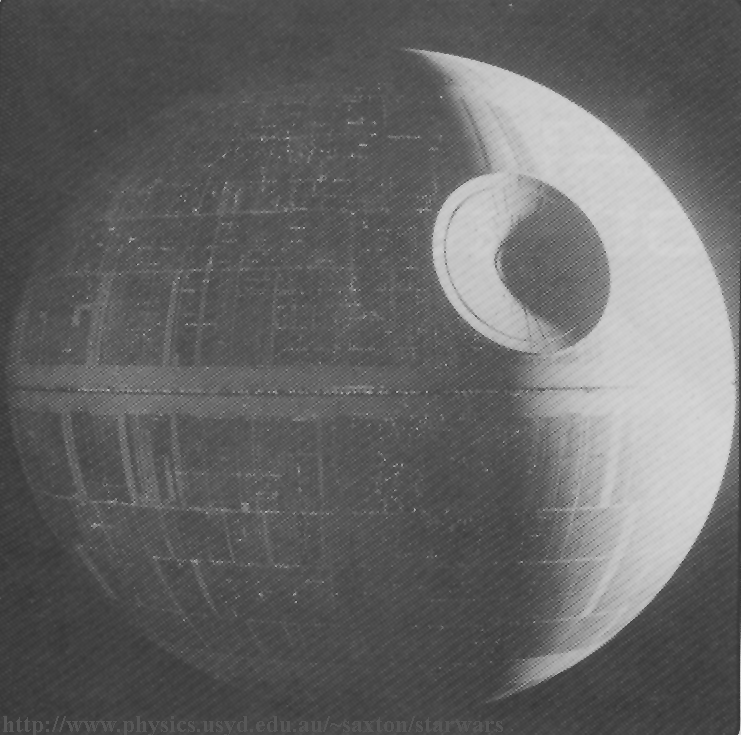
| quote: |
| Originally posted by Yoepus pics or STFU |


IMHO if it's large enough to have gravity which binds it together, and it's orbiting the Sun, then just call it a planet. If it's too small for gravity, then its an asteroid (which is 1 big chunk of rock as opposed to many smaller ones held together by gravity). If it circles a planet instead of the Sun (or any star), call it a moon.
| quote: |
| Originally posted by nrjizer IMHO if it's large enough to have gravity which binds it together, and it's orbiting the Sun, then just call it a planet. If it's too small for gravity, then its an asteroid (which is 1 big chunk of rock as opposed to many smaller ones held together by gravity). If it circles a planet instead of the Sun (or any star), call it a moon. |

Yeah, I guess Haley should be a planet by that definition. And all those "asteroids" in the Kuiper Belt are just a bunch of "mini-planets"?
Hmmm. Interesting.
| quote: |
| Originally posted by MisterOpus1 Yeah, I guess Haley should be a planet by that definition. And all those "asteroids" in the Kuiper Belt are just a bunch of "mini-planets"? Hmmm. Interesting. |
The Sumerians knew about this like 8,000 years ago.
New York Times article from 6/19/82
Something out there beyond the farthest reaches of the known solar system seems to be tugging at Uranus and Neptune. Some gravitational force keeps perturbing the two giant planets, causing irregularities in their orbits. The force suggests a presence far away and unseen, a large object that may be the long- sought Planet X. The last time a serious search of the skies was made it led to the discovery in 1930 of Pluto, the ninth planet. But the story begins more than a century before that, after the discovery of Uranus in 1781 by the English astronomer and musician William Herschel. Until then, the planetary system seemed to end with Saturn.Today, scientists accept theories concerning plate tectonics. There are articles and studies showing that, at one time, all of Earth continents were on one side of the planet. What the stories don't explore is the question, if all the continents were on one side, what was on the other? The other side has been described as a tremendous gap, matching the Sumerian story of how the Earth came about. The Sumerians said Earth was really half a planet called Tiamat, which broke up in a collision with Nibiru, [or Planet X].
The discovery of new planets has, in the last two hundred years, owed more to the science of mathematics than it has to the design of bigger and better telescopes. The unaccounted-for mathematical irregularities in the orbits of the outer planets have prompted astronomers to speculate upon the existence of a further, undiscovered planet. Astronomers are so certain of this planet's existence that they have already named it 'Planet X' - the Tenth Planet.
In 1982, NASA themselves officially recognised the possibility of Planet X, with an announcement that 'some kind of mystery object is really there - far beyond the outermost planets'. One year later, the newly launched IRAS (Infrared Astronomical Satellite) spotted a large mysterious object in the depths of space. The Washington Post summarised an interview with the chief IRAS scientist from JPL, California, as follows:
"A heavenly body possibly as large as the giant planet Jupiter and possibly so close to Earth that it would be part of this solar system has been found in the direction of the constellation Orion by an orbiting telescope... 'All I can tell you is that we don't know what it is', said Gerry Neugebauer, chief IRAS scientist.
The 6,000 year old Sumerian descriptions of our solar system include one more planet they called "Nibiru", which means "Planet of the crossing".The descriptions of this planet by the Sumerians match precisely the specifications of "Planet X" (the Tenth Planet), which is currently being sought by astronomers in the depths of our own Solar System. Why has Planet X not been seen in recent times? Views from modern and ancient astronomy, which both suggest a highly elliptical, comet-like orbit, takes Planet X into the depths of space, well beyond the orbit of Pluto. We discovered Pluto with our telescopes just recently in 1930. Is it not possible that there are other forces at work on our solar system besides the nine planets we know of? YES!!!! The Sumerian descriptions of Our Solar System are being confirmed with modern advances in science. This article will show actual diagrams from the Sumerian times and how the accuracy for describing the planets is overwhelming!

| quote: |
| Originally posted by DrUg_Tit0 Well, I hate to burst your theory but every existing object exhibits that funny property of gravitationally attracting other objects and holding itself together because of gravity, so you'll have to come up with a better solution than this one |
| quote: |
| Originally posted by DrUg_Tit0 Well, I hate to burst your theory but every existing object exhibits that funny property of gravitationally attracting other objects and holding itself together because of gravity, so you'll have to come up with a better solution than this one |
| quote: |
| Originally posted by Ondrayce I agree with Drug Tito. Planets aren't considered planets by size. Planets only orbit around a star. Moons orbit around a planet. Simple. As far as asteroids. The Asteroid field, when I last read something on it, was believed to be pieces of a former planet, or planets. A debate comes when talking about Jupiter's moons because Jupiter is believed by some to be a fromer star or a mass, that if ignited, coul become a star. |
| quote: |
| Originally posted by nrjizer Well no shit, but you're average asteroid is usually one whole chunk of rock. It may attract nearby tiny pieces but thats about it. A whole planet is much different. Just look at Earth, with its iron core, mantle, crust (complete with plates) mountains, large rocks, whatever. It's definately not one big chunk of rock. If you suddenly broke the largest asteroid you could find into smaller pieces their gravity would be too weak to pull each other back together. Even if you break just one piece off that asteroid it's probably going to fly off. I'm saying |
Good article on the controversy behind defining the term "planet" here:
http://www.space.com/scienceastrono...ons_030227.html
I like this suggestion:
| quote: |
| He proposes that the murky lower limit for planet-hood get set at a diameter of about 435 miles (700 kilometers). That's roughly the bulk needed to allow gravity to shape an object into a sphere, depending on density. Smaller objects -- both asteroids and comets -- tend to look like potatoes or bell peppers. |
| quote: |
| Originally posted by nrjizer IMHO if it's large enough to have gravity which binds it together, and it's orbiting the Sun, then just call it a planet. If it's too small for gravity, then its an asteroid (which is 1 big chunk of rock as opposed to many smaller ones held together by gravity). If it circles a planet instead of the Sun (or any star), call it a moon. |
As I clearly stated, thats just my opinion. And as far as I know, many of these scientists who dedicate their lives to the subject are still trying to define some sort of clear distinction between planets and planetoids (even pluto is not considered a real planet by many scientists).
| quote: |
| It all depends on the foce with which you break the chunk off. Every body in the solar system has its escape velocity. The velocity is much smaller for asteroids than it is for planets, but it exists nevertheless. Besides, some planets like Mercury don't have tectonic plates or a mantle and crust. |
| quote: |
| Originally posted by nrjizer This is very true, but even Mercury is a "complex" body, complete with an iron core, mantle and crust. Mariner has also found evidence of ancient volcanism. My random idea was to just classify anything orbiting the sun with a) enough gravity to sustain itself (if its a complex body like Mercury, Earth, Jupiter, etc), and/or b) an atmosphere of some kind. But whatever, it's not even important, just some crazy random idea. I'm sure theres nothing wrong with current classification guidelines. |

Powered by: vBulletin
Copyright © 2000-2021, Jelsoft Enterprises Ltd.