
TranceAddict Forums (www.tranceaddict.com/forums)
- Political Discussion / Debate
-- The significance of Saddam's capture
The significance of Saddam's capture
Well, when Saddam was captured last december the U.S. administration said it would be the beginning of the end of the violence against the coalition forces in Iraq. Saddam was supposed to be the mastermind and/or head of the resistance against the U.S. troops and their various partners. With him caught the "organization" would fall apart.
With the latest insurgency against the coalition forces in Iraq it seems reasonable to question what impact Saddam's capture really had on the troubles in Iraq. Othar than being a a political win for the U.S. administration and perhaps a moral boost for the troops it looks like it didn't really have any real effect in Iraq.
Is what we see now still just "the last squirms of a decapitated body" (that some proponents argued) or could it be that Saddam, after he had to leave his throne so to speak, really didn't have very much to do with (or at least wasn't that important to) the opposition in Iraq.
My personal view (and speculation) is that after going into hiding he became quite harmless. It was simply impossible for him to wield any significant power due to the restraints the act of hiding from the coalition forces caused. Thus the capture of Saddam was mostly a "propaganda" tool for the U.S. administration to keep support for the war high domestically and to tell the world that things are actually moving ahead in Iraq.
Anyone with a different view on this?
i agree, the same will happen when (if?) they capture osama, nothing... it's just a symbolic thing...
Place him in the center of Fallujah and we will see how it works out. The U.S. is on the turf of other people on a daily basis and will suffer continued casualities as this filth called Iraq drags on. If I was Iraqi I might have the same feelings about America's presence. Is it any surprise that many of the Middle East nations are run by "strongmen" essentially. None of them are elected under any legitimate circumstance, maybe they know something that America doesn't
Re: The significance of Saddam's capture
| quote: |
| Originally posted by Dj_Irish Well, when Saddam was captured last december the U.S. administration said it would be the beginning of the end of the violence against the coalition forces in Iraq. Saddam was supposed to be the mastermind and/or head of the resistance against the U.S. troops and their various partners. With him caught the "organization" would fall apart. With the latest insurgency against the coalition forces in Iraq it seems reasonable to question what impact Saddam's capture really had on the troubles in Iraq. Othar than being a a political win for the U.S. administration and perhaps a moral boost for the troops it looks like it didn't really have any real effect in Iraq. Is what we see now still just "the last squirms of a decapitated body" (that some proponents argued) or could it be that Saddam, after he had to leave his throne so to speak, really didn't have very much to do with (or at least wasn't that important to) the opposition in Iraq. My personal view (and speculation) is that after going into hiding he became quite harmless. It was simply impossible for him to wield any significant power due to the restraints the act of hiding from the coalition forces caused. Thus the capture of Saddam was mostly a "propaganda" tool for the U.S. administration to keep support for the war high domestically and to tell the world that things are actually moving ahead in Iraq. Anyone with a different view on this? |
| quote: |
| April 4, 2004 GOP Operatives Lead Iraq Press Office By THE ASSOCIATED PRESS Filed at 10:16 p.m. ET BAGHDAD, Iraq (AP) -- Inside the marble-floored palace hall that serves as the press office of the U.S.-led coalition, Republican Party operatives lead a team of Americans who promote mostly good news about Iraq. Dan Senor, a former press secretary for Spencer Abraham, the Michigan Republican who's now Energy Secretary, heads the office that includes a large number of former Bush campaign workers, political appointees and ex-Capitol Hill staffers. More than one-third of the U.S. civilian workers in the press office have GOP ties, running an enterprise that critics see as an outpost of Bush's re-election effort with Iraq a top concern. Senor and others inside the coalition say they follow strict guidelines that steer clear of politics. One of the main goals of the Office of Strategic Communications -- known as stratcom -- is to ensure Americans see the positive side of the Bush administration's invasion, occupation and reconstruction of Iraq, where 600 U.S. soldiers have died and a deadly insurgency thrives. ``Beautification Plan for Baghdad Ready to Begin,'' one press release in late March said in its headline. Another statement last month cautioned, ``The Reality is Nothing Like What You See on Television.'' Senor, spokesman for the U.S.-led Coalition Provisional Authority, said his office is guided by ethical ``red lines'' that prevent it from crossing into the Bush campaign. ``We have an obligation to communicate with the U.S. Congress and the American people, given that they're spending almost $20 billion in Iraq and have committed over 100,000 U.S. troops here,'' Senor said in an interview with The Associated Press. Earlier in his career, after Hebrew University and Harvard Business School, Senor was with the Carlyle Group, an investment firm with Bush family ties and big defense industry holdings. Senor jogged in a Thanksgiving Day race here wearing a ``Bush-Cheney 2004'' T-shirt. Known as the Green Room, the press office is inside coalition headquarters in the Republican Palace that used to belong to Saddam Hussein. The palace is in central Baghdad's heavily fortified Green Zone. The office counts 21 Republicans -- 11 of whom have worked inside the Bush administration before their Iraq posting -- among its 58 U.S. civilian staffers, according to figures Senor provided. The political affiliation of the 37 others could not be determined. More than half a dozen CPA officials in the press office worked on Bush's 2000 presidential campaign or are related to Bush campaign workers, according to payroll records filed with the Federal Elections Commission. Republican figures also permeate the wider CPA staff, including top advisers to U.S. administrator L. Paul Bremer and the Iraqi ministries. The U.S. team stands in deep contrast to the British team that works alongside it, almost all of whom are civil or foreign service employees, not political appointees. Many of the British in Iraq display regional knowledge or language skills that most of the Americans lack. The drive to re-elect Bush is a sensitive topic. Several coalition officials angered by what they see as CPA politicking -- with U.S. accomplishments in Iraq being trumpeted to help Bush -- grumbled privately, but would not go on record with complaints. But Gordon Robison, a former CPA contractor who helped build the Pentagon-funded Al-Iraqiya television station in Baghdad, said Republicans in the press room intensely followed the Democratic presidential primaries as John Kerry emerged as the presumed nominee. ``Iraq is in danger of costing George W. Bush his presidency and the CPA's media staff are determined to see that does not happen,'' Robison said. ``I had the impression in dealing with the civilians in the Green Room that they viewed their job as essentially political, promoting what the Coalition Provisional Authority is doing in Iraq as a political arm of the Bush administration,'' he added. Robison, a journalist who said his political affiliation is a private matter, left Baghdad in March after finishing his contract with U.S. defense contractor Science Applications International Corp. A new U.S. contractor, Harris Corp., has taken over the Al-Iraqiya operations. One CPA staffer who spoke on condition of anonymity said the press office had sent targeted ``good news'' releases to American television, radio and newspaper outlets that were timed to deflect criticism of Bush during the Democratic primaries. Stratcom's schedule of news releases shows that stories were sent to media outlets in Florida, Ohio, Illinois, Tennessee and Virginia and other states in the days before their Democratic primaries. But the schedule also shows releases sent to Virginia, Ohio and Florida after the primaries were over. Senor said any correlation to the vote was a coincidence. Rich Galen, 57, a well-known Republican strategist, oversees the daily news releases sent directly to media outlets in the United States. Before joining the CPA press operation late last year, Galen wrote a GOP insider column and appeared on Fox News to harpoon liberal critics of Bush. Now, he's still writing an Internet column, but he's turned it into what he calls a travelogue about Iraq. And he still appears on Fox -- but long-distance via satellite and as a CPA spokesman. Galen has been press secretary for both former House Speaker Newt Gingrich and former Vice President Dan Quayle during their careers. Galen's 27-year-old son, Reed, is involved in the Bush re-election effort. Since arriving in Iraq, Galen said he has made sure not to veer into politics in his work in the Green Room, in his column or during his television appearances. ``I understand when the game clock is on and when the game clock is off,'' Galen said. ``The clock is off.'' Were he to get directly involved in the Bush campaign, Galen said he'd be far more effective working at an office in Virginia outside of Washington D.C. than from the Iraqi capital. ``It's as inefficient a way to run a campaign as I can imagine,'' he said of being in Baghdad. Outside political analysts, however, said Galen's vast expertise lies in political campaigning, not shipping radio and TV spots to local audiences. Putting a sharp strategist like him in the press room is a campaign masterstroke, said Bob Boorstin of the Center for American Progress, a nonpartisan political think-tank in Washington. ``You know they're in trouble if they shipped Rich Galen over there,'' said Boorstin, who worked on four presidential campaigns, all Democratic. ``They're desperate to control the story over there. It's a very smart thing on their part. He knows what he's doing.'' Still, Boorstin said the shaping of the American message out of Iraq should come as no surprise. The rigors of election year politics demand the best possible portrayal of key policies, and Bush has staked his presidency on the notion that he's a war president. ``There's some deep questions about whether (the U.S. invasion) was a good idea. Wherever and whenever they can, Bush's political people are manipulating whatever they can,'' he said. ``Is that a surprise? No. Would Democrats do it? Yes. But it's particularly noxious because people's lives are on the line.'' ------ Associated Press Writer Aparna H. Kumar contributed to this report from Washington. http://www.nytimes.com/aponline/nat...ng-on-Iraq.html |
Re: The significance of Saddam's capture
| quote: |
| Originally posted by Dj_Irish My personal view (and speculation) is that after going into hiding he became quite harmless. It was simply impossible for him to wield any significant power due to the restraints the act of hiding from the coalition forces caused. Thus the capture of Saddam was mostly a "propaganda" tool for the U.S. administration to keep support for the war high domestically and to tell the world that things are actually moving ahead in Iraq. Anyone with a different view on this? |
i hope he doesnt get the death penalty or executed cause he will turn into a martyr for some iraqis and more trouble will be ahead.
| quote: |
| Originally posted by tranceaholic i hope he doesnt get the death penalty or executed cause he will turn into a martyr for some iraqis and more trouble will be ahead. |

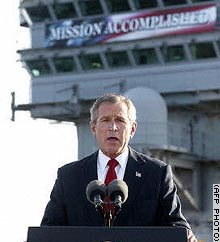
thread over.
| quote: |
| Originally posted by rizen thread over. |


Re: Re: The significance of Saddam's capture
| quote: |
| Originally posted by igottaknow Unfortunately, with Saddam out of the picture, all the factions saw it as a green light to pursue their plans to grab power without fear of retribution from Saddam. It's no longer a fight to restore the bath regime, but multi-faction fight for who will rule Iraqi. The US is now stuck in the middle of this mess, playing referee. |
Re: Re: Re: The significance of Saddam's capture
| quote: |
| Originally posted by Dj_Irish Agreed but what irks me is the planning of this whole thing. Sometimes it seems to be bordering to stupidity. Invade Iraq, despose the leader and then have no, or insufficient, plans on how to deal with the aftermath. Then, when the leader is actually finally captured, the conflicts between the various fractions emerge and once again it looks like this is a suprise to everybody involved. Maybe I'm oversimplyfying things but sometimes it just looks like everything that wasn't included in the initial attack on Iraq has been of second-hand interest. |

Powered by: vBulletin
Copyright © 2000-2021, Jelsoft Enterprises Ltd.