
TranceAddict Forums (www.tranceaddict.com/forums)
- Political Discussion / Debate
-- The Effects of Bush's Tax Cuts
Pages (2): [1] 2 »
The Effects of Bush's Tax Cuts
A pretty interesting article on a study which demonstrates the effects of Bush's tax cuts on other taxes, as well as the imbalanced effects of those tax cuts on the lower and middle classes. I'd be interested in hearing comments from conservatives to refute these points:
| quote: |
| Shifty Tax Cuts By Sean Gonsalves AlterNet Wednesday April 2004 Little Tommy had just caught a rabbit. On his way home, walking down a dusty road carrying the furry, squirming little creature he tried to console his captured carrot-eater. "Mistah Rabbit," he said. "Pretty li'l rabbit, sweet li'l rabbit, why are you wiggling so much. I ain't gonna do nothin' but knock you upside your head an' skin an' cook ya." Attention: my dear rabbit readers, analysts at United for a Fair Economy have just released a new report called "Shifty Tax Cuts: How They Move the Tax Burden off the Rich and onto Everyone Else." Here are some of the key findings in the report. (Go to http://FairEconomy.org/ press/2004/ShiftyTaxCuts_pr.html to see the full report). * For fiscal years 2002-2004, state governments filled approximately $200 billion in budget gaps by raising state taxes and fees and by cutting services. And during those same years, newly enacted federal tax cuts delivered about as much money � $197.3 billion � in new tax breaks for the wealthiest one percent of Americans (households making more than $337,000 a year). "Had that money instead been directed to state fiscal aid, it could have prevented virtually all recent tax hikes and service cuts at the state level, which fall hardest on low- and middle-income Americans," write the report's authors. * The choice to send nearly $200 billion to the top one percent rather than to state governments underscores just one way the federal tax cuts of 2001 and 2003 are actually "tax shifts," not tax cuts, for the vast majority of Americans. * Between 2000 and 2003, the United States saw a federal-to-state tax shift of historic magnitude: the share of the total tax burden borne at the state and local level jumped 15 percent. "This is the largest such shift in the tax burden since the period 1947-1950. This shift is making the tax system more regressive." Amazingly, in 2002, Americans in the bottom 20 percent of households paid 11.4 percent of their income in state and local taxes, while those in the top 1 percent paid only 5.2 percent of their income in state and local taxes � less than half the rate of the poorest fifth. * Since 1962, the share of total federal receipts collected from the regressive payroll tax, which collects proportionately more from low-income workers than high-income workers, has risen from 17 percent of total receipts to 40 percent � an increase of 135 percent. Meanwhile, the total share supplied by progressive income and corporate taxes has dropped from 63 percent of total receipts to 52 percent, which is a decline of 17 percent. * Between 1980 and now, the main tax on wage income � the payroll tax � has jumped 25 percent. In the same period, top tax rates on investment income and large inheritances have been cut between 31 percent and 79 percent. "Taxes on wealth are falling fast with shrinking taxes on capital gains, dividends and estate taxes." Oh, it gets better. * Since 1962, the share of federal revenues contributed by corporations has declined by two-thirds, while the share contributed by individuals has risen 17 percent. * Current tax policies are fueling the national debt, imposing an average $13,000 in additional debt on each man, woman and child in America between 2002 and 2007 -or more than $52,000 in added debt per family of four. * During the summer of 2003, millions of parents received $400-per-child checks from the IRS � an advance payment for the expanded federal child tax credit. But, at the same time, many of those same parents saw their local and state taxes increase. Some will consider this a propaganda piece encouraging class warfare. Call it what you want. As billionaire Warren Buffet points out, "If class warfare is being waged in America, my class is clearly winning." Let them eat rabbit! http://www.alternet.org/story.html?StoryID=18483 |
So taxes are shifting from the federal government to states and local municipalities where taxes should be levied. Who better to assess the needs of the community and determine your tax burden than the state as opposed to a centralized body in Washington DC? Sounds like you have a problem with how states are taxing their citizens ... so instead of taking the issue up with the federal government why not direct it to where it should go to ... the states. Are you saying the republicans banded together, analyzed all state taxation systems, and concluded that the way to shift the tax burden to the poor is by lowering federal taxes and grants to the states? By the way ... it's nice to see you arguing for a cut in payroll taxes for a change! I agree 100%!!! The sooner we do away with the black hole of government taxed and funded social security and medicare the better!
Re: The Effects of Bush's Tax Cuts
| quote: |
| Originally posted by MisterOpus1 A pretty interesting article on a study which demonstrates the effects of Bush's tax cuts on other taxes, as well as the imbalanced effects of those tax cuts on the lower and middle classes. I'd be interested in hearing comments from conservatives to refute these points: |


| quote: |
| Originally posted by occrider So taxes are shifting from the federal government to states and local municipalities where taxes should be levied. Who better to assess the needs of the community and determine your tax burden than the state as opposed to a centralized body in Washington DC? Sounds like you have a problem with how states are taxing their citizens ... so instead of taking the issue up with the federal government why not direct it to where it should go to ... the states. Are you saying the republicans banded together, analyzed all state taxation systems, and concluded that the way to shift the tax burden to the poor is by lowering federal taxes and grants to the states? By the way ... it's nice to see you arguing for a cut in payroll taxes for a change! I agree 100%!!! The sooner we do away with the black hole of government taxed and funded social security and medicare the better! |

Re: Re: The Effects of Bush's Tax Cuts
| quote: |
| Originally posted by Shakka Honestly, after a long-ass week I just don't have it in me to answer this right now--I'll get back to you later. |
Re: Re: Re: The Effects of Bush's Tax Cuts
| quote: |
| Originally posted by imokruok Low-income Americans already pay little to no taxes at the state and federal level. Frankly, they should be paying more, because then they'd realize what a raw deal those in the brackets above them get, and would actually have a stake in seeing tax policy massively overhauled. |

Re: Re: Re: Re: The Effects of Bush's Tax Cuts
| quote: |
| Originally posted by Shakka Great point. How do you sell it? |
| quote: |
| For 1999, the most recent year for which complete Internal Revenue Service statistics are available, 6.3 million taxpayers whose incomes were in the top 5 percent paid more than 55 percent of all income taxes. They had incomes above $120,846 a year meaning two spouses could each earn a bit over $60,000 and be considered among the nation's richest. |
Re: Re: The Effects of Bush's Tax Cuts
| quote: |
| Originally posted by Shakka Also, the left loves to argue that the government is a more efficient spender of your money than you yourself are. Don't give in to it! |
| quote: |
Poll: Balanced Budget Beats Tax Cuts Tue Apr 13,10:56 PM ET Add U.S. National - AP to My Yahoo! By WILL LESTER, Associated Press Writer WASHINGTON - By almost a 2-1 margin, Americans prefer balancing the nation's budget to cutting taxes, according to an Associated Press poll, even though many believe their overall tax burden has risen despite tax cuts over the past three years. About six in 10, 61 percent, chose balancing the budget while 36 percent chose tax cuts when they were asked which was more important, according to a poll conducted for the AP by Ipsos Public Affairs. As the nation's tax deadline of April 15 approaches, people's lukewarm feeling about tax cuts may be influenced by a belief that recent cuts haven't helped them personally. Half in the poll, 49 percent, said their overall tax burden � including federal, state and local taxes � had gone up over the past three years. That's almost four times the 13 percent in the poll who said their overall taxes had gone down. "Every time you turn around, there's a new gasoline tax, more property taxes, a library tax � because they don't have enough money," said Tom Artley, a 52-year-old supervisor at a manufacturing plant in Williamsport, Pa. He was referring to increasing financial problems faced by many cities and states. "I'd like to retire in the next five years," Artley said. "It's scary for people like me who are going to be living on a fixed income." Even when it comes to federal taxes, most in the public don't feel their taxes have gone down over the past three years. Twenty-five percent in the poll said their federal taxes had gone up during that time, while 43 percent said they had stayed the same. Among those most likely to say their taxes had gone down were the wealthy and investors. Both the conservative-leaning Tax Foundation and the liberal-leaning Center on Budget and Policy Priorities have come to the conclusion that the federal tax burden is easing for the average American family. The Tax Foundation suggests that federal income taxes are lower for Americans than they have been for almost four decades. The perception of many that they're paying more overall is no surprise to Iris Lav, deputy director of the Center on Budget and Policy Priorities. "Federal tax cuts largely benefit higher income people," Lav said. "In the meantime, people face tax increases on sales, cigarettes, gasoline." For 73-year-old Bonnie Shoemaker of Fort Morgan, Colo., the choice between tax cuts and balancing the budget is a tough one. "We all need money to live on," she said. "But I think we ought to concentrate on balancing the budget." Opinion was mixed on whether the wealthiest Americans should have to give up the tax cuts they've gotten over the past three years. Just over half, 53 percent, said they want the elimination of recent tax cuts for people who earn more than $200,000 a year, while 45 percent said they want those cuts to remain in place. The presidential campaign has included plenty of debate between President Bush (news - web sites) and Democrat John Kerry (news - web sites) about taxes and balanced budgets. More of the poll respondents thought Kerry would raise taxes than believed Bush would, 51 percent to 34 percent. Bush has been pushing cuts since his first campaign for president in 2000. Some see tax cuts as the best way to improve the economy and � eventually � to balance the budget. "If I had to choose, I would pick cutting taxes," said Marta Mitzenmacher of Miami, a budget director for a community college. "I think the more money I have in my pocket, the more that circulates in the economy, and that puts more money back into government." The AP-Ipsos poll of 1,001 adults was taken March 19-21 and has a margin of sampling error of plus or minus 3 percentage points. ___ On the Net: Ipsos: http://www.ipsos.com/ap |
I think if Bush wants to make political hay off his tax cuts, it will probably only work on fewer than he thinks.
http://money.cnn.com/2004/04/15/new...tion_moneypoll/
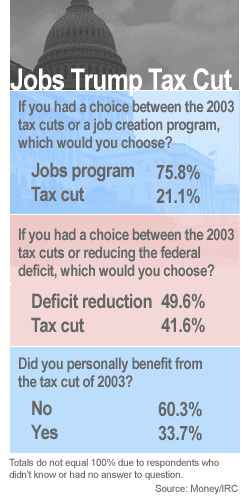
| quote: |
Money poll: Tax cuts unpopular Most want jobs program and deficit reduction. Some 60% say they didn't benefit from tax cut. April 15, 2004: 11:28 AM EDT NEW YORK (CNN/Money) - Most Americans don't believe they benefited personally from the 2003 tax cut, according to a poll conducted for Money magazine, and would have preferred the government devoted resources to job creation or deficit reduction. The poll of 1,007 people, conducted last week by International Communications Research, found that 60 percent said the tax cut did not personally help them. Only about a third of respondents said they benefited from the tax cut. The poll also found Americans badly split along partisan lines on the question of whether the tax cut helped the economy. It found 79 percent of Republicans believed the tax cuts were somewhat or very successful in stimulating the economy, while 65 percent of Democrats said the cuts were not too successful or not at all successful. Independents were more evenly divided but overall skeptical of the tax cut's help to the economy, with 43 percent saying the cuts were very or somewhat successful and 52 percent saying they were not too successful or not successful at all. Overall 48.4 percent thought the tax cuts were very or somewhat helpful stimulating the economy, while 45.1 percent felt they were not at all or not too successful stimulating the economy. The poll found 76 percent of those surveyed would have preferred the government devote resources to job creation rather than the tax cut, and even 54 percent of Republicans would have chosen jobs over tax cuts. Democrats, at 89 percent, and independents at 83 percent were overwhelmingly in favor of jobs programs rather than tax cuts. A plurality of Americans also would have preferred deficit reduction over the tax cut, with 49 percent choosing deficit reduction and only 42 percent picking the cut. While a majority of Republicans would have chosen tax cuts over deficit reduction, Democrats picked deficit reduction by a two-to-one margin, while 49 percent of independents would have preferred reducing the federal deficit. Asked who would do a better job managing the economy, 41.4 percent of registered voters surveyed chose President Bush, narrowly edging out Democratic challenger John Kerry at 37.7 percent. That was just beyond the poll's 3.1 percent margin of error. A 51 percent majority said their own economic circumstance is the same as it was a year ago, while 27 percent said their own situation is better and 21 percent said it was worse. Among those who identified themselves as investors, 45 percent said their own financial condition was about the same as a year ago, despite the rise in U.S. stock markets during that time. Meanwhile 37.3 percent said they were better off while only 17.4 percent said they were worse off. |
Re: Re: Re: The Effects of Bush's Tax Cuts
| quote: |
| Originally posted by imokruok Nor should you have to spend time responding. People drop in here, post an article, say "ha! refute this!", and go about their day. They do none of the work, and leave it all for someone else to refute it. |
| quote: |
| But to echo occrider, the state and local level are exactly where federal taxes should be levied. If you don't like it, don't blame the feds for lowering your taxes. Blame the states for raising them, while hoping no one will notice. |
| quote: |
| Low-income Americans already pay little to no taxes at the state and federal level. Frankly, they should be paying more, because then they'd realize what a raw deal those in the brackets above them get, and would actually have a stake in seeing tax policy massively overhauled. |
| quote: |
| Originally posted by occrider So taxes are shifting from the federal government to states and local municipalities where taxes should be levied. Who better to assess the needs of the community and determine your tax burden than the state as opposed to a centralized body in Washington DC? Sounds like you have a problem with how states are taxing their citizens ... so instead of taking the issue up with the federal government why not direct it to where it should go to ... the states. |
| quote: |
| Are you saying the republicans banded together, analyzed all state taxation systems, and concluded that the way to shift the tax burden to the poor is by lowering federal taxes and grants to the states? |

| quote: |
| By the way ... it's nice to see you arguing for a cut in payroll taxes for a change! I agree 100%!!! The sooner we do away with the black hole of government taxed and funded social security and medicare the better! |
| quote: |
| * Since 1962, the share of total federal receipts collected from the regressive payroll tax, which collects proportionately more from low-income workers than high-income workers, has risen from 17 percent of total receipts to 40 percent � an increase of 135 percent. Meanwhile, the total share supplied by progressive income and corporate taxes has dropped from 63 percent of total receipts to 52 percent, which is a decline of 17 percent. |
| quote: |
| Originally posted by MisterOpus1 Now I know you have a libertarian stance on this particular issue, but I cannot possibly concede to having the tax burden being completely shifted to the states, as you seem to have suggested. You probably have guessed that I believe it is our duty as citizens to pay taxes both on the state and federal level in order to uphold certain policies and systems that everyone on all income levels should have equal access to. I will admit, however, that I'm not educated enough to give specifics on where to draw the line on how much we should pay the state versus the federal level. But what is clear, however, is something that I have been pointing out from the get go about Bush's tax cuts - it will squeeze the states and will effect the lower income bracket in a disproportionate manner. That is discriminatory, deliberately or undeliberately. As this article suggests, it ultimately effects lower income folks more than the financial elite. It did not mention other factors, such as the rise in college tuition across all states, which ultimately hurts lower income folks more than upper income (again). Furthermore, cuts in public education programs, which again ultimately hurts the lower income more, considering they have a greater population in the public schools. And on this particular point, I would say that I believe this is a fairly deliberate act of Bush and the Repubs., esp. when you consider they have also cut federal funds to the states at the same time, but I digress. |
| quote: |
Oh yes, I certainly believe they are that diabolical! |
| quote: |
Look, I'm happy as hell that Cheney saved over $80,000 or so in taxes this year. That makes me giddy to the point of a near orgasm, but not quite. But I don't know if even I could pin an evil plot on the ultra-conservatives like that. What I do believe, however, is that they did not listen or even want to listen to the possible consequences of their actions on this tax cut. In a strange ironic twist, it seems the only person willing to consider the consequences to their actions was Bush himself, as Paul O'Neil points out in his book (Bush: "Haven't we already given money to rich people ... Shouldn't we be giving money to the middle?", Rove: "Stay the course..."). Seriously, many people don't even feel the "benefits" of this tax cut as a direct result of the shift of tax burdens from the feds. to the states, as the first article of DaveSZ's points out, and it's why more people are not so concerned about taxes as they are about jobs, as Dave's second article suggests. Furthermore, the lower income people feel the consequences even more, as my article points out (and what I've pointed out in the past). |
| quote: |
I'm not for a cut in payroll taxes per se, and I have to say that's rather clever of you to attempt to point this out. Let's look at the article: While it does show that payroll taxes are harsher towards the low-income workers, it is making a comparison with the second paragraph, which refers to corporate taxes. The comparison is that while corporate taxes have dropped, thereby giving back more money to the corporation, payroll taxes have increased, giving the low-income worker less money even though the corporation is saving more money. And with this comparison, I must agree with the author's criticism by pointing this out. |
Damn forums won't even give me the courtesy of bumping the thread for my post!
| quote: |
| Originally posted by occrider What's the matter? You never took my cheapshots so seriously before! |

Re: Re: Re: Re: Re: The Effects of Bush's Tax Cuts
| quote: |
| Originally posted by imokruok Everytime John Kerry slams the rich, he slams my parents, who live in an area where $150k after taxes will barely pay for house payments, two car payments, and living expenses. It's sick and disgusting that they scrape to get by and have to listen to that "not paying their fair share" crap everytime they turn on the TV. |
Re: Re: Re: Re: Re: Re: The Effects of Bush's Tax Cuts
| quote: |
| Originally posted by mps242 Dude, not to be a dick, but if your parents are just scraping by on $150k/year then they need to think about the lifestyle they choose to live. I agree with the rest of your post, but sorry that I don't shed any tears for your parents when they live in a nice big house, have two nice cars, and an expensive lifestyle and then moan about how tough life is... I'm sure they work very hard and earn every penny they are paid, but I feel no sympathy for their pain.... |
Also, my apologies to MisterOpus1. The time I posted the first response to the thread was right after a slew of posts 'sufee_b'. I was getting sick of his shit, and my anger should have been directed at him.
Re: Re: Re: Re: Re: The Effects of Bush's Tax Cuts
| quote: |
| Originally posted by imokruok Everytime John Kerry slams the rich, he slams my parents, who live in an area where $150k after taxes will barely pay for house payments, two car payments, and living expenses. It's sick and disgusting that they scrape to get by and have to listen to that "not paying their fair share" crap everytime they turn on the TV. |
.
Re: Re: Re: Re: Re: Re: Re: The Effects of Bush's Tax Cuts
| quote: |
| Originally posted by imokruok It's not lifestyle, it's location. And granted, they chose the location, but the feds take no consideration in your taxes dependent on where you live. (They can't, because of equal apportionment of taxation in the Constitution). They live in West LA, so they can have a commute to work that's less than an hour each way. The median home price is $6-700k for a 2-bedroom ranch with no yard. Their cars aren't that great, both American, under $25k. And they're saving for retirement. Don't talk shit about their lifestyle, because you're obviously not aware of the situation. |
Re: The Effects of Bush's Tax Cuts
| quote: |
| Originally posted by MisterOpus1 A pretty interesting article on a study which demonstrates the effects of Bush's tax cuts on other taxes, as well as the imbalanced effects of those tax cuts on the lower and middle classes. I'd be interested in hearing comments from conservatives to refute these points: * Since 1962, the share of federal revenues contributed by corporations has declined by two-thirds, while the share contributed by individuals has risen 17 percent. |
Re: Re: The Effects of Bush's Tax Cuts
| quote: |
| Originally posted by DJ Fin You gotta love the analysis of statistics or even statements. Two people from two totally different points of view can use it to prove their points. Unfortunately, a lot of times these "statistics" are not even correct as stated. If they were given about 10 pages more of context and re-explained in better terminology they would at least come close to being correct. As they stand, however, they are close to useless and slightly better, perhaps, than the average person's opinion. The statistic I quoted above is a prime example of this. It is flat-out wrong. The exact opposite is actually true. Since 1962, or really since the beginning of our current system, non-voluntary corporate contributions to federal revenues has always increased, not decreased. Two possible alterations to this: 1) The RATE at which contribution increases may go down. But it is still an increase. Just at a lower RATE or speed than previous increases. 2) They are speaking relatively, with the I (business investment) portion of G, I, C in basic models being considered versus the C (consumer) portion. Speaking about these things relatively without discussing them seperately or historically in relation to their seperate increases is ridiculous. If this is the case, as I might suspect, they are merely saying that consumers pay a larger percentage of federal revenues in relation to business investment. Let me discuss this further. From a professional standpoint, I would have to say, well ....no SHIT! And might I add ...DUH! Yes, consumers are spending more money today, even relatively speaking, than they were in 1962. This INCREASE has been so significant as to discount respectively significant INCREASES in business investment, or non-voluntary corporate contributions to federal revenues. Both of those things are good. Pointing out the relative shifts in one to the other from over 40 years ago to suggest that corporations are paying LESS now IN TOTAL, ON AVERAGE or the like is just crazy. Not only false, it is basically impossible even during terrorist attacks (2001) and stock market crashes (1987, 1989)... by the way, this isn't meant in anyway as an attack on the person who started this thread, MisterOpus, as this is an excellent topic for debate. It is more a little bit of reasoning missing from interpretations of data presented to the mainstream. Only one thing bothers me more than hearing about how a decrease in a RATE (such as GDP/Productivity) is reported like it is a decrease in TOTAL (two totally different things). (Decreases in rates are still increases in total, just not at the same rates) That other thing was hearing all the idiots talk in the 90s about how we had finally discounted economic theory and the bubble would never burst. Those same people who were so positive then can't "afford" to be anything but negative now. A little moderation seems in order, and a more clear and simple explanation of what is going on around us. ...and I don't wanna hear anyone on the left bashing me thinking I'm on the right. You'd be wrong in such an assumption. |
Okay, I'm breaking this up in 3 parts, just to keep this long rant under control. So here goes:
| quote: |
| Originally posted by Occrider Well obviously I'm not calling for an abolishment of all federal taxes, what I'm calling for is a reduction in federal taxes such that proceeds of said tax go towards paying for federal institutions rather than state projects. If the state needs funding to pay for education, public works projects, etc., than the state should raise taxes. Why should we pay more in federal taxes to pay for pork barrell projects that other states manage to successfully lobby the federal government for? Why should we pay ANY federal tax money to states when the state can, and should, raise its own taxes if it needs to pay for something it wants? It increases accountability on the part of the state to do what's in the best interest of its citizens cost wise and benefits wise. But why is the shifting of the tax burden to states discriminatory on Bush's part? It's each state's own tax laws, they have sole discretion to alter their tax brackets to whatever they would like. Why is the state not discriminatory, and why are you not directing your criticism at the state rather than bush? The state tax structure only becomes an issue now that bush is decreasing the federal tax role? Well, if anything this should expose the inequity of our states' laws ... something that is far easier and tangible to change as opposed to federal law. |
| quote: |
| Tax cuts - Some of the federal tax cuts enacted since 2001 are reducing state revenues because of linkages between the federal and state tax codes. Restrictions on state taxation - For example, the federal Internet Tax Freedom Act, first enacted in 1998, bars states from taxing the access fees that people pay for Internet service. In addition, two Supreme Court cases prevent state and local governments from collecting sales taxes on most catalog or Internet purchases, even though sales taxes apply when the very same items are purchased in retail stores. Federal legislation has recently been introduced to correct this problem but has not garnered significant support from Congress or the Administration, and its passage is not expected anytime soon. Unfunded mandates - In several policy areas, such as homeland security and education, the federal government has burdened states with demands and requirements but has not provided adequate funding to enable states to meet them. Shifting health care costs - For over a decade, the cost of health care for low-income elderly and disabled people has been shifting from Medicare to Medicaid. A prominent reason is the increasing use of prescription drugs, which Medicaid covers but Medicare does not. Because Medicare is fully federally funded, while Medicaid is jointly financed by the federal government and the states, this shift in costs from Medicare to Medicaid has increased the financial pressure on states. The recently enacted Medicare drug bill will leave states responsible for the large majority of their drug costs. Under the drug bill, seniors eligible for both Medicare and Medicaid will receive drug coverage through Medicare beginning in 2006. While this will produce significant savings for state Medicaid programs, states will be required to return the bulk of these savings to the federal government in perpetuity. The $20 billion in fiscal relief Congress provided in 2003 has helped states cope with the fiscal crisis, but it pales in comparison to the size of the problem. Yet the large deficits faced by the federal government prevent it from doing more. Moreover, a significant part of the projected federal deficits is caused by the 2001 and 2003 tax cuts, which primarily benefit households least in need of assistance. For example, households making over $1 million a year will receive an average tax cut in 2003 of $113,000 each, according to the Urban Institute-Brookings Tax Policy Center. |
Here's the second part:
| quote: |
| Originally posted by Occrider Just as an aside, I know you're arguing about the shifting of the tax burden as opposed to absolute effect, but as a clarification to others the tax cuts have not had a negative effect (even taking into account state taxes) so far: http://www.factcheck.org/article.aspx?docID=100 http://www.ctj.org/pdf/fsl2004.pdf |
| quote: |
| The decline in state revenue would have been even worse had not a majority of states raised taxes. Since late 2001, about 30 states have expanded their tax bases or increased tax rates to lessen the decline in revenues. Such tax increases have been enacted in states with Republican leadership, Democratic leadership, and bipartisan leadership. When fully implemented, these tax increases will raise some $18.4 billion per year, about 3.4 percent of total state tax collections. Nevertheless, the tax increases enacted during this downturn are far fewer and smaller than the tax cuts enacted during the economic expansion of the 1990s. From 1994 to 2001, some 44 states enacted significant tax cuts. The economic boom of the late 1990s, and in particular the large increase in capital gains during those years, temporarily offset the revenue loss resulting from those tax cuts. Those temporary economic conditions have ended. Yet most of the tax cuts of the 1990s remain in place and are costing states some $40 billion or more per year. It also is worth noting that while most of the tax cuts of the 1990s were in progressive taxes (taxes that fall most heavily on higher-income households), most of the recent tax increases have been in regressive taxes. In other words, lower-income households benefited less from the tax cuts of the 1990s and now are being hurt more by the tax hikes of 2002-2003. http://www.cbpp.org/10-22-03sfp4.htm |
| quote: |
| Nationwide, middle-income families pay almost 10 percent on their earnings in state and local taxes and poor families pay more than 11 percent. But the richest people effectively pay only 5.2 percent of their income in state and local taxes. Since 1989, state and local taxes have risen on low- and middle-income taxpayers, but have fallen on the very wealthy. |
| quote: |
| Combined federal, state and local taxes in 2004 will take only a slightly higher share of the income of the very richest Americans than the average for all other income groups. |
And the last part:
| quote: |
| Originally posted by Occrider It's a comparison that shouldn't even be made. Those are two completely different taxes that are funding two completely different purposes. |
| quote: |
| The payroll tax solely contributes to social security and medicare and only taxes workers. It does not go anywhere else, and it's always going to go up, regardless of what an administration wants to do, with the way medicare and social security are structured. Therefore, one can ALWAYS unfairly criticize ANY decrease in ANY type of tax other than the payroll tax as shafting the worker because, simply put, no one is going to decrease that particular tax which is an individual entity in itself so to speak. For example: http://www.cnn.com/2004/ALLPOLITICS...a.ap/index.html Bush wants to do away with the internet access tax and extend it to broadband. It is by default bad to remove such a tax however, since it comes at the expense of workers because of the increased payroll tax. |
| quote: |
| Since 1962, the top corporate tax rate has been cut from 52% to 35% and the top income tax rate has been cut from 91% to 35% (this is on dollars earned above the threshold rate). Over the same period, the payroll tax rate has been raised from 6.25% to 15.3% (this includes both the employer and employee shares of the tax, but it is commonly agreed that employers compensate for their payroll tax share with lower wages for employees so the employee effectively pays the total tax). The case of the progressive income tax is more complex but telling nonetheless. The share of federal revenue contributed by the progressive income tax has remained essentially constant since 1962, even though income has become dramatically more concentrated at the top of the spectrum during the period. Had income tax rates remained unchanged, we would have expected the income-tax share to rise as income grew and became more concentrated. Instead, the income-tax share was constrained by large tax cuts at the top. The revenue effects of the recent income tax cuts can be clearly seen in the sharp shift in tax burden from income taxes to payroll taxes since 2000. If current trends continue, the payroll tax will surpass the income tax as the leading source of federal revenue sometime within the decade. Once again, this tax shift affects who is paying for the cost of government. Since 71% of households pay more in payroll taxes than income taxes, the long-term shift toward payroll taxes has placed a heavier tax burden onto the shoulders of ordinary working Americans. |
| quote: |
| In 1965, US federal, state, and local income taxes were 4.1% of US GDP. In 2002, the last year for which full federal, state and local figures are available, US corporate taxes plummeted to only 1.5% of GDP. Corporate lobbyists claim that the US overtaxes business. But corporations are lightly taxes in the US compared with our trading partners. In a survey of industrialized countries by the Organization for Economic Cooperation and Development, the US came in 22nd out of 29 countries in terms of corporate taxes as a percentage of GDP in 2000. If other countries� corporate tax shares remained the same, reports Citizens for Tax Justice, the US would have had the lowest tax share in 2002 of all the other countries except Iceland. |
| quote: |
| Originally posted by MisterOpus1 Okay, I'm breaking this up in 3 parts, just to keep this long rant under control. So here goes: |
| quote: |
| Well I think again you have an idealistic viewpoint on where the money shifting from the federal to the states, where the states actually have to pick up the tabs for their own endeavors. To that idealism I would agree. But a few things come to mind: 1. According to the study I posted, between 2002-2004, state govt�s closed approx. $200 billion in budget gaps with cuts in services and raising taxes, while during that same time $197 billion in new tax breaks for the wealthiest 1% of Americans was given. Now this is where I agree strongly with Kerry � why do the wealthiest 1% need that much in tax breaks? Don�t the wealthiest 1% typically invest in their money, and how would that help our overall economy? Furthermore, how would that increase demand of products in any way (part of the supply-side theory I never understood, but I�m digressing on this)? If that money could have been diverted to other needs (such as the state grants and so forth), not only could we have helped where it was needed, but the deficit would have been that much less. |
.| quote: |
2. Considering the pitfall that the states were suffering from as a result of a decrease in state revenue, was this really a good time to shift that burden onto the states? Was it a good time to give these states a financial crisis, thus creating huge cuts across the board in employment, Medicaid, and education, as well as other various state programs? Much of the state money is tied to federal grants, so when Bush cut a lot of those grants, that left the states up sh$t creek. A few points from this study: http://www.cbpp.org/10-22-03sfp4.htm Here�s a more comprehensive overview: http://www.cbpp.org/10-17-03sfp.htm |
| quote: |
Additionally, it�s really quite a lovely thing that the federal govt. enjoys being able to avoid balancing it�s budget every year, but as you well know the states are obligated to do just that. This is one serious disadvantage when we�re talking about state vs. federal spending (and tax cuts), considering that the fed. govt. doesn�t necessarily have to owe up to anything at the end of the fiscal year (though the deficit will eventually bite Bush in the ass) verses the state. So while I do believe states should have a more responsibility for their own given programs, now was certainly not the time for Bush to throw them out and fend on their own, at least in the manner that he chose to do. |
But so long as states maintain the ability to change sales taxes, income taxes, and property taxes to a fiscally feasible standpoint, I see NO REASON why the federal governemnt should not make states more accountable for the spending that they do.

Powered by: vBulletin
Copyright © 2000-2021, Jelsoft Enterprises Ltd.