
TranceAddict Forums (www.tranceaddict.com/forums)
- Political Discussion / Debate
-- Support for Iraq in the 1980's - America's Selective Memory vs. the Internet Archives
Pages (2): [1] 2 »
Support for Iraq in the 1980's - America's Selective Memory vs. the Internet Archives
original link at bottom of page
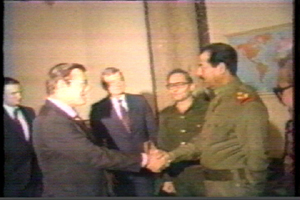
The Iran-Iraq war (1980-1988) was one of a series of crises during an era of upheaval in the Middle East: revolution in Iran, occupation of the U.S. embassy in Tehran by militant students, invasion of the Great Mosque in Mecca by anti-royalist Islamicists, the Soviet Union's occupation of Afghanistan, and internecine fighting among Syrians, Israelis, and Palestinians in Lebanon. The war followed months of rising tension between the Iranian Islamic republic and secular nationalist Iraq. In mid-September 1980 Iraq attacked, in the mistaken belief that Iranian political disarray would guarantee a quick victory.
The international community responded with U.N. Security Council resolutions calling for a ceasefire and for all member states to refrain from actions contributing in any way to the conflict's continuation. The Soviets, opposing the war, cut off arms exports to Iran and to Iraq, its ally under a 1972 treaty (arms deliveries resumed in 1982). The U.S. had already ended, when the shah fell, previously massive military sales to Iran. In 1980 the U.S. broke off diplomatic relations with Iran because of the Tehran embassy hostage crisis; Iraq had broken off ties with the U.S. during the 1967 Arab-Israeli war.
The U.S. was officially neutral regarding the Iran-Iraq war, and claimed that it armed neither side. Iran depended on U.S.-origin weapons, however, and sought them from Israel, Europe, Asia, and South America. Iraq started the war with a large Soviet-supplied arsenal, but needed additional weaponry as the conflict wore on.
Initially, Iraq advanced far into Iranian territory, but was driven back within months. By mid-1982, Iraq was on the defensive against Iranian human-wave attacks. The U.S., having decided that an Iranian victory would not serve its interests, began supporting Iraq: measures already underway to upgrade U.S.-Iraq relations were accelerated, high-level officials exchanged visits, and in February 1982 the State Department removed Iraq from its list of states supporting international terrorism. (It had been included several years earlier because of ties with several Palestinian nationalist groups, not Islamicists sharing the worldview of al-Qaeda. Activism by Iraq's main Shiite Islamicist opposition group, al-Dawa, was a major factor precipitating the war -- stirred by Iran's Islamic revolution, its endeavors included the attempted assassination of Iraqi Foreign Minister Tariq Aziz.)
Prolonging the war was phenomenally expensive. Iraq received massive external financial support from the Gulf states, and assistance through loan programs from the U.S. The White House and State Department pressured the Export-Import Bank to provide Iraq with financing, to enhance its credit standing and enable it to obtain loans from other international financial institutions. The U.S. Agriculture Department provided taxpayer-guaranteed loans for purchases of American commodities, to the satisfaction of U.S. grain exporters.
The U.S. restored formal relations with Iraq in November 1984, but the U.S. had begun, several years earlier, to provide it with intelligence and military support (in secret and contrary to this country's official neutrality) in accordance with policy directives from President Ronald Reagan. These were prepared pursuant to his March 1982 National Security Study Memorandum (NSSM 4-82) asking for a review of U.S. policy toward the Middle East.
One of these directives from Reagan, National Security Decision Directive (NSDD) 99, signed on July 12, 1983, is available only in a highly redacted version Document 21. It reviews U.S. regional interests in the Middle East and South Asia, and U.S. objectives, including peace between Israel and the Arabs, resolution of other regional conflicts, and economic and military improvements, "to strengthen regional stability." It deals with threats to the U.S., strategic planning, cooperation with other countries, including the Arab states, and plans for action. An interdepartmental review of the implications of shifting policy in favor of Iraq was conducted following promulgation of the directive.
By the summer of 1983 Iran had been reporting Iraqi use of using chemical weapons for some time. The Geneva protocol requires that the international community respond to chemical warfare, but a diplomatically isolated Iran received only a muted response to its complaints Note 1. It intensified its accusations in October 1983, however, and in November asked for a United Nations Security Council investigation.
The U.S., which followed developments in the Iran-Iraq war with extraordinary intensity, had intelligence confirming Iran's accusations, and describing Iraq's "almost daily" use of chemical weapons, concurrent with its policy review and decision to support Iraq in the war Document 24. The intelligence indicated that Iraq used chemical weapons against Iranian forces, and, according to a November 1983 memo, against "Kurdish insurgents" as well Document 25.
What was the Reagan administration's response? A State Department account indicates that the administration had decided to limit its "efforts against the Iraqi CW program to close monitoring because of our strict neutrality in the Gulf war, the sensitivity of sources, and the low probability of achieving desired results." But the department noted in late November 1983 that "with the essential assistance of foreign firms, Iraq ha[d] become able to deploy and use CW and probably has built up large reserves of CW for further use. Given its desperation to end the war, Iraq may again use lethal or incapacitating CW, particularly if Iran threatens to break through Iraqi lines in a large-scale attack" Document 25. The State Department argued that the U.S. needed to respond in some way to maintain the credibility of its official opposition to chemical warfare, and recommended that the National Security Council discuss the issue.
Following further high-level policy review, Ronald Reagan issued National Security Decision Directive (NSDD) 114, dated November 26, 1983, concerned specifically with U.S. policy toward the Iran-Iraq war. The directive reflects the administration's priorities: it calls for heightened regional military cooperation to defend oil facilities, and measures to improve U.S. military capabilities in the Persian Gulf, and directs the secretaries of state and defense and the chairman of the Joint Chiefs of Staff to take appropriate measures to respond to tensions in the area. It states, "Because of the real and psychological impact of a curtailment in the flow of oil from the Persian Gulf on the international economic system, we must assure our readiness to deal promptly with actions aimed at disrupting that traffic." It does not mention chemical weapons Document 26.
Soon thereafter, Donald Rumsfeld (who had served in various positions in the Nixon and Ford administrations, including as President Ford's defense secretary, and at this time headed the multinational pharmaceutical company G.D. Searle & Co.) was dispatched to the Middle East as a presidential envoy. His December 1983 tour of regional capitals included Baghdad, where he was to establish "direct contact between an envoy of President Reagan and President Saddam Hussein," while emphasizing "his close relationship" with the president Document 28. Rumsfeld met with Saddam, and the two discussed regional issues of mutual interest, shared enmity toward Iran and Syria, and the U.S.'s efforts to find alternative routes to transport Iraq's oil; its facilities in the Persian Gulf had been shut down by Iran, and Iran's ally, Syria, had cut off a pipeline that transported Iraqi oil through its territory. Rumsfeld made no reference to chemical weapons, according to detailed notes on the meeting Document 31.
Rumsfeld returned to Baghdad in late March 1984. By this time, the U.S. had publicly condemned Iraq's chemical weapons use, stating, "The United States has concluded that the available evidence substantiates Iran's charges that Iraq used chemical weapons" Document 47. Briefings for Rumsfeld's meetings noted that atmospherics in Iraq had deteriorated since his December visit because of Iraqi military reverses and because "bilateral relations were sharply set back by our March 5 condemnation of Iraq for CW use, despite our repeated warnings that this issue would emerge sooner or later" [Document 48]. Rumsfeld was to discuss with Iraqi officials the Reagan administration's hope that it could obtain Export-Import Bank credits for Iraq, the Aqaba pipeline, and its vigorous efforts to cut off arms exports to Iran. According to an affidavit prepared by one of Rumsfeld's companions during his Mideast travels, former NSC staff member Howard Teicher, [b]Rumsfeld also conveyed to Iraq an offer from Israel to provide assistance, which was rejected Document 61].
Although official U.S. policy still barred the export of U.S. military equipment to Iraq, some was evidently provided on a "don't ask - don't tell" basis. In April 1984, the Baghdad interests section asked to be kept apprised of Bell Helicopter Textron's negotiations to sell helicopters to Iraq, which were not to be "in any way configured for military use" Document 55. The purchaser was the Iraqi Ministry of Defense. In December 1982, Bell Textron's Italian subsidiary had informed the U.S. embassy in Rome that it turned down a request from Iraq to militarize recently purchased Hughes helicopters. An allied government, South Korea, informed the State Department that it had received a similar request in June 1983 (when a congressional aide asked in March 1983 whether heavy trucks recently sold to Iraq were intended for military purposes, a State Department official replied "we presumed that this was Iraq's intention, and had not asked.") Document 44
(...)
Document 42
Department of State Cable from George P. Shultz to the United States Interests Section in Iraq. "U.S. Chemical Shipment to Iraq," March 4, 1984.
Indicates that a shipment of 22,000 pounds of phosphorous fluoride to Iraq was held back at JFK airport because of "concern over Iraq's possible intention to use the chemical in the manufacture of chemical weapons." Washington asks the U.S. interests section in Baghdad to remind Iraq's Ministry of Foreign Affairs of the U.S.'s grave concern about chemical weapons, and to inform it that the U.S. will publicly condemn their use in the near future. The interests section is to reiterate the request that Iraq not use chemical warfare, and to say that the U.S. opposes Iraq's attempts to acquire chemical weapons related material from the U.S.: "When we become aware of attempts to do so, we will act to prevent their export to Iraq."
Document 48
Department of State Cable from George P. Shultz to the United States Embassy in Sudan. "Briefing Notes for Rumsfeld Visit to Baghdad [Page Missing]," March 24, 1984.
A State Department background cable for Donald Rumsfeld's March 1984 visit to Baghdad notes the distress caused to Iraqi officials by the U.S.'s public condemnation of Iraq's use of chemical weapons "despite our repeated warnings that this issue would emerge sooner or later." Most of the cable is concerned with the Reagan administration's interest in reassuring Iraqi officials that U.S. financing might be available for the proposed pipeline to deliver Iraqi oil to Aqaba, and other U.S. regional interests. The cable notes that Iraqi officials are "confused" by the administration's "means of pursuing our stated objectives in the region."
Document 52
Department of State Cable from George P. Shultz to the United States Embassy in Lebanon [et al.]. "Department Press Briefing, March 30, 1984," March 31, 1984.
The State Department announces it has imposed foreign policy controls on Iran and Iraq for exports of chemical weapons precursors. It responds to questions from the press about U.S. policy regarding the Iran-Iraq war, and a department spokesperson says Iraq's chemical weapons use will not change U.S. interest in pursuing closer U.S.-Iraq relations.
Document 56
Letter from Richard M. Nixon to Nicolae Ceausescu. [Regarding U.S.-Romanian Venture to Sell Uniforms to Iraq], May 3, 1984.
Former president Richard Nixon sends a letter to Romanian President Nicolae Ceausescu in support of a deal made by Colonel John Brennan, his former aide and chief of staff, and former attorney general John Mitchell, to buy Romanian-manufactured military uniforms for export to Iraq.
Media and criminal investigations of U.S. companies that had exported weapons-related or dual-use items to Iraq were conducted after Iraq's invasion of Kuwait. Many of these companies seemed to have connections with former U.S. government officials.
Document 61
United States District Court (Florida: Southern District) Affidavit. "United States of America, Plaintiff, v. Carlos Cardoen [et al.]" [Charge that Teledyne Wah Chang Albany Illegally Provided a Proscribed Substance, Zirconium, to Cardoen Industries and to Iraq], January 31, 1995.
Former Reagan administration National Security Council staff member Howard Teicher says that after Ronald Reagan signed a national security decision directive calling for the U.S. to do whatever was necessary to prevent Iraq's defeat in the Iran-Iraq war, Director of Central Intelligence William Casey personally led efforts to ensure that Iraq had sufficient weapons, including cluster bombs, and that the U.S. provided Iraq with financial credits, intelligence, and strategic military advice. The CIA also provided Iraq, through third parties that included Israel and Egypt, with military hardware compatible with its Soviet-origin weaponry.
This affidavit was submitted in the course of one of a number of prosecutions, following Iraq's invasion of Kuwait, of U.S. companies charged with illegally delivering military, dual-use, or nuclear-related items to Iraq. (In this case, a Teledyne affiliate was charged will illegally selling zirconium, used in the manufacture of explosives, to the Chilean arms manufacturer Carlos Industries, which used the material to manufacture cluster bombs sold to Iraq.) Many of these firms tried to defend themselves by establishing that providing military materiel to Iraq had been the actual, if covert, policy of the U.S. government. This was a difficult case to make, especially considering the rules of evidence governing investigations involving national security matters.
http://www.gwu.edu/~nsarchiv/NSAEBB/NSAEBB82/
The National Security Archive combines a unique range of functions in one non governmental, non-profit institution. The Archive is simultaneously a research institute on international affairs, a library and archive of declassified U.S. documents obtained through the Freedom of Information Act, a public interest law firm defending and expanding public access to government information through the FOIA, and an indexer and publisher of the documents in books, microfiche, and electronic formats. The Archive's approximately $2.3 million yearly budget comes from publication revenues and from private philanthropists such as the Carnegie Corporation, the John D. and Catherine T. MacArthur Foundation, the John S. and James L. Knight Foundation and the Ford Foundation. As a matter of policy, the Archive receives no government funding.
The National Security Archive was founded in 1985 by a group of journalists and scholars who had obtained documentation from the U.S. government under the Freedom of Information Act and sought a centralized repository for these materials. Over the past decade, the Archive has become the world's largest non governmental library of declassified documents. Located on the seventh floor of the George Washington University's Gelman Library in Washington, D.C., the Archive is designed to apply the latest in computerized indexing technology to the massive amount of material already released by the U.S. government on international affairs, make them accessible to researchers and the public, and go beyond that base to build comprehensive collections of documents on specific topics of greatest interest to scholars and the public.
http://www.gwu.edu/~nsarchiv/NSAEBB/NSAEBB82/
Times changed. We decided to take down Saddam which was a better solution to the problem. A free Iraq in the mideast will stabilize the region.
| quote: |
| Originally posted by emander Times changed. We decided to take down Saddam which was a better solution to the problem. A free Iraq in the mideast will stabilize the region. |
| quote: |
| Originally posted by Trancer-X Well, it's about time that region was stabilized, seeing as how they've been fighting since the times of Isaac and Ishmael! |
| quote: |
| I just have a hard time believing that the deposing of Saddam Hussein was the magical, cure-all pill. |
Maybe you, Yoepus need to realize that not everyone NEEDS to change to suit your beliefs.
"Why are you so skeptical that wars can bring peace"
I think I'm gonna use that as my sig cause it's gotta be the dumbest thing I've ever heard!
| quote: |
| Originally posted by Yoepus So was Europe. The USA stablizied that region after a large scale war. Why are you so skeptical that wars can bring peace? It's a start. If you'd let me and my buddy neo-cons have our way. It wouldn't be the 'Saddam' magic pill. But an aggressive strategy against the entire middle-east as needed until they get it through their skulls times have changed and they need to too. |
| quote: |
| Originally posted by habsfan Maybe you, Yoepus need to realize that not everyone NEEDS to change to suit your beliefs. "Why are you so skeptical that wars can bring peace" I think I'm gonna use that as my sig cause it's gotta be the dumbest thing I've ever heard! |
| quote: |
| Originally posted by habsfan Maybe you, Yoepus need to realize that not everyone NEEDS to change to suit your beliefs. "Why are you so skeptical that wars can bring peace" I think I'm gonna use that as my sig cause it's gotta be the dumbest thing I've ever heard! |
| quote: |
http://www.ipsnews.net/interna.asp?idnews=24164 RAQ: Saddam Will Miss Old Buddy Reagan Aaron Glantz BAGHDAD, Jun 12 (IPS) - The Iraq issue today may never have arisen if it were not for the support former U.S. president Ronald Reagan gave Saddam Hussein. Reagan died Saturday Jun. 5 in his Los Angeles home. Reagan's two terms as President correspond roughly to the Iran-Iraq war, the longest conventional war of the 20th century. Saddam Hussein invaded Iran on Sep. 22, 1980 with the stated goal of gaining control of the Shatt al-Arab, the river that has formed a border between Iran and Iraq, and which would give Iraq better access to the Persian Gulf. The U.S. government was then interested in containing Iran, which had just become one of Washington's major enemies after the Islamic Revolution lead by Ayatollah Khomeini. U.S. hostages had been taken, and Ronald Reagan had just been elected partly on the strength of criticising President Jimmy Carter's inability to free them. �America and Saddam thought the same way at that time, because America wanted to destroy the revolution in Iran,� retired Iraqi Brigadier-General Zekki Daoud Jabber told IPS in an interview in his Baghdad home. -more |
| quote: |
http://www.ipsnews.net/interna.asp?idnews=24257 IRAQ: The West May Go On Trial with Saddam Aaron Glantz ARBIL, Jun 18 (IPS) - A year after the fall of Saddam Hussein, the mountains and plains of Northern Iraq are still covered in landmines planted by the former Iraqi dictator's regime during the 1980s. That is when he fought a decade-long war with Iran and many battles with Kurdish guerrillas. The Red Cross has made thousands of synthetic limbs for Iraqi civilians who have lost their arms or legs. Hundreds have been killed. �We were in the village when we heard the mines go off in the middle of the night,� recalls Mohammed Abuznawee, a shepherd who lives near a minefield outside Kirkuk. The Iraqi army mined the area around his village in 1985. �Over 200 sheep broke out of their pen and walked into the minefield in the middle of the night and were killed. Then my brother went out to try to save the flock. He also died.� Iraq did not make any of the landmines Saddam used in his wars. They were all sold to him by Italy, China, the United States, and the former Soviet Union. -more |
| quote: |
| Originally posted by habsfan Maybe you, Yoepus need to realize that not everyone NEEDS to change to suit your beliefs. "Why are you so skeptical that wars can bring peace" I think I'm gonna use that as my sig cause it's gotta be the dumbest thing I've ever heard! |
| quote: |
| Originally posted by ogvh5150 Mr. Saddam Hussein: Thanks for the memories you really made it make sense after all. Your #1 fan, ogvh5150 (click here) |
| quote: |
| Originally posted by emander Times changed. We decided to take down Saddam which was a better solution to the problem. A free Iraq in the mideast will stabilize the region. |
Wouldn't an end to the Israel/Palestine conflict be a better 1st step approach to fixing the instability in the mid-east?
Plus, Even though Saddam invaded Kuwait some 12 years ago he was under a lot of restrictions since then and wasn't considered a threat to anyone of the surrounding countries. Except Israel perhaps.
| quote: |
| Originally posted by DaveSZ Actual Bush quote: "When you're talking about war, you're really talking about peace." That's simply the neocon philosophy, so it shouldn't surprise you in the least. |
| quote: |
| Originally posted by George H.W. Bush April 28, 1992 Remarks at Bush-Quayle Campaign Headquarters April 28, 1992 ..."These are big things when you're talking about war and peace and saying to a whole generation of Americans you don't have near as much to worry about because of the fear of nuclear weapons..." |
| quote: |
| Originally posted by occrider ...Wars can bring peace... |
| quote: |
| Originally posted by ogvh5150 Are those his words verbatim? I can't seem to find that phrase. All I found was this: Maybe the Orwellian doublespeak can be found somewhere else and I will post it. War Is Peace Freedom Is Slavery Ignorance Is Strength -George Orwell Either you are with us, or you are with the terrorists -George W. Bush |
| quote: |
| "I just want you to know that, when we talk about war, we're really talking about peace." -George W. Bush June 18th 2002 |
| quote: |
| War Is Peace Freedom Is Slavery Ignorance Is Strength -George Orwell |
Sorry about that.
:P
Re: Support for Iraq in the 1980's - America's Selective Memory vs. the Internet Arch
| quote: |
| Originally posted by Trancer-X Document 56 Letter from Richard M. Nixon to Nicolae Ceausescu. [Regarding U.S.-Romanian Venture to Sell Uniforms to Iraq], May 3, 1984. Former president Richard Nixon sends a letter to Romanian President Nicolae Ceausescu in support of a deal made by Colonel John Brennan, his former aide and chief of staff, and former attorney general John Mitchell, to buy Romanian-manufactured military uniforms for export to Iraq. Media and criminal investigations of U.S. companies that had exported weapons-related or dual-use items to Iraq were conducted after Iraq's invasion of Kuwait. Many of these companies seemed to have connections with former U.S. government officials. Document 61 United States District Court (Florida: Southern District) Affidavit. "United States of America, Plaintiff, v. Carlos Cardoen [et al.]" [Charge that Teledyne Wah Chang Albany Illegally Provided a Proscribed Substance, Zirconium, to Cardoen Industries and to Iraq], January 31, 1995. Former Reagan administration National Security Council staff member Howard Teicher says that after Ronald Reagan signed a national security decision directive calling for the U.S. to do whatever was necessary to prevent Iraq's defeat in the Iran-Iraq war, Director of Central Intelligence William Casey personally led efforts to ensure that Iraq had sufficient weapons, including cluster bombs, and that the U.S. provided Iraq with financial credits, intelligence, and strategic military advice. The CIA also provided Iraq, through third parties that included Israel and Egypt, with military hardware compatible with its Soviet-origin weaponry. |
| quote: |
| Originally posted by Q5echo you call it a dichotomy. one exist from the other and vice vresa. it's the way it will always be. your dumb to think otherwise. |


interesting stuff


| quote: |
| Originally posted by DaveSZ Yeah, I wouldn't make something like that up. Here is the audio: http://www.kaicurryservices.com/pea...dishonestdubya/ |
| quote: |
| Originally posted by ogvh5150 Mr. Saddam Hussein: Thanks for the memories you really made it make sense after all. Your #1 fan, ogvh5150 (click here) |
Thank you for reading and telling us.
Should Mr. Hussein survive to see his trial, it would be interesting to see what he was a witness to.
| quote: |
| Originally posted by Yoepus So was Europe. The USA stablizied that region after a large scale war. Why are you so skeptical that wars can bring peace? |

| quote: |
| Originally posted by ogvh5150 Thank you for reading and telling us. |

Powered by: vBulletin
Copyright © 2000-2021, Jelsoft Enterprises Ltd.