
TranceAddict Forums (www.tranceaddict.com/forums)
- Political Discussion / Debate
-- Gold Exposes the Dollar (An Interesting Article)
 Gold Exposes the Dollar (An Interesting Article)
Gold Exposes the Dollar
by Rep. Ron Paul, MD
| quote: |
The existence of gold in the economy is a constant reminder of the poor quality of the government paper, and it always poses a threat to replace the paper as the country's money. ~ Economist Murray Rothbard |
thats silly.
Gold like government notes fluctuates on demand.
All you are doing is taking national power away from currency.
Instead of the US being able to maintain the standard of its currency to prevent disasterous economic cycles with gold you are at mercy of the international system.
If gold prices drop world wide, everybody is screwed.
If the US dollar drops world wide (and you don't want it to), you stop printing it.
The decline in the worth of the US dollar is not making the US poorer, if anything it is making Europe poorer.
| quote: |
| Originally posted by Yoepus If the US dollar drops world wide (and you don't want it to), you stop printing it. |

| quote: |
| Let me remind you why you need to do that. Two years ago, May 9, we passed the President's spending plan. The President's tax cuts passed with almost every Republican vote, passed with a couple of Democratic votes. I voted against it. I did not think it would work. It turns out this time I was right. In just over 2 years under that budget passed by you guys, you have increased the national debt by $1 trillion. Let us put that in reference. If you went all the way from the Revolutionary War to 1979, the Revolutionary War, the War of 1812, the Mexican-American War, the Civil War, the Spanish-American War, World War I, World War II, Korea and Vietnam, built the interstate highway system, built the Golden Gate Bridge, the intercoastal waterway, we borrowed less than $1 trillion. In 25 months, you guys have borrowed $1 trillion. The Speaker in the chair knows what a $1,000 check looks like. It is what a lot of us write for rent checks up here in Washington. If you wrote that $1,000 rent check a thousand times, you have spent a million. If you wrote a $1 million check a thousand times, you have spent a billion. If you wrote a $1 billion check a thousand times, you have spent a trillion. That is how much money a trillion is. In just the past 12 months, you have increased the national debt by $544 billion. More importantly, you have stolen $371 billion from the Social Security trust fund. Mr. Speaker, the reason I say stolen is if you take it back and you do not have a plan to repay it, it is stealing. If someone pays on their payroll taxes toward Social Security, they fully expect it to be put in a trust fund just for Social Security and that it is going to be sitting there for when they need it. That is not the plan, Mr. Speaker. I would encourage you or any of my colleagues to tell me the name of the bank account that the Social Security trust fund is put in. Because you know and I know there is not a dime in it. It is nothing but IOUs, government securities. You have borrowed $167 billion from Medicare, the same thing. Hard-working Americans pay payroll taxes. On that payroll tax is a line item that goes to Medicare with the promise that it would be set aside just for their retirement. There is not a penny there. Military retirement, the Federal employees' retirement, we owe the Federal employees' retirement system, Mr. Speaker, over $500 billion. There are laws that would have prevented you back when you were in your medical practice from dipping into your employees' retirement fund for any reason, good or bad. If you had done so, you would have gone to jail. There is not a penny in the Federal employees' retirement fund. Yet you continue to borrow against it to disguise the true nature of the American debt. You borrowed $314 billion from foreign investors, and my buddy from Cuba will love this one, because you have borrowed $52.5 billion from Communist China. You have borrowed $122 billion from Japan. We now owe $1.3 trillion to foreign nations and investors, including $122 billion to Communist China. Tell me you are proud of that. Tell me the Republican majority is proud that we owe $122 billion to China and that $50 billion a year of American tax dollars go to pay interest on what we owe just to foreigners like the Communist Chinese. Our children will have to pay back China, Japan, our foreign creditors before they can even get back to paying what we should have paid all along to Social Security, Medicare and the retirement funds. They have to repay our debts before they ever repay theirs. This is the Republican place in history. You are responsible for more deficit spending this year than in any year in American history. Tell me you are proud of that. You are responsible for the largest increase in the national debt in American history. Tell me you are proud of that. http://www.house.gov/genetaylor/floor07-16-03.htm |
It definitely makes THIS look like it's from the good old days!
I don't understand what all this negativism is about.
Realize this:
US GDP is 11 TRILLION DOLLARS A YEAR.
That means every year, the USA creates 11 trillion dollars in wealth. Money that for the most part, did not exist before.
The US Federal Government takes a big ass junk of this change in the form of income tax - lets say 30% for the sake of argument. Thats 3.3 TRILLION dollars a year for the Federal budget.
Now you tell me this, and I'll assume its true again for th esake of argument:
| quote: |
$1.3 trillion to foreign nations and investors, including $122 billion to Communist China. Tell me you are proud of that. Tell me the Republican majority is proud that we owe $122 billion to China and that $50 billion a year of American tax dollars go to pay interest on what we owe just to foreigners like the Communist Chinese |
It was easy to reduce debt in Sim City. You configured your budget to turn a profit then just left the game running.
But, if i remember correctly, if your taxes are too damn high, people will start leaving the damn city, then you'll go red again  . The strategy was to tax residential around 5% mark, and tax the damn industries or commercial sector heavily, screw the traffic problems; then screw the damn environmentalist and the recreationist at the same time, you're gonna be green
  . Same tactic is applied to the heavily growing economies of the world; see the correlation?.
| quote: |
| Originally posted by Yoepus I don't understand what all this negativism is about. Realize this: US GDP is 11 TRILLION DOLLARS A YEAR. That means every year, the USA creates 11 trillion dollars in wealth. Money that for the most part, did not exist before. The US Federal Government takes a big ass junk of this change in the form of income tax - lets say 30% for the sake of argument. Thats 3.3 TRILLION dollars a year for the Federal budget. Now you tell me this, and I'll assume its true again for th esake of argument: Now if the USA is paying just 50 billion dollars a year on a 1,300 billion dollar debt, thats some good interest! At less than 4% a year, try and get that for your house or car! Now if the USA wanted too, it could pay back the debt in one year, all it would have to do is either raise taxes slightly, or cut down a 1/3 of the government. Or, if we consider what debt really is - a loan, it has 10-50 years to pay it back with no consequence. If you are buying a house for $120,000 (and purchase it via a loan) and making $340,000 a year it is a comparable to the state of the Federal Government. Now, if I were to tell you that you are fiscally irresponsible for buying a 120k house when you are making 340k a year, you'd laught at me. Why is it different with the government? |
| quote: |
| Originally posted by Trancer-X So in essence you're trying to make the justification for continued borrowing (along with ever compounding interest payments) from countries such as Communist China. I'd say that mentality is either zealous or traitorous, or both. |
| quote: |
| Originally posted by Yoepus Realistically, you'd want all the immoral countries to own your debt, because if they do, and they do something immoral, you simple refuse to pay back your debt to that country until they shape up, and the world will love you for it. |
| quote: |
| Since 1969, the federal government has spent more that it received in revenues every year. Even supposed single-year surpluses never existed, but were merely an accounting trick based on stealing IOUs from the imaginary Social Security trust fund. Remember that the total federal debt continued to rise rapidly even during the claimed surplus years. Since Congress is incapable of spending only what the Treasury takes in, it must borrow money. Unlike ordinary debts, however, government debts are not repaid by those who spend the money � they�re repaid by you and future generations. The federal government issues U.S. Treasury bonds to finance its deficit spending. The largest holders of those Treasury notes � our largest creditors � are foreign governments and foreign individuals. Asian central banks and investors in particular, especially China, have been happy to buy U.S. dollars over the past decade. But foreign governments will not prop up our spending habits forever. Already, Asian central banks are favoring Euro-denominated assets over U.S. dollars, reflecting their belief that the American economy is headed for trouble. It�s akin to a credit-card company cutting off a borrower who has exceeded his credit limit one too many times. Debt destroys U.S. sovereignty, because the American economy now depends on the actions of foreign governments. While we brag about our role as world superpower in international affairs, we are in truth the world�s greatest debtor. Like all debtors, we are not truly free. China and other foreign government creditors could in essence wage economic war against us simply by dumping their huge holdings of U.S. dollars, driving the value of those dollars sharply downward and severely damaging our economy. Desmond Lachman, an economist at the American Enterprise Institute, states that foreign central banks �Now have considerable ability to disrupt U.S. financial markets by simply deciding to refrain from buying further U.S. government paper.� Former Treasury secretary Lawrence Summers warns about �A kind of global balance of financial terror,� noting our dependency on �the discretionary acts of what are inevitably political entities in other countries.� http://www.lewrockwell.com/paul/paul213.html |
| quote: |
| Originally posted by Trancer-X Realistically, I'm really starting to question whether you are just full of hot air or if you are actually under the assumption that you know what you're talking about. If China wanted to wage economic warfare all they would have to do is start selling the $122 Billion they own of our National Debt. Our dollar is at the mercy of foreign investors and it doesn't take a economist to figure that out. |

| quote: |
| Originally posted by Trancer-X Realistically, I'm really starting to question whether you are just full of hot air or if you are actually under the assumption that you know what you're talking about. |


| quote: |
| If China wanted to wage economic warfare all they would have to do is start selling the $122 Billion they own of our National Debt. |
| quote: |
| Our dollar is at the mercy of foreign investors and it doesn't take a economist to figure that out. |
| quote: |
| IMF continues warning on US deficit By Shihoko Goto UPI Senior Business Correspondent Published 1/7/2004 5:37 PM WASHINGTON, Jan. 7 (UPI) -- The U.S. budget deficit is burgeoning from rising defense and security spending, even as tax cuts are lowering government revenue, amid increasing demands on the budget from the retiring baby boom generation, the International Monetary Fund cautioned once again Wednesday. But the IMF's warnings and its prescriptions for dealing with the budgetary as well as trade deficits are unlikely to have much impact on U.S. policymakers, if any, particularly in a presidential election year. Since the Bush administration took over in 2001, the federal budget balance has deteriorated rapidly, and the government deficit is expected to exceed 4 percent of gross domestic product for the current fiscal year. "And that deficit is likely to be sustained...which raises longer-term issues," not just for the U.S. economy, but for overall global economic prospects, said Charles Collyns, deputy director of the IMF's western hemisphere department in a phone conference with reporters. The group released a study Wednesday on U.S. fiscal policies and priorities for long-run stability, which Collyns said was based on discussions with U.S. authorities over the summer. The IMF warned that the large fiscal deficits will likely continue over the next decade as the administration keeps on cutting taxes on the one hand, while increasing defense and social spending on the other. That, in turn, could lead to a rise in interest rates, even though the international agency did not specify by just how much monetary policy could be tightened. It also noted that higher interest rates would crowd out private sector investments and ultimately hamper business and productivity growth as well as consumer spending. In the near-term, of course, prospects for the U.S. economy and indeed the world economy, appear to be looking much better than they did a year ago. With U.S. asset prices on the rise once again and GDP outpacing analysts' expectations in the third quarter, a brighter outlook for the U.S. economy has been key to improving prospects for both Japan and Europe. Still, the IMF said that in the longer-term, the ballooning budget deficit and net foreign liability position in the United States will be the biggest dark spot in the global economy moving forward, and could "eventually" raise real interest rates in industrialized nations by 0.50 to 1.00 percentage points. "The United States is on course to increase its net external liabilities to around 40 percent of GDP within the next few years...this trend is likely to put pressure on the U.S. dollar, particularly because the current account deficit increasingly reflects low savings rather than high investment," the IMF stated. The Bush administration has continuously argued that the current account deficit largely stemmed from the fact that foreign investors were attracted to U.S. markets, and would continue to put their money in the United States, making a current account imbalance a non-issue for the overall domestic economy. But the IMF's Collyns said while such an argument may be true if the amount were smaller, but he said the pace in which the deficit was growing as well as its sheer size made the current account deficit a significant liability to U.S. economic prospects. At the same time, the IMF warned that the evaporation of fiscal surpluses accumulated over the 1990s "has left the budget less well-prepared to cope with the retirement of the baby boom generation, which will begin later this decade and place massive pressure on the social security and Medicare systems." "Without the cushion provided by earlier surpluses, there is less time to address these programs' underlying insolvency to address these programs' underlying insolvency before government deficits and debt begin to increase unsustainably, making more urgent the need for meaningful reform," the IMF added. As such, the international agency argued that the United States should focus its economic policy on restoring a budget balance, and quickly at that. While the IMF recognized the need for more military and security spending in light of the terrorist attacks and new global risks that need to be addressed, it nonetheless stressed the need for more disciplined spending by the government. It also called for better, and broader, ways of increasing the tax base, for example by reducing corporate and personal income tax preferences including corporate tax shelters and mortgage interest deductibility. It also reported that energy taxes "which are comparatively light in the United States", could be a good way of increasing government income. While economists may argue on whether the IMF's assessment of the state of the U.S. economy and its suggestions for dealing with the ballooning deficits, it is unlikely that U.S. policymakers will take much, if any, of the IMF's warnings and suggestions to heart. For one, neither the Republican nor Democratic administration has had a track record of not taking much notice of what the IMF suggests about directing the U.S. economy. But more significantly, the United States is the single largest shareholder in the IMF, and is effectively its boss. Unlike many developing nations or countries in financial crises such as Argentina or Turkey, the United States is the biggest provider of funds to the international agency. As such, it does not borrow money from the IMF, and thus it is free from the so-called conditionalities that the IMF would impose upon those countries that would become borrowers of their funds. And given that the IMF is prescribing such measures such as eliminating corporate tax shelters and introducing bigger energy taxes as the nation gears up for a presidential election, such unpopular policies suggested by an international organization are highly unlikely to gain much support among U.S. policymakers. Copyright � 2001-2004 United Press International http://www.upi.com/view.cfm?StoryID...7-050537-8810r+ |
http://www.brook.edu/views/papers/orszag/20040105.htm
http://yaleglobal.yale.edu/article.print?id=2365
http://www.cfr.org/pub7025/roger_m_...ade_deficit.php
http://www.stern.nyu.edu/globalmacr...policy/cad.html
http://www.brillig.com/debt_clock/faq.html
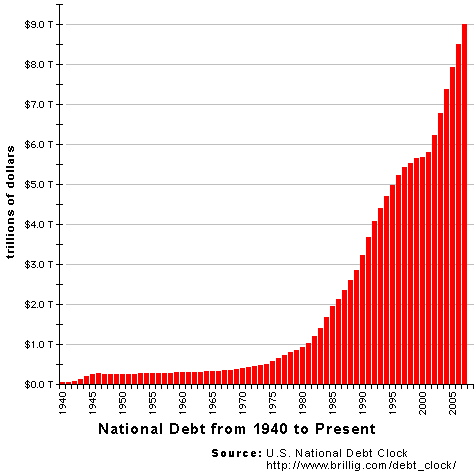
To make a contribution to reduce the public debt:
Make check payable to the "Bureau of the Public Debt"
In the memo section of the check, make sure you write "Gift to reduce the Public Debt"
Mail check to:
ATTN DEPT G
BUREAU OF THE PUBLIC DEBT
PO BOX 2188
PARKERSBURG, WV 26106-2188
Regardless of the size of the national debt, I fail to see the argument against allowing foreigners to buy US debt or a good argument of why the US should abolish its currency and reinstate the double (or just gold) standard.
Obviously whenever you take a loan you are obviously going to have naysayers that say "Don't buy what you can't pay for". Fact of the matter is that borrowing creates wealth if done for the right purposes.

Powered by: vBulletin
Copyright © 2000-2021, Jelsoft Enterprises Ltd.