
TranceAddict Forums (www.tranceaddict.com/forums)
- Political Discussion / Debate
-- Good news from the war on other species: 500 more species nearly wiped out!
Good news from the war on other species: 500 more species nearly wiped out!
Overall highlight must be the impressive reduction in number of hippos:
| quote: |
| 16,000 endangered species on Red List Polar bears, hippos and freshwater fish are among more than 16,000 species of animal, bird, fish and plant threatened with global extinction, the World Conservation Union said today. According to the Swiss-based group, known by its acronym IUCN, the number of species classified as in serious danger of extinction rose from about 15,500 in its previous Red List report, published in 2004. These include one in three amphibians, a quarter of the world�s mammals and coniferous trees and one in eight birds, according to a preview of the 2006 Red List. The full report is published later this week. �Biodiversity loss is increasing, not slowing down,� said IUCN director general Achim Steiner. �The implications of this trend for the productivity and resilience of ecosystems and the lives and livelihoods of billions of people who depend on them are far-reaching.� The Red List classifies about 40,000 different species according to their risk of extinction and provides a searchable online database of the results. The total number of species on the planet is unknown, with 15 million being the most widely accepted estimate. Up to 1.8 million are known today. People are the main reason for most species� decline, mainly through habitat destruction, according to IUCN. Polar bears are threatened by global warming and melting ice caps, because they are conditioned for the icy environment and depend on Arctic ice floes for hunting seas. They are predicted to suffer a 30% population decline in the next 45 years. The hippopotamus population in war-ravaged Congo, meanwhile, has plummeted by 95%, mainly due to unregulated hunting for meat and ivory in their teeth. �Regional conflicts and political instability in some African countries have created hardship for many of the region�s inhabitants and the impact on wildlife has been equally devastating,� said IUCN chief scientist Jeffrey McNeely. Freshwater fish have suffered some of the most dramatic population declines because of human activities that damage their habitat, like forest clearance, pollution and water extraction. Around the Mediterranean, more than half of the 252 endemic species are threatened with extinction. Seven species, including two relatives of carp, are already extinct, IUCN said. The conservation union warned that the decline in wetlands and freshwater ecosystems will also damage supplies for humans of food, clean drinking water and sanitation. Other species threatened with extinction include desert gazelles, ocean sharks and Mediterranean flowers, IUCN said. Some 784 are listed as extinct, a small increase from 2004, while 65 are found only in captivity. But the situation looks a little brighter for some others, such as the white-tailed eagle and Indian vultures. �Reversing this trend is possible, as numerous conservation success stories have proven,� Steiner said. �Biodiversity cannot be saved by environmentalists alone. It must become the responsibility of everyone with the power and resources to act.� |

Well, hippos are one of the worlds most dangerous animals. There are more hippo-related deaths than crocodiles and sharks combined.
Hey, if we can bring the wooly mammoth back (Soon), we can do anything.
| quote: |
| Originally posted by Marc Summers Well, hippos are one of the worlds most dangerous animals. There are more hippo-related deaths than crocodiles and sharks combined. Hey, if we can bring the wooly mammoth back (Soon), we can do anything. |
I just wonder how many species would be on the verge of extinction if humans did not exist at all. Biologically speaking, the earth is constantly gaining and losing species. I mean, we weren't around during the time of the dinosuars, and a great percentage of the species around during that time are no longer here, at no fault of our own.
I'm not saying losing life on earth is a good thing, but 500 out of a proposed 15 million sounds more like natural turnover to me than a human-lead xenocidal conspiracy.
My two cents.
| quote: |
| Originally posted by Lepanto ...what? |
@Neo: Good point. However, the 500 is just in a span of four years. Moreover, if you are right, one would expect new species to replace those being wiped out. Have you heard of new species emerging in known areas (as opposed to being discovered along with remote parts of jungle/ocean floor)? Especially species of similar level of sophistication level as the hippo or polar bear? Say, in the last 100 years?
| quote: |
| Originally posted by Marc Summers Remember like, 6 years ago they found a completly preserved wooly mammoth in Siberia? They've been fucking around with it's DNA, and implanting it in elephants to create a new mammoth race. At least that is what the discovery channel said. |

| quote: |
| Originally posted by trancaholic @Neo: Good point. However, the 500 is just in a span of four years. Moreover, if you are right, one would expect new species to replace those being wiped out. Have you heard of new species emerging in known areas (as opposed to being discovered along with remote parts of jungle/ocean floor)? Especially species of similar level of sophistication level as the hippo or polar bear? Say, in the last 100 years? |

| quote: |
| Originally posted by Lepanto no no i know that. they found him in russia. but the other part of your post |
| quote: |
| While they are typically content to sleep away the day on the shore of a river or in the shallows, when alarmed they are quick to show their hostile side. Hippos are reputed to cause more human deaths than any other large animal in Africa |
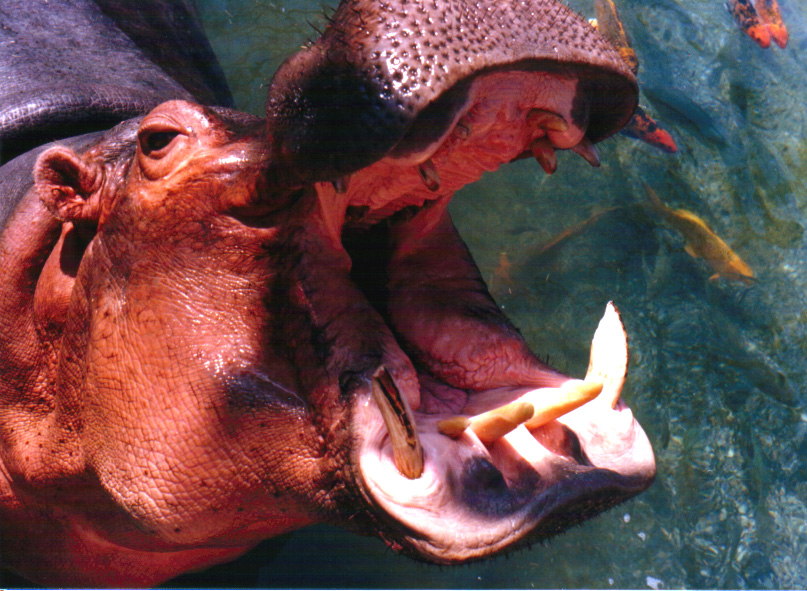

holy crap i thought hippos were harmless.
 ? Or insurgent hippos?

People are always for saving the environment when it is at danger but what if that danger comprised of the human element and that human element had to be eradicated?
Would anyone of those tree huggers line up to die to balance nature?
Reminds me of the time one of those PETA disciples was wearing leather shoes in Union Square.
| quote: |
| Originally posted by NeoPhono Actually, from what I know, the number of species is not a constant. There are certain periods in earth's history where you have a relatively large amount of species, compared to other times. And then there are the 5 major extinction events as well. Maybe this graph will show it a little better. |

| quote: |
| Originally posted by NeoPhono Actually, from what I know, the number of species is not a constant. There are certain periods in earth's history where you have a relatively large amount of species, compared to other times. And then there are the 5 major extinction events as well. Maybe this graph will show it a little better. |
| quote: |
| Originally posted by trancaholic Interesting. Judging from the graph, however, it seems that the number of species is generally increasing unless some extinction event takes place. Seen in that context, it is either odd that the number of species is currently dropping, or we may conclude that humans constitute an extinction event. |
| quote: |
| Originally posted by NeoPhono Do we know that the total number of species is on the decline? |
| quote: |
| New animal species can emerge much quicker than previously thought, say scientists. Salmon in a US lake split into two separate populations in just 13 generations, or about 60-70 years, researchers have revealed. Until now, it was believed that new species took hundreds or thousands of years to appear. And, in a separate study, insects were found to alter the way they attracted a mate in just nine generations. The salmon study took place in Lake Washington, Washington State. The fish were first placed there in 1937. Since then, they have split into two separate populations which prefer not to breed with each other. One group adapted to breeding in a river environment. The others laid their eggs on the lake's beaches. As a result, the two populations have developed slightly different physical features. The male river fish evolved shallower bodies that are better for swimming through strong currents. The female river fish were bigger than the lake ones and able to dig deeper nests. The new evidence suggests that animals can adapt to new environments about 10 times faster than once thought. Researcher Dr Andrew Hendry of the University of Massachusetts, Amherst, who led the study said: "This should really make us rethink the importance of natural selection and adaptation to the rapid generation of new species and the generation of biological diversity." In a separate study, researchers at the University of Queensland, Australia, looked at an insect, the fruit fly. They found that male fruit flies altered the chemicals they use to attract mates after nine generations. The flies appeared to have evolved mechanisms to identify females of the same species, to improve their chances of breeding success. Both studies are reported in the journal Science. |
| quote: |
| Originally posted by Renegade I would still argue that the rate of extinction would be accelerating faster than the possible rate of speciation (presuming that the 500 extinct species in 4 years figure is accurate) and that the breeding rates of larger animals would preclude the possibility of the emergence of any new major species of animal (capable of adapting to the changing environment) in the next few centuries, but at least there's some hope there I guess. |
| quote: |
| The fish were first placed there in 1937. Since then, they have split into two separate populations which prefer not to breed with each other. |
| quote: |
| Originally posted by Renegade http://news.bbc.co.uk/1/hi/sci/tech/979950.stm |
| quote: |
| Originally posted by trancaholic This quote left me a little confused: I thought that the definition of sharing species was the ability to breed? In that case the two populations of salmon cannot really be said to be different species if they only "prefer" not to breed with each other. In which case the article's conclusions seem dubious. |
| quote: |
| Originally posted by trancaholic This quote left me a little confused: I thought that the definition of sharing species was the ability to breed? |

| quote: |
| Labels require definitions, and species is a very particular label that has been defined in different ways through the past. It first just meant a distinctly-describable type; then it was distinct types that could not interbreed; then it was distinct types that could breed and produce offspring that themselves could go on as adults to breed (some crosses between species can produce young, such as horses and donkeys producing mules, but they grow up to be sterile adults). Today, the best, latest, nontechnical definition of species is... Species: A group that, in natural surroundings, breeds exclusively within the group. In effect, we now let the organisms themselves determine what belongs to their species and what doesn't. This still is not a great definition - it says nothing about asexual species. And, like almost any biological definition, it still has exceptions, such as with coyotes, dogs, and wolves, which can and do interbreed (but not commonly) and are definitely considered separate species. But it works fairly well. |
| quote: |
| Originally posted by Renegade So did I, but apparently the science of taxonomy has progressed somewhat since us old bastards last studied it at school. |
| quote: |
| Originally posted by Renegade Doesn't seem like a precise science, but I guess under this definition the salmon could be considered different species without too much controversy? |

Powered by: vBulletin
Copyright © 2000-2021, Jelsoft Enterprises Ltd.