
TranceAddict Forums (www.tranceaddict.com/forums)
- Production Studio
-- Studio Buildout Discussion
Pages (4): [1] 2 3 4 »
Studio Buildout Discussion
Hi,
After months of threatening it I hereby start the Diginerd's Monster Studio buildout thread.
For those who don't know (or have waited so long that they've forgotten what I'm talking about!), I'm building a purpose built space in the basement of my house.
My key goals for this are:-
1. Best possible monitoring at the listening position.
Time for a fair amount of Maths and a bunch of modelling before I start, and then lots of tweaking once it's built
2. Be ergonomic (ie easy to use and be in).
I'm fed up with my gear being poorly laid out, hard to reach around the back to connect cables (the fact I have to do that regularly is a sign that it's not right!), and the wife would appreciate it not being a fire hazard!
3. Minimize cables & clutter as far as possible.
If you've ever had more than 3 bits of gear you'll be quite aware of how cables and tangles breed like rabbits. Id like to minimize that, or at the very least hide it all from view.
I have a pretty substantial collection of rack gear, so this is really important, espectiall when coupled with point 2.
4. Try not to break the bank or myself whilt I'm building it.
I've not set a budget for this, but I'd like to keep it as cheap as possible whilst still doing a good job. Time, Money & Quality, pick 2.
I I need quality and cost effective, so that means it's going to take a lot of time.
Right now if you put a gun to my head I'd estimate this is going to take at least $2000. Last time I had someone do the buildout for me, it took him and his assistant 3 weeks full time for construction (No painting or gear installation) and they billed me around �7700 all in (That's right, about $13,500!). Of course I moved out 1 year later and it wasn't right so I'm not going to repeat that mistake again!
I really have no idea how many hours this is going to take, but there's going to be little music produced for a while!
I also need to be careful not seriously injuring or killing myself during this process too. Powertools are dangerous, as are heave pieces of sheetrock, sharp edges on studding, and worst of all working with power, breakers and outlets. This stuff can kill. If I stop posting suddenly there may be a reason!
Ok, let's begin.
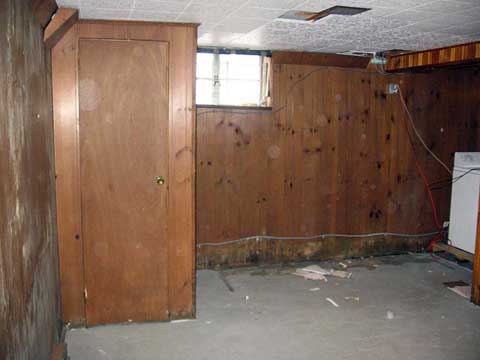
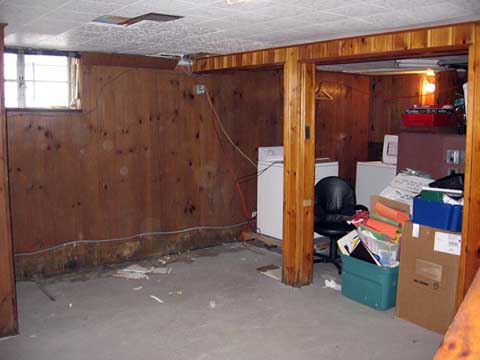
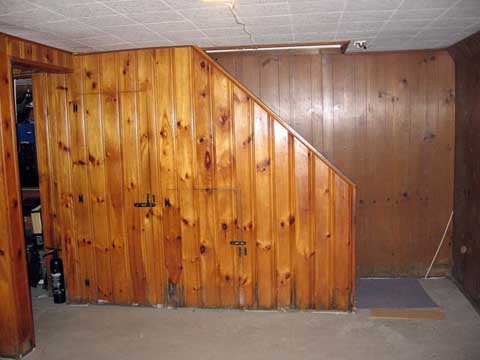
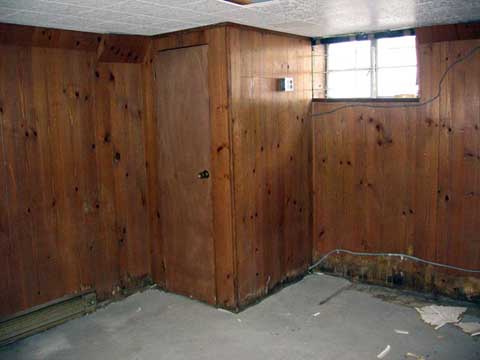
Here's the space I have to work with:-
View from the bottom of the stairs #1
View from the bottom of the stairs #2
View from under the Window
Back towards the window from the other side
The Ceiling
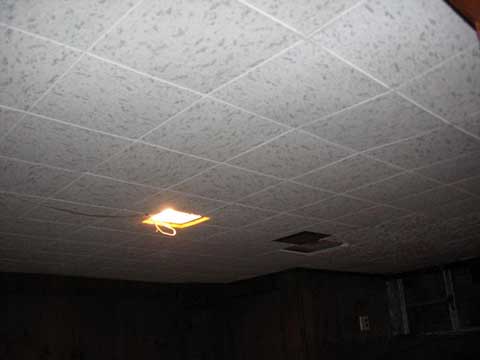
Planning coming soon..
I like this idea a lot. Please keep us updated with pictures of the construction in progress. My girlfriend and I are planning on buying our own place very soon, and I'll building a project studio strait away.
I'd like to learn from your little proejct here.

things that come in mind:
1. Make your room symetric. Locate your listening position so that reflextions from walls around you will have equal travelling time and absorption.
2. You got a quite small room, make your walls absorb as much as you can.
3. Place speakers at least 1.5 m away from walls or make them fit inside the wall. Avoid faces (desk, equipment,...) that provide direct reflection from speakers to listening position.
...keep on posting your plans, I'll check them if you like (have M.Sc. in Acoustics).
Thanks for the tips, I am seriously aware that I don't have a lot of space so there are going to have to be some pretty significant tradeoffs.
I'd love to float the room for isolation, but I don't have the height or the budget for that. Right now I'm not even sure of the exact dimensions of the room, as I haven't taken a look behind the panelling. I do know that behind there is the outerwall of the house which is about 15 inches thick. On the long wall the outside is buried under the ground, as is half of the wall with the window. The wall next to the stairs has another thick loadbearing wall, and behind is the garage.
I'm going to have fun with the partition wall that's going to be going up infront of the pillars. Not sure how I'm going to compensate for that. I'm not sure that I want to be putting in massive amounts of brickwork down the middle of the basement..
I'm up to my eyes in CaraCAD right now building models of the room.
I'm tweaking wall and ceiling construction as well as interior dimensions to try and get the smoothest distribution of absorbtion.
This may lead to the room getting up to 12" smallerin width & length as I essntially turn the walls into basstraps whilst making the hwd as dissimilar as possible in the space given.
Oh and I failed to mention I need to damp as much sound going up and out the window as possible. It's no fun mixing at 3am and having the neighbors complain.
As for speaker placement I have a pair of ATC SCM-50A's which are too big for the room. Soffit mounting them could be an option, but I'd loose an additional 24" on whichever dimension I stuck them in.
At first glance it looks like I'll be running lengthwise (Speakers next to the wall with the window) as the modes are more widely spaced that way, as well as making the room have enough space to fit a couple of people in there. It's goign to be tight with the amount of gear I have to install..
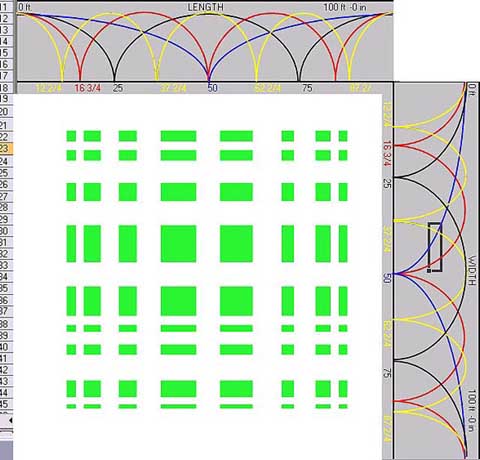
Here's an excel sheet I found to start calculating modes & positioning.
Link to speaker specs.
http://www.atc.gb.net/scm50/scm50.html
Gah, a thought just occurred to me. It might be a really bad idea to Soffit-mount these guys in the space available.. Each one has three Class A amps in the back with a massive heatsink.
For those not aware, class A amps are always running at full power draw. If you are listening to silence you basically have a couple of expensive electric radiators as the power is dissipated as heat.
In an enclosed space with little / no cooling this would be a major issue. ATC have a work around (Which I'm not happy to do!) which is remove the amp packs from the cabinets and mount them separately in a cooled space. The throught of ripping theys guys apart is not one I'm comfortale with..
It might be scary. But It might be your best option. It makes total sense in the long run. In fact all of our schools studio speakers (except the mini-self powered monitors on the meter bridges etc) amps are in racks in the wall with cooling equipment.
I would do it if I were you. Then again. I don't own fancy speakers that I would be very nervous about taking apart.
Hmm, it looks like you'd want to use a dehumidifier down there. (Judging by the look of the paneling near the floor)
They're a little noisy, but keep your basement dry and odourless. I'm thinking moisture would be bad for the studio equipment.
The basement is actually very dry. The damage there is from a flood over 10 years ago, there is now decent drainage outside so it shouldn't happen again.
That said it's a consideration that I want to keep the power far off the floor, and prolly my gear too!
Back to the soffits, another problem is the main power board for the house is in that closet next to the window. I'm going to have to tear it down to make space, or I could build out a wall to put the speakers in with a door next to them.
The problem then is I would have a very asymetric setup around the back. Not only that but by chopping off 2 to 3 feet off the length of the room screws with the ratios of Hight x Width x length, I need to run some more numbers to work out if the payoff is worth it.
I think I'll start poking at the ceiling tonight.
My hope is that above the false ceiling there are open beams to the floorboards above. If that's the case I'll caulk between the boards and along the joists, pack the cavity between the joists with rock wool leaving a couple of inches of joist protruding (Airgap).
I'd like to hang the ceiling (currently planned to be at least 2 (Prolly 3)layers of 1/2" sheetrock off of Resiliant Channel (Top Hat profile track) screwed to the joists.
I'd love to use proper hanging clips too but the resultant additional drop in height would pose problems both accousically and ergonomically. One of the guys I work with is pretty tall and him banging his head into lights (I dream of halogen track lights) would be ungood.
Also they're wicked expensive and from the last time I went through this the kind of construction I described does a pretty decent job, though not perfect.
Thoughts?
Very intresting and good idea posting this, i will follow it
| quote: |
| Originally posted by Diginerd The basement is actually very dry. The damage there is from a flood over 10 years ago, there is now decent drainage outside so it shouldn't happen again. That said it's a consideration that I want to keep the power far off the floor, and prolly my gear too! |
Those centre beams would have some (if little) effect on the room modes.
Is bricking up the window an option?
It's not difficult to float the floor, I build studios. Just get 25mm polystyrene, 1.2m x 2.4m, and lay your floor over that. It will give a lot of isolation and help with damping. Try and find a factory that makes high density foam, as I've found that this is the best method of absorption. There are commercially available options such as Auraflex, but they cost a fortune. Make sure you use an anti-static floor, i.e. no carpets, as there's nothing worse than shocking yourself on your gear! I find industrial vinyl or formica to be the best. You don't need a booth anymore (unless you're planning to record bands), I find that recording vocalists in the room with me is much more personal and gets better results.
I'd also keep the window, just double or triple glaze it, as natural light in a studio is great, otherwise it feels like a bit of a dungeon.
So I poked at the ceiling last night.
I ripped down all the tiles and found that there is a layer of 1" fiber board nailled to the underside of the joists, with wooden slats running at 90 degrees to them.
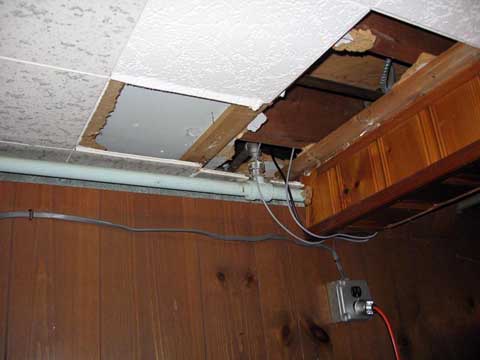
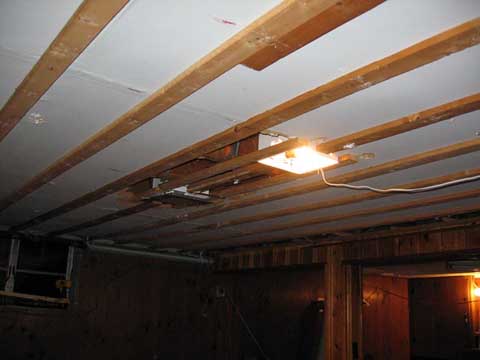
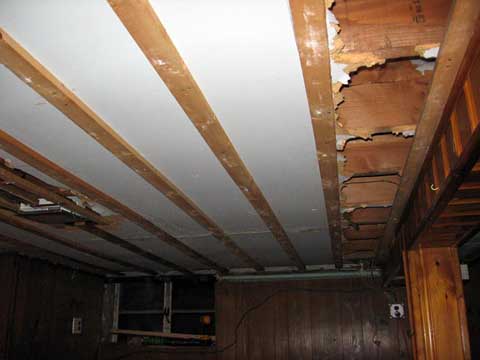
That poses an interesting problem.
I could rip it all down, alternately if I pack in behind the fiber board between the joists with rock wool leaving an air gap it gives me an additional layer of material for sound proofing (So long as it's sealed)
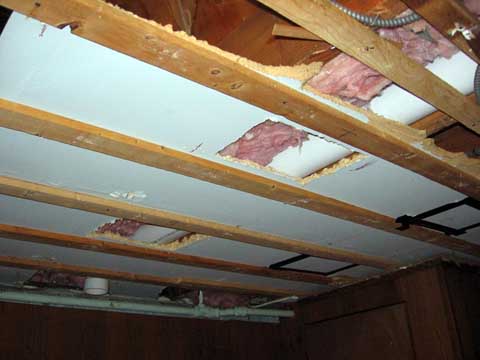
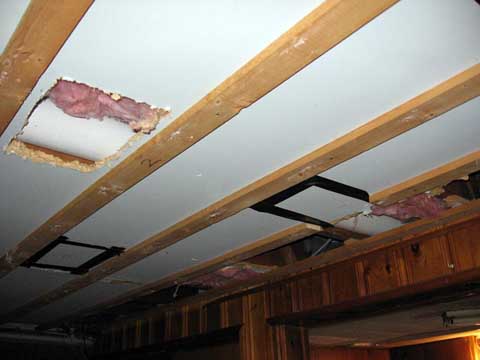
To get the rock wool in I'd have to cut some holes in the fiber board and pull the insulation through. As you can see in the last image the edge has already been attacked by someone laying in a cable.
Once that's done I'll tape the cutouts back into place with Gaffa tape (aka duct tape).
Just run some numbers and CaraCAD says that leaving the fiber board in place would be better than removing it, so I guess it stays.
Once I've finished putting my thoughts together on some other points I'll post again later today
So I've read through some of the comments and done some thinking..
1. Racks in Walls.. Hmmmmm Yummy. I was wondering how to fit my two quiklok rack tolleys into the room and come to the conclusion that I don't have to if I build two racks into a wall.
More to the point I'm putting up a partion wall down the middle of he basement. If the racks live in there, there can be a dorr to access the rest of the basement which also provides access to the backs of the racks.
That kills a couple of birds with one stone.
a) Creates much more room in the studio
b) Removes most of the cabling to OUTSIDE of the studio (Tidy!)
c) Easy access around the back to work on hooking things up and changing things.
d) I could put mu comps on the otherside of the wall and have a pretty quiet room..
Me like. :->
2) Float the room. By that I meant put in a 2" neoprene pad, and pour a cement block on that and built the alls and ceiling all on that and not attached to any part of the house. That's too big an undertaking (not least I don't have 12" of headroom to loose)
On the otherhand I do have a bunch of interlocking high density foam tiles that are 8/10ths of an inch thick, and enought to cover the floor. That will do nicely as an underlay.
Looking at my CaraCAD models if I build the way I think I am with the walls, the three outerwalls will be pretty significant bass traps, and I will actually have a pretty bright room, which will need foam to treat. This is the opposite of most rooms, where adittional bass trapping will have a much better impact on overal sonics..
Lets see how I get on with the ceiling..
| quote: |
| It's not difficult to float the floor, I build studios. Just get 25mm polystyrene, 1.2m x 2.4m, and lay your floor over that. It will give a lot of isolation and help with damping. |
StyroFOAM is actually very porous, this creates lots of little airgaps which can help convert soundwaves to heat (Absorption). Works mostly in the mid an upper ranges.
WARNING LINKS HAVE REASONABLE TO HEAVY MATHS CONTENT!
http://www.du.edu/~jcalvert/waves/soundwav.htm
above gives a fairly decent overview
and below is a collection of BBC whitepapers on the subject of accoustics. They know their stuff..
http://www.bbc.co.uk/rd/pubs/whp/wh...iles/WHP021.pdf
http://www.bbc.co.uk/rd/pubs/archiv...fpartitions.pdf
http://www.bbc.co.uk/rd/pubs/archiv...ticpractice.pdf < This one rocks and is a veritable "How to"
The BBC papers are a goldmine of information, the TV licence is good for something!
Thanks for these pdf's, I look forward to reading them.
Yea Diginerd but polystyrene isnt foam? Foam is definitely porous. You can see the air pockets. But polystyrene is designed to fill out and expand. There are no air pockets.
Polystyrene is porous, just the air gaps are very small, do some research and you'll see.
I'm on my work comp so i don't have my CaraCad models to hand, but here's some more photos of me packing the ceiling out.
You can see how I cut access holes, put the insulation in and then tape up the hole again. Also the white duct is a piece of pipe that goes over the studio and will go down the long wall and terminate as a hol in the wall. this will let me get the computer cables from one side of the room to the other without stretching them messily around the edge.
I'll draw up a chicken scratch of how it's going to be, scan it and post it soon..
Ooh, working with rockwool is such a bitch, why don't you use Isotherm rather?
I have several questions:
1. Do you plan to use your studio as a professional recording environment, with hopes of renting it out?
2. How many producers that work without all these nick-nacks but have quality material are able to get their work done without much hindrance?
I'm actually at the same point as you - I also have similar type of basement scenario, with loads of gear and miles of cabling. it became so intimidating to go in there that I actually gave up the whole idea alltogether and moved some select few items to my upstairs office. No acoustic treatments, no racks, just 4 near and dear pieces of gear, running through $250 M-Audio BX5a monitors. So far, I was able to get more recorded and accomplished in the last week than I have done in the last year. Why? Simple - too much mucking around, getting the "perfect recording environment", at the same time loosing the main focus - I'm there to make music and have fun, not have an extra job.
Now, don't take me wrong - if this is what you use to relax, relieve your mind and have fun - by all means. I found it to be so frustrating and overwhelming, I had weeks when I couldn't even think of doing any music stuff.
Sometimes, I even thought that perhaps all this "rearanging, making shit perfect" was just an excuse not to do anything artistic.
Just my $0.02...
Have fun either way.
p.s. according to my latest calculations, I have sunk close to $30K into my existing setup... and that's not counting the time, gas, and other byproducts.
I'm currently running in my "upstairs studio" on about $3000 worth of kit and 1000% more productive. No insulation, not acoustically treated, etc, etc. etc.
something to think about. cheers! 
1. Purely for personal fun and amusement. I've worked in a for profit studio before, except it's hard to make the profit part come out right. That said, by the time I've finished building this out I can play tax games with the space, as well as have demonstratble costs when putting out records (ie more money for me).
2. That's the other reason I'm doing this. I have a ton of gear, and I never seam to have it all setup or be able to use it as I wish. Too many moving parts and all that. I want to be able to go in there and be making music inside 5 minutes.
For that I need to do a lot of up-front systems design, by which I mean setup the midi control just so, all the audio hooked up to the patchbay in just the right way so I can use everything without patching. ie I only need to use the patchbay if I want to do something special with a particular source.
All of this translates to a significant period of time of not doing any actual music, but ultimately it should pay of with massively increased productivity when I'm in there, and once things are all "Shaken down" no more annoying "WTF? Why is it only coming through on the right channel" kind of moments.
I want to be able to quickly chose to do something and have it happen, not spend 20 minutes struggling and killing my creativity in the process. That's one of the major benefits of going through this process.
Of course if I was purely software based it would be akin to setting up my "PC just so", unfortunately the physical world is a little tougher to deal with in this manner!
As to your point of being more creative with less gear, I'm a big fan of working under limitations (as you may have seen from my water software discussions a while back), but on the otherhand if I can have all my tools available to me inside 10 seconds then why the hell not..
Finally it was a matter of space in the house. This is the only location where I could put my gear, so having it nice to work in strikes me as a good move.

Powered by: vBulletin
Copyright © 2000-2021, Jelsoft Enterprises Ltd.