
TranceAddict Forums (www.tranceaddict.com/forums)
- Political Discussion / Debate
-- Bush you f$cking turd - stop screwing with science
Damnit Bush, stop screwing with science!
It's getting monotonous. But he's crossing the line with this one with me:
| quote: |
| August 24, 2006 Evolution Major Vanishes From Approved Federal List By CORNELIA DEAN Evolutionary biology has vanished from the list of acceptable fields of study for recipients of a federal education grant for low-income college students. The omission is inadvertent, said Katherine McLane, a spokeswoman for the Department of Education, which administers the grants. �There is no explanation for it being left off the list,� Ms. McLane said. �It has always been an eligible major.� Another spokeswoman, Samara Yudof, said evolutionary biology would be restored to the list, but as of last night it was still missing. If a major is not on the list, students in that major cannot get grants unless they declare another major, said Barmak Nassirian, associate executive director of the American Association of Collegiate Registrars and Admissions Officers. Mr. Nassirian said students seeking the grants went first to their college registrar, who determined whether they were full-time students majoring in an eligible field. �If a field is missing, that student would not even get into the process,� he said. That the omission occurred at all is worrying scientists concerned about threats to the teaching of evolution. One of them, Lawrence M. Krauss, a physicist at Case Western Reserve University, said he learned about it from someone at the Department of Education, who got in touch with him after his essay on the necessity of teaching evolution appeared in The New York Times on Aug. 15. Dr. Krauss would not name his source, who he said was concerned about being publicly identified as having drawn attention to the matter. An article about the issue was posted Tuesday on the Web site of The Chronicle of Higher Education. Dr. Krauss said the omission would be �of great concern� if evolutionary biology had been singled out for removal, or if the change had been made without consulting with experts on biology. The grants are awarded under the National Smart Grant program, established this year by Congress. (Smart stands for Science and Mathematics Access to Retain Talent.) The program provides $4,000 grants to third- or fourth-year, low-income students majoring in physical, life or computer sciences; mathematics; technology; engineering; or foreign languages deemed �critical� to national security. The list of eligible majors (which is online at ifap.ed.gov/dpcletters/attachments/GEN0606A.pdf) is drawn from the Education Department�s �Classification of Instructional Programs,� or CIP (pronounced �sip�), a voluminous and detailed classification of courses of study, arranged in a numbered system of sections and subsections. Part 26, biological and biomedical sciences, has a number of sections, each of which has one or more subsections. Subsection 13 is ecology, evolution, systematics and population biology. This subsection itself has 10 sub-subsections. One of them is 26.1303 � evolutionary biology, �the scientific study of the genetic, developmental, functional, and morphological patterns and processes, and theoretical principles; and the emergence and mutation of organisms over time.� Though references to evolution appear in listings of other fields of biological study, the evolutionary biology sub-subsection is missing from a list of �fields of study� on the National Smart Grant list � there is an empty space between line 26.1302 (marine biology and biological oceanography) and line 26.1304 (aquatic biology/limnology). Students cannot simply list something else on an application form, said Mr. Nassirian of the registrars� association. �Your declared major maps to a CIP code,� he said. Mr. Nassirian said people at the Education Department had described the omission as �a clerical mistake.� But it is �odd,� he said, because applying the subject codes �is a fairly mechanical task. It is not supposed to be the subject of any kind of deliberation.� �I am not at all certain that the omission of this particular major is unintentional,� he added. �But I have to take them at their word.� Scientists who knew about the omission also said they found the clerical explanation unconvincing, given the furor over challenges by the religious right to the teaching of evolution in public schools. �It�s just awfully coincidental,� said Steven W. Rissing, an evolutionary biologist at Ohio State University. Jeremy Gunn, who directs the Program on Freedom of Religion and Belief at the American Civil Liberties Union, said that if the change was not immediately reversed �we will certainly pursue this.� Dr. Rissing said removing evolutionary biology from the list of acceptable majors would discourage students who needed the grants from pursuing the field, at a time when studies of how genes act and evolve are producing valuable insights into human health. �This is not just some kind of nicety,� he said. �We are doing a terrible disservice to our students if this is yet another example of making sure science doesn�t offend anyone.� Dr. Krauss of Case Western said he did not know what practical issues would arise from the omission of evolutionary biology from the list, given that students would still be eligible for grants if they declared a major in something else � biology, say. �I am sure an enterprising student or program director could find a way to put themselves in another slot,� he said. �But why should they have to do that?� Mr. Nassirian said he was not so sure. �Candidly, I don�t think most administrators know enough about this program� to help students overcome the apparent objection to evolutionary biology, he said. Undergraduates would be even less knowledgeable about the issue, he added. Dr. Krauss said: �Removing that one major is not going to make the nation stupid, but if this really was removed, specifically removed, then I see it as part of a pattern to put ideology over knowledge. And, especially in the Department of Education, that should be abhorred.� http://www.nytimes.com/2006/08/24/w...=rssnyt&emc=rss |
You guys need to play with the right card:

That should do it 
Darwin tried to kill Bush's father

| quote: |
| Originally posted by InterMilan31 Darwin tried to kill Bush's father |
It's official: America is a theocracy
| quote: |
| Originally posted by George Smiley It's official: America is a theocracy |
it never ceases to amaze me how the #1 free nation in the world can be so far behind in so many important ways 
Um guys, don't forget that evolution is just a "theory" here, which makes it no more true than the "theory" of atoms or the "theory" of gravity. Just because the entire existent body of empirical, scientific evidence supports the evolutionary theory, that doesn't necessarily make it true! Afterall, a scientific "theory" is just the opinion of some scientist guys sitting around in a laboratory somewhere - and what would a scientist know about genetics or biology!
Personally, I think it's great that the Bush administration is willing to listen to both sides of this evenly matched debate and to ignore 150 years of indisputable scientific evidence in favour of the delusions of completely fucking insane dickheads: teach the controversy, I say! Afterall, why should the US government fund it's own young medical researchers to learn about something that is - in the words of the scientists themselves! - just a "theory"? Surely American students of genetics and medicine wouldn't be put at a disadvantage if they were to be taught that everything we know about genetics is inherently wrong and that it all actually happened by magic? WHY ARE YOU LEFT-WING SCIENCE ELITISTS ALL SO CLOSED-MINDED!!!????
| quote: |
| Originally posted by Renegade Um guys, don't forget that evolution is just a "theory" here, which makes it no more true than the "theory" of atoms or the "theory" of gravity. |
Fucking fundamentalists...
| quote: |
| Originally posted by sasslife lol... Iranica |
| quote: |
75% in Arkansas, Alabama Believe Bible Literally True August 26, 2006 Not surprisingly, the Bible Belt region lives up to its name with states like Alabama, Arkansas, Tennessee and West Virginia containing the highest percentage of those who believe the Bible is literally true. Alabama and Arkansas came out on top as 75% say they believe the Bible is literally true. West Virginia (70%) and Tennessee (68%) are close behind. The northeast region of our map represents the other extreme. In Vermont and Massachusetts, only 22% of those respondents believe the Bible is literally true�the lowest percentages in all states surveyed. Earlier this summer, a national survey found that 54% of American adults believe the Bible is literally true. In Arkansas, the question proves to be one of the rare ones that doesn�t cause divisions along party lines; 83% of Republicans and 75% of Democrats say the believe in the Bible�s literal truth. Seventy-nine percent (79%) of women and 69% of men identify themselves as true believers. In Alabama, Democrats and Republicans both share high levels of belief on the authenticity and literal truth of the Bible. Women again outnumber men, though by a smaller percentage, 79% to 72%. The states differ, though, when the question is dissected by respondents� ages. Percentages of those agreeing with the Bible�s authenticity are in the high 70�s across all age demographics for Alabama. In Arkansas, however, percentages are actually higher for younger voters. Eighty-one percent (81%) of those 18-29 and 83% of those 30-39 believe the Bible�s literal truth and then the numbers drop off, hitting a low of 66% for voters ages 50-64. In Vermont, 37% of GOP voters and only 14% of Democrats say they are believers. Along age lines, the highest percentage of believers are those ages 65 and older (36%.) In Massachusetts, Republican believers again outnumber Democrats (39% to 17%) Surprisingly, among conservatives in the state, the percentage of those who believe the Bible is true (41%) is outweighed by the percentage who do not (44%.) As expected, strong connections exist in most of the states surveyed between the percentage of those who answered affirmatively on the Bible question and their positions on abortion and same-sex marriage. See Daily Snapshot to go to tables with a state-by-state breakdown of responses on all three subjects for Premium Members. The national survey was of all adults. The state surveys consisted of Likely Voter samples. The results may not be directly comparable. Rasmussen Reports is an electronic publishing firm specializing in the collection, publication, and distribution of public opinion polling information. The Rasmussen Reports ElectionEdge� Premium Service for Election 2006 offers the most comprehensive public opinion coverage ever provided for a mid-term election. We update the President's Job Approval Ratings daily and are polling every Senate and Governor's race at least once a month in 2006. Rasmussen Reports was the nation's most accurate polling firm during the Presidential election and the only one to project both Bush and Kerry's vote total within half a percentage point of the actual outcome. During Election 2004, RasmussenReports.com was also the top-ranked public opinion research site on the web. We had twice as many visitors as our nearest competitor and nearly as many as all competitors combined. Scott Rasmussen, president of Rasmussen Reports, has been an independent pollster for more than a decade. |
On the upside, there was a partial victory against fundamentalism:
http://news.worldfitness.ca/2006/08...ans-for-plan-b/
It was only a partial victory because under 18 women still need a prescription, an arbitrary decision clearly influenced by fundamentlism.
In Iran women who merely shake hands with a man can be jailed, and they can be stoned to death for adultery.
Had the old confederacy survived as an intact nation, perhaps there would have been stonings and witch burnings.
Yet Iran's theocracy remains...where's the outrage there? 
| quote: |
| Originally posted by trancaholic I agree completely that Bush is a twat and that the US is a disgraceful theocracy. Moreover, I don't mind announcing evolution through natural selection as our best theory for explaining the current variety of life. However, I'd like to know exactly what kind of predictions neo-darwinism (as you seem to support) allows for and exactly what kind of experiments that could debunk it. I know that both the theory of atoms and gravity (and superstring theory, quantum mechanics, and the theory of relativity) allow for bold conjectures, but I still don't see any such postulates coming from the likes of Dawkins? (Btw. I've had an *extremely lengthy* discussion with Mister Opus about this "problem" before, and I apologize in advance if this turns out to be a repeat: I cannot commit myself to deep debate at this point of time - just thought that my above caveat needed mentioning.) |
Re: Bush you f$cking turd - stop screwing with science
| quote: |
| Originally posted by MisterOpus1 Fucking asshole. Just keep them dumb, just the way you like 'em, eh? |
Re: Re: Bush you f$cking turd - stop screwing with science
| quote: |
| Originally posted by Q5echo have you found out anything about this being policy issue? or is this more symptom of your "Bush Derangement Syndrome"? |
| quote: |
| Originally posted by Fir3start3r Yet Iran's theocracy remains...where's the outrage there? |
To get back to tranceaholic's question, I'm going to be posting some links to predictions that will help out a bit.
First the obvious ones:
http://www.talkorigins.org/indexcc/CA/CA210.html
http://chem.tufts.edu/AnswersInScience/evo_science.html
http://www.talkorigins.org/indexcc/CA/CA215.html
A more recent one in WaPost:
http://www.washingtonpost.com/wp-dy...5092501177.html
Just for the kick of it, I scanned through a few articles on PubMed and here's some interesting stuff at first glance:
http://www.ncbi.nlm.nih.gov/entrez/...l=pubmed_docsum
http://www.ncbi.nlm.nih.gov/entrez/...l=pubmed_DocSum
http://www.ncbi.nlm.nih.gov/entrez/...l=pubmed_DocSum
http://www.ncbi.nlm.nih.gov/entrez/...l=pubmed_DocSum
http://www.ncbi.nlm.nih.gov/entrez/...l=pubmed_DocSum
http://www.ncbi.nlm.nih.gov/entrez/...l=pubmed_DocSum
http://www.ncbi.nlm.nih.gov/entrez/...l=pubmed_DocSum
http://www.ncbi.nlm.nih.gov/entrez/...l=pubmed_DocSum
http://www.ncbi.nlm.nih.gov/entrez/...l=pubmed_DocSum
Here's an interesting one:
| quote: |
| Urochordate βγ-Crystallin and the Evolutionary Origin of the Vertebrate Eye Lens Sebastian M. Shimeld, Andrew G. Purkiss, Ron P.H. Dirks, Orval A. Bateman, Christine Slingsby, and Nicolette H. Lubsen Abstract:A refracting lens is a key component of our image-forming camera eye; however, its evolutionary origin is unknown because precursor structures appear absent in nonvertebrates [1]. The vertebrate βγ-crystallin genes encode abundant structural proteins critical for the function of the lens [2]. We show that the urochordate Ciona intestinalis, which split from the vertebrate lineage before the evolution of the lens, has a single gene coding for a single domain monomeric βγ-crystallin. The crystal structure of Ciona βγ-crystallin is very similar to that of a vertebrate βγ-crystallin domain, except for paired, occupied calcium binding sites. The Ciona βγ-crystallin is only expressed in the palps and in the otolith, the pigmented sister cell of the light-sensing ocellus. The Ciona βγ-crystallin promoter region targeted expression to the visual system, including lens, in transgenic Xenopus tadpoles. We conclude that the vertebrate βγ-crystallins evolved from a single domain protein already expressed in the neuroectoderm of the prevertebrate ancestor. The conservation of the regulatory hierarchy controlling βγ-crystallin expression between organisms with and without a lens shows that the evolutionary origin of the lens was based on co-option of pre-existing regulatory circuits controlling the expression of a key structural gene in a primitive light-sensing system. |
| quote: |
| * Fossils of more complex organisms would occur only in younger rock strata. (true) * There must be some internal mechanism that creates variability so that change over time can occur. (Genetics) * Fossils of similar organisms will be found in certain locations on earth, in isolation from other non-similar organisms. (true) * DNA similarity should be predictive of how closely related two organisms are to each other. (true) This corroborates the fossil record, too. In science, a "prediction" does not necessarily mean describing a future event. It is simply the logical result you would expect from the data you have. http://wilstar.com/evolution/predictions.html |
Re: Re: Re: Bush you f$cking turd - stop screwing with science
| quote: |
| Originally posted by MisterOpus1 My contention about Bush's war on science is a well-documented one, and if that is a "derangement" on my part, that derangement pretty much encompasses a large body of scientists and researchers from a variety of fields who've spoken out on the matter as well. If you wish further documentation on the matter, let me know. |
Re: Re: Re: Re: Bush you f$cking turd - stop screwing with science
| quote: |
| Originally posted by Q5echo no, your contention alleges George Bush is secretly denying Federal grants to undergrads that want to learn about evolutionary biology. your contention is deranged and founded only by a news article that admits that it probably is a mistake. don't make this more than it really is, Goebbels. |
| quote: |
| Originally posted by trancaholic I agree completely that Bush is a twat and that the US is a disgraceful theocracy. Moreover, I don't mind announcing evolution through natural selection as our best theory for explaining the current variety of life. However, I'd like to know exactly what kind of predictions neo-darwinism (as you seem to support) allows for and exactly what kind of experiments that could debunk it. |
| quote: |
| All great apes apart from man have 24 pairs of chromosomes. There is therefore a hypothesis that the common ancestor of all great apes had 24 pairs of chromosomes and that the fusion of two of the ancestor's chromosomes created chromosome 2 in humans. The evidence for this hypothesis is very strong. The Evidence Evidence for fusing of two ancestral chromosomes to create human chromosome 2 and where there has been no fusion in other Great Apes is: 1) The analogous chromosomes (2p and 2q) in the non-human great apes can be shown, when laid end to end, to create an identical banding structure to the human chromosome 2. (1) 2) The remains of the sequence that the chromosome has on its ends (the telomere) is found in the middle of human chromosome 2 where the ancestral chromosomes fused. (2) 3) the detail of this region (pre-telomeric sequence, telomeric sequence, reversed telomeric sequence, pre-telomeric sequence) is exactly what we would expect from a fusion. (3) 4) this telomeric region is exactly where one would expect to find it if a fusion had occurred in the middle of human chromosome 2. 5) the centromere of human chromosome 2 lines up with the chimp chromosome 2p chromosomal centromere. 6) At the place where we would expect it on the human chromosome we find the remnants of the chimp 2q centromere (4). Not only is this strong evidence for a fusion event, but it is also strong evidence for common ancestry; in fact, it is hard to explain by any other mechanism. 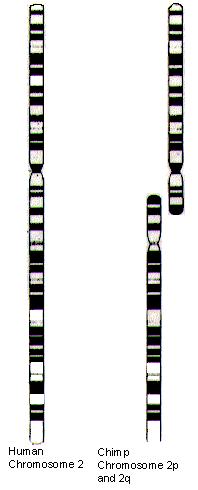 |
| quote: |
| I know that both the theory of atoms and gravity (and superstring theory, quantum mechanics, and the theory of relativity) allow for bold conjectures, but I still don't see any such postulates coming from the likes of Dawkins? |

| quote: |
| * Fossils of more complex organisms would occur only in younger rock strata. (true) * There must be some internal mechanism that creates variability so that change over time can occur. (Genetics) * Fossils of similar organisms will be found in certain locations on earth, in isolation from other non-similar organisms. (true) * DNA similarity should be predictive of how closely related two organisms are to each other. (true) This corroborates the fossil record, too. |
| quote: |
| Originally posted by MisterOpus1 Are you asking how evolution makes certain future predictions for future research and discoveries? |
| quote: |
| Originally posted by MisterOpus1 If so, would you like that on a geological scale, a cellular/molecular scale, or both? |
| quote: |
| Originally posted by MisterOpus1 To get back to tranceaholic's question, I'm going to be posting some links to predictions that will help out a bit. |
| quote: |
| Similarly, Darwin predicted that Precambrian fossils would be found. He wrote in 1859 that the total absence of fossils in Precambrian rock was "inexplicable" and that the lack might "be truly urged as a valid argument" against his theory. When such fossils were found, starting in 1953, it turned out that they had been abundant all along. They were just so small that it took a microscope to see them. |
| quote: |
| Evolution predicts that the fossil record will show different populations of creatures at different times. For example, it predicts we will never find fossils of trilobites with fossils of dinosaurs, since their geological time-lines don't overlap. The "Cretaceous seaway" deposits in Colorado and Wyoming contain almost 90 different kinds of ammonites, but no one has ever found two different kinds of ammonite together in the same rockbed. |
| quote: |
| "If it could be proved that any part of the structure of any one species had been formed for the exclusive good of another species, it would annihilate my theory, for such could not have been produced through natural selection." |

| quote: |
| Originally posted by MisterOpus1 Evolution's tenet is that new functions, organs, etc. come to fruition via modification from existing functions or genes over time. |
| quote: |
| Originally posted by MisterOpus1 HTH |

| quote: |
| Originally posted by Renegade Because evolution is essentially a study of the past, I'm sure you appreciate that there are limits to the kind of predictions that can be made - same with the study of, say, geology or history. |
| quote: |
| Originally posted by Renegade The only area of evolutionary study that I'm familiar with that is capable of making genuinely testable predictions is that of phylogeny, or the study of the genetic history of species of animals. Essentially, the theory goes that all species of plant and animal can be traced back to a common ancestor, and so the prediction is that species of animals with more a recent common ancestor should be have more in common genetically than those animals with a more distant common relative. As we map the genetic structures of more and more animals, we should find - if our predictions about evolution are accurate - that species of animals we presume to be closely related should share many of their genes, with species having less and less in common genetically as their relationship because more and more distant. |
| quote: |
| Originally posted by Renegade This is only one fairly minor example of course, but as our ability to map the genetic structures of animals improves, we will see the study of phylogeny throwing up predictions like this on a daily basis, which will - in each case - have the potential to "debunk", as you put it, the theory of evolution as we know it. |
| quote: |
| Originally posted by Renegade Consider the weight of evidence supporting each of these major hypotheses and then consider that just one contrary piece of evidence could throw the entire theory into doubt. The fact is that when you look at the scope of the predictions made by Darwinism, they are every bit as bold as the predictions made in other scientific fields (despite the retrospective nature of the discipline) and just as well supported by the weight of scientific evidence. |
| quote: |
| Originally posted by trancaholic Well, pretty much just some prediction of the value of some hitherto unknown variable, which we *know* we will be able to measure/read within the span of some ten years. Whether the actual variable in question regards causal manifestations from years back is of no consequence. However, I want a prediction which the vast majority of Darwinists would be ready to bet their conviction on: If the reading turns out to be different from the predicted value they must all be prepared to state that evolution through natural selection cannot be seen as the only mechanism for determining the varieties of life on Earth. Ok? |
| quote: |
| Basically, it doesn't matter much to me. In principle, however, the hypothesis should be prepared to give predictions on all areas it claims explanative power on. |
| quote: |
| In science, a "prediction" does not necessarily mean describing a future event. It is simply the logical result you would expect from the data you have. http://wilstar.com/evolution/predictions.html |
| quote: |
| Nice post. I liked this one in particular: Unfortunately, the very fact that the theory survived for nearly a hundred years - as a correct explanation, rather than a model - puts it beyond my definition of bold conjecture (how can it be bold when no-one will face up to the consequences?). |
| quote: |
| I also liked this one However, I doubt a Darwinist to abandon his beliefs if such pairs of fossils were ever discovered. It seems like there are too many things that could have gone wrong (i.e. the findings can be explained away too easily). |
| quote: |
| About this: How would you go about proving something like this? |
| quote: |
| Natural selection cannot possibly produce any modification in a species exclusively for the good of another species; though throughout nature one species incessantly takes advantage of, and profits by, the structures of others. But natural selection can and does often produce structures for the direct injury of other animals, as we see in the fang of the adder, and in the ovipositor of the ichneumon, by which its eggs are deposited in the living bodies of other insects. If it could be proved that any part of the structure of any one species had been formed for the exclusive good of another species, it would annihilate my theory, for such could not have been produced through natural selection. Although many statements may be found in works on natural history to this effect, I cannot find even one which seems to me of any weight. It is admitted that the rattlesnake has a poison-fang for its own defence, and for the destruction of its prey; but some authors suppose that at the same time it is furnished with a rattle for its own injury, namely, to warn its prey. I would almost as soon believe that the cat curls the end of its tail when preparing to spring, in order to warn the doomed mouse. It is a much more probable view that the rattlesnake uses its rattle, the cobra expands its frill, and the puff-adder swells whilst hissing so loudly and harshly, in order to alarm the many birds and beasts which are known to attack even the most venomous species. Snakes act on the same principle which makes the hen ruffle her feathers and expand her wings when a dog approaches her chickens; but I have not space here to enlarge on the many ways by which animals endeavour to frighten away their enemies. http://www.bartleby.com/11/6008.html |
| quote: |
| As to the PubMed abstracts, I'm afraid I didn't understand them just by "scanning". I mean, do you expect an opening paragraph like "The interaction of non-covalently bound monomeric protein subunits forms oligomers." to be of any kind of meaning to a non-biologist? I'm not even sure if "forms" really *is* the verb. |
| quote: |
| I guess we're at odds at this one. I thought that neo-Darwinism's main tenet is that *all* natural evolution is due to natural selection and mutation? |
| quote: |
| HTH? |


Powered by: vBulletin
Copyright © 2000-2021, Jelsoft Enterprises Ltd.