
TranceAddict Forums (www.tranceaddict.com/forums)
- Political Discussion / Debate
-- I know, wrong section, MASSIVE BLACK HOLES!!
I know, wrong section, MASSIVE BLACK HOLES!!
for reals
watch them all. this is some serious shit. 4 parts.
I know, wrong section, but ..... not that bright out there and I hope to stimulate some brain patterns other than the regular..... plus we are all geeks at heart
I thought you were going to talk about my wallet...
...or that thing on my bosses face...
just straight up crazy shit.
i can't even fathom thinking about it. so big to fill up a whole solar system? the scale of the universe boggles my mind. we're so damn insignificant, like pebbles on a sandy beach.now im depressed
After watching it I was like, wow.... walked outside and almost wanted to cry.. serious man..
Am I the only one who thought it was uplifting? 
| quote: |
| Originally posted by Haunted just straight up crazy shit. i can't even fathom thinking about it. so big to fill up a whole solar system? the scale of the universe boggles my mind. we're so damn insignificant, like pebbles on a sandy beach.now im depressed |


| quote: |
| Originally posted by Haunted just straight up crazy shit. i can't even fathom thinking about it. so big to fill up a whole solar system? the scale of the universe boggles my mind. we're so damn insignificant, like pebbles on a sandy beach.now im depressed |
3-4830432*$#@*$)@!*#_@#*!)&%$)%&@)#*!_@#(!#)@!%&$#%{&#@%!#&@!)#*@!
yeah. i've been meditating on this kind of stuff for the last few months, contemplating what to make of it. the scale i just really can't fathom. the thing i don't understand about the big bang.. is what existed before? what was space before matter was introduced to it via the big bang? and is there a finite end to the universe? like they say that the universe is expanding.. but for something to expand there has to be room for it, are there barriers? maybe it really is infinite, something i can't really fathom in my mind because us humans are so used to finite easily definable things
| quote: |
| Originally posted by Haunted 3-4830432*$#@*$)@!*#_@#*!)&%$)%&@)#*!_@#(!#)@!%&$#%{&#@%!#&@!)#*@! yeah. i've been meditating on this kind of stuff for the last few months, contemplating what to make of it. the scale i just really can't fathom. the thing i don't understand about the big bang.. is what existed before? what was space before matter was introduced to it via the big bang? and is there a finite end to the universe? like they say that the universe is expanding.. but for something to expand there has to be room for it, are there barriers? maybe it really is infinite, something i can't really fathom in my mind because us humans are so used to finite easily definable things |
| quote: |
| Originally posted by Haunted 3-4830432*$#@*$)@!*#_@#*!)&%$)%&@)#*!_@#(!#)@!%&$#%{&#@%!#&@!)#*@! yeah. i've been meditating on this kind of stuff for the last few months, contemplating what to make of it. the scale i just really can't fathom. the thing i don't understand about the big bang.. is what existed before? what was space before matter was introduced to it via the big bang? and is there a finite end to the universe? like they say that the universe is expanding.. but for something to expand there has to be room for it, are there barriers? maybe it really is infinite, something i can't really fathom in my mind because us humans are so used to finite easily definable things |

This documentary is absolutely amazing. Loved it. We should not feel small considering the vastness of the universe. Our intelligence is large enough to comprehend its working and that is a phenomenal feat in itself. Besides, all our limitations can be overcome by working out appropriate solutions. We have been doing it till now, and I don't see how we can be limited in our ability to do that in the future.
| quote: |
| Originally posted by Haunted 3-4830432*$#@*$)@!*#_@#*!)&%$)%&@)#*!_@#(!#)@!%&$#%{&#@%!#&@!)#*@! yeah. i've been meditating on this kind of stuff for the last few months, contemplating what to make of it. the scale i just really can't fathom. the thing i don't understand about the big bang.. is what existed before? what was space before matter was introduced to it via the big bang? and is there a finite end to the universe? like they say that the universe is expanding.. but for something to expand there has to be room for it, are there barriers? maybe it really is infinite, something i can't really fathom in my mind because us humans are so used to finite easily definable things |
My theory...The universe is much bigger than the human mind can imagine...Our entire universe could simply the result of a collapsed black hole in a parallel "mother" universe.
Scientists don't know exactly what happens at the singularity of a black hole, but many have speculated that all the matter and light entering a black hole is not crushed into nothing...but is actually "spit out" in the form of a white hole...creating an entirely new universe!
This is called the multiverse theory...that claims there are really an infinite number of parallel universes, where gravity is crushing matter and "blowing" it out in the form of new white hole universes. Imagine blowing a bubble...the bubble is the universe. When a black hole forms on the end of that universe, the matter at the singularity is crushed to zero size, then blown out to create a parallel universe...kinda like an ant walking on top of your bubblegum bubble and blowing a bubble of his own.
So as big as our universe seems, we could simply be a bubble on a bubble on a bubble!
The big bang theory says that all of the matter and energy in our universe was at one point crushed to zero size.
In the beginning, WE WERE A SINGULARITY where the laws of time and space ceased to exist. This is exactly what happens at the center of every black hole!! Matter, energy, and light are crushed into a point of zero size. Time stops and gravity is infinite. When galaxies are crushed by black holes and all of that energy disappears into the center, they are creating "big bangs", but the reason we don't see them is because they are happening in parallel universes! Space is 'pinched off' for us at the center of every black hole, so it is impossible for us to reach or observe the other universes...but they are there.

I actually watched that.
Pretty interesting actually; nice post 
I feel smart and all that now...
^^ I know huh?? ^^
I love watching info like this, gets all .... all
hey, real quick .
why aren't any Mexican Astronauts???
.....
.....
.....
Cause this is as High as I'm gonna get....
yeah well, love watching this type of info, just love it, m8ks m3 all smrt
There is a mexican astronout you dumbass!
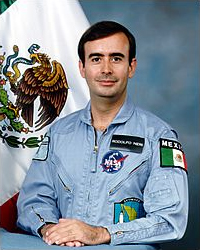
| quote: |
| Originally posted by metalgearsolid There is a mexican astronout you dumbass! |
what is consciousness? is the self an illusion? : i'm gonna jump into a black hole.
What a great video.  Especially because I don't have TV. Thanks for the post!
And wow @ what Capitalizt said!
So I'm curious to know: if there are so many black holes, is it possible that they might intersect or influence each other? And if so, what happens?

| quote: |
| This image shows the central region of the galaxy cluster Abell 400. The colour coding gives the temperature of the X-ray emitting gas trapped in the cluster: black-cold (18 million degrees Celsius) to white-hot (38 million degrees Celsius). The contours show the radio emission from the jets of plasma being expelled by the black holes. As the two black holes stream through the gas at supersonic velocities, the jets are bent toward the top of the image. The gas in front of the black holes is compressed and heated, as seen by the hotspot below them. The inset shows a blow up of the central regions. Each dot represents a position where an X-ray photon has struck Chandra's X-ray camera. The two black holes are seen as bright regions where as many as 250 X-ray photons struck the camera. The contours again show the radio emission from the black holes and the jets of plasma being ejected from them. (Image courtesy of the Journal Astronomy & Astrophysics) |
| quote: |
Two Supermassive Black Holes Spiraling Toward Collision A pair of supermassive black holes in the distant universe are intertwined and spiraling toward a merger that will create a single super-supermassive black hole capable of swallowing billions of stars, according to a new study by astronomers at the University of Virginia, Bonn University and the U.S. Naval Research Laboratory. The study appears in the April 6, 2006 issue of the journal Astronomy & Astrophysics. Black holes are among the oldest regions of the universe and hold clues to understanding the formation of the universe and its destiny. Though astronomers have theorized that coupled black holes exist, and that black holes sometimes merge and form supermassive black holes, the new study provides further evidence that this in fact occurs. "The two key questions about supermassive black holes are: Where do they come from and how do they grow over time?" said Craig Sarazin, the W.H. Vanderbilt Professor of Astronomy at the University of Virginia and co-author of the study. "The birth, care and nurturing of supermassive black holes is a very active area of study in astronomy." Supermassive black holes are areas in space that are so dense and massive they contain up to billions of stars and continually suck in more stars, further building their mass and gravitational pull. Even light cannot escape the pull of gravity in a black hole. The area appears as it is described: a black hole in space. "Black holes are the ultimate garbage disposals," Sarazin said. "The material they swallow disappears without any trace, except for the gravity of the black hole." Sarazin and his colleagues used NASA's Chandra X-ray Observatory to glean their results. Black holes are detectable because they produce large amounts of X-ray emission, similar to the radiation used for medical diagnosis. This high-energy radiation is invisible to our eyes, but can be seen with X-ray telescopes. "There is no way to determine how a black hole was created or what kinds of things it has swallowed just by looking at the resulting black hole," Sarazin said. "You have to catch the black hole when it is sitting down to dinner or still eating." That, essentially, is what the Sarazin team has accomplished. They focused their observations on the center of a cluster of galaxies named Abell 400 where astronomers had previously suggested that a pair of supermassive black holes might be colliding. The two holes seemed to be relatively close together, but there was no proof that they were bound to one another or merging. "The question was: Is this pair of supermassive black holes an old married couple, or just strangers passing in the night?" Sarazin said. "We now know that they are coupled, but more like the mating of black widow spiders. One of the black holes invariably will eat the other." NASA is interested in helping astronomers better understand the formation of supermassive black holes and is currently planning to build an array of three space satellites called LISA (Laser Interferometry Space Antenna) to detect gravity waves from merging black holes. "Obviously, astronomers would like to be certain that this process of supermassive black hole mergers really does occur, so that LISA will have something to detect," Sarazin said. In recent years, astronomers have discovered that every large galaxy in the present day universe likely has a supermassive black hole. The Milky Way's own supermassive black hole has swallowed as much material as four million suns. The biggest galaxies contain black holes that have swallowed many billions of stars worth of material. In some cases, two galaxies containing supermassive black holes collide and merge together, and eventually the two supermassive black holes fall into the center of the merged larger galaxy, and spiral together. Ultimately, they merge into one even larger hole. Sarazin's team found that the two merging supermassive black holes in Abell 400 appear to be swallowing gas from their host galaxy, and each is ejecting a pair of oppositely-directed jets of radio-emitting plasma. As the supermassive black holes fall through the gas in the cluster Abell 400, jets of radio-emitting plasma are swept back behind them. "The jets are similar to the contrails produced by planes as they fly through the air on Earth," Sarazin said. "From the contrails, we can determine where the planes have been, and in which direction they are going. What we see is that the jets are bent together and intertwined, which indicates that the pair of supermassive black holes are bound and moving together." Sarazin's co-authors are Daniel Hudson and Thomas Reiprich of the University of Bonn, and Tracy Clarke of the U.S. Naval Research Laboratory. The work was begun when Reiprich and Clarke were post-doctoral fellows working with Professor Sarazin at the University of Virginia. |

Powered by: vBulletin
Copyright © 2000-2021, Jelsoft Enterprises Ltd.