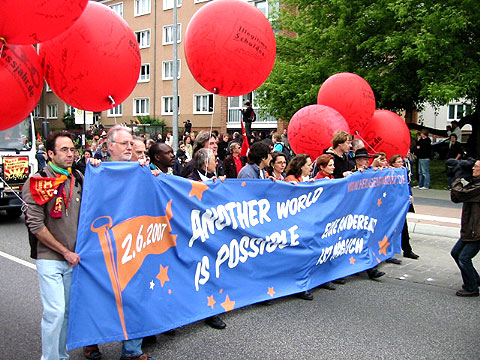
Who are the people protesting the G8 summit, and why?
Today in the news I saw pictures of ppl protesting against the G8 summit, and I'm just curious what their causes are.
anybody care 2 explain
Posted by occrider on Jun-07-2007 21:38:
Rich countries exploit poor countries blah blah blah blah ...
Posted by Shakka on Jun-07-2007 22:12:
Anti-globalization peeps primarily. Plus any and all other professional protesters. Your basic run-of-the-mill ultimate frisbee fanatics.
Posted by Magnetonium on Jun-07-2007 22:18:
So goes the denial ... I guess its NOT true then that G8 countries do not exploit poor countries and do not reap off profits off them while millions of people live in utter poverty and thousands die every day from preventable causes that are cheap to fix. A big lie, eh?
The protesters are not crazy. They want to protect their national identity. They want fair trade, they see how some big business is corrupt, greedy and selfish. And they see how some countries like USA are bent on global domination like a new British Empire pretty much.
Posted by Fir3start3r on Jun-07-2007 23:49:
In a nutshell...
and this is not to say that no one should be protesting, but if you're going to protest, at least have viable, alternative solutions...
quote:
G-8 Protests Show Weaknesses of Activist Movements
By Jason Steck
In what is becoming a perennial ritual, protests at the G-8 summit have erupted into violence. While the majority of protesters remain peaceful, their crowds have served as a shield behind which violent radicals attack police and destroy property.
Supposedly, this is all in the name of a better, more just world. But a closer look at the protesters reveals little more than nihilism and narcissism.
On their face, anti-globalization protesters seem to point to genuine problems. The economic prosperity that is the calling card of globalization often affects only an elite few, with the majority of the population in developing countries left to deal with lifestyles that are radically altered but left without any significant new resources.
But to criticize the status quo alone is not enough. Alternatives are necessary to make real progress. And the anti-globalization movement, like many activist movements, shows serious weakness when asked to provide concrete ideas. The overarching slogan of the G-8 protests �another world is possible� begs the question of what that alternative world would look like and how it would function. Few details are offered, and they certainly are not available for assessment and critique. They hate capitalism, but they don�t defend any alternative. They defend the poor, but give no ideas on how to feed or employ them. They idolize the environment, but they are blind to the empirical record about where environmental protections are economically and politically possible (hint: socialist countries finish a distant second place). Instead, the protesters offer little more than a mish-mash assortment of activist groups, brought together under the vaguest possible umbrella to inflate their numbers and provide the largest possible turnout.
Once these problems are exposed, it is difficult not to see these massive protests as mere exercises in narcissism and nihilism, expressions of anger and, in some cases, blind rage bereft of serious intellectual content. Indeed, protests are becoming events, party-like atmospheres where basically the same groups of people get together to �protest� different issues. Today it is globalization, tomorrow it might be the Iraq war, the next the environment, and the next nuclear weapons.
When they have concrete proposals for alternatives, as with �orange revolution� protests in the Ukraine, protesters have found themselves able to obtain significant public support and to enact substantial, even revolutionary change. But when they lack proposals and embrace only the �it�s your problem to give alternatives�, protesters relegate themselves to the political margins as political adolescents unready for the responsibility of defining policy.
I find it interesting how banks can loan money they don't even have, and get interest off it. Bankers rule us.
Posted by Sunsnail on Jun-07-2007 23:54:
quote:
Originally posted by Magnetonium
[COLOR=FF7F50]
So goes the denial ... I guess its NOT true then that G8 countries do not exploit poor countries and do not reap off profits off them while millions of people live in utter poverty and thousands die every day from preventable causes that are cheap to fix.
any examples of problems that would be cheap and easy to fix?
Posted by Q5echo on Jun-08-2007 00:24:
i woke up this afternoon and turned on the news and i had just caught one of the reporters there commenting on the protest situation. she said it was mostly like "a big picnic with random incidences of people dressed like clowns being chased across cornfields by cops in full riot gear."
i giggled for like 5 minutes in the shower after that.
Posted by occrider on Jun-08-2007 07:10:
quote:
Originally posted by Magnetonium
So goes the denial ... I guess its NOT true then that G8 countries do not exploit poor countries and do not reap off profits off them while millions of people live in utter poverty and thousands die every day from preventable causes that are cheap to fix. A big lie, eh?
The protesters are not crazy. They want to protect their national identity. They want fair trade, they see how some big business is corrupt, greedy and selfish. And they see how some countries like USA are bent on global domination like a new British Empire pretty much.
Ummm the whole concept of globalization is to maximize competitive strengths and weaknesses such that ultimately trade benefits all participants as a whole. If a country is SO inefficient that it has nothing to offer than of course it will fail. Since the vast majority of economics statistics have validated globalization I'm not quite sure what you're trying to argue other than rhetoric. Now I hate arguing rhetoric, but since this is economics and the name of the game is stastics and economic indicators, fine I'll joust, what exactly are you saying and base it on economic indicators please.
Posted by star-traveller on Jun-08-2007 07:21:
Can anybody explain me, why the Western media dramatized march of dissidents in Russia so much, but almost quiet about G8 summit marches?
Why no politics in the World condemns actions of German police forces?
I mean, the number of people get arrested or Human Right Abuses are comparable in both cases.
Double standards again?
Posted by Magnetonium on Jun-08-2007 07:32:
quote:
Originally posted by Fir3start3r
In a nutshell...
and this is not to say that no one should be protesting, but if you're going to protest, at least have viable, alternative solutions...
Yeah, history showed that peaceful protests are far more successful than violent protests Those quiet peaceful protests will never achieve anything because noone gives a shit. Though using violence is not very nice either but come on, face it, peaceful protesters are not going to stop G8 ... ever. Why would G8 roll over and give in to some peaceful and non-violent protesters who dont threaten the hierarchy of the endless gigantic profiteers of G8 countries?
quote:
Originally posted by occrider
Ummm the whole concept of globalization is to maximize competitive strengths and weaknesses such that ultimately trade benefits all participants as a whole. If a country is SO inefficient that it has nothing to offer than of course it will fail. Since the vast majority of economics statistics have validated globalization I'm not quite sure what you're trying to argue other than rhetoric. Now I hate arguing rhetoric, but since this is economics and the name of the game is stastics and economic indicators, fine I'll joust, what exactly are you saying and base it on economic indicators please.
I like how you highlighted the word ULTIMATELY because thats what they've been talking about for how many centuries now? The economy needs cheap labour and poor countries to live off. If we paid Chinese labourers 20 bucks an hour, would you still have those Dollarama stores and EVERYTHING-MADE-IN-CHINA thing? I dont think so. I dont think Chinese would be so poor then. And I dont think Western companies are going to like that either. Face it - its always been like that. Slavery or very cheap labour. Same ol' methods.
quote:
Originally posted by Sunsnail
any examples of problems that would be cheap and easy to fix?
Its cheaper and easier not to do anything about it, you know ... cause thats what the G8 leaders are doing for most part. They dont give a rats ass about some small African nation their companies are making huge profits in. They only care about their own interests, their own profits and will support any dictator or whoemever that will guarantee that to them. Please refer to China, Turkmenistan, Saudi Arabia, Indonesia as examples.
Posted by Shakka on Jun-08-2007 11:49:
All of those poor exploited countries were soooo much better off when they were completely uninvolved in global commerce. Just look at the Bushmen in Africa--their standard of living is second to none!
Posted by Lira on Jun-08-2007 12:02:
quote:
BBC NEWS- Q&A: Who are the G8 protesters?
Thousands of demonstrators have converged on Rostock in northern Germany, ahead of the G8 summit in nearby Heiligendamm. The BBC News website's Jacqueline Head examines the different groups protesting.
Who are the groups?
There are a broad range of groups rallying, from environmental and anti-poverty campaigners to anti-globalisation and multi-faith groups, with one overarching common interest: social justice.
Organisations include the Global Call to Action against Poverty (GCAP), Greenpeace, Oxfam, Christian Aid, trade unions, Friends of the Earth, Block G8, Attac and "Black Bloc" demonstrators.
They are divided into two main thought camps.
One recognises the G8 as a legitimate way to bring about change, and uses the summit to lobby for causes they believe should be addressed or acted upon by the leaders.
The other is rallying against the notion of G8. They believe that having leaders from eight different nations making decisions on global issues is not democratic, and that those nations are responsible for many of the world's current problems.
What kind of people are marching?
There are a wide range of ages and nationalities attending rallies around the G8 summit.
They are reported to include boy scouts and over-50s groups.
Some movements, such as those under the Block G8 umbrella - a movement aiming to block the entrance to Heiligendamm - are made up primarily of young Germans, organisers say.
Others, such as GCAP or Greenpeace, have supporters in Germany from all over the world, including France, the UK, China, Japan, the Philippines and Africa, along with a wide range of ages.
What are the main issues for the protesters?
The most prominent issues centre on this year's G8 agenda - above all, poverty and climate change.
Many groups are calling for cancellation of developing nations' debt, trade justice, better healthcare, education, water and sanitation across the globe and action to tackle climate change.
Others are using the summit as a platform to draw attention to other issues, such as war and torture, GM crops, militarisation and "discriminatory" immigration policies.
GCAP are calling for the leaders to fulfil the promises they made at Gleneagles in 2005, saying that the G8 nations are falling short of the targets they originally set themselves.
Ciara O'Sullivan, GCAP spokesperson, said they plan to present UK Prime Minister Tony Blair and German Chancellor Angela Merkel with a petition of one million voices calling on them to fulfil their promises.
Tricia O'Rourke, spokesperson for Oxfam, said: "We are reminding them that they have to deliver."
"In 2005 in Gleneagles they promised they would increase aid to $50bn (�25bn) by 2010, but we recently calculated following current trends they will be short by $30bn."
Greenpeace have an action list they want the leaders to fulfil, which includes reducing carbon dioxide (CO2) emissions by 30% by 2020 and 80-90% by 2050.
The EU has pledged to slash CO2 emissions by 20% from 1990 levels by the year 2020, and UK ministers have outlined proposals to cut emissions by 60% by 2050.
Greenpeace campaigner Agnes de Rooij said there was no point in the G8 allocating aid to countries if they could not deliver on climate change.
"You can give aid to developing countries, but if you don't solve the climate problem it won't make any difference. They need to solve the climate problem or the aid won't be effective."
How are people protesting?
The majority of demonstrators are holding peaceful marches. Some have chosen to block roads with their bodies in an effort to stop traffic from entering Heiligendamm.
Others have drawn up action points they hope leaders will take note of, or petitions from different countries.
The majority are adamant that their protests are peaceful.
The Black Bloc, who include anarchists, wear black clothing and masks.
Campaigners on the ground say only a very small minority are involved in violence.
Why are people protesting against G8 itself?
Some people believe that the G8 is not a democratic method of making decisions that could affect the rest of the world, or that the countries involved are not effective in bringing about the right kind of change.
They want a more "democratic" approach - stemming from grassroots activism, rather than from the most powerful leaders in the world.
Block G8 is an umbrella of 125 groups organising a massive blockade against the summit.
Christoph Kleine, a spokesperson for the collective, said their protest is a "clear sign of our rejection of the G8 and our belief that the G8 is completely illegitimate.
"These are the governments of eight countries who think they can rule the world because they are the richest and most powerful. This is not democratic.
"We can see the result of domination by these countries - war, social injustice. They stand for the danger of climate change. They are the countries who are responsible for most of the emissions."
But other groups take a contrasting view and use the G8 summit to push their own agenda.
Tricia O'Rourke, from Oxfam, said: "The G8 have it within their power to end poverty. They can deliver on climate change. These are the people who can make a difference."
I like how you highlighted the word ULTIMATELY because thats what they've been talking about for how many centuries now? The economy needs cheap labour and poor countries to live off. If we paid Chinese labourers 20 bucks an hour, would you still have those Dollarama stores and EVERYTHING-MADE-IN-CHINA thing? I dont think so. I dont think Chinese would be so poor then. And I dont think Western companies are going to like that either. Face it - its always been like that. Slavery or very cheap labour. Same ol' methods.
Chinese labourers are getting paid peanuts compared to western standards yet their economic well-being is doubling every 5 years - faster than any other nation in the world. Exploitation?? i think not...
China is thankful for their low wages, and so they should be because it is the main driver in keeping the worlds economy afloat.
Posted by Magnetonium on Jun-09-2007 20:31:
quote:
Originally posted by Dupz
Chinese labourers are getting paid peanuts compared to western standards yet their economic well-being is doubling every 5 years - faster than any other nation in the world. Exploitation?? i think not...
China is thankful for their low wages, and so they should be because it is the main driver in keeping the worlds economy afloat.
Go find out the minimum wage of an average Chinese labourer and tell me if you'd want to try it! Also let me know in your research a) how many Chinese people are still in poverty b) who is reaping the profits here - Chinese people or western companies c) standards of living of Chinese workers vs. standards of living of western workers in China. 5 cents is a miserable wage for an electronics worker making your Ipod. These slave workers often are forced to work overtime to make ends meet. To make your Ipod.
BTW, this is NOT a Chinese government article - read carefully:
Fast-food giants McDonald�s, Kentucky Fried Chicken (KFC) and Pizza Hut have been caught underpaying their young workforce in China by as much as 40 percent below the � abysmal � legal minimum wage.
A series of expos�s in China�s state-run media has shone the spotlight on rampant labour abuses at the US-owned transnationals. McDonald�s has 670 restaurants employing a total of 50,000 in China. KFC runs more than 1,500 restaurants in China and Pizza Hut � part of the same concern as KFC, Yum! Brands Inc. � has over 200, totaling around 100,000 employees between them.
Investigations into alleged legal violations by the companies were initiated by the southern newspaper, New Express. The newspaper discovered that part-time workers accounted for about 80 percent of the total staff of the foreign fast-food restaurants, although their definition of �part-time� turned out to be a cover for underpaying the workforce and denying them their legal rights to such things as written contracts of employment, medical insurance and more. As Beijing Review reports, � In order to earn money to support themselves, the students sometimes had to work long hours, on occasion 13 hours in one day.�
As this newspaper points out, �According to labour regulations in China, the average daily working hours for part-time employees cannot surpass five hours, and their weekly working time cannot surpass 30 hours [or] the employer is bound by law to make them full-time employees and take on the responsibilities that go with that.� [Beijing Review, 3 May 2007].
The average pay for part-time staff in a dozen investigated McDonald�s restaurants in Guangdong Province was four yuan per hour � around 50 US cents � plus a subsidy of 1.3 yuan per hour. The province�s minimum wage (minimum wage levels are set by provincial governments in China) for part-time workers is 7.5 yuan � around 98 US cents � an hour.
�Even the so-called minimum wage is a joke,� university student Qu Yun, told China Worker. �Most people have never heard what the minimum is. It�s never enforced so no one really knows.�
Minimum wage rulings are ignored at more than 60 percent of China�s workplaces, he says, showing that US companies are not the only villains. Many Chinese employers act in exactly the same way.
Mostly poor students
University students from poor families make up a large part of the workforce at foreign fast-food chains. These youth and their parents rely on the low pay from �McJobs� to help ease the cost of a college education, which has rocketed after years of �market reforms� in the education sector. The average yearly cost (tuition fees plus other charges) of a place at a public university is 10,000 yuan (1,300 US dollars). This is almost the equivalent of a year�s disposable income in the most developed parts of China, as China Daily (17 May 2007) points out. At this rate a student working at McDonald�s must work 38 hours a week, all 52 weeks of the year, in order just to pay their university fees. Of course that would be impossible, and many students from poor families finance their education by taking out loans, saddling them with hefty debts at the start of their working life.
�Many part-time workers in McDonald�s and KFC who are working as many hours as full-time employees can only get paid as part-time workers without any benefits or social security subsidy,� complained a female university student and McDonald�s employee to New Express (28 March 2007).
�I have worked in this KFC outlet for over a year, but still haven�t got a work contract with the restaurant,� grade-four university student Wu Juan told Beijing Review (3 May 2007). �But I dare not to ask for the work contract that I am entitled to since I cannot afford to lose this job.�
Government intervenes?
The March report in New Express attracted government attention at the provincial level in Guangdong. The province�s Labour and Social Security Department launched an investigation. On April 10, the department published its investigation results, which confirmed that the fast-food restaurants had violated China�s labour code in several areas, but failed to find them guilty of violating the minimum wage. This incident speaks volumes about what is happening in China today, where the organs of the �communist� government in nine cases out of ten, if not more, support the capitalists against the workers. Only when subjected to huge pressure and the threat of destabilising protests, do the authorities intervene to compel management to offer concessions, or obey the law.
Defending his company�s actions, Cui Huanming, the marketing director of the Guangdong branch of Yum! Brands Inc., claimed, �The university students we have hired are neither full-time employees nor part-time employees. They are a special group of employees.� [Beijing Review, 3 May 2007].
The use of such legalistic sleight of hand, by unscrupulous bosses is unfortunately a very common practise in China.
The provincial government refused to take action against the company, but instead called in its trade union arm, the All China Federation of Trade Unions (ACFTU). In early April, the Guangdong Federation of Trade Unions (ACFTU�s branch in the province) announced that a �preparatory panel on setting up a trade union in McDonald�s Guangdong branch, consisting of labour and management representatives,� (our emphasis) had been established. The state media made a big thing about this �breakthrough� for ACFTU in the fast-food sector, but the above statement shows that what is happening has nothing to do with trade unionism, and will lead to few if any benefits for the workers.
Not a real union
The ACFTU is not a genuine, independent, democratically controlled trade union, but rather an arm of the authoritarian state. It has a proven record of opposing strikes and supporting repression against workers that organise to defend their rights. ACFTU officials, like every other section of the state apparatus, are ever on the lookout for �business opportunities�. Union officials in the state-owned companies, for example, get preferential treatment when shares are distributed as a step towards company privatisation.
For some years, however, the ACFTU has been trying to beef up its influence in the fast-growing private and foreign-controlled sector as its membership has shrunk dramatically in tandem with the contraction of the once dominant state-owned sector. This process was especially rapid in the late 1990s. At its congress in 2000, the then ACFTU chairperson, Wei Jianxing, reported that branches �have collapsed and their members [have been] washed away�.
For the ACFTU and the ruling �communist� party, this poses a vital issue of control over a large, unorganised and increasingly disatisfied workforce. In a report released last week, the ACFTU claimed it has now set up union branches at 60 percent of China�s foreign-owned companies.
�Sound labour-management relations in foreign companies will attract more foreign investment,� a union spokesperson said, in presenting the report. [China Daily, 16 May 2007].
The ACFTU�s �corporatist� doctrine � ensuring that management are integrated into union structures at the very top � has generally won over even sceptical foreign capitalist conglomerates such as Wal-Mart, which agreed to ACFTU representation at its China outlets in 2005 in what was seen as a �landmark� decision for the union�s turn towards the non-state sector. At many Chinese enterprises the chair of the ACFTU branch is appointed by management, usually this role is held by the personnel manager. The ACFTU sees its role as preventing conflicts and above all any steps by workers to organise themselves independently of the state. Nowadays, the ACFTU like every other section of the state apparatus, echoes president Hu Jintao�s confucian mantra about �building a harmonious society�. This is meant to signify a rejection of struggle � something associated with the Mao era in China�s history and definitely not desirable in today�s environment.
What about Chinese capitalists?
China�s �McScandal� case shows that foreign capitalists, rather than a force for improving workers� rights and conditions, are among the worst abusers. These companies hypocritically sign �codes of ethics� in an attempt to disarm consumer activism and growing criticism in their main markets, only to continue a policy of brutal exploitation in China and other low-wage economies.
But this episode also exposes the hypocrisy of China�s state-run media, tilting at convenient �foreign� targets, as if the practises of McDonald�s and KFC were exceptional. This is of course not the case. The conditions �exposed� at US-owned fast-food outlets are standard in China. Even relatively privileged white-collar workers face an increasing workload and declining real living standards. The Beijing Morning Post revealed that 70 percent of China�s white-collar workers put in an average of more than 10 hours a day and are denied holidays. China Daily (9 May 2007) noted that, �the number of professionals complaining of overwork and lack of sleep has soared� in the last three years. It is also significant that university students, previously a relatively privileged layer, are forced to sweat under such exploitive conditions, not far removed from those of the migrant workers who occupy the bottom rung of China�s new class order. This, and the increasing difficulty for graduates to get well-paid jobs, is radicalising many of these youth and opening their eyes to the realities of the �market system�.
These conditions are preparing a torrent of demands for genuine trade unions in China, which are of course illegal today. Manoeuvres by officialdom, like the present efforts by ACFTU to �organise� in private and foreign-owned companies, will not succeed in cutting across this process. On the contrary, the pro-management line of the ACFTU is further exposing this organisation among layers of workers and youth that had no direct experience of its role in the past. Many young workers are scathing that the only change when ACFTU sets up a branch is that more money is docked from their salary � for union membership!
China Worker calls for:
A national minimum wage of at least 1,500 yuan!
Nationalisation without compensation of all companies � foreign or domestic � that violate the labour code, on working hours and levels of overtime, wages, child labour, and holiday entitlement!
Genuine fighting and democratic trade unions, and elected workplace committees!
Solidarity from the international labour movement � �an injury to one is an injury to all!� Chinese workers should not be left to struggle for democratic and trade union rights alone, they need material and political support from trade unionists in other countries, in the best traditions of the international trade union movement!
----------
BTW, I worked at a McDonalds here IN CANADA, I know full well how the employer cheats you out of benefits and health premiums - 90% of employees at my former busiest store in the city are part-time. Only the "senior" managers can get any benefits whatsoever. If you work full-time nightshifts, you dont get any benefits.
---------------------------
As part of the recent propaganda, the wages have been "slightly" raised in China, but how does that reflect on worker's well-being???
The Guangdong provincial government announced this late November its decision to raise the minimum wage level for all workers and staff members within the province. The new minimum wage standard, with an average increase of 8.61% , was implemented in December 1, 2004.
It is reported that this is the sixth time for the Guangdong province to raise the wage level since the beginning of the minimum wage standard measure back in 1994.
The new minimum wage standard is divided into the following categories: the first category is 684 Yuan/month, the second category - 574 Yuan/month, the third category - 494 Yuan/month, the fourth category - 446 Yuan/month, the fifth category - 410 Yuan/month, the sixth category -377 Yuan/month, and the seventh category - 352 Yuan/month. Each region within the province can choose its own minimum wage standard, which should not be lower than the seventh category, based on its specific situation. The different districts within a city can also carry out different wage levels.
New Standard Includes Social Security Fee
The current minimum wage standard was formulated on the basis of �Regulations on Enterprises Minimum Wage�, enacted by the Ministry of Labor, and the local government�s �Regulations on Enterprises Minimum Wage in Guangdong Province�. It does not include workers� social security fee.
The new minimum wage standard includes workers� minimum social security fee, which used to be paid separately by employers to workers who in turn pay the relevant government agencies. This new measure prevents employers from referring to all kinds of excuses and from not to paying workers� social security fee, thus this measure can, to some extend, protect workers� rights.
Actual Increase Rate is Low
On the other hand, because the new minimum wage standard includes workers� social security fee, the actual increase rate is not high at all.
Take Guangzhou, the provincial capital of Guangdong province, for example.
Under the new standard Guangzhou�s minimum wage level is increased from 510 Yuan per month to 684 Yuan with an increase rate of 34%. However, after deducting 155 Yuan as the minimum social security fee, the actual wage increase is only 19 Yuan, indicating an increase rate of only 3.73%.
�I work 8 hours a day and receive 800 Yuan per month. Little will be left after paying 82 Yuan for gas and more than 300 Yuan for water, electricity, rent, and phone bills. For a mother who has to raise a child, even 800 is not enough�, says Liu Yongli, a woman from Hunan province currently working as a street cleaning worker at Guangta Street, Yuexiu District. (Source: Information Daily).
Guangdong is one of the most economically developed provinces in China.
Since the 1970s when China launched the economic reforms, Guangdong province has been developing many industrial sectors, such as export, foreign investment, where the province is now leading, per capita income.
However, workers� wages in general, with migrant workers� wages in particular, have not witnessed any significant increase since the 1980s. Many private employers do not even implement the minimum wage standard at all, and never pay for their employees� medical insurance and social security. Workers� already low wages are not enough for them to make a normal living, which is made even worse due to the continuingly increasing prices.
China Labor Watch strongly urges the government to formulate a monitoring mechanism and a system of rewards and penalties to fully carry out the minimum wage standard. If employers offer a wage that is lower than the minimum wage level or, as very often, delay the payment, government departments in charge should take effective measures to make them comply with the regulations, or even fine them if necessary. Posted by venomX on Jun-09-2007 23:58:
quote:
Originally posted by Dupz
Chinese labourers are getting paid peanuts compared to western standards yet their economic well-being is doubling every 5 years - faster than any other nation in the world. Exploitation?? i think not...
China is thankful for their low wages, and so they should be because it is the main driver in keeping the worlds economy afloat.
Exploitation is exploitation, even if the people who are being exploited are 'better off' than if they werent exploited. Saying that now they are relatively better off is no justification for exploiting someone. We know it's exploitation. The companies know it's exploitation. You would not allow the company you work for, your family or friends work for to do what these companies do. It's not just chinese companies either. We all know that big western companies are having a field day in many developed countries, making huge profits and not giving anything back to those people they are exploiting.
Posted by NeoPhono on Jun-10-2007 00:11:
What is the line then between exploitation and the job going to the lowest bidder? The person willing to do the job for the lowest cost is going to get the job no matter what country you live in. Right now labor is cheapest in Asia and if that were not the case, there wouldn't be jobs in there in the first place. If companies were forced to pay Asian workers wages comparable to Western countries the jobs there would simply disappear or again move to the lowest bidder. You can call it exploitation, but when the alternative is no job many would call it employment. If I, as an uneducated Asian worker, had to choose between being "exploited" and being able to put food on the table and a roof over my head, or seeing my job disappear and starve as others decided to inflate my wages, making them uncompetitive, I know which side I'd prefer.
Posted by Purple on Jun-10-2007 08:23:
They are doing it cos its the 'in' thing to do right now.. more like partying.
Posted by Dupz on Jun-10-2007 09:21:
NeoPhono has hit the nail on the head. To me, exploitation is a subjective term, especially in the case where two willing parties are involved.
Magnetonium - In terms of your argument, I think we're on different wavelengths. Your argument revolves much around companies breaking the law, which shows exploitation that is rather more explicit. That's not a matter for the G8 members to fix with fair/free trade etc., but rather for law enforcement.
Comparing minimum wages of western countries and east Asian countries is ludicrous. I wont even start on how irrelevant the comparison is.
Besides, minimum wages are a farce that do nothing but hurt the people they�re supposedly trying to help. Lets double the minimum wage in China and watch the companies flood across the borders � great economic policy in my books..
There is a reason why Socialist economic policies are dead across the globe (minus North Korea and Cuba � great examples of economic prosperity). It�s because they don�t work!
The G8 are doing more for developing countries than any of these so called do-gooder protesters will ever do.
Posted by Lilith on Jun-10-2007 09:52:
quote:
China is thankful for their low wages, and so they should be because it is the main driver in keeping the worlds economy afloat.
I'll pull you up on that because it's wrong, China is an economy which is extremely focused on its export markets-
It has done very little to develop a domestic consumer base, over 80% of it's GDP is from export.
It self-depreciates it's own currency to keep that export base going and is very reluctant to match other international currencies based on international trade.
If there's a downturn in exports... *pop*
It's going to be ugly, for a lot of people, but mostly the Chinese.
What China does do is keep the price of goods down in the markets aimed for poor and middle income consumers and gives them a little more money in their pockets and keeps inflation down in places like the US which import a lot of Chinese exports. While the deficit is usually in China's favour regarding US exports, the US still manages to export an awfully large amount back to them so the end result is starting to even out.
And when all's said and done, as big and exciting as the Chinese economy is still dwarfed by the US.
The dark horse in all this is actually India, who sells far more to the Chinese than they sell to India.
quote:
The G8 are doing more for developing countries than any of these so called do-gooder protesters will ever do.
Well, they've got to have something to do when they're not living it up on their industrialist parent's paid university tuition or backpacking through eastern europe looking for cheap beer.
Posted by George Smiley on Jun-10-2007 16:30:
They are middle class liberals who are suffering from serve identity crises and are desperately trying to find some kind of identity to cling to to make their otherwise meaningless lives somehow mean something, and they have chosen the grand and rightful cause of trying to improve the world's oppressed and exploited but seem to have forgotten the important issue of finding a viable way of doing it.