
TranceAddict Forums (www.tranceaddict.com/forums)
- DJ Booth
-- Music Theory
Music Theory
I've been using the Camelot system for the last 10 months to help me mix harmonically, but after reading a lot lately about how it is much better to just learn the proper notes, I thought it was time that I moved to the next level 
I'd like to see what key a tune is in and know straight away what other keys will compliment that.
So to those that use this method, are there any good sites that I can visit that will help teach me this? Are there any decent books that will teach me this?
Ta 
Given a nice little keyboard to work from:
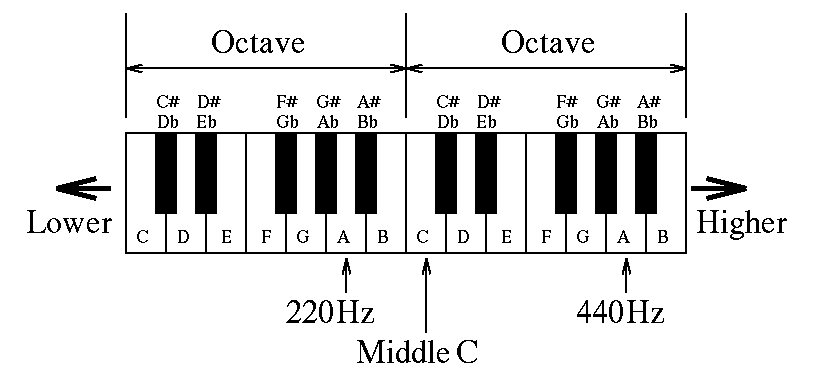
The 'standard' intervals you can use are the tonic (same note), major 4th (5 semitones up) and major 5th (7 semitones up)...
So from Cm you've got Cm, Fm and Gm
From Ab (for example) you've got Abm, Dbm and Ebm
And so on
Then the relative minor (if you're in a major key) is the major 6th (9 semitones up)...
So from Cm it's Amaj
From Abm it's Fmaj
And the relative major (if you're in a minor key) is the minor 3rd (3 semitones up)
So from Cmaj it's Ebm
From Abmaj it's Bm
Then you can just transpose that across the whole scale.
After a bit of practice, you'll be able to look at two keys and know straight off without counting if they'll work (according to the rules)
Thanks for that Stu. Are the majors the black keys and the minors the white keys?
I don't know what most of what you just said means  so I think I need to start learning from a lower degree.
Major and minor keys are to do with the scales they use...
So a track in C major will almost exclusively use the notes C, D, E, F, G, A and B, while a track in C minor will use C, D, Eb, F, G, Ab and B (so is unlikely to contain any the notes E and A) - which gives the song a different feel, a bit more melancholy in the case of minor keys (while major keys are more 'happy')
The white notes are the "natural" notes (i.e. non-sharp or flat notes - C, D, E etc) and the black notes are the "accidentals" (i.e. sharps and flats - C#, Eb, etc). Remember sharps and flats coincide, that is C# is the same note as Db, D# is the same note as Eb and so on.
just play some tunes dan.
Great info from Stu Cox here on a VERY important topic. We should get a Music Theory sticky that features the best posts on subjects such as this. I'm sure there are tons of TA's looking for info like this!
| quote: |
| Originally posted by DJChrisB Great info from Stu Cox here on a VERY important topic. We should get a Music Theory sticky that features the best posts on subjects such as this. I'm sure there are tons of TA's looking for info like this! |
Negative. The black keys are sharps/flats. D# (D-Sharp) is the same note as Eb (E-flat). In written music, even though the note is the same, the more "appropriate" one will be chosen based on the key (to indicate going up or down).
Major key versus Minor key affects the overall "tone" of a song. Typically, a minor key will sound more "somber" or "sad", and a major key will sound more "bright" or "happy".
Dance music is nearly all written as minor... so there's definitely exceptions to that rule (as a lot of dance music is pretty happy sounding). When you hear a dance track in a Major key, it'll usually sound pretty "cheesy".
For every major key, there is a relative minor key. To determine the relative minor key, you take the tonic of the major key, and count down 3 half steps. So for C Major, you'll hit A minor. The opposite is true... for a minor key, count UP 3 half steps, and you'll hit C major. The key signatures are the same...
Now... what was said about the 4th and 5th is true as far as being compatible keys. If you look at the camelot wheel (which is really the circle of 5ths), you'll see the "C" has to it's right "G" and to it's left "F". The 4th and 5th. Someone was just smart enough in the 1700's to realize that if you take a tonic, find the 5th, find that 5ths 5th, and keep going around, you'll come full circle. Neat huh?
Also, if you look at the outer ring (the major keys), you'll see that they just associate with their relative minor keys on the inner ring. The 4th/5th thing is the same, just shifted 3 half steps.
Oh, if you have access to a piano keyboard/midi controller, you can play around with chords. To play a C major chord, play "C E and G". To play a C minor chord, you drop the 3rd (the E) a half step to Eb. By learning how to form chords, you'll learn how to determine keys without software.
http://www.mixshare.com/wiki/lib/exe/fetch.php?cache=cache&media=easymix.jpg
| quote: |
| Originally posted by agentdansmith Thanks for that Stu. Are the majors the black keys and the minors the white keys? I don't know what most of what you just said means so I think I need to start learning from a lower degree. |
i feel the best way to learn more about theory and music is to pick up a book about theory and also buy a cheap keybord and learn how to play it.
there are many keyboards out there that have menus and setting that can teach you scales and chords. playing on a daily basis will help you train your ears and you'll also learn how to play an instrument a the same time.
| quote: |
| Originally posted by hooj1 i feel the best way to learn more about theory and music is to pick up a book about theory and also buy a cheap keybord and learn how to play it. there are many keyboards out there that have menus and setting that can teach you scales and chords. playing on a daily basis will help you train your ears and you'll also learn how to play an instrument a the same time. |
| quote: |
| Originally posted by hooj1 i feel the best way to learn more about theory and music is to pick up a book about theory and also buy a cheap keybord and learn how to play it. there are many keyboards out there that have menus and setting that can teach you scales and chords. playing on a daily basis will help you train your ears and you'll also learn how to play an instrument a the same time. |
excuse my ignorance, but if we're talking about just mixing tunes, how does music theory help at all? if you understand and obey nem's rules, i don't see what a greater understanding will give you??
will definitely help u in producing music 

| quote: |
| Originally posted by Stu Cox Given a nice little keyboard to work from: The 'standard' intervals you can use are the tonic (same note), major 4th (5 semitones up) and major 5th (7 semitones up)... So from Cm you've got Cm, Fm and Gm From Ab (for example) you've got Abm, Dbm and Ebm And so on Then the relative minor (if you're in a major key) is the major 6th (9 semitones up)... So from Cm it's Amaj From Abm it's Fmaj And the relative major (if you're in a minor key) is the minor 3rd (3 semitones up) So from Cmaj it's Ebm From Abmaj it's Bm Then you can just transpose that across the whole scale. After a bit of practice, you'll be able to look at two keys and know straight off without counting if they'll work (according to the rules) |
| quote: |
| Originally posted by pkcRAISTLIN excuse my ignorance, but if we're talking about just mixing tunes, how does music theory help at all? if you understand and obey nem's rules, i don't see what a greater understanding will give you?? |
| quote: |
| Originally posted by discobiscuit sounds like a good idea... any music theory book reccomendations? i'm 24... learning to play an instrument at this age will be very challenging won't it? |
Hey Stu, that diagram and explanation was the smartest piece of advice on harmonic theory that I've read.
If everything I've read on harmonic mixing are like finished textbooks, your diagram and explanation were like Cliff Notes. Brief and to the point.
| quote: |
| Originally posted by pkcRAISTLIN excuse my ignorance, but if we're talking about just mixing tunes, how does music theory help at all? if you understand and obey nem's rules, i don't see what a greater understanding will give you?? |
Easy
www.musictheory.net
EVERYTHING YOU NEED - Literally, it has trainers, ear trainers (for learning to hear pitches), step by step really well defined lessons and you can pretty much cover a vast majority of music theory as well as some advanced theory from that site.
It would probably help to understand the scales if you understood the patters of whole steps and half steps (a half step is going from one key to the next, including black keys...) so that these keys make more sense...but allll thats in the beginning lessons of that site! Check it out!! Helps me alot in college as a music student sooo get to it 
| quote: |
| Originally posted by Raveaddict19 Easy www.musictheory.net EVERYTHING YOU NEED - Literally, it has trainers, ear trainers (for learning to hear pitches), step by step really well defined lessons and you can pretty much cover a vast majority of music theory as well as some advanced theory from that site. It would probably help to understand the scales if you understood the patters of whole steps and half steps (a half step is going from one key to the next, including black keys...) so that these keys make more sense...but allll thats in the beginning lessons of that site! Check it out!! Helps me alot in college as a music student sooo get to it |
| quote: |
| Originally posted by Raveaddict19 Easy www.musictheory.net EVERYTHING YOU NEED - Literally, it has trainers, ear trainers (for learning to hear pitches), step by step really well defined lessons and you can pretty much cover a vast majority of music theory as well as some advanced theory from that site. It would probably help to understand the scales if you understood the patters of whole steps and half steps (a half step is going from one key to the next, including black keys...) so that these keys make more sense...but allll thats in the beginning lessons of that site! Check it out!! Helps me alot in college as a music student sooo get to it |
Anytime man! Seriously is the perfect online teacher! Even has quizzes and everything!
Best of lucK! Prepare to see a massive change in the way you write\listen\ and play music
Thanks for the link man, appreciate it. I think that keyboard trainer may be just what I need to finally get my sorry self to memorize the letters of the keys. As much as I play around with my keyboard I just can't seem to memorize the freaking letters.
Silly, yes, but so am I

Powered by: vBulletin
Copyright © 2000-2021, Jelsoft Enterprises Ltd.