
TranceAddict Forums (www.tranceaddict.com/forums)
- Political Discussion / Debate
-- Insect Robot Spies Spotted at Political Rallies
 Insect Robot Spies Spotted at Political Rallies
Yikes...
I'm normally not one for CT type stuff but man...
| quote: |
Dragonfly or Insect Spy? Scientists at Work on Robobugs. By Rick Weiss Washington Post Staff Writer Tuesday, October 9, 2007; A03 Vanessa Alarcon saw them while working at an antiwar rally in Lafayette Square last month. "I heard someone say, 'Oh my god, look at those,' " the college senior from New York recalled. "I look up and I'm like, 'What the hell is that?' They looked kind of like dragonflies or little helicopters. But I mean, those are not insects." Out in the crowd, Bernard Crane saw them, too. "I'd never seen anything like it in my life," the Washington lawyer said. "They were large for dragonflies. I thought, 'Is that mechanical, or is that alive?' " That is just one of the questions hovering over a handful of similar sightings at political events in Washington and New York. Some suspect the insectlike drones are high-tech surveillance tools, perhaps deployed by the Department of Homeland Security. Others think they are, well, dragonflies -- an ancient order of insects that even biologists concede look about as robotic as a living creature can look. No agency admits to having deployed insect-size spy drones. But a number of U.S. government and private entities acknowledge they are trying. Some federally funded teams are even growing live insects with computer chips in them, with the goal of mounting spyware on their bodies and controlling their flight muscles remotely. The robobugs could follow suspects, guide missiles to targets or navigate the crannies of collapsed buildings to find survivors. The technical challenges of creating robotic insects are daunting, and most experts doubt that fully working models exist yet. "If you find something, let me know," said Gary Anderson of the Defense Department's Rapid Reaction Technology Office. But the CIA secretly developed a simple dragonfly snooper as long ago as the 1970s. And given recent advances, even skeptics say there is always a chance that some agency has quietly managed to make something operational. "America can be pretty sneaky," said Tom Ehrhard, a retired Air Force colonel and expert in unmanned aerial vehicles who is now at the Center for Strategic and Budgetary Assessments, a nonprofit Washington-based research institute. Robotic fliers have been used by the military since World War II, but in the past decade their numbers and level of sophistication have increased enormously. Defense Department documents describe nearly 100 different models in use today, some as tiny as birds, and some the size of small planes. All told, the nation's fleet of flying robots logged more than 160,000 flight hours last year -- a more than fourfold increase since 2003. A recent report by the U.S. Army Command and General Staff College warned that if traffic rules are not clarified soon, the glut of unmanned vehicles "could render military airspace chaotic and potentially dangerous." But getting from bird size to bug size is not a simple matter of making everything smaller. "You can't make a conventional robot of metal and ball bearings and just shrink the design down," said Ronald Fearing, a roboticist at the University of California at Berkeley. For one thing, the rules of aerodynamics change at very tiny scales and require wings that flap in precise ways -- a huge engineering challenge. Only recently have scientists come to understand how insects fly -- a biomechanical feat that, despite the evidence before scientists' eyes, was for decades deemed "theoretically impossible." Just last month, researchers at Cornell University published a physics paper clarifying how dragonflies adjust the relative motions of their front and rear wings to save energy while hovering. That kind of finding is important to roboticists because flapping fliers tend to be energy hogs, and batteries are heavy. The CIA was among the earliest to tackle the problem. The "insectothopter," developed by the agency's Office of Research and Development 30 years ago, looked just like a dragonfly and contained a tiny gasoline engine to make the four wings flap. It flew but was ultimately declared a failure because it could not handle crosswinds. Agency spokesman George Little said he could not talk about what the CIA may have done since then. The Office of the Director of National Intelligence, the Department of Homeland Security and the Secret Service also declined to discuss the topic. Only the FBI offered a declarative denial. "We don't have anything like that," a spokesman said. The Defense Department is trying, though. In one approach, researchers funded by the Defense Advanced Research Projects Agency (DARPA) are inserting computer chips into moth pupae -- the intermediate stage between a caterpillar and a flying adult -- and hatching them into healthy "cyborg moths." The Hybrid Insect Micro-Electro-Mechanical Systems project aims to create literal shutterbugs -- camera-toting insects whose nerves have grown into their internal silicon chip so that wranglers can control their activities. DARPA researchers are also raising cyborg beetles with power for various instruments to be generated by their muscles. "You might recall that Gandalf the friendly wizard in the recent classic 'Lord of the Rings' used a moth to call in air support," DARPA program manager Amit Lal said at a symposium in August. Today, he said, "this science fiction vision is within the realm of reality." A DARPA spokeswoman denied a reporter's request to interview Lal or others on the project. The cyborg insect project has its share of doubters. "I'll be seriously dead before that program deploys," said vice admiral Joe Dyer, former commander of the Naval Air Systems Command, now at iRobot in Burlington, Mass., which makes household and military robots. By contrast, fully mechanical micro-fliers are advancing quickly. Researchers at the California Institute of Technology have made a "microbat ornithopter" that flies freely and fits in the palm of one's hand. A Vanderbilt University team has made a similar device. With their sail-like wings, neither of those would be mistaken for insects. In July, however, a Harvard University team got a truly fly-like robot airborne, its synthetic wings buzzing at 120 beats per second. "It showed that we can manufacture the articulated, high-speed structures that you need to re-create the complex wing motions that insects produce," said team leader Robert Wood. The fly's vanishingly thin materials were machined with lasers, then folded into three-dimensional form "like a micro-origami," he said. Alternating electric fields make the wings flap. The whole thing weighs just 65 milligrams, or a little more than the plastic head of a push pin. Still, it can fly only while attached to a threadlike tether that supplies power, evidence that significant hurdles remain. In August, at the International Symposium on Flying Insects and Robots, held in Switzerland, Japanese researchers introduced radio-controlled fliers with four-inch wingspans that resemble hawk moths. Those who watch them fly, its creator wrote in the program, "feel something of 'living souls.' " Others, taking a tip from the CIA, are making fliers that run on chemical fuels instead of batteries. The "entomopter," in early stages of development at the Georgia Institute of Technology and resembling a toy plane more than a bug, converts liquid fuel into a hot gas, which powers four flapping wings and ancillary equipment. "You can get more energy out of a drop of gasoline than out of a battery the size of a drop of gasoline," said team leader Robert Michelson. Even if the technical hurdles are overcome, insect-size fliers will always be risky investments. "They can get eaten by a bird, they can get caught in a spider web," said Fearing of Berkeley. "No matter how smart you are -- you can put a Pentium in there -- if a bird comes at you at 30 miles per hour there's nothing you can do about it." Protesters might even nab one with a net -- one of many reasons why Ehrhard, the former Air Force colonel, and other experts said they doubted that the hovering bugs spotted in Washington were spies. So what was seen by Crane, Alarcon and a handful of others at the D.C. march -- and as far back as 2004, during the Republican National Convention in New York, when one observant but perhaps paranoid peace-march participant described on the Web "a jet-black dragonfly hovering about 10 feet off the ground, precisely in the middle of 7th avenue . . . watching us"? They probably saw dragonflies, said Jerry Louton, an entomologist at the National Museum of Natural History. Washington is home to some large, spectacularly adorned dragonflies that "can knock your socks off," he said. At the same time, he added, some details do not make sense. Three people at the D.C. event independently described a row of spheres, the size of small berries, attached along the tails of the big dragonflies -- an accoutrement that Louton could not explain. And all reported seeing at least three maneuvering in unison. "Dragonflies never fly in a pack," he said. Mara Verheyden-Hilliard of the Partnership for Civil Justice said her group is investigating witness reports and has filed Freedom of Information Act requests with several federal agencies. If such devices are being used to spy on political activists, she said, "it would be a significant violation of people's civil rights." For many roboticists still struggling to get off the ground, however, that concern -- and their technology's potential role -- seems superfluous. "I don't want people to get paranoid, but what can I say?" Fearing said. "Cellphone cameras are already everywhere. It's not that much different." |
Re: Insect Robot Spies Spotted at Political Rallies
| quote: |
| Originally posted by Fir3start3r Yikes... I'm normally not one for CT type stuff but man... >>Source<< |
What does this have to do in any way with Conspiracy Theories?
I'm beginning to think that many of you folks simply like to use that phrase as a buzzword in order to mentally disregard something that you really don't want to think about.
Anyhow, this is just another one of the numerous methods of surveillance which they're developing to spy on us American's. However, in it's current stage of development it's kind of a joke because it apparently can only fly in straight lines and not with a diverse (and often erratic) flight trajectory like a real dragonfly would. As it is right now it's relatively easy to spot but I'm sure that they're busy trying to fix that, though.
In a similar vein, here's another story that hasn't gotten all that much attention even though it's nearly a year old:
FBI taps cell phone mic as eavesdropping tool
The FBI appears to have begun using a novel form of electronic surveillance in criminal investigations: remotely activating a mobile phone's microphone and using it to eavesdrop on nearby conversations.
The technique is called a "roving bug," and was approved by top U.S. Department of Justice officials for use against members of a New York organized crime family who were wary of conventional surveillance techniques such as tailing a suspect or wiretapping him.
High ImpactWhat's new:
The FBI is apparently using a novel surveillance technique on alleged Mafioso: activating his cell phone's microphone and then just listening.
Bottom line:
While it appears this is the first use of the "roving bug" technique, it has been discussed in security circles for years.
Nextel cell phones owned by two alleged mobsters, John Ardito and his attorney Peter Peluso, were used by the FBI to listen in on nearby conversations. The FBI views Ardito as one of the most powerful men in the Genovese family, a major part of the national Mafia.
The surveillance technique came to light in an opinion published this week by U.S. District Judge Lewis Kaplan. He ruled that the "roving bug" was legal because federal wiretapping law is broad enough to permit eavesdropping even of conversations that take place near a suspect's cell phone.
Kaplan's opinion said that the eavesdropping technique "functioned whether the phone was powered on or off." Some handsets can't be fully powered down without removing the battery; for instance, some Nokia models will wake up when turned off if an alarm is set.
While the Genovese crime family prosecution appears to be the first time a remote-eavesdropping mechanism has been used in a criminal case, the technique has been discussed in security circles for years.
The U.S. Commerce Department's security office warns that "a cellular telephone can be turned into a microphone and transmitter for the purpose of listening to conversations in the vicinity of the phone." An article in the Financial Times last year said mobile providers can "remotely install a piece of software on to any handset, without the owner's knowledge, which will activate the microphone even when its owner is not making a call."
Nextel and Samsung handsets and the Motorola Razr are especially vulnerable to software downloads that activate their microphones, said James Atkinson, a counter-surveillance consultant who has worked closely with government agencies. "They can be remotely accessed and made to transmit room audio all the time," he said. "You can do that without having physical access to the phone."
Because modern handsets are miniature computers, downloaded software could modify the usual interface that always displays when a call is in progress. The spyware could then place a call to the FBI and activate the microphone--all without the owner knowing it happened. (The FBI declined to comment on Friday.)
"If a phone has in fact been modified to act as a bug, the only way to counteract that is to either have a bugsweeper follow you around 24-7, which is not practical, or to peel the battery off the phone," Atkinson said. Security-conscious corporate executives routinely remove the batteries from their cell phones, he added.
FBI's physical bugs discovered
The FBI's Joint Organized Crime Task Force, which includes members of the New York police department, had little luck with conventional surveillance of the Genovese family. They did have a confidential source who reported the suspects met at restaurants including Brunello Trattoria in New Rochelle, N.Y., which the FBI then bugged.
But in July 2003, Ardito and his crew discovered bugs in three restaurants, and the FBI quietly removed the rest. Conversations recounted in FBI affidavits show the men were also highly suspicious of being tailed by police and avoided conversations .. phones whenever possible.
That led the FBI to resort to "roving bugs," first of Ardito's Nextel handset and then of Peluso's. U.S. District Judge Barbara Jones approved them in a series of orders in 2003 and 2004, and said she expected to "be advised of the locations" of the suspects when their conversations were recorded.
Details of how the Nextel bugs worked are sketchy. Court documents, including an affidavit (p1) and (p2) prepared by Assistant U.S. Attorney Jonathan Kolodner in September 2003, refer to them as a "listening device placed in the cellular telephone." That phrase could refer to software or hardware.
One private investigator interviewed by CNET News.com, Skipp Porteous of Sherlock Investigations in New York, said he believed the FBI planted a physical bug somewhere in the Nextel handset and did not remotely activate the microphone.
"They had to have physical possession of the phone to do it," Porteous said. "There are several ways that they could have gotten physical possession. Then they monitored the bug from fairly near by."
But other experts thought microphone activation is the more likely scenario, mostly because the battery in a tiny bug would not have lasted a year and because court documents say the bug works anywhere "within the United States"--in other words, outside the range of a nearby FBI agent armed with a radio receiver.
In addition, a paranoid Mafioso likely would be suspicious of any ploy to get him to hand over a cell phone so a bug could be planted. And Kolodner's affidavit seeking a court order lists Ardito's phone number, his 15-digit International Mobile Subscriber Identifier, and lists Nextel Communications as the service provider, all of which would be unnecessary if a physical bug were being planted.
A BBC article from 2004 reported that intelligence agencies routinely employ the remote-activiation method. "A mobile sitting on the desk of a politician or businessman can act as a powerful, undetectable bug," the article said, "enabling them to be activated at a later date to pick up sounds even when the receiver is down."
For its part, Nextel said through spokesman Travis Sowders: "We're not aware of this investigation, and we weren't asked to participate."
Other mobile providers were reluctant to talk about this kind of surveillance. Verizon Wireless said only that it "works closely with law enforcement and public safety officials. When presented with legally authorized orders, we assist law enforcement in every way possible."
A Motorola representative said that "your best source in this case would be the FBI itself." Cingular, T-Mobile, and the CTIA trade association did not immediately respond to requests for comment.
Mobsters: The surveillance vanguard
This isn't the first time the federal government has pushed at the limits of electronic surveillance when investigating reputed mobsters.
In one case involving Nicodemo S. Scarfo, the alleged mastermind of a loan shark operation in New Jersey, the FBI found itself thwarted when Scarfo used Pretty Good Privacy software (PGP) to encode confidential business data.
So with a judge's approval, FBI agents repeatedly snuck into Scarfo's business to plant a keystroke logger and monitor its output.
Like Ardito's lawyers, Scarfo's defense attorneys argued that the then-novel technique was not legal and that the information gleaned through it could not be used. Also like Ardito, Scarfo's lawyers lost when a judge ruled in January 2002 that the evidence was admissible.
This week, Judge Kaplan in the southern district of New York concluded that the "roving bugs" were legally permitted to capture hundreds of hours of conversations because the FBI had obtained a court order and alternatives probably wouldn't work.
The FBI's "applications made a sufficient case for electronic surveillance," Kaplan wrote. "They indicated that alternative methods of investigation either had failed or were unlikely to produce results, in part because the subjects deliberately avoided government surveillance."
Extra: How soon can I get teleported? Bill Stollhans, president of the Private Investigators Association of Virginia, said such a technique would be legally reserved for police armed with court orders, not private investigators.
There is "no law that would allow me as a private investigator to use that type of technique," he said. "That is exclusively for law enforcement. It is not allowable or not legal in the private sector. No client of mine can ask me to overhear telephone or strictly oral conversations."
Surreptitious activation of built-in microphones by the FBI has been done before. A 2003 lawsuit revealed that the FBI was able to surreptitiously turn on the built-in microphones in automotive systems like General Motors' OnStar to snoop on passengers' conversations.
When FBI agents remotely activated the system and were listening in, passengers in the vehicle could not tell that their conversations were being monitored.
Malicious hackers have followed suit. A report last year said Spanish authorities had detained a man who write a Trojan horse that secretly activated a computer's video camera and forwarded him the recordings.
http://news.zdnet.com/2100-1035_22-6140191.html
| quote: |
| Originally posted by Trancer-X What does this have to do in any way with Conspiracy Theories? |
| quote: |
I'm beginning to think that many of you folks simply like to use that phrase as a buzzword in order to mentally disregard something that you really don't want to think about. |
| quote: |
"Endless threads about conspiracies which no one seems to be able to sway anyone else opinion and thus turns into slandering one another, possibly an amusing activity for some. But pointless." |

I've read about this on yahoo news a week ago, I wasnt surprised, but didnt feel like starting up another conspiracy topic which would take up too much of my time. But this is not a conspiracy. Slowly but surely, these tools will be slowly implemented until one day noone will realize the change and things will be accepted.
| quote: |
| Originally posted by Magnetonium But this is not a conspiracy. Slowly but surely, these tools will be slowly implemented until one day noone will realize the change and things will be accepted. |

| quote: |
| Originally posted by Magnetonium Slowly but surely, these tools will be slowly implemented until one day noone will realize the change and things will be accepted. |
| quote: |
| Originally posted by Trancer-X Ultimately they'll have the power to control history and will be able to write it and rewrite it so that nobody will ever know that freedom ever even existed on this planet. |
| quote: |
| Originally posted by DJ Shibby Fuck "they". I'm free because I choose to think for myself and act as I will in accordance with these three basic principles of existence: Do Good; Be Kind; Live Well. |
The military industrial complex sure knows how to spend our money...
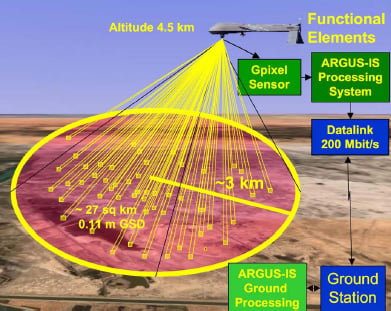
Boeing robo-chopper for DARPA's super-spyeye
I'm somewhat amazed that Faux News aired this story
| quote: |
| Originally posted by Trancer-X The military industrial complex sure knows how to spend our money... Boeing robo-chopper for DARPA's super-spyeye |


| quote: |
| Originally posted by Fir3start3r Gah.... Makes me wonder if I should have used my eletronics background towards military applications... Definiately much more exiting than what I'm currently doing |
I can say that I've personally done some significant work on a project along those lines. Development has really picked up in the last few years due to a large increase in the size and number of contracts for the research and development into that type of surveillance technology. Of course, there are certainly applications beyond surveillance as well.
Total information awareness is officially dead, but in practice the underlying philosophy is alive and well. What puzzles me is why people seem so quick to raise ethics questions with regards to technologies like this, yet they willingly carry around cell phones which permit their movements to be constantly tracked, if the government so desired. It's not so much the paranoia that gets me as the selective paranoia. The reality is that technology is going to keep moving forward regardless of how much we worry about how it "might" be used. The only genuine solution is to get people in places of authority who can and will see to it that they're used ethically.
| quote: |
| Originally posted by Arbiter The reality is that technology is going to keep moving forward regardless of how much we worry about how it "might" be used. |

| quote: |
| The only genuine solution is to get people in places of authority who can and will see to it that they're used ethically. |
| quote: |
| Originally posted by Trancer-X Unfortunately, that's much easier said than done. In an age of corporate greed and political corruption, ethics have become a thing of the past for the majority of those who seek to achieve political authority. |
| quote: |
| Originally posted by DJ Shibby Ah, but here's the catcher: People have never, ever been ethical, nor really cared about ethics. |
| quote: |
 Gah.... Makes me wonder if I should have used my eletronics background towards military applications... Definiately much more exiting than what I'm currently doing |
| quote: |
| Originally posted by Trancer-X That's not entirely true, though. The majority of human civilization hasn't been ethical but there are still pockets of very ethical people which have been and are further becoming extremely marginalized in our industrialized world (example 1, example 2). They're called Jains, Sikh's, Hindu's and Buddhists. The major difference between them and most of us is that they believe in the law of cause and effect, otherwise known as Karma. Early Christians (particularly the Essenes) believed it in as well but those views ultimately became supplanted by those of the Roman Catholic Church. About a hundred or so years after the turn of the first millenium the Cathars also believed in it as well but they were branded as heretics and were thus eventually wiped out during the Crusades. |
| quote: |
| Originally posted by Trancer-X I don't know what it is but I often look at your avatar picture and think of Austin Milbarge (Dan Akroyd) sitting in his sub-basement office at the Pentagon in the movie Spies Like Us I loved that movie but since I couldn't find that exact scene this one will have to do: |
| quote: |
| Originally posted by Fir3start3r Ok, now I'm going have to watch the movie again |

| quote: |
| Originally posted by Fir3start3r Gah.... Makes me wonder if I should have used my eletronics background towards military applications... Definiately much more exiting than what I'm currently doing |
| quote: |
| Originally posted by Trancer-X It's definitely one of my favorites of all time. |

Powered by: vBulletin
Copyright © 2000-2021, Jelsoft Enterprises Ltd.