
TranceAddict Forums (www.tranceaddict.com/forums)
- Production Studio
-- What is LFO in synthesizers ??? LFO IS...
What is LFO in synthesizers ??? LFO IS...
Ok so I wanted to ask this for a while now
Please don't flame me 
What is LFO in synthesizers?
I know that synths have oscillators that produce the sound in different waveforms most commonly sine square saw triangle (depending on how the wave form looks like) or any combination of the three then on the more complex synths you have a mixer section that allows you to mix different oscillators together then you got the filters that take out certain frequencies depending on whether it is a hi pass (only highs) low pass (only lows)(band pass only mids or any combination of those three then you got a amp Env that shapes the sound characteristics of the synth such as attack how fast it kicks in decay how fast it dies out sustain how long the sound stays there ect then possibly you got effects ect but the thing the puzzles me at this point is what the hell is LFO?
I don't understand what this thing is supposed to do...
Anybody know and care to explain...
LFO=Low Frequency Oscillator
It's an oscillator that oscillates in the sub-audible range. In other words, it is different than the oscillators that generate sound because its frequency (# of cycles per second) is too slow to create sound that can be heard by humans, whereas the sound-generating oscillators in the "oscillator" section of synth have much higher frequencies that can be heard. So, LFOs are used to modulate (change) other parameters of a synth sound to add movement. For example, slightly modulating the pitch with an LFO will give a vibrato sound, large modulations in the pitch will give a siren sound, modulating the output level will give a tremelo effect, etc. Square LFOs can be used to create on/off effects, jump from one note to another, etc. HTH.
edit: typ0s
BTW, what synths are you using? Maybe we can help you better understand LFOs and how to use them, control them with, for example, a mod wheel, etc. by showing you how to assign them to a sound. That's usually the best way to learn.
Good explanation cryophonik....now let me ask this.
What do the MOD knobs/sliders do on a synth? I know you can use it to tweak the sound a bit, but i never fully understood it.
--peace
| quote: |
| Originally posted by djsaekone What do the MOD knobs/sliders do on a synth? |
I guess it varies from synth to synth...what about the example below?

I have V-Station but haven't used in forever, so I'm going from memory here.
Near the center of V-Station's GUI, you'll see a section called "Mod Env" that has ADSR (Attack, Decay, Sustain, Release) controls - you use those knobs to create a generic envelope that changes over time (hopefully, you're familiar with that concept; if not, let us know). Then, you'll notice in the Oscillator 1, 2, and 3 sections and in the Filter section, there are knobs called "Mod Env" - those knobs control how much effect the ADSR envelope that you created in the "Mod Env" section have on each of those parameters. For example, raising the "Mod Env" knob in the Filter section will increase the effect of the Mod Env on the filter cutoff frequency. I believe that for the Oscillators, the Mod Env knob is dedicated to the pulse width modulation (PWM), but maybe someone else can verify this.
OK, so it kinda seems like its almost like the lfo except with ADSR controls and more functionality.
Thanks!
| quote: |
| Originally posted by cryophonik For example, slightly modulating the pitch with an LFO will give a vibrato sound, large modulations in the pitch will give a siren sound... |

| quote: |
| Originally posted by djsaekone OK, so it kinda seems like its almost like the lfo except with ADSR controls and more functionality. |
| quote: |
| Originally posted by MrJiveBoJingles To add to this: If you use an audio-rate (very fast) frequency to modulate the pitch of an oscillator, the vibrato starts to "blur" into new tones and you have FM synthesis. FM synthesis is built on a form of very fast vibrato. |
It depends what they're assigned too..... Modulation is just a fancy word for generating sound. You assign different parameters to those knobs or faders. Some of them will be static, for instance an ADSR envelope in a VST. Some will offer a drop down menu that lets you choose from several different things you want to "modulate" (generate/change sound) - If you have a MIDI controller, assigning modulation to various parts of a synth and then playing with them will really help you to understand how they work. I would suggest something simple like Sylenth1
It sounds like you need a more advanced subtractive synthesis break down. You know the basics, but I think you might benefit from studying the more complex tasks/features. The best way to learn this is to read manuals for subtractive synthesis VST's. Again, Sylenth1's manual is very basic and probably is the perfect start for where you are. If you still have more questions after that you'll need to check out a more advanced synth like Albino 3. I would recommend ignoring FM synthesis until you have a good grasp on subtractive synthesis. (Both concepts are fairly easy to understand but take years and years to master)
Browse YouTube for some tutorials on subtractive synthesis or try to find videos that show people making patches that explain along the way why they're choosing a square wave and this setting or that setting. Do that, along with trial and error (practice practice practice), and dedicate yourself to learn, and you'll surprise the hell out of yourself!
Good information hear, learned a few things.
| quote: |
| Originally posted by djsaekone Good explanation cryophonik....now let me ask this. What do the MOD knobs/sliders do on a synth? I know you can use it to tweak the sound a bit, but i never fully understood it. --peace |
Cryo - Care to give us the dirty on Mod Matrix's? I still don't think I know how to use them to their fullest.
| quote: |
| Originally posted by Stephen Wiley Cryo - Care to give us the dirty on Mod Matrix's? I still don't think I know how to use them to their fullest. |
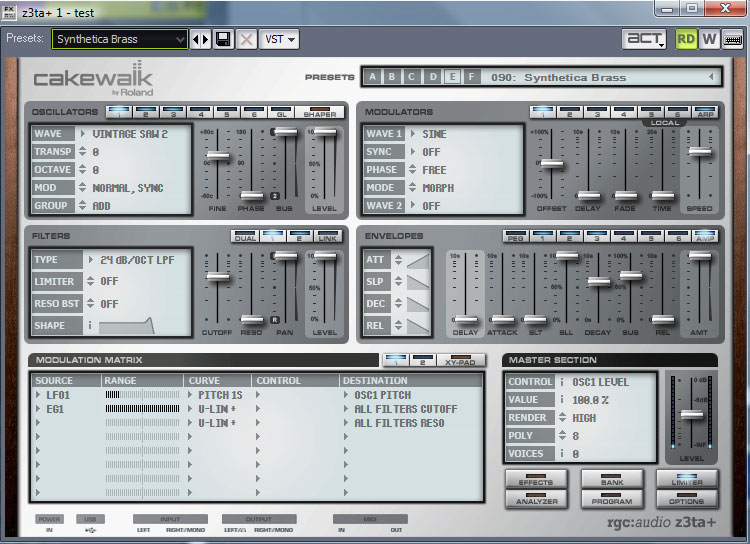 (Snow Skin)
Thank you for all the useful information.
| quote: |
| Originally posted by MrJiveBoJingles To add to this: If you use an audio-rate (very fast) frequency to modulate the pitch of an oscillator, the vibrato starts to "blur" into new tones and you have FM synthesis. FM synthesis is built on a form of very fast vibrato. |


Powered by: vBulletin
Copyright © 2000-2021, Jelsoft Enterprises Ltd.