
TranceAddict Forums (www.tranceaddict.com/forums)
- Production Studio
-- Ways to keep bass adequate at low levels?
Ways to keep bass adequate at low levels?
I've been monitoring a lot of my own stuff lately along with other productions and have been trying to pinpoint the differences and most importantly the attention paid to details. I believe that is the key of making "professional" music, but anyway....
On almost all tracks that I think are "professional" you can hear the bass much, much better when the track is being played very softly.
On tracks, such as my own (and 95% of what you buy lately), I find that when the volume is very soft, the bass pretty much disappears. It's a quite noticeable difference too. I'm sure EQ and compression are the culprit here but I can't figure it out.
I have noticed the same.
Someone told me to try multiband compression during the mastering, but I still couldn't reach the desired results.
Maybe eq is involved too.
ps: for mulitband compression I have tried Ozone Izotope
when mixing i always try to mix at low volumes - but sometimes it does not work like that.
I think it's alot to do with Eq and compression
More mid frequency content.
| quote: |
| Originally posted by Beatflux More mid frequency content. |
multiband compression is indeed the trick here... you have two options do it on your master and isolate the kick & bass together or bus them ahead of time and again compress together.
so A.) your kick & bass need to sit together naturally, if you're not getting them sounding right as is, change the kick or change the tone of hte bass
b.) once kick & bass sound good (before sidechain, eq, compression, etc) find out where in frequency they over lap & notch the bass
c.) apply compression to bass
d.) run bass & kick to a buss and put multiband on it if it still doesn't sound cohesive.

Excellent thread, I have trouble with this as well. It's not so bad if you're trying to produce electro house or something, where you can get away with a lot of high-frequency buzzing and such in your basslines. But, when you're trying to produce deeper, more "brooding" basslines like I have been, it seems to become more difficult.
| quote: |
| Originally posted by david.michael Excellent thread, I have trouble with this as well. It's not so bad if you're trying to produce electro house or something, where you can get away with a lot of high-frequency buzzing and such in your basslines. But, when you're trying to produce deeper, more "brooding" basslines like I have been, it seems to become more difficult. |
| quote: |
| Originally posted by evo8 also i dont really see how Multi Band Compression can help with this? |
analog
sidechain
If you really want to get freaky with it send your bass content, kick+sub, to a send channel, add an LP at about 160 hz, an HP at 40 hz, add some distortion and boost some sub freqs at 60 hz. Compress it hard, and voila.
Lots of bass.
| quote: |
| Originally posted by msz sidechain |
+1 to Diginut, also a lot comes from the quality of the bass... Kinda thought I'd never say this myself, but when palm said "analog", it does hold its value kinda.
Last project I did I had the pleasure of working with a moog voyager, and the bass made there just insanely struck out better than any VST can dream of achieving, required very little post-processing, and sounds like winning the lottery.
Just sayin'
| quote: |
| Originally posted by Tarpex Last project I did I had the pleasure of working with a moog voyager, and the bass made there just insanely struck out better than any VST can dream of achieving, required very little post-processing, and sounds like winning the lottery. Just sayin' |
Sidechain helps, but the most important aspect is the original sound.
Try working at extremely low volumes, in mono, and go through some bass patches/presets, and you'll notice some come through a lot better than others at that low volume. It's a good habit to get into, checking your bass at very low volume before you spend a lot more time on the rest of the mix.
Some bass patches have way too much low end. Sometimes I'll apply quite a bit of high pass filtering to get the low end under control. You could see if this is part of the problem - the sub frequencies will make it sound like there's plenty of bass when you're listening at decent volumes, but the bass will disappear at lower volumes.
learn ADSR
a well mixed track will have less bass at low volumes. The reduced response to bass is a physiological component of our hearing system and adjusting your mix to have a prominent bass level at low volumes will make the bass overly loud at normal volumes.
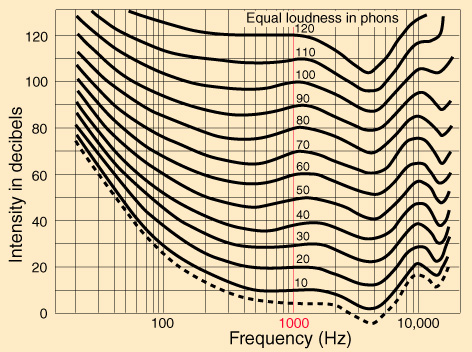
As far as your description of "pro" tracks, i think you aren't properly disseminating the real reason yours is different. I can't really tell you without some examples but it probably isn't the overall bass level that is the culprit. Your mix probably sounds bad at normal levels too.
| quote: |
| Originally posted by RichieV As far as your description of "pro" tracks, i think you aren't properly disseminating the real reason yours is different. I can't really tell you without some examples but it probably isn't the overall bass level that is the culprit. Your mix probably sounds bad at normal levels too. |
+1 fletcher-munson related
"pro" tracks likely have had a 3rd party mastering, which through subjective technical listening, applies uniform loudness as long as the mix is an A- or better. as far as mixing the bass right, i agree on balancing the sub-range 40-120 with the range up to 600-800hz, and centralizing always. most other harmonics in this area should be weak or panned, aside from perhaps the lead but thats decided by content..
im killing mixes using mid-side eq in Live 7. bass stays in the middle, harmonies and instruments panned or low q low cut.
I am not signed, but I am geeky.
Re: Ways to keep bass adequate at low levels?
My method is to take a very narrow notch using EQ somewhere in the mid range of said bass, as this I find helps it to stay audible on low playback volumes.
Sound choice is critical.
I now focus everything on teh bass end before going to far in a track as I find this the most challenging area. Mid rolling bass in particular is my nemesis.

Powered by: vBulletin
Copyright © 2000-2021, Jelsoft Enterprises Ltd.