
TranceAddict Forums (www.tranceaddict.com/forums)
- Chill Out Room
-- Socionomics - History's Hidden Engine (MUST SEE DOCUMENTARY)
Socionomics - History's Hidden Engine (MUST SEE DOCUMENTARY)
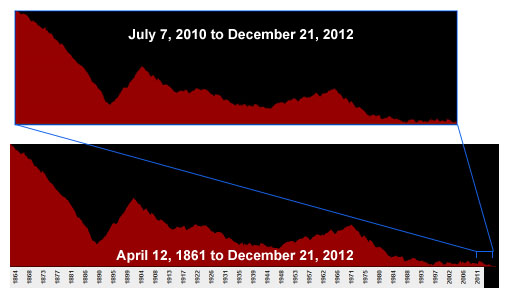
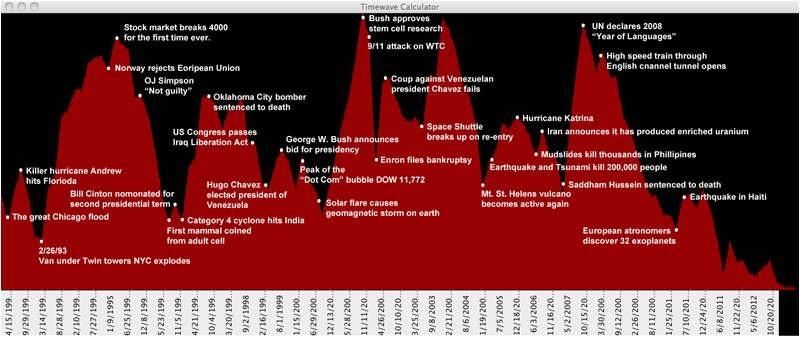
This documentary blew my mind. It talks about how specific mathematical principles dictate the ebb and flow of society (i.e. pop culture, war, peace, elections, stock market, etc) as a whole, in addition to, all of nature, of which, society is a part of. It's simple and easy to understand despite the subject matter. The three principles are the Elliot Wave Principle, Logarithmic Spiral, and Fibonacci Sequence/Ratio (.618). It simply is nothing less than amazing how this documentary fits it all together. A great example of how mathematics isn't just numbers and formulas, but the very language of the reality that surrounds us all, every day of our lives, and far after our deaths.
Length: 60 minutes
Did you read "Freakonomics" by any chance? Such an awesome book.
| quote: |
| Originally posted by The17sss Did you read "Freakonomics" by any chance? Such an awesome book. |
| quote: |
| Originally posted by The17sss Did you read "Freakonomics" by any chance? Such an awesome book. |

Haha... it gives lots of intetesting alternative perspectives for sure. Some of which, like the possible correlation between abortion becomimg legal and crime rates noticeably dropping in urban areas 15-20 years later are hard to ignore. They do a good job using factual data to draw conclusions... not so much saying their conclusions are fact. Either way, very interesting stuff.
enrique, you forgot to log out krypton.
Freakonomics was pretty good but fucking shame Levitt's best work imo was left out of the book entirely, a decision I still can't understand (http://en.wikipedia.org/wiki/Steven_Levitt#LoJack, certainly less sensational than economics applied to crime syndicates but still). Also no fucking way was it the best work of non-fiction ever.
Check out Dan Areily if you like freakonomics, he's got a new one out but his first book (Predictably Irrational) just came out in paperback.
I know someone starting college this year..undecided major, and the school is making EVERY freshman read Freakanomics. Does anyone know why they would do this? This is a major state university and it seems odd that they would make this a prereq for all freshmen. Is the book that damn good? What relevance could it have to people with an undeclared major?
Hah, I went on 4chan's literature board and a thread about Freakonomics was at the top.
According to Anonymous:
| quote: |
| they're the economic equivalent of popular science or psychology, and are thus pretty inaccurate. i find it particularily ironic that they make such a song and dance about other economists not thinking outside the box, or making mistakes, when as much of freakonomics makes the same mistakes with assumptions or omissions in order to make their point. for a book that proclaims to look at the hidden side of everything, most of their results are either glaringly obvious (why do drug dealers live with their moms? because they're poor - no shit...) or else wouldn't stand up to scrutiny. |
| quote: |
| Freakonomics claimed that it was possible to "tease" out the effect of extra police on crime by analysing electoral cycles. The evidence behind these claims was shown to be due partly to a programming error. McCrary stated "While municipal police force size does appear to vary over state and local electoral cycles ... elections do not induce enough variation in police hiring to generate informative estimates of the effect of police on crime." |

Properly using statistics and their evaluation, as well as the difference between correlation and causality is something loads of scientists and basically all the idiots talking about their findings have failed at.
This explains it quite nicely:

reminds me of terence mckenna's garbage
I enjoyed Freakonomics, as well as the follow-up Superfreakonomics. I don't think its conclusions should be taken as conclusive, but how they look at different factors is interesting. Many of the accusations against Levitt & Dubner were thrown at Malcolm Gladwell (who wrote an endorsement for Freakonomics) for his works Blink, Tipping Point, and Outliers. I found all of these books very interesting, but didn't walk away from them thinking I had an iron-clad understanding of the subjects.
One of Gladwell's more interesting theories was that Asians are good at math because the subject is largely dependent on persistence, and the agricultural history of the culture toiling in rice fields instilled this trait in them more than others. At the conclusion of this section, Gladwell overtly stated that this was just his theory, but no one has yet to come up with a better one.
His theory on why the Irish fight so much is really interesting too.
| quote: |
| Originally posted by mezzir Also no fucking way was it the best work of non-fiction ever. |
| quote: |
| Originally posted by WittyHandle I enjoyed Freakonomics, as well as the follow-up Superfreakonomics. I don't think its conclusions should be taken as conclusive, but how they look at different factors is interesting. Many of the accusations against Levitt & Dubner were thrown at Malcolm Gladwell (who wrote an endorsement for Freakonomics) for his works Blink, Tipping Point, and Outliers. I found all of these books very interesting, but didn't walk away from them thinking I had an iron-clad understanding of the subjects. One of Gladwell's more interesting theories was that Asians are good at math because the subject is largely dependent on persistence, and the agricultural history of the culture toiling in rice fields instilled this trait in them more than others. At the conclusion of this section, Gladwell overtly stated that this was just his theory, but no one has yet to come up with a better one. His theory on why the Irish fight so much is really interesting too. |
Extensive analysis of why Levitt's "more abortion leads to lower crime" theory is bogus:
http://www.isteve.com/abortion.htm
Poppy social science stuff is admittedly fun to read and think about, but a lot of it is ultimately unsupportable junk. People tend to be so much in awe of the counterintuitive or striking appearance of a thesis, or the eloquence and clarity with which an author presents it, that they can forget to look at the evidence more carefully.

I don't doubt that a fair amount of it is incorrect. I think that it is very absorbing the way they look at things, and that can be a siren song away from the facts at times. I look forward to reading your link later tonight when I get home. I'm not out to defend or attack any of these authors, I just find their work to be very interesting.
| quote: |
| Originally posted by The17sss I read "Outliers"... looking forward to the other two. Which was your favorite? Most people I ask that have read Gladwell's books seem to like Blink the best. |

Powered by: vBulletin
Copyright © 2000-2021, Jelsoft Enterprises Ltd.