
TranceAddict Forums (www.tranceaddict.com/forums)
- Production Studio
-- modulation
modulation
so hey is there any neat tutorials on the web that explains what this is exactly....whenever i google modulation i get some other stuff that pop ups that has to do with broadcasting and stuff..basically i know in its most basic form..it means controlling something..that controls something else...correct? i just basically wanna know how can i use it to my advantage and such..
*braces for impact*
you can modulate your ratio of time spent in prison compared to out of prison by the amount of minors you bugger.
yeah im a newb..what can i say..
thanks eric, still a bit confused but that made it alot more clear.
i was modulating the lfo and the osc detune on fab filters twin 2 just now..and coming up with some weird stuff..
Yeah, what Eric said. It might also help to think of the parameters as sources and destinations. A modulation source is the parameter that is modulating (having an effect on) another parameter (i.e. the destination). Depending on the synth, the destination can usually have more than one source modulating it. For example you could have both an LFO and an envelope modulating the filter cutoff frequency individually and in parallel (the arrows point from the modulation source to the destination):
LFO > Filter Cutoff Frequency
and
Envelope > Filter Cutoff Frequency
Or, you could have one (or more) modulation source modulating another parameter that is modulating the final destination in series, in which case the middle parameter is both a destination and a source, as in:
Envelope > LFO > Filter Cutoff Frequency
You could have the same settings for all parameters in both scenarios, but end up with much different sounds just based on the manner in which they're configured.
Edit: after re-reading Eric's post a little slower, I realize that I just pretty much said the same thing he did, except I used "destination" rather than "target". Oh well, hopefully this still helped somewhat.
| quote: |
| Originally posted by LoveHate yeah im a newb..what can i say.. ...thanks eric, still a bit confused but that made it alot more clear. |
| quote: |
| Originally posted by cryophonik Don't be afraid to ask. This isn't knowledge that you're born with and, despite the impression that many people try to give here, you're not the only one who doesn't have a good grasp on synthesis. One thing I'll mention is that, even though I love Twin 2, I might suggest learning on a different synth with a more conventional modulation matrix. The only reason I mention this is because Twin 2 has a sorta unconventional way of doing things, particularly modulation, that you might find difficult to apply to other synths. That said, if you're most familiar and comfortable with that synth, then just go with it. |

the blofeld can do boolean operations in regards to modulation. basically way cooler than what the virus does.
So, this might add a little more confusion but I think it's important to talk about the role that "controllers" play in modulation. Controllers are essentially features that give you real-time (or automated) control over the way that a source modulates a destination(s). They usually include parameters like velocity, aftertouch, mod wheel, breath controllers, some foot pedals, etc. They're usually used to control the amount of effect that a source has on a given destination.
A common example is using velocity to determine how much effect an envelope has on the cutoff frequency - when a note is played softly (i.e., low velocity), the envelope has little effect on the filter so it sounds more muted, whereas notes played with higher velocities cause the envelope to have a greater amount of effect on the cutoff (i.e., open more), thereby creating a brighter sound. So, generally speaking, controllers are useful for adding expression and variation, and even add more realism in some cases.
IMO tasteful use of control parameters for modulation is one thing that sets most pro sound designers apart from the rest - adding in some control with the mod wheel, velocity, and/or aftertouch can really add a lot of expression, diversity, and dynamics to your sounds.
heres a tutorial vid for Alchemy modulation focusing on LFOs - it may help you a little bit
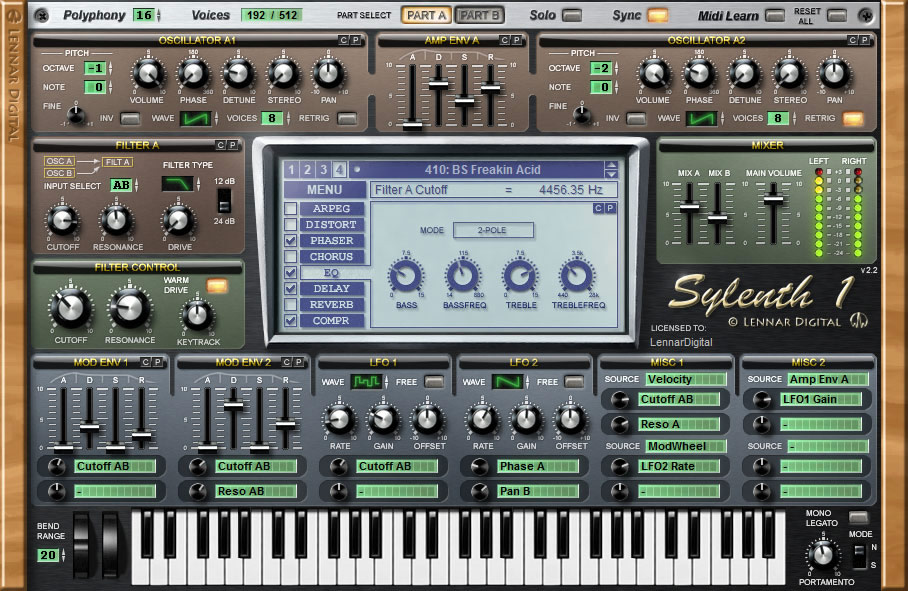
Sylenth1 is probably the easiest VST to learn modulation on. It's all sitting there at the bottom of the GUI with simple dropdown choices.
LFO IS MY BEST FREND
| quote: |
| Originally posted by ken_lee LFO IS MY BEST FREND |

thanks for the replys...i guess the next step would be ..knowing when to use it.
| quote: |
| Originally posted by LoveHate thanks for the replys...i guess the next step would be ..knowing when to use it. |

Powered by: vBulletin
Copyright © 2000-2021, Jelsoft Enterprises Ltd.