
TranceAddict Forums (www.tranceaddict.com/forums)
- Music Discussion
-- What is 'abstract' in music?
What is 'abstract' in music?
It's something I've been pondering about for a while now.
In graphic art it's pretty simple, as from what i understand it's simply a measure for how far it's removed from actual real world objects. But in music i don't find it that obvious, because all music can be seen as an abstraction. And i'm not sure what would lie on the other end of the scale, what is 'real' music?
At first i thought it was just a measure for how much it leaves to the imagination, how obvious or abundant it is. Synonymous with terms like 'deep' or 'intelligent'. But apart from being rather subjective and vague it also conflicts with how i'd categorize EDM genres by their abstraction when going by intuition.
Normally i'd say techno is more abstract then house. And IDM is more abstract then techno. However things like braindance IDM or breakcore are not exactly subtle, but i'd still call them abstract.
This would imply that it has more to do with how far it's removed from something. Possibly the more 'human' elements in music. Or 'soul'?
So there'll probably some more music-savvy who can explain it a bit better. As well as discussing what genre's can be considered abstract.
I never really thought about music in terms of abstraction, because in music more than most artistic forms, subject and object collapse into one and conventional semiotic processes don't really apply. I think most of the people who use "abstract" just use it as a synonym for "weird". I heard someone call my Post Apocalyptic mix "abstract" and I found it a really strange concept.
I guess you could say that music rooted in conventional instrumental and vocal origins - where the sounds are the clear result of the live performance of real instruments - has the relationship between a real physical process and the music. Abstract music would be divorced from what is seen as the real, live process of performance. It would be music that is just sound, with no connotations of any corresponding physical event in its creation.
| quote: |
| Originally posted by SYSTEM-J |
| quote: |
| Originally posted by SYSTEM-J I never really thought about music in terms of abstraction, because in music more than most artistic forms, subject and object collapse into one and conventional semiotic processes don't really apply. I think most of the people who use "abstract" just use it as a synonym for "weird". I heard someone call my Post Apocalyptic mix "abstract" and I found it a really strange concept. I guess you could say that music rooted in conventional instrumental and vocal origins - where the sounds are the clear result of the live performance of real instruments - has the relationship between a real physical process and the music. Abstract music would be divorced from what is seen as the real, live process of performance. It would be music that is just sound, with no connotations of any corresponding physical event in its creation. |
| quote: |
| Originally posted by ripped your post is very abstract and what does "conventional semiotic processes" mean? |
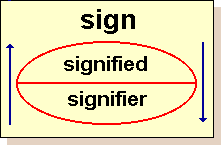
is this abstract enough?
| quote: |
| Originally posted by Bierheld Well all music is just sound of course. |
| quote: |
| Originally posted by SYSTEM-J Yeah, but some sounds are more abstract than others. A recording of rainfall is less sonically abstract than an acid line, a recording of someone crying is also less emotionally abstract than a piano melody. Then there are lyrics, which are just sounds where abstraction has been given meaning through a semiotic system called language. And so on. |
| quote: |
| Originally posted by ripped is this abstract enough? |
| quote: |
| Originally posted by SYSTEM-J I guess you could say that music rooted in conventional instrumental and vocal origins - where the sounds are the clear result of the live performance of real instruments - has the relationship between a real physical process and the music. Abstract music would be divorced from what is seen as the real, live process of performance. It would be music that is just sound, with no connotations of any corresponding physical event in its creation. |
| quote: |
| Originally posted by Vector A Yeah, that is one meaning. There is also the idea of "absolute music," meaning music that is not written to accompany anything else (stories, or images, or activities like dancing or ceremonies). In that sense any music made "just for listening" could be called "abstract" or "absolute." |
| quote: |
| Originally posted by ripped |
| quote: |
| Originally posted by ripped is this abstract enough? |
| quote: |
| Originally posted by Vector A There is also the idea of "absolute music," meaning music that is not written to accompany anything else (stories, or images, or activities like dancing or ceremonies). In that sense any music made "just for listening" could be called "abstract" or "absolute." |
abstract music is not only antirepresentational. Bierheld gave the example of paintings -- there it seems really evident, you achieve "abstraction" when you paint away from a strictly realistic depiction of the object. the development of perspective and a 'photorealistic' approach to painting is pretty new, though. if you look at pre-renaissance art in West, stretching back to cave paintings there is an entirely different set of criteria for painting "realistically".
abstraction is not just lines and junk on a canvas, its also to do with getting at some essential truth of the thing. for example if you look at some guy walking down the street, try to empty all his particular details, "abstract away" his legs and leave only the motion of his walk intact. its about trying to perceive or isolate something despite all the pressure to see it all together as one thing incarnated in a "real" object.
this is one of my favorite releases in "abstract" music:
http://www.discogs.com/Various-Audi...release/1428327
all the pieces are produced with synthesized sound, no recordings are used. these guys try to put together audio spaces that sound "real" and "distinct" while in fact having no basis in any actual location at all.
Francisco Lopez made this one piece called "Azoic Zone" -- describes perfectly the paradox of abstract music.
| quote: |
| Originally posted by sljiva high energy, dense stream of electrons going wild around some imaginary trajectory trying to break loose - unsuccessfully, because they are subdued by an electromagnetic force that takes them back on the path the whole time. Suddenly an unknown, even greater force appears and starts to manipulate the stream first into peaceful, beautiful and otherworldly shapes suggesting nothing harmful could ever happen, but then all of a sudden it receives a command that the stream must be destroyed and launches a weapon of self destruction that finally annihilates the whole stream structure. |


well, experimental music is a sub-genre of electronic music... and for me it doesn't matter at all if it's trance, minimal, dubstep or house... I listen to all electronic music genres, I love 'em all

Powered by: vBulletin
Copyright © 2000-2021, Jelsoft Enterprises Ltd.