 |
|
|
|
 |
|
|
|
imokruok
Lawyers, guns, and money

Registered: Aug 2003
Location: Los Angeles, CA / Milwaukee, WI
|
|
|
First off, Greenspan is right. The funding mechanism does need to change. The ratio of current workers who provide for the retired is far too low. Partial privatization is a reasonable option, but when you try and take control out of Washington, the lefties scream. (Even though my dog could do better than the 2% annual return the government gives us on our money.) If anything is a "washed-up" program, it's social security.
And dumping more money into it will not solve the problem, because in the end, you still have systemic problems. The government trying to spend its way through the coming crisis will cost, literally, trillions. The mechanism has to change. The only good thing about the impending problems is that the US doesn't have it nearly as bad as some European pension systems, which are already on the verge of collapse, and are destined to get worse. Their ratios of workers to retired are even lower.
___________________
FLUSHED THE JOHNS!
|
|
 Feb-25-2004 19:44 Feb-25-2004 19:44 
|
|
|
|
|
MisterOpus1
Grumpy Old Fart

Registered: Dec 2001
Location: Kansas City
|
|
|
Re: Re: Greenspan: Cut Social Security
I'm tired of hearing the excuse that tax cuts do not cause deficits. Without looking at numbers, it simply seems common sense to see that the return is significantly less as a result of less taxes to the government. But when we do look at numbers:
February 13, 2003
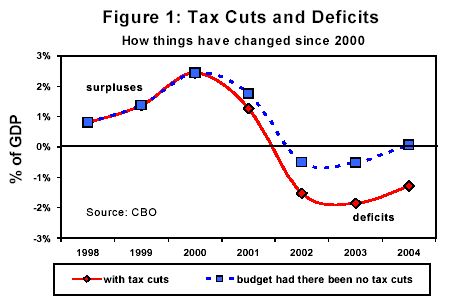
Tax Cuts a Major Factor in Return of Deficits
The Center on Budget and Policy Priorities has released Are Tax Cuts a Minor or Major Factor in the Return of Deficits?, which examines this question using data the Congressional Budget Office issued in late January. Mitchell Daniels, the Director of the President’s Office of Management and Budget, has said that the tax cuts of the past two years have played only a “minor” role in the return of budget deficits and that the budget would be in deficit even without them. The Center’s analysis finds that:
A third of the deterioration in the budget is due to the tax cuts. Since 2000, the budget has deteriorated by an amount equal to 4.0 percent of GDP. One-third of this deterioration has been caused by tax cuts enacted in the last two years, making the tax cuts one of the principal factors behind the budget deterioration.
The CBO data do not reflect the possible economic stimulus effects of recent tax or spending measures. The President’s Council of Economic Advisers argues that the tax cuts have stimulated economic growth and has estimated how much worse the economy would have been without them. Yet even using the CEA estimates, the net cost of the tax cuts would still turn out to have caused almost 30 percent of the budget deterioration since 2000. Moreover, other studies suggest the CEA estimates likely overstate the tax cuts’ effect on the economy.
Without the tax cuts, surpluses would return in 2004. The recession, along with defense, homeland security, and other spending increases already enacted, would have driven the budget into deficit in 2002 and 2003 even without the tax cuts. But the budget would be back in surplus in 2004 and stay there for the rest of the decade were it not for the tax cuts. In contrast, the Administration itself says the budget will remain in deficit every year for the next 75 years under its budget, which would make the 2001 tax cut permanent, add further tax cuts, and increase spending in areas like a prescription drug benefit.
More than half of 2003 and 2004 budgetary costs are due to tax cuts. Over the last two years, Congress has enacted legislation costing an annual average of $260 billion in 2003 and 2004. Some 58 percent of this cost is due to tax cuts, more than all other legislation — including increases for the military and homeland security, last year’s farm bill, and other legislation — combined. (Using the favorable CEA assumptions to factor in the supposed economic benefits of the tax cuts reduces that 58 percent figure only slightly, to 54 percent.)
http://www.cbpp.org/2-13-03bud-fact.htm
Here's a nice projection seemingly beginning to take shape:
| quote: | January 26, 2004
CBO DATA CONFIRM THAT EXTENDING TAX CUTS WOULD MORE THAN
DOUBLE THE SIZE OF ITS OWN OFFICIAL DEFICIT PROJECTIONS
The new Congressional Budget Office budget projections show deficits of $1.9 trillion over the next ten years, fiscal years 2005 – 2014. As CBO has acknowledged, however, the baseline projections are unrealistically optimistic, since they do not include the costs of continuing various existing policies, such as the recent tax cuts and relief from the Alternative Minimum Tax. Table 1-3 on page 6 of CBO’s new report, along with footnote 13 of the report, show that extending the tax cuts and AMT relief would themselves add another $2.9 trillion to deficits over the next ten years — bringing the total ten-year deficit to $4.8 trillion.
In recent months, four different analyses have been conducted of deficits over the decade from 2004 – 2013 if current policies — such as the tax cuts and AMT relief — are continued. All four analyses — a joint analysis by the business-backed Committee for Economic Development, the Concord Coalition, and the Center on Budget and Policy Priorities, as well as analyses by the Brookings Institution, Goldman Sachs, and Decision Economics (a Wall Street forecasting firm), found deficits of $5 trillion or more.
The Brookings analysis, issued earlier this month, also includes a projection for the years 2005 – 2014. It projects deficits of $5.3 trillion over this period.
The Center on Budget and Policy Priorities is currently preparing a new analysis of projected deficits for 2005 – 2014, based on the CBO projections issued today and incorporating the costs of continuing current policies, as noted above. This analysis will be completed later on January 26 or on January 27. But the bottom line is clear — a more realistic projection shows actual deficits over the next ten years will be about $3 trillion above CBO’s official $1.9 trillion figure and will be roughly $5 trillion.
http://www.cbpp.org/1-26-04bud2.htm
|
___________________
Whence September dusk grows crisper still,
with leaves all crimson conquered,
I yearn to shout,
and dance about,
and stick pickles in my honker...
|
|
|
Feb-25-2004 20:55
|
|
|
|
|
DaveSZ
When The Levee Breaks

Registered: Jan 2003
Location: ATX
|
|
|
Re: Re: Greenspan: Cut Social Security
| quote: | Originally posted by MisterOpus1
Hey, whadya know? It's early Christmas for Conservatives! You Rebubs. |
LOL since when are the so-called "conservatives" in Congress fiscal conservatives? 
| quote: | Originally posted by MisterOpus1
I'm tired of hearing the excuse that tax cuts do not cause deficits. |
Cutting taxes, increasing pork barrel spending, creating a new 430 billion dollar entitlement program, and starting two wars cause deficits. You can't cut taxes and not proportionally cut spending.
I happen to agree we need SS reform, but we also need to get rid of the "faith based initiative," and "abstinence only" sex education.
Republicans still create new entitlement programs. The only difference is that they're corporate welfare for drug and insurance companies instead of for people.
| quote: | Originally posted by Shakka
How 'bout this. Reverse the structure. Congress gets a lump sum of tax receipts, out of which they can try to pursue whatever programs they like. At the end of the day, whatever is left can be divied up among them and that will be their salary. Seriously--these guys are supposed to be the ones who work for the public good, yet they are the ones most guilty of sapping the public treasury for all it's worth and then bitching that there's not enough in the end, so therefore Mr. & Mrs. John Doe must cough up another 10% of their own hard earned money to pay for the latest entitlement program du jour. Congressmen should work for public sector wages, yet they are some of the wealthiest criminals in this country. |
For once we agree.
Did you read that article, I think it was in the Financial Times, about the fact that Senators’ stock portfolios outperformed the market by an average of 12 per cent a year? Damned insider traders.
 
___________________
http://www.discoboomer.com/forums/
Last edited by DaveSZ on Feb-26-2004 at 10:01
|
|
Feb-26-2004 09:33 
|
|
|
|
|
DaveSZ
When The Levee Breaks
Registered: Jan 2003
Location: ATX
|
|
|
Here is the report:
http://msnbc.msn.com/id/4372995/
| quote: |
Senators' stocks often outperform market
Study supports belief elected officials have advantageBy Deborah Brewster
Updated: 2:43 p.m. ET Feb. 25, 2004NEW YORK - U.S. senators' personal stock portfolios outperformed the market by an average of 12 percent a year in the five years to 1998, according to a new study.
advertisement
"The results clearly support the notion that members of the Senate trade with a substantial informational advantage over ordinary investors," says the author of the report, Professor Alan Ziobrowski of the Robinson College of Business at Georgia State University.
He admits to being "very surprised" by his findings, which were based on 6,000 financial disclosure filings and are due to be published in the Journal of Financial and Quantitative Analysis.
"The results suggest that senators knew when to buy their common stocks and when to sell."
First-time senators did especially well, with their stocks outperforming by 20 percent a year on average — a result that very few professional fund managers would be able to achieve.
"It could be argued that the junior senators most recently came out of private industry, so may have better connections. Seniority was definitely a factor in returns," says Prof. Ziobrowski.
There was no difference in performance between Democrats and Republicans.
A separate study in 2000, covering 66,465 U.S. households from 1991 to 1996 showed that the average household's portfolio underperformed the market by 1.44 percent a year, on average. Corporate insiders (defined as senior executives) usually outperform by about 5 percent.
The Ziobrowski study notes that the politicians' timing of transactions is uncanny. Most stocks bought by senators had shown little movement before the purchase. But after the stock was bought, it outperformed the market by 28.6 per cent on average in the following calendar year.
Returns on sell transactions are equally intriguing. Stocks sold by senators performed in line with the market the year following the sale.
When adjusted by the size of stocks, the total portfolio returns outperformed by 12 percent a year on average. The study used a total market index as the benchmark for comparison.
The study took eight years to complete because there was no database of information and the documents had to be gathered and examined manually. Stocks held in blind trusts are not included in the disclosure documents.
© The Financial Times Ltd 2004. "FT" and "Financial Times" are trademarks of the Financial Times.
|
___________________
http://www.discoboomer.com/forums/
Last edited by DaveSZ on Feb-26-2004 at 10:27
|
|
|
Feb-26-2004 10:19
|
|
|
|
|
|
|
|
| |
All times are GMT. The time now is 17:24.
Forum Rules:
You may not post new threads
You may not post replies
You may not edit your posts
|
HTML code is ON
vB code is ON
[IMG] code is ON
|
|
|
|
|
|
Contact Us - return to tranceaddict
Powered by: Trance Music & vBulletin Forums
Copyright ©2000-2026, Jelsoft Enterprises Ltd.
Privacy Statement / DMCA

|


