|
| quote: | Originally posted by MisterOpus1
Now I know you have a libertarian stance on this particular issue, but I cannot possibly concede to having the tax burden being completely shifted to the states, as you seem to have suggested. You probably have guessed that I believe it is our duty as citizens to pay taxes both on the state and federal level in order to uphold certain policies and systems that everyone on all income levels should have equal access to. I will admit, however, that I'm not educated enough to give specifics on where to draw the line on how much we should pay the state versus the federal level. But what is clear, however, is something that I have been pointing out from the get go about Bush's tax cuts - it will squeeze the states and will effect the lower income bracket in a disproportionate manner.
That is discriminatory, deliberately or undeliberately. As this article suggests, it ultimately effects lower income folks more than the financial elite. It did not mention other factors, such as the rise in college tuition across all states, which ultimately hurts lower income folks more than upper income (again). Furthermore, cuts in public education programs, which again ultimately hurts the lower income more, considering they have a greater population in the public schools. And on this particular point, I would say that I believe this is a fairly deliberate act of Bush and the Repubs., esp. when you consider they have also cut federal funds to the states at the same time, but I digress.
|
Well obviously I'm not calling for an abolishment of all federal taxes, what I'm calling for is a reduction in federal taxes such that proceeds of said tax go towards paying for federal institutions rather than state projects. If the state needs funding to pay for education, public works projects, etc., than the state should raise taxes. Why should we pay more in federal taxes to pay for pork barrell projects that other states manage to successfully lobby the federal government for? Why should we pay ANY federal tax money to states when the state can, and should, raise its own taxes if it needs to pay for something it wants? It increases accountability on the part of the state to do what's in the best interest of its citizens cost wise and benefits wise. But why is the shifting of the tax burden to states discriminatory on Bush's part? It's each state's own tax laws, they have sole discretion to alter their tax brackets to whatever they would like. Why is the state not discriminatory, and why are you not directing your criticism at the state rather than bush? The state tax structure only becomes an issue now that bush is decreasing the federal tax role? Well, if anything this should expose the inequity of our states' laws ... something that is far easier and tangible to change as opposed to federal law.
Just as an aside, I know you're arguing about the shifting of the tax burden as opposed to absolute effect, but as a clarification to others the tax cuts have not had a negative effect (even taking into account state taxes) so far:
http://www.factcheck.org/article.aspx?docID=100
http://www.ctj.org/pdf/fsl2004.pdf
| quote: |
Oh yes, I certainly believe they are that diabolical!
|
What's the matter? You never took my cheapshots so seriously before! 
| quote: |
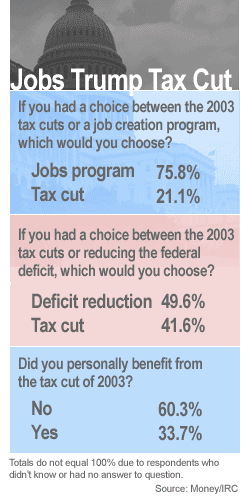
Look, I'm happy as hell that Cheney saved over $80,000 or so in taxes this year. That makes me giddy to the point of a near orgasm, but not quite. But I don't know if even I could pin an evil plot on the ultra-conservatives like that. What I do believe, however, is that they did not listen or even want to listen to the possible consequences of their actions on this tax cut. In a strange ironic twist, it seems the only person willing to consider the consequences to their actions was Bush himself, as Paul O'Neil points out in his book (Bush: "Haven't we already given money to rich people ... Shouldn't we be giving money to the middle?", Rove: "Stay the course..."). Seriously, many people don't even feel the "benefits" of this tax cut as a direct result of the shift of tax burdens from the feds. to the states, as the first article of DaveSZ's points out, and it's why more people are not so concerned about taxes as they are about jobs, as Dave's second article suggests. Furthermore, the lower income people feel the consequences even more, as my article points out (and what I've pointed out in the past).
|
So once again this is a job for states to remedy. If the majority of people do not want reform or don't care enough to actively support reform than what can you do?
| quote: |
I'm not for a cut in payroll taxes per se, and I have to say that's rather clever of you to attempt to point this out. Let's look at the article:
While it does show that payroll taxes are harsher towards the low-income workers, it is making a comparison with the second paragraph, which refers to corporate taxes. The comparison is that while corporate taxes have dropped, thereby giving back more money to the corporation, payroll taxes have increased, giving the low-income worker less money even though the corporation is saving more money. And with this comparison, I must agree with the author's criticism by pointing this out. |
It's a comparison that shouldn't even be made. Those are two completely different taxes that are funding two completely different purposes. The payroll tax solely contributes to social security and medicare and only taxes workers. It does not go anywhere else, and it's always going to go up, regardless of what an administration wants to do, with the way medicare and social security are structured. Therefore, one can ALWAYS unfairly criticize ANY decrease in ANY type of tax other than the payroll tax as shafting the worker because, simply put, no one is going to decrease that particular tax which is an individual entity in itself so to speak.
For example:
http://www.cnn.com/2004/ALLPOLITICS...a.ap/index.html
Bush wants to do away with the internet access tax and extend it to broadband. It is by default bad to remove such a tax however, since it comes at the expense of workers because of the increased payroll tax.
___________________
Retro ...

|