 |
|
|
|
 |
tecnolover
Senior tranceaddict

Registered: Sep 2004
Location: somewhere in, USA
|
|
|
| quote: | Originally posted by occrider
Point 1: while it is true that people are often influenced by different things, you have consistently failed to make a substantive case demonstrating how Jefferson has derived his moral or ethical code from Christianity. I could just as easily follow your example, of showing no evidence, to support my premise that Jefferson derived his moral and ethical code from Satanism under the ridiculous qualifier that people are influenced! I, on the other hand, quoted Jefferson’s own words where he has rejected Christianity, rejected the major tenants of Christianity, and castigated Christianity time and time again. Despite all of this, you still come to the conclusion that Jefferson was inspired and influenced by the very religion he despised??? |
I do not claim to know for certain all Jefferson’s influences that formed his moral code in particular but as for he deistic ideas yes I do still come to this conclusion. I believe that most of his influence for Deity came from christianity and most probably even the influential writer Lord Viscount Bolingbroke (1678-1751), who influenced him. Particulary with Jefferson, as I’ve said before because of his study of the bible and fascination with the moral philosophy of Christ and the fact that he believed in God. Plus the fact that his early childhood tutors were christian clergymen. If Jefferson had not been influenced by some religion (even if not christianity) then where did his belief in a God come from? Surely he didn’t wake up one morning and say to himself…”I think there is a God” . What is the rationale behind that? Until you can give me a good argument as to why a person should come to the conclusion that a supreme God exists completely on their own devoid of any indoctrination or societal influences of any religious kind then I must make the conclusion based on the philosophy that ‘all ideas come from experience’ and are learned, that Jefferson got the idea from religious influences.
If a person was born among a pack of wolves in the forest away from society and religious influence would he come to the conclusion that God must exist? I see no evidence that he should even possess that idea. Although, I do allow for the possibility that the idea that the idea of God could be innate in every born person, I don’t have any evidence to support it. Is that what you are trying to suggest??
Whether the strongest influence was from christianity I can only speculate and I admit this. Given that christianity was the largest population in colonial america at that time edit: and that Jefferson had two mentors/teachers that were Christian clergymen I would say it is highly probable.
| quote: |
At the age of five, Thomas was placed by his father at an English school, where he continued four years, at the expiration of which he was transferred to a Latin school, where he remained five years under the tuition of Mr. Douglass, a clergyman from Scotland.
On the death of his father, Mr. Jefferson was placed under the instruction of the Rev. Mr. Maury, to contemplate the necessary preparation for college.
http://etext.virginia.edu/jefferson/biog/lj01.htm
|
| quote: | written by Occrider…
Point 2: That’s an unsubstantiated assumption. Simply because popular religious sects emigrated to escape religious persecution, such as the puritans, they remain by and large a small percentage of the total population. Lynn R. Buzzard, executive director of the Christian Legal Society (a national organization of Christian lawyers) has admitted that there is little proof to support the claim that the colonial population was overwhelmingly Christian. "Not only were a good many of the revolutionary leaders more deist than Christian," Buzzard wrote, "but the actual number of church members was rather small. Perhaps as few as five percent of the populace were church members in 1776" (Schools They Haven't Got a Prayer, Elgin, Illinois David C. Cook Publishing, 1982, p. 81). |
These passages are very biased and distorted. First, it is quite evident from the title that the author is anti-prayer in schools. The fact he targets out christianity and tries to weaken the idea that it had a strong influence in early america, suggests that christianity is the dominant belief system of america. Which it is. But he’s painting the impression through vaguery that christianity wasn’t a strong influence, because he has to in order to have a leg to stand on. But he’s a deciever! The fact is that christianity has been the single most influential religion in the entire history of the USA and still is.
First of all christianity was the dominant religion of nearly all the colonists and they were highly devout people in their faith. These were people who opposed the Church of england and the persecution by Roman catholicism and protestants. That is the reason they came to america! To escape the religious persecution in europe. The majority of europeans were christian. In europe many groups formed off of protestantism which broke off of Roman catholicism durring the reformation. The rise of so many different christian sects is what brought about the persecution in europe. So in actuality anyone not christian was indeed very rare and a small minority in early america.
Later in the 18th century christianity continued stronly and there is no evidence to suggest otherwise but to the contrary...
Lets examine his use of vaguery in detail…
"Not only were a good many of the revolutionary leaders more deist than Christian," Buzzard wrote, "but the actual number of church members was rather small. Perhaps as few as five percent of the populace were church members in 1776"
First,
A ‘good many’ doesn’t mean squat to me. If he doesn’t give hard numbers it can mean anything he wishes. I have references here that suggest deists were always a small minority in america and eventually were completely suppressed in 19th century america by ‘evangelicalism’.
| quote: | Another religious movement that was the antithesis of evangelicalism made its appearance in the eighteenth century. Deism, which emphasized morality and rejected the orthodox Christian view of the divinity of Christ, found advocates among upper-class Americans. Conspicuous among them were Thomas Jefferson and John Adams. Deists, never more than "a minority within a minority," were submerged by evangelicalism in the nineteenth century
Deists in the United States never amounted to more than a small percentage of an evangelical population.http://www.loc.gov/exhibits/religion/rel02.html |
It is quite evident that ‘deism’ was not and never has been a significantly influential religion in US history.
Second, what actual number of what members were small as five percent?? This doesn’t tell the reader anything. We don’t know what denomination he was refering to. There were many different different christian sects in early america. To use just one christian denomination to represent the entire populace of christians is absurd and decieving. I can’t take the passage from your source as anything meaninful unless there is more you haven’t posted that can substaniate what you are trying to show.
Next, …
| quote: | written by Occrider again…..
This is corroborated by historians: Richard Hofstadter says that "perhaps as many as ninety percent of the Americans were unchurched in 1790" (Anti-Intellectualism in American Life, New York Alfred A. Knopf, 1974, p. 82) who goes on to say "mid-eighteenth century America had a smaller proportion of church members than any other nation in Christendom," noting that "in 1800 [only] about one of every fifteen Americans was a church member" (p. 89). Historian James MacGregor Burns agrees with these figures, noting that "(t)here had been a `very wintry season' for religion every where in America after the Revolution" (The American Experiment Vineyard of Liberty, New York Vintage Books, 1983, p. 493). He adds that "ninety percent of the people lay outside the churches." |
As far as 1790, maybe that is true. If the writer was trying to make a case that americans were not religious why couldn't he substantiate it with more than just one years record?? Like how about showing a trend over 10-20years. As, the writer suggests it was after the war and posssibly many were occupied with things other than worship at that time like rebuilding who knows?. That can happen. I also wonder what does his definition of ‘unchurched’ mean exactly? As far as middle 18th century nothing could be further from the truth. Ever heard of the term ‘The Great Awakening’? Obviously not. My evidence below…
| quote: |
“Against a prevailing view that eighteenth-century Americans had not perpetuated the first settlers' passionate commitment to their faith, scholars now identify a high level of religious energy in colonies after 1700. According to one expert, religion was in the "ascension rather than the declension"; another sees a "rising vitality in religious life" from 1700 onward; a third finds religion in many parts of the colonies in a state of "feverish growth." Figures on church attendance and church formation support these opinions. Between 1700 and 1740, an estimated 75 to 80 percent of the population attended churches, which were being built at a headlong pace. “http://www.loc.gov/exhibits/religion/rel01.html |
This is probably a larger percentage of faithful active members than modern times. continuing…..
| quote: |
“Toward mid-century the country experienced its first major religious revival. The Great Awakening swept the English-speaking world, as religious energy vibrated between England, Wales, Scotland and the American colonies in the 1730s and 1740s. In America, the Awakening signaled the advent of an encompassing evangelicalism--the belief that the essence of religious experience was the "new birth," inspired by the preaching of the Word. It invigorated even as it divided churches. The supporters of the Awakening and its evangelical thrust--Presbyterians, Baptists and Methodists--became the largest American Protestant denominations by the first decades of the nineteenth century. Opponents of the Awakening or those split by it--Anglicans, Quakers, and Congregationalists--were left behind.” |
| quote: | Originally posted by occrider
To further bolster this argument historians have found censuses conducted in the 1770s to bolster these claims:
“In 1775, by a census Rossiter viewed as reliable, there were 668 Congregationalist churches or congregations, 588 Presbyterian, 495 Anglican, 494 Baptist, 310 Quaker, 159 German Reformed, 150 Lutheran, 65 Methodist, 56 Catholic, 31 Moravian - and a sprinkling of Congregational-Separatists, Mennonites, French Protestants, Dunkers, Sandemanians and five Jewish congregations. Many colonists belonged to no church at all and attitudes toward religion were quite casual among the upper class and the poorest of the colonists. “
http://www.ocregister.com/commentary/bock/bock81102.htm
|
What is this supposed to prove except that the majority of denominations were christian!? LOL. Almost every denomination that is mentioned here is christian! LOL. This supports my argument more than it does yours! Jeez.
p.s. my full conclusions soon to come. i will post everything in a thread named 'christianity and the foundation of U.S. goverment'. peace
|
|
 Nov-01-2004 22:07 Nov-01-2004 22:07 
|
|
|
|
|
occrider
Traveladdict

Registered: Oct 2000
Location: New York
|
|
|
Re: Christianity and the foundation of US gov.
Oops I'll have to delete my response in the other thread.
| quote: | Originally posted by tecnolover
Occrider, you completely misunderstood this, perhaps I didn’t communicate this very well…..
here it is again
Christianity in it's truest form never suggested it be ruled by a catholic authority. It is about each person having faith and learning for themselves the truth and then being able to worship God how they want to and not any authoritarian church.”tecnolover
|
No I understood your statement perfectly. If you had read my arguments I never said that one had to be a Catholic or be a member of an authoritarian church in order to follow the tenets of Christianity. No I said that one had to subscribe to the beliefs that are dictated in the bible. And low and behold, I put forth some beliefs dictated by the scriptures of the bible. Now we both know that some of Jefferson’s beliefs directly contradict some of the scripture contained within the bible, therefore Jefferson could hardly be a Christian.
| quote: |
The meaning here is simply- that which is in the Bible and translated accurately, is the true gospel. It isn’t the Catholic gospel although catholicism took much of it for their own and also twisted much of it also but that is another discussion. The point is christianity, being the belief in Christ and the true gospel (much of which is in the bible), is something that each person is to discover for themselves and gain a true testimony of. When we gain a testimony of the true gospel and of Christ we are to follow the teachings. This however, does not mean that we must prescribe to ANY of the popular christian churches and how they say we are to worship God or even believe all the doctrines they proclaim. The bible never ever has suggested we follow an authoritarian religion who prescribes how we must worship God. Authoritarian religions sprang from the compilation of the Bible! Sorry that was not made clear. Thanks for all the nice scriptures though.
|
Why you keep obfuscating the issue I have no idea … but you failed to address my argument. I never said that Christianity dictates that we follow an authoritarian church. I said Christianity dictates that we follow some core beliefs from the bible. You correctly pointed out that some of those beliefs include salvation through the belief in Jesus Christ the Son of God, as well as the belief in the gospel or new testament. Now I have pointed out how Jefferson thought of Jesus as a “man of illegitimate birth, of a benevolent heart, enthusiastic mind, who set out without pretensions to divinity, ended in believing them, and was punished capitally for sedition by being gibbeted.”( Works, Vol. ii., p. 217) therefore he clearly thought of Jesus as a mortal man who was simply killed … he did not believe in his divinity.
As a matter of fact, he looked upon all that garbage in the same light as he looked at Roman mythology:
"The day will come when the mystical generation of Jesus, by the Supreme Being as his father, in the womb of a virgin will be classed with the fable of the generation of Minerva in the brain of Jupiter" (Works, Vol. iv, p. 365).
With respect to the gospel of the history of Jesus Christ, he looked upon the disciples as simply making stuff up, and he called it:
“a groundwork of vulgar ignorance, of things impossible, of superstitions, fanaticism, and fabrications" (Works, Vol. iv, p. 325).”
He goes on to say:
"If we could believe that he [Jesus] really countenanced the follies, the falsehoods, and the charlatanism which his biographers [Matthew, Mark, Luke, and John,] father on him, and admit the misconstructions, interpolations, and theorizations of the fathers of the early, and the fanatics of the latter ages, the conclusion would be irresistible by every sound mind that he was an impostor" (Ibid..).
At this point I’m simply reposting all this crap because you apparentely have trouble with reading comprehension, but allow me to summarize: Jefferson DID NOT believe in the divinity of Christ, and he DID NOT believe in the gospels that portrayed the divinity of Jesus. Since that contradicts the scriptures I quoted for you that come from the bible Jefferson is NOT a Christian. Now as for Jefferson’s influences or beliefs coming from Christianity, you never addressed the last Jefferson quote I sourced where Jefferson summarily rejects Christianity as an influence:
"I was glad to find in your book a formal contradiction at length of the judiciary usurpation of legislative powers; for such the judges have usurped in their repeated decisions, that Christianity is a part of the common law. The proof of the contrary which you have adduced is incontrovertible; to wit, that the common law existed while the Anglo-Saxons were yet Pagans, at a time when they had never yet heard the name of Christ pronounced, or knew that such a character had ever existed. But it may amuse you to show when and by what means they stole the law in upon us. In a case of quare impedit in the Year Book 34 H. 6, folio 38, (anno 1458,) a question was made, how far the ecclesiastical law was to be respected in a common law court. And Prisot, Chief Justice, gives his opinion in these words: 'A tiel leis qu'ils de seint eglise ont en ancien scripture covient a nous a donner credence,' etc. See S.C. Fitzh. Abr. Qu. imp. 89. Bro.; Abr. Qu. imp. 12.
Finch, in his first book, c. 3 is the first afterwards who quotes this case, and mistakes it thus: 'To such laws of the church as have warrant in Holy Scripture our law giveth credence;' and cites Prisot, mistranslating 'ancien scripture' into 'Holy Scripture.' Whereas Prisot palpably says 'To such laws as those of holy church have in ancient writing it is proper for us to give credence;' to wit, to their ancient written laws. This was in 1613, a century and a half after the dictum of Prisot. Wingate, in 1658, erects this false translation into a maxim of common law, copying the words of Finch, but citing Prisot. Wing, Max. 3. And Sheppard, title 'Religion,' in 1675, copies the same mistranslation, quoting the Y.B. Finch and Wingate. Hale expresses it in these words: 'Christianity is parcel of the laws of England.' 1 Ventr. 293. 3 Keb. 607. But he quotes no authority. By these echoings and reechoings from one to another it had become so established in 1728 that, in case the King vs. Woolston, 2 Stra. 834, the court would not suffer it to be debated, whether to write against Christianity was punishable in the temporal courts at common law. Wood, therefore, 409, ventures still to vary the phrase, and say that all blasphemy and profaneness are offenses by the common law, and cites 2 Stra. Then Blackstone, in 1763, 4.59, repeats the words of Hale, that 'Christianity is part of laws of England,' citing Ventris and Strange. And finally, Lord Mansfield, with a little qualification in Evans's case, in 1767, says that 'the essential principles of revealed religion are part of the common law.' Thus engulfing Bible, Testament, and all, into the common law, without citing any authority. And thus we find this chain of authorities hanging link by link, one upon another, and all ultimately on one and the same book, and that a mistranslation of the words 'ancien scripture' used by Prisot.
Finch quotes Prisot; Wingate does the same. Sheppard quotes Prisot, Finch, and Wingate. Hale cites nobody. The court in Woolston's case cites Hale. Wood cites Woolston's case. Blackstone quotes Woolston's case and Hale. And Lord Mansfield, like Hale, ventures on his own authority. Here I might defy the best read lawyer to produce another scrip of authority for this judiciary forgery; and I might go on further to show how some of they Anglo-Saxon priests interpolated into the texts of Alfred's laws 20th, 21st, 22d, and 23d chapters of Exodus, and the 15th of the Acts of the Apostles, from the 23d to the 29th verse. But this would lead my pen and your patience too far. What a conspiracy this between church and state! Sing Tantarara, rogues all, rogues all!" (Works, Vol. iv., pp. 397, 398).
| quote: |
Now, concerning deism. You are right deism is a very simplistic. But it is a religion nonetheless and accepted as one because of the belief in a supreme deity. Jefferson claimed to be a deist. My confusion here is that I don't understand how he believed in a God deity unless he was influenced by a religion in some way. Maybe not necessarily christianity but some religion. Where else other than pre existing religion does the assumption of a God come from? Are you going to suggest next that the idea of God is innate and born? That would be interesting to discuss! But a new thread ok. lol I have not suggested that Jefferson was christian i've only suggested that I believe that is where he formed his idea of the existance of God to which he eventually became a deist. Every belief has it's influences.
|
It is not that difficult to philosophically believe that there is some kind of higher power who is responsible for our existence without the influence of a religion. I think you’re getting your influences mixed up, organized religion likely arose from Deism. Or rather monotheism and polytheism arose from Theism. However, I’ll let Jefferson speak for himself:
I never submitted the whole system of my opinions to the creed of any party of men whatever in religion, in philosophy, in politics, or in anything else where I was capable of thinking for myself. Such an addiction is the last degradation of a free and moral agent. -Thomas Jefferson, letter to Francis Hopkinson, March 13, 1789
If I may be so bold to paraphrase Jefferson’s words, he’s saying he’s not so stupid that he needs a guide or an influence to generate beliefs that he can do so by thinking for himself.
I never submitted the whole system of my opinions to the creed of any party of men whatever in religion, in philosophy, in politics, or in anything else where I was capable of thinking for myself. Such an addiction is the last degradation of a free and moral agent. -Thomas Jefferson, letter to Francis Hopkinson, March 13, 1789
| quote: |
Obviously two relgious men played a large role in his early childhood and were responsible for educating him. Doesn't suprise me one bit actually. No suprise at all.
|
Ummm so I quote Jefferson’s own words time and time again to demonstrate his distaste towards Christianity, and you reference the fact that two of his educators were affiliated with religion as a proof that he was influenced by Christianity? If you by influence you mean [I]negatively[/b] influenced than you might have a case. However, the pedestal for your assumption has the consistency of swiss cheese and the stability of bread crumbs. I, for example, grew up in the roman catholic church, and underwent about 10 years of religious schooling. Yet I could sum up the positive influences on me from church and religion on one hand … no forget that, I don’t need a hand, I could be a quadruple amputee and I could still sum up the the positive influences on one stump.
| quote: |
And then there is the fact that it was drafted by him into a political document. If politics and religion are to be kept separated why wasn't mention of ‘Creator’ and ‘Natures God’ left out? Neither of you have given a strong argument as to why mention of a supreme deity should have been written into a political document.
|
I never said that Jefferson was an atheist. He was a Deist.
| quote: |
Part of my overall argument has been that politics and religion do mix. Always have and always will. That relgion and politics are married together in that morality comes from religion and government cannot function without civil morality. In the USA and now the world christianity is the single most dominant religion. Therfore, the morality of the USA on the whole as a nation can be considered based on christian ethics/standards.
|
You’re barking up the wrong tree if you think that Jefferson thought that politics and religion should mix:
| quote: |
Gentlemen
The affectionate sentiments of esteem & approbation which you are so good as to express towards me, on behalf of the Danbury Baptist association, give me the highest satisfaction. my duties dictate a faithful & zealous pursuit of the interests of my constituents, and in proportion as they are persuaded of my fidelity to those duties, the discharge of them becomes more & more pleasing.
Believing with you that religion is a matter which lies solely between man & his god, that he owes account to none other for his faith or his worship, that the legitimate powers of government reach actions only, and not opinions, I contemplate with sovereign reverence that act of the whole American people which declared that their legislature should make no law respecting an establishment of religion, or prohibiting the free exercise thereof, thus building a wall of separation between church and state. [Congress thus inhibited from acts respecting religion, and the Executive authorised only to execute their acts, I have refrained from presenting even occasional performances of devotion presented indeed legally where an Executive is the legal head of a national church, but subject here, as religious exercises only to the voluntary regulations and discipline of each respective sect.] Adhering to this expression of the supreme will of the nation in behalf of the rights of conscience, I shall see with sincere satisfaction the progress of those sentiments which tend to restore to man all his natural rights, convinced he has no natural right in opposition to his social duties.
I reciprocate your kind prayers for the protection and blessing of the common Father and creator of man, and tender you for yourselves and your religious association, assurances of my high respect & esteem.
(signed) Thomas Jefferson
Jan.1.1802.
http://www.usconstitution.net/jeffwall.html
|
As for Washington’s farewell address, yes he mentions religion. However, not once does he make any mention of Christianity.
Anyway I shall have to continue with the second part of your argument tomorrow.
___________________
Retro ...

|
|
|
Nov-01-2004 22:11
|
|
|
|
|
tecnolover
Senior tranceaddict
Registered: Sep 2004
Location: somewhere in, USA
|
|
|
Re: Re: Christianity and the foundation of US gov.
| quote: | Originally posted by occrider
Oops I'll have to delete my response in the other thread.
No I understood your statement perfectly. If you had read my arguments I never said that one had to be a Catholic or be a member of an authoritarian church in order to follow the tenets of Christianity. No I said that one had to subscribe to the beliefs that are dictated in the bible. And low and behold, I put forth some beliefs dictated by the scriptures of the bible. Now we both know that some of Jefferson’s beliefs directly contradict some of the scripture contained within the bible, therefore Jefferson could hardly be a Christian.
Why you keep obfuscating the issue I have no idea … but you failed to address my argument. I never said that Christianity dictates that we follow an authoritarian church. I said Christianity dictates that we follow some core beliefs from the bible. You correctly pointed out that some of those beliefs include salvation through the belief in Jesus Christ the Son of God, as well as the belief in the gospel or new testament. Now I have pointed out how Jefferson thought of Jesus as a “man of illegitimate birth, of a benevolent heart, enthusiastic mind, who set out without pretensions to divinity, ended in believing them, and was punished capitally for sedition by being gibbeted.”( Works, Vol. ii., p. 217) therefore he clearly thought of Jesus as a mortal man who was simply killed … he did not believe in his divinity.
At this point I’m simply reposting all this crap because you apparentely have trouble with reading comprehension, but allow me to summarize: Jefferson DID NOT believe in the divinity of Christ, and he DID NOT believe in the gospels that portrayed the divinity of Jesus. Since that contradicts the scriptures I quoted for you that come from the bible Jefferson is NOT a Christian. Now as for Jefferson’s influences or beliefs coming from Christianity, you never addressed the last Jefferson quote I sourced where Jefferson summarily rejects Christianity as an influence: |
It was not necessary to post all of Jefferson's writings Occrider. You seem to have missed the point I stated a few posts back. I reitterated it again in these last two posts as well but let me spell it out. "I am not saying Jefferson was Christian". Ok. I hope we are clear on this. I don't know if I ever completely suggested he was even from the beginning. I have said over and over quite a few times now I agree that he was a Deist. I have even gone so far to even mention one of his main strong Deistic influences that being the writings of Lord Viscount Bolingbroke (1678-1751). What else do you want from me??!! Jeez! Obviously somewhere back in this discussion you missed something.
I have been making point for awhile now that the Jefferson's idea of the existance of a God must have come from established religion. Simple as that. I hope we are clear now. My position is that it was from christianity. Whether he agreed with christian ideology or not isn't the point now. It's the idea of a God that we are talking about.
| quote: |
It is not that difficult to philosophically believe that there is some kind of higher power who is responsible for our existence without the influence of a religion. I think you’re getting your influences mixed up, organized religion likely arose from Deism. Or rather monotheism and polytheism arose from Theism. However, I’ll let Jefferson speak for himself:
I never submitted the whole system of my opinions to the creed of any party of men whatever in religion, in philosophy, in politics, or in anything else where I was capable of thinking for myself. Such an addiction is the last degradation of a free and moral agent. -Thomas Jefferson, letter to Francis Hopkinson, March 13, 1789
If I may be so bold to paraphrase Jefferson’s words, he’s saying he’s not so stupid that he needs a guide or an influence to generate beliefs that he can do so by thinking for himself. |
If we are to rationally believe that all ideas are learned and derived from experience most certainly it does. Why would a person ever come to a conclusion or even have an idea of a God in the first place? Even mythology is in part based on some kind of truth. Ideas come from perceptions and are learned. So how is it that you can suggest that it's not philosophically hard to believe in the existance of God without having a source for that idea? Just because you might have the idea of a God because you were raised and taught catholicism doesn't mean that someone that hasn't been religiously indoctrinated as you could even concieve such an idea. IMO Jefferson had to have been taught it as a child most probably from his tutors since there isn't any evidence that his father or mother were religious from my research.
Once more, we aren't even talking about beliefs yet. We are talking about the mere idea of the existance of God. Whether Jefferson believed isn't the point right now. We already know he did because he was a deist.
| quote: | | Ummm so I quote Jefferson’s own words time and time again to demonstrate his distaste towards Christianity, and you reference the fact that two of his educators were affiliated with religion as a proof that he was influenced by Christianity? If you by influence you mean negatively[/b] influenced than you might have a case. However, the pedestal for your assumption has the consistency of swiss cheese and the stability of bread crumbs. I, for example, grew up in the roman catholic church, and underwent about 10 years of religious schooling. Yet I could sum up the positive influences on me from church and religion on one hand … no forget that, I don’t need a hand, I could be a quadruple amputee and I could still sum up the the positive influences on one stump. |
... well this is still a continuation of the misunderstanding from before. Nonetheless, my evidence stands. I believe that Jefferson's idea of the existance of a God most probably came from christian influences. Whether he embraced it or hated it isn't the point.
| quote: | | I never said that Jefferson was an atheist. He was a Deist. |
What does that have to do with anything? The point is he drafted his religious views into an official political document. And it was officially adopted by congress.
| quote: | | You’re barking up the wrong tree if you think that Jefferson thought that politics and religion should mix: |
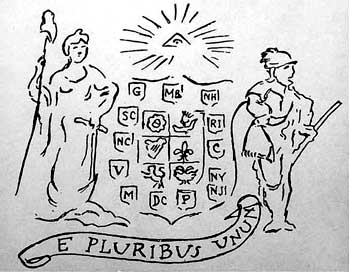
Well he did it intentionally in the DOI. Not to mention both Jefferson and Benjamin Franklin used graphical bible stories in their design of the national seal! Yes, it is true Occrider. The seal was not adopted but none the less Jefferson and Franklin considered to be the two most liberal founders were imparting biblical symbology in a national symbol. This was during the revolutionary war period. Both of these men not only chose to mix religion in politics but even design a symbol that american christian majority believed in. And this is only one example of many places where the mention of God and religious symbolism is found in american history as well as many of present day like currency and government buildings and in judicial court rooms.
| quote: |
"On July 4, 1776, Congress appointed Benjamin Franklin, Thomas Jefferson and John Adams "to bring in a device for a seal for the United States of America." Franklin's proposal adapted the biblical story of the parting of the Red Sea (left). Jefferson first recommended the "Children of Israel in the Wilderness, led by a Cloud by Day, and a Pillar of Fire by night. . . ." He then embraced Franklin's proposal and rewrote it (right). Jefferson's revision of Franklin's proposal was presented by the committee to Congress on August 20. Although not accepted these drafts reveal the religious temper of the Revolutionary period. Franklin and Jefferson were among the most theologically liberal of the Founders, yet they used biblical imagery for this important task." http://www.loc.gov/exhibits/religion/rel04.html
 |
Now whether Jefferson thought politics and religion should mix or not is irrelevant. The facts are that religion and politics have been married since the beginning of US history. Jefferson himself was guilty of this at least couple of times now as I have clearly shown. This is all evidence adding up to support my claim. All of this evidence and more will be presented in my concluding post.
| quote: |
As for Washington’s farewell address, yes he mentions religion. However, not once does he make any mention of Christianity.
|
| quote: | written previously by tecno.....
"Above all, the pure light of revelation has had an influence on mankind, and increased the blessings of society. It is impossible to rightly govern the world without God and the Bible." |
Oh really?? Then explain to me why he says "God and the Bible"? or did you miss that line? The bible consists of the New Test. as you should know and that is where christian doctorine lies. What else other than christian belief could he have been talking about?! Give me a friggin break!
Not only did he talk about the importance of the bible but he explained religion's role in government quite clearly, even if you chose turn a blind eye to that Occrider. I believe John Adams wrote a similar passage regarding religious morality and government also. I will try to find the reference. peace.
Here chew on these while your at it...
U. S. Grant: "The Bible is the sheet-anchor of our liberties."
Franklin D. Roosevelt.
"The young must be taught, and they must be taught truly if spring waters of democracy are to be kept untainted. The influence of the Scriptures in the early days of the Republic is plainly revealed in the writing and thinking of the men who made the nation possible.... They found in the Scriptures that which shaped their course and determined their action."
Immanuel Kant.
"The existence of the Bible, as a book for the people, is the greatest benefit which the human race has ever experienced: Every attempt to belittle it is a crime against society."
|
|
|
Nov-02-2004 00:28
|
|
|
|
|
occrider
Traveladdict
Registered: Oct 2000
Location: New York
|
|
|
| quote: | Originally posted by tecnolover
It was not necessary to post all of Jefferson's writings Occrider. You seem to have missed the point I stated a few posts back. I reitterated it again in these last two posts as well but let me spell it out. "I am not saying Jefferson was Christian". Ok. I hope we are clear on this. I don't know if I ever completely suggested he was even from the beginning. I have said over and over quite a few times now I agree that he was a Deist. I have even gone so far to even mention one of his main strong Deistic influences that being the writings of Lord Viscount Bolingbroke (1678-1751). What else do you want from me??!! Jeez! Obviously somewhere back in this discussion you missed something.
I have been making point for awhile now that the Jefferson's idea of the existance of a God must have come from established religion. Simple as that. I hope we are clear now. My position is that it was from christianity. Whether he agreed with christian ideology or not isn't the point now. It's the idea of a God that we are talking about. |
And you have failed to provide any evidence to show that Jefferson’s philosophical beliefs in a higher power were in any way whatsoever derived from an established religion much less Christianity. However, everything that he says from his own words seems to indicate that he is distasteful of Christianity, and he even goes forth to ridicule those who claim that Christianity had any influence whatsoever in the laws he put forth. Instead you keep putting forth conjecture and your own unsubstantiated personal opinions which hold little weight in the face of Jefferson’s writings.
| quote: |
If we are to rationally believe that all ideas are learned and derived from experience most certainly it does. Why would a person ever come to a conclusion or even have an idea of a God in the first place? Even mythology is in part based on some kind of truth. Ideas come from perceptions and are learned. So how is it that you can suggest that it's not philosophically hard to believe in the existance of God without having a source for that idea? Just because you might have the idea of a God because you were raised and taught catholicism doesn't mean that someone that hasn't been religiously indoctrinated as you could even concieve such an idea. IMO Jefferson had to have been taught it as a child most probably from his tutors since there isn't any evidence that his father or mother were religious from my research.
Once more, we aren't even talking about beliefs yet. We are talking about the mere idea of the existance of God. Whether Jefferson believed isn't the point right now. We already know he did because he was a deist.
|
All ideas are NOT learned or derived from experience. I can philosophically ponder my own existence and where I came from without learning from some external source that these unanswered questions exist. And once again you are projecting your unsubstantiated opinion as fact when you have no evidence to support your claim. Furthermore, let us assume for a minute that Jefferson did indeed gather concepts of a higher power from an organized religion, that doesn’t necessitate that he was influenced in any other way whatsoever in crafting his moral or ethical code. Certainly not from a religion he summarily rejects, and particularly when he himself states that he has never submitted his own system of opinions to the creed of any external source other than his own thinking.
| quote: |
... well this is still a continuation of the misunderstanding from before. Nonetheless, my evidence stands. I believe that Jefferson's idea of the existance of a God most probably came from christian influences. Whether he embraced it or hated it isn't the point.
|
What evidence??? You haven’t shown any evidence. Your evidence is opinionated conjecture. Conjecture that has virtually no weight in the face of what we know from Jefferson’s own words. Do you know what he said of the God of the Old Testament? The very same God that Christians worship? He called him:
"a being of terrific character -- cruel, vindictive, capricious, and unjust" (Works Vol. iv., p. 325).
When he was referring to the Jewish preists of the old testament he called them:
"a bloodthirsty race, as cruel and remorseless as the being whom they represented as the family God of Abraham, of Isaac, and Jacob, and the local God of Israel" (Ibid.).
And finally in a letter to John Adams, dated April 8, 1816, he says of the God of the Jews:
"Their God would be deemed a very indifferent man with us" (Ibid., p. 373).
The God of the Old Testament is the very same God that Christians worship in the new testament.
| quote: |
What does that have to do with anything? The point is he drafted his religious views into an official political document. And it was officially adopted by congress.
|
Actually Jefferson did not draft religion into the declaration of independence. Jefferson’s original draft did not make any reference at all to the creator:

A subsequent revision by Adams also did not reference the creator. Therefore the concession was likely made to either Franklin or the other two members of the commission sometime after the first two revisions but before the document went to Congress. Therefore Jefferson never intended to invoke Religion into the document but it is possible he made concessions to some of the other members of the commission and included it.
| quote: |
Well he did it intentionally in the DOI. Not to mention both Jefferson and Benjamin Franklin used graphical bible stories in their design of the national seal! Yes, it is true Occrider. The seal was not adopted but none the less Jefferson and Franklin considered to be the two most liberal founders were imparting biblical symbology in a national symbol. This was during the revolutionary war period. Both of these men not only chose to mix religion in politics but even design a symbol that american christian majority believed in. And this is only one example of many places where the mention of God and religious symbolism is found in american history as well as many of present day like currency and government buildings and in judicial court rooms.
|
Clearly Jefferson did not intend to mix religion and politics with respect to the DOI. As for the seal, it should be noted that Franklin and Jefferson did indeed propose some biblical scenes for the seal. However, they all proposed a variety of allegorical scenes. Adams proposed an allegorical picture known as the "Choice" or "Judgment of Hercules" as engraved by Simon Gribelin, an image that deeply impressed Adams. According to the editors of the Adams Family Correspondence:
The original fable is attributed to Xenophon in his Memoirs of Socrates, which narrates a debate, or rather a succession of appeals to the young Hercules, by female impersonations of Virtue and Vice (Pleasure). Vice speaks first and points out the flowery path of self-indulgence; Virtue follows and adjures Hercules to ascend the rugged, uphill way of duty to others and honor to himself.
http://www.greatseal.com/committees...comm/index.html
So is Adam’s promoting the religion of Greek mythology within US government? Of course not. Similarly, Jefferson proposed the allegorical depiction of children of Israel in the wilderness, led by a cloud by day and a pillar of fire by night. On the reverse, however, he proposed an allegorical image of Hengist and Horsa:
Hengist and Horsa were mythological horse Gods among the Germanic people.
http://myths.allinfoabout.com/feature42.html
Are we then to conclude that Jefferson was promoting Germanic mythology within the US government? Again, no, they are simply allegorical scenes. Perhaps we should look at the actual seal that was decided upon:

Nope no biblical scene there. As a matter of fact, what I do spot is an eye in a triangle surrounded with light … along with the phrase 'Annuit Coeptis’. The latin phrase comes from Virgil’s masterpiece, the Aeneid, which contains the sentence: "Jupiter omnipotens, audacibus annue coeptis." (All-powerful Jupiter, favor [my] daring undertakings.). Virgil is of course a Roman poet and Jupiter is naturally a Roman God. Therefore according to your illogical argument I could conclude that they intended for the US government to embrace Roman mythology. Certainly would make more sense than Christianity to me …
| quote: |
Now whether Jefferson thought politics and religion should mix or not is irrelevant. The facts are that religion and politics have been married since the beginning of US history. Jefferson himself was guilty of this at least couple of times now as I have clearly shown. This is all evidence adding up to support my claim. All of this evidence and more will be presented in my concluding post.
|
Ok well what evidence do you have left now?
| quote: |
Oh really?? Then explain to me why he says "God and the Bible"? or did you miss that line? The bible consists of the New Test. as you should know and that is where christian doctorine lies. What else other than christian belief could he have been talking about?! Give me a friggin break!
Not only did he talk about the importance of the bible but he explained religion's role in government quite clearly, even if you chose turn a blind eye to that Occrider. I believe John Adams wrote a similar passage regarding religious morality and government also. I will try to find the reference. peace.
|
Oh? “God and Bible”? Washington said that? Did he really? Here’s a link to his farewell address:
http://www.yale.edu/lawweb/avalon/washing.htm
Here’s another one:
http://usinfo.state.gov/usa/infousa...democrac/49.htm
Better yet here’s as it was published in the Independent Chronicle:
http://earlyamerica.com/earlyameric...tones/farewell/
Why don’t you point out where that phrase “God and Bible” is. 
| quote: |
Here chew on these while your at it...
U. S. Grant: "The Bible is the sheet-anchor of our liberties."
Franklin D. Roosevelt.
"The young must be taught, and they must be taught truly if spring waters of democracy are to be kept untainted. The influence of the Scriptures in the early days of the Republic is plainly revealed in the writing and thinking of the men who made the nation possible.... They found in the Scriptures that which shaped their course and determined their action."
Immanuel Kant.
"The existence of the Bible, as a book for the people, is the greatest benefit which the human race has ever experienced: Every attempt to belittle it is a crime against society." |
More irrelevance? Why am I not surprised? Here I can play your silly games too:
"This would be the best of all possible worlds if there were no [organized] religion in it"
John Adams
"Nothing can be more contrary to religion and the clergy than reason and common sense."
Voltaire (Philosophical Dictionary, 1764)
"I began to be regarded, by pious souls, with horror, either as an apostate or an Atheist"
Ben Franklin
"The Bible is not my book, nor Christianity my profession"
Abraham Lincoln
"My earlier views of the unsoundness of the Christian scheme of salvation and the human origin of the Scriptures have become clearer and stronger with advancing years and I see no reason for thinking I shall ever change them."
Abraham Lincoln
___________________
Retro ...
Last edited by occrider on Nov-02-2004 at 16:22
|
|
|
Nov-02-2004 16:14
|
|
|
|
|
tecnolover
Senior tranceaddict
Registered: Sep 2004
Location: somewhere in, USA
|
|
|
| quote: | Originally posted by occrider
And you have failed to provide any evidence to show that Jefferson’s philosophical beliefs in a higher power were in any way whatsoever derived from an established religion much less Christianity. However, everything that he says from his own words seems to indicate that he is distasteful of Christianity, and he even goes forth to ridicule those who claim that Christianity had any influence whatsoever in the laws he put forth. Instead you keep putting forth conjecture and your own unsubstantiated personal opinions which hold little weight in the face of Jefferson’s writings. |
This whole point of where Jefferson got his idea of God isn't really relevant for the original argument. How did we get sidetracked? lol Anyway, my only intention was to show some of evidence of his early years from which he mostly likely got this idea. The evidence of his childhood mentors being clergymen is documented and good evidence. We will never know for sure and really it's not that important. Again, just sidetracked.
| quote: |
All ideas are NOT learned or derived from experience. I can philosophically ponder my own existence and where I came from without learning from some external source that these unanswered questions exist. And once again you are projecting your unsubstantiated opinion as fact when you have no evidence to support your claim. Furthermore, let us assume for a minute that Jefferson did indeed gather concepts of a higher power from an organized religion, that doesn’t necessitate that he was influenced in any other way whatsoever in crafting his moral or ethical code. Certainly not from a religion he summarily rejects, and particularly when he himself states that he has never submitted his own system of opinions to the creed of any external source other than his own thinking. |
Yes you can ponder but your ponderings are based on learned ideas themselves. Ideas comes from empirical data. Arbiter and I discussed this at exhaustive length in another thread about the existence of God and I think that is the only thing we both might have agreed on. You ought to read it. I don't think you can provide evidence of an idea that isn't a composite of other empirical data.
| quote: |
Actually Jefferson did not draft religion into the declaration of independence. Jefferson’s original draft did not make any reference at all to the creator:
|
What do you mean? I think maybe you need to get some better reading glasses on. can't you see the line in his draft that says "laws of nature and of natures god entitle them...." ? This is blatant deism. then a few lines down and above the scratched out words state 'they are endowed by their creator with...." That is two references to deity in his original draft.
| quote: |
A subsequent revision by Adams also did not reference the creator. Therefore the concession was likely made to either Franklin or the other two members of the commission sometime after the first two revisions but before the document went to Congress. Therefore Jefferson never intended to invoke Religion into the document but it is possible he made concessions to some of the other members of the commission and included it. |
Again, it's in his own writing in his earliest FULL draft. Look closer. Whether he wrote them in by concession can only be speculated. In either case my point stands. A religious reference into a congressional document. Politics and religion mixed.
| quote: |
Clearly Jefferson did not intend to mix religion and politics with respect to the DOI. As for the seal, it should be noted that Franklin and Jefferson did indeed propose some biblical scenes for the seal. However, they all proposed a variety of allegorical scenes. Adams proposed an allegorical picture known as the "Choice" or "Judgment of Hercules" as engraved by Simon Gribelin, an image that deeply impressed Adams. According to the editors of the Adams Family Correspondence:
The original fable is attributed to Xenophon in his Memoirs of Socrates, which narrates a debate, or rather a succession of appeals to the young Hercules, by female impersonations of Virtue and Vice (Pleasure). Vice speaks first and points out the flowery path of self-indulgence; Virtue follows and adjures Hercules to ascend the rugged, uphill way of duty to others and honor to himself.
http://www.greatseal.com/committees...comm/index.html
So is Adam’s promoting the religion of Greek mythology within US government? Of course not. Similarly, Jefferson proposed the allegorical depiction of children of Israel in the wilderness, led by a cloud by day and a pillar of fire by night. On the reverse, however, he proposed an allegorical image of Hengist and Horsa:
Are we then to conclude that Jefferson was promoting Germanic mythology within the US government? Again, no, they are simply allegorical scenes. Perhaps we should look at the actual seal that was decided upon:
Nope no biblical scene there. As a matter of fact, what I do spot is an eye in a triangle surrounded with light … along with the phrase 'Annuit Coeptis’. The latin phrase comes from Virgil’s masterpiece, the Aeneid, which contains the sentence: "Jupiter omnipotens, audacibus annue coeptis." (All-powerful Jupiter, favor [my] daring undertakings.). Virgil is of course a Roman poet and Jupiter is naturally a Roman God. Therefore according to your illogical argument I could conclude that they intended for the US government to embrace Roman mythology. Certainly would make more sense than Christianity to me …
|
The point is that these things should not have been submitted by Jefferson at all. Or any of the others. Whether it be mythology or religion. I say again! religion was clearly used in Jefferson/Franklins proposed seal even with the words 'Rebellion to tyrants is obedience to God'. Obviously a revolutionary call to arms for all religious faiths of the day. Will you or will you not agree on this?? A further point being that religion was used to spur the American revolution. These are only a few examples pinned to Jefferson, there were certianly a multitude of others by the christian politicians of the day. Again, the point is clear that religion has been mixed in politics from the beginning. Occrider, you are the one that has to prove otherwise. I've already given evidence of this and even pinned it to Jefferson himself. Believe me I have plenty of other evidence I can an will provide in my conclusions post including the articles of confederation that show revolutionary america was more full of religion in government and the evidence is everywhere post constitution and up to present.
You know what? You are right. It's not in there. My mistake. I should have cross-refereced better. My appology.
However, I'll state again the entire section of his address about morality, religion and government is in there and it essentially says the same thing just in more elaborate words.
"And let us with caution indulge the supposition that morality can be maintained without religion. Whatever may be conceded to the influence of refined education on minds of peculiar structure, reason and experience both forbid us to expect that national morality can prevail in exclusion of religious principle.
It is substantially true that virtue or morality is a necessary spring of popular government. The rule indeed extends with more or less force to every species of free government. Who that is a sincere friend to it can look with indifference upon attempts to shake the foundation of the fabric? Promote, then, as an object of primary importance, institutions for the general diffusion of knowledge. In proportion as the structure of a government gives force to public opinion, it is essential that public opinion should be enlightened."
http://usinfo.state.gov/usa/infousa...democrac/49.htm
This basically what I've been saying. Government cannot function without morality. And he states that morality comes from religion. So to have a governed society there needs be religion and in that time as with today it was none other than a christian religious majority.
| quote: | "My earlier views of the unsoundness of the Christian scheme of salvation and the human origin of the Scriptures have become clearer and stronger with advancing years and I see no reason for thinking I shall ever change them."
Abraham Lincoln |
As for the little quotes. Everything is relative to the context it was written in my friend. This certainly goes for mine also.
By the way, I'm particularly curious to know the context Lincoln wrote those words and what he meant by 'human origin of the scriptures'. We all know that Lincoln was a very strong christian.
|
|
|
Nov-09-2004 22:24
|
|
|
|
|
occrider
Traveladdict
Registered: Oct 2000
Location: New York
|
|
|
| quote: | Originally posted by tecnolover
This whole point of where Jefferson got his idea of God isn't really relevant for the original argument. How did we get sidetracked? lol Anyway, my only intention was to show some of evidence of his early years from which he mostly likely got this idea. The evidence of his childhood mentors being clergymen is documented and good evidence. We will never know for sure and really it's not that important. Again, just sidetracked.
|
Ummm sorry but baseless speculation is never good evidence. I could just as easily assume that Jefferson developed his anti-Christian beliefs from these very same tutors that you credit for Jefferson's theological development. And if the topic of where Jefferson got his idea of God is so irrelevant than why were you the one to introduce it into the argument? It's only irrelevant now that your argument that Jefferson was significantly influenced by the tenets of Christianity has been so thoroughly refuted by Jefferson himsself.
| quote: |
Yes you can ponder but your ponderings are based on learned ideas themselves. Ideas comes from empirical data. Arbiter and I discussed this at exhaustive length in another thread about the existence of God and I think that is the only thing we both might have agreed on. You ought to read it. I don't think you can provide evidence of an idea that isn't a composite of other empirical data.
|
Huh? How is the philosophical question of "how did I/everything come to exist" derive itself from learned ideas ... particularly learned ideas that only come from organized religion? And how does your vague statement in any way address the arguments of my post? You have no idea how Jefferson developed his thoughts of a higher power other than your own baseless opinion. An opinion that is tragically disadvantaged by Jefferson's distate for organized religion. Furthermore, your illogical argument possesses causality errors. You assume that because all ideas are derived from empirical data, that the source for questions about how we came to exist come from religion, however, those inquiries may come from a variety of sources such as philosophy, logic, etc. If inquiry into higher powers require organized religions as sources how did Greek mythology develop? How did Egyptian mythology develop? How did Hinduism develop?
| quote: |
What do you mean? I think maybe you need to get some better reading glasses on. can't you see the line in his draft that says "laws of nature and of natures god entitle them...." ? This is blatant deism. then a few lines down and above the scratched out words state 'they are endowed by their creator with...." That is two references to deity in his original draft.
|
Ahh I love how Christians attempt to use every Jeffersonian reference to "god" as a self-evident proof that he advocated the Christian God or theology. All the while failing to realise that "god" can have many definitions ranging from nature to supernatural. Considering Jefferson's thoughts of Christian mysticism and superstition, "nature's god" has about as much to do with theology as the "law of nature" has to do with genuine law. Or is there a geunine "law" of nature??? If you want to prescribe that reference as a theological link, than I hope you are placing equal importance in the fact that nature has laws and that nature is indeed following those written laws to the letter.
As for the "creator" add on, those were not in the original draft made by Jefferson to the Commitee. That document was the final rough draft submitted to Congress. Meaning the original words underneath the crossouts were the original words intended by Jefferson. Therefore the word "creator" was never put in by Jefferson:
| quote: |
THE VARIOUS TEXTS OF THE DECLARATION in Jefferson's handwriting that are known to be extant are six (in 1943, now seven) in number, one (or, two of the seven) of them fragmentary. These, together with the highly important copy taken by and in the handwriting of John Adams, provide the materials for tracing the evolution of the text through its formative history.. . . Jefferson is known to have sent copies between July 4 and 10 to John Page, Edmund Pendleton, George Wythe, and Philip Mazzei, in addition to that known as the Richard Henry Lee copy-no other complete drafts have come to light. These texts in the handwriting of Jefferson are as follows: (i) the Rough Draft which was endorsed by Jefferson "original Rough draft" ;. . . (2) the copy made for Richard Henry Lee;. . . (3) the copy in the Emmet Collection of the New York Public Library, sent to an unidentified person and referred to here as the Cassius F. Lee copy ; . . . (4) the copy made by Jefferson for James Madison in 1783 from the draft in the Notes which Jefferson made in Congress during the debates on the Declaration . . . (5) the draft in the Notes from which the Madison copy was taken; . . . and (6) the incomplete copy in the Washburn Papers of the Massachusetts Historical Society; and (7), discovered in 1947, the composition document fragment. . . ,. In any study of these Jefferson drafts and copies, four other texts must be taken into consideration: the copy taken by John Adams . . . and the three official texts. The first of the official texts is the John Dunlap broadside which was probably printed the night of July 4-5 and then wafered into the Rough Journal of Congress, in which a blank space had been left for it, . . .. The second is the copy in the Corrected Journal of Congress which is written out by hand rather than printed and the third is the engrossed parchment copy which was signed by the delegates. It would be supposed that the Corrected Journal of Congress would, in all likelihood, be the most authoritative official text, but the Corrected journal omits two words that are to be found in the copy in the Rough Journal and in all other texts, including the engrossed copy . . . . .5
Inasmuch as Jefferson's Rough Draft was submitted to Adams twice and perhaps also to Franklin, there are three distinct stages that must be considered in the evolution of the Declaration: (1) as it was when Jefferson presented it to Franklin and Adams in advance of a meeting with the Committee and secured Adams' and perhaps Franklin's corrections; (2) as it was when reported by the Committee of Five to Congress; and (3) as it was when Congress had completed its additions and deletions. It would be impossible to arrive at even an approximation of these stages if it were not for the fact that the Rough Draft stands flanked by the Adams and other copies. The Adams copy gives an approximation of the text in its earlier stages and the Madison, Richard Henry Lee, and other copies indicate changes that occurred in the final phase. 6 . . . The problem is enormously complicated by the fact that changes in the text consisted of both deletions and additions, . . ., for Jefferson himself made alterations in the text, it may be assumed, at almost every stage in its progress.7
1 Original Rough Draught of the Declaration of Independence
2 Jefferson's "original Rough draught [sic]" of the Declaration of Independence:
We hold these truths to be sacred & undeniable; that all men are created equal & independant, that from that equal creation they derive rights inherent & inalienable, among which are the preservation of life, & liberty, & the pursuit of happiness; . . .
Source of Information:
This is Professor Julian Boyd's reconstruction of Thomas Jefferson's "original Rough draught" of the Declaration of Independence before it was revised by the other members of the Committee of Five and by Congress. From: The Papers of Thomas Jefferson. Vol. 1, 1760-1776. Ed. Julian P. Boyd. Princeton: Princeton University Press, 1950, pp 243-247.]
http://www.constitution.org/tj/doi_rough.htm
3 The Declaration of Independence, The Evolution of the Text, By Julian P. Boyd, Edited by Gerald W. Gawalt. Revised Edition, The Library of Congress in association with the Thomas Jefferson Memorial Foundation, Inc., University Press of New England (1999) p. 60
4 Op. Cit., p. 74
5 Op. Cit., p. 25
6 Op. Cit., p.26
7 Op. Cit., p.26
|
| quote: |
Again, it's in his own writing in his earliest FULL draft. Look closer. Whether he wrote them in by concession can only be speculated. In either case my point stands. A religious reference into a congressional document. Politics and religion mixed.
|
Against the desires of a principal founding father which is what I believe this entire argument is about .
| quote: |
The point is that these things should not have been submitted by Jefferson at all. Or any of the others. Whether it be mythology or religion. I say again! religion was clearly used in Jefferson/Franklins proposed seal even with the words 'Rebellion to tyrants is obedience to God'. Obviously a revolutionary call to arms for all religious faiths of the day. Will you or will you not agree on this?? A further point being that religion was used to spur the American revolution. These are only a few examples pinned to Jefferson, there were certianly a multitude of others by the christian politicians of the day. Again, the point is clear that religion has been mixed in politics from the beginning.
Occrider, you are the one that has to prove otherwise. I've already given evidence of this and even pinned it to Jefferson himself. Believe me I have plenty of other evidence I can an will provide in my conclusions post including the articles of confederation that show revolutionary america was more full of religion in government and the evidence is everywhere post constitution and up to present.
|
So let's summarize your illogical response:
1. You say that Jefferson referenced historical Christian scenes for one design of the US seal as a demonstration of his desire to intermix religion and politics ... despite his own personal beliefs.
2. I point out that Jefferson referenced many other allegorical and historical depictions for the seal that have nothing to do with Christianity. Therefore following your illogical argument, Jefferson could also have been illogicaly interpretated to have intended that the US was to be founded upon Greco-Roman mythology ... hint: it's ALL an illogical argument.
3. You refute my argument by ignoring it and saying that if Jefferson didn't mean to mingle politics and Christianity he wouldn't have made any obscure reference to religion whatseover ...
thereby ignoring the fact that Jefferson referenced Roman mythology as much as he did Christianity ...
| quote: |
You know what? You are right. It's not in there. My mistake. I should have cross-refereced better. My appology.
However, I'll state again the entire section of his address about morality, religion and government is in there and it essentially says the same thing just in more elaborate words.
"And let us with caution indulge the supposition that morality can be maintained without religion. Whatever may be conceded to the influence of refined education on minds of peculiar structure, reason and experience both forbid us to expect that national morality can prevail in exclusion of religious principle.
It is substantially true that virtue or morality is a necessary spring of popular government. The rule indeed extends with more or less force to every species of free government. Who that is a sincere friend to it can look with indifference upon attempts to shake the foundation of the fabric? Promote, then, as an object of primary importance, institutions for the general diffusion of knowledge. In proportion as the structure of a government gives force to public opinion, it is essential that public opinion should be enlightened."
http://usinfo.state.gov/usa/infousa...democrac/49.htm
This basically what I've been saying. Government cannot function without morality. And he states that morality comes from religion. So to have a governed society there needs be religion and in that time as with today it was none other than a christian religious majority.
|
No your argument was that the country was a "christian nation" and that the founding father's intended to be as such. I've slowly whittled your argument down to the fact that many of the principal founding fathers were in fact, quite "anti-Christian," and that most, if they ever made any reference to religion at all, made no direct reference to Christianity. If you want to continue to populate your arguments with blatant falsehoods such as Washington's "Prayer at Valley Forge", his reference to "God and Bible", Jefferson's enbracement of Christianity as evidenced by his "bible", or your own unsubstantiated opinions than so be it. I can only logically debate with you within the bounds of rationality.
| quote: |
As for the little quotes. Everything is relative to the context it was written in my friend. This certainly goes for mine also.
By the way, I'm particularly curious to know the context Lincoln wrote those words and what he meant by 'human origin of the scriptures'. We all know that Lincoln was a very strong christian. |
Huh??? So you you respond to my argument by saying that my quotes (and yours) are subsequentely contextually irrelevant once you are confronted with similar irrelevant idiocy??? Look I'm starting to get pissed off here ... either you willingly deceive others with such idiotic arguments in an attempt to undermine their cause or you unwittingly propogate irrelevant arguments because you lack the intellectual capacity to recognize idiocy from the point of origin. I'm not sure which is better ...
As for the religion of Lincoln, there is a volume of evidence that suggests that Lincoln was not so Christian as many believe ... these are the arguments suggested by some who have studied Lincoln's biography:
In regard to a Supreme Being he entertained at times Agnostic and even Atheistic opinions. During the later years of his life, however, he professed a sort of Deistic belief, but be did not accept the Christian or anthropomorphic conception of a Deity.
So far as the doctrine of immortality is concerned, he was an Agnostic.
He did not believe in the Christian doctrine of the inspiration of the Scriptures. He believed that Burns and Paine were as much inspired as David and Paul.
He did not believe in the doctrine of Christ's divinity. He affirmed that Jesus was either the son of Joseph and Mary, or the illegitimate son of Mary.
He did not believe in the doctrine of a special creation.
He believed in the theory of Evolution, so far as this theory had been developed in his time.
He did not believe in miracles and special providence. He believed that all things are governed by immutable laws, and that miracles and special providence, in the evangelical sense of these terms, are impossible.
He rejected the doctrine of total, or inherent depravity.
He repudiated the doctrine of vicarious atonement.
He condemned the doctrine of forgiveness for sin.
He opposed the doctrine of future rewards and punishments.
He denied the doctrine of the freedom of the will.
He did not believe in the efficacy of prayer understood by orthodox Christians.
He indorsed, for the most part, the criticisms of Thomas Paine on the Bible and Christianity, and accepted, to a great extent, the theological and humanitarian views of Theodore Parker.
He wrote a book (which was suppressed) against the Bible and Christianity.
His connection with public affairs prevented him from giving prominence to his religious opinions during the later years of his life, but his earlier views concerning the unsoundness of the Christian system of religion never underwent any material change, and he died, as he had lived, an unbeliever.
I can provide more specific evidence at request.
___________________
Retro ...
|
|
|
Nov-10-2004 08:51
|
|
|
|
|
tecnolover
Senior tranceaddict
Registered: Sep 2004
Location: somewhere in, USA
|
|
|
| quote: | Originally posted by occrider
Ummm sorry but baseless speculation is never good evidence. I could just as easily assume that Jefferson developed his anti-Christian beliefs from these very same tutors that you credit for Jefferson's theological development. And if the topic of where Jefferson got his idea of God is so irrelevant than why were you the one to introduce it into the argument? It's only irrelevant now that your argument that Jefferson was significantly influenced by the tenets of Christianity has been so thoroughly refuted by Jefferson himsself. |
Without risk of getting into another long philosophical debate let me point out that speculating is pretty much what we have been doing this whole time. Baseless? Why on earth would you say that? Just because you hate the strong possibility that indeed Jefferson did get his idea of deity from a christian source? And again in your statement above you keep bringing up his anti christian writings which is irrelevant to this one point. This argument has in no way been refuted by you or Jefferson's writings and I have to admit I'm getting frustrated that you keep going in circular debate here without hearing what you are saying. Granted, I went off on a tangent with this little argument and I think where it sits is as far as we can go so therfore, I moved back closer to my main argument. That is all.
| quote: |
Huh? How is the philosophical question of "how did I/everything come to exist" derive itself from learned ideas ... particularly learned ideas that only come from organized religion? And how does your vague statement in any way address the arguments of my post? You have no idea how Jefferson developed his thoughts of a higher power other than your own baseless opinion. An opinion that is tragically disadvantaged by Jefferson's distate for organized religion. Furthermore, your illogical argument possesses causality errors. You assume that because all ideas are derived from empirical data, that the source for questions about how we came to exist come from religion, however, those inquiries may come from a variety of sources such as philosophy, logic, etc. If inquiry into higher powers require organized religions as sources how did Greek mythology develop? How did Egyptian mythology develop? How did Hinduism develop? |
How far do we want to go off here? Let me just say that your philosophical question of 'how did I/everything come to exist?' most certainly derives from empirical data. The mere idea of 'I' is learned from a perception is it not? You have to have a self awareness that you exist or think to you know there is 'I'. Mythology is the same. There is nothing that you imagine or think of that isn't founded from empirical data. Questions, pondering, thought itself all formed from empirical data. And ofcourse religion and existence of deity. Can you prove this is not the case? If so, please do! but maybe in another thread so we don't get too sidetracked.
| quote: |
Ahh I love how Christians attempt to use every Jeffersonian reference to "god" as a self-evident proof that he advocated the Christian God or theology. All the while failing to realise that "god" can have many definitions ranging from nature to supernatural. Considering Jefferson's thoughts of Christian mysticism and superstition, "nature's god" has about as much to do with theology as the "law of nature" has to do with genuine law. Or is there a geunine "law" of nature??? If you want to prescribe that reference as a theological link, than I hope you are placing equal importance in the fact that nature has laws and that nature is indeed following those written laws to the letter. |
Jeez! You are by far the most stubborn of all the people I've encountered in this forum yet. Now you are trying to convince me that 'natures god' in Jefferson's writing didn't suppose a deity?! Give me a break! And stop referring to my statements as being anything more than deity. I never said that Jefferson was refering to the christian God. This was about Jefferson putting his deistic religious views in a political document. I really wonder if this is worth my effort. Maybe for others reading this but as for you, I'm convinced you will refute everything even when it's obvious you are BSing here.
| quote: |
As for the "creator" add on, those were not in the original draft made by Jefferson to the Commitee. That document was the final rough draft submitted to Congress. Meaning the original words underneath the crossouts were the original words intended by Jefferson. Therefore the word "creator" was never put in by Jefferson:
Against the desires of a principal founding father which is what I believe this entire argument is about . |
As far my evidence goes, the drafted document you showed which is the same as the one I have researched is the only FULL oringal draft by Jefferson. The oldest and first draft by Jefferson is only a fragment and contains only ideas. Oh, I did read all your source material ok. But I already knew about the fragment ok. Anyway, if it wasn't Jefferson's own correction, evidence is pretty strong that it was either Franklin or Adams that did. In either case it's there and put in by founding fathers.
Yes, I'm aware that my original argument was about christianity and the foundation of our gov. I have not forgot this. But there are a few other arguments going on here and they all relate to each other. Pariculary the argument that politics and religion (namely christianity) are not part of US government.
| quote: |
So let's summarize your illogical response:
1. You say that Jefferson referenced historical Christian scenes for one design of the US seal as a demonstration of his desire to intermix religion and politics ... despite his own personal beliefs.
2. I point out that Jefferson referenced many other allegorical and historical depictions for the seal that have nothing to do with Christianity. Therefore following your illogical argument, Jefferson could also have been illogicaly interpretated to have intended that the US was to be founded upon Greco-Roman mythology ... hint: it's ALL an illogical argument.
3. You refute my argument by ignoring it and saying that if Jefferson didn't mean to mingle politics and Christianity he wouldn't have made any obscure reference to religion whatseover ...
thereby ignoring the fact that Jefferson referenced Roman mythology as much as he did Christianity ... |
Just because Jeff/franklin or Adams introduced other mythological ideas also does not justify the other. What kind of rationale is that?! The point is that all are unacceptable in gov if we are to follow a priciple of separation of religion, mysticism, metaphysics and government. That is why your counter example is meaningless and irrelevant justification and it only serves to bolster my point more.
FYI-the writing they submitted on the seal 'resistance to tyrants is obedience to God' was none other than Johnathan Mayhew's original concept which was preached in one of the most influential christian sermons of american history. The idea that christians were to resist tyranny. They not only used biblical characature but used a moto that was blatantly in reference to Mayhews concept. They were trying to spur the revolution with christian creed or ideas. why? because obviously the majority of the citizens were christian and to propose it as a national seal shows the incredible strength and popularity of christianity of the day. You aren't fooling anyone Occrider. Certainly not myself and hopefully not others who may be less inclined to research US history.
The revolutionary period in particular was chock full of a mix of gov and christianity and if you really want to seriously try to refute this then get ready for a whole slew of evidene that you can spend your next lifetime trying to refute Occrider. Matter of fact why don't you just rewrite US history according to Occrider while your at it. No. nevermind. because you probably will seriously try and I don't have the time or patience to hear all your rhetoric. I'll just post it in my final conclusions paper which is almost finished as a lot of the evidence and sources are in there.
| quote: |
No your argument was that the country was a "christian nation" and that the founding father's intended to be as such. I've slowly whittled your argument down to the fact that many of the principal founding fathers were in fact, quite "anti-Christian," and that most, if they ever made any reference to religion at all, made no direct reference to Christianity. If you want to continue to populate your arguments with blatant falsehoods such as Washington's "Prayer at Valley Forge", his reference to "God and Bible", Jefferson's enbracement of Christianity as evidenced by his "bible", or your own unsubstantiated opinions than so be it. I can only logically debate with you within the bounds of rationality. |
Anti-christian? Granted some were deists but anti-christian I don't think so. That is much to harsh. From the research I have about Adams and Madison they shifted their ideologies throughout time. It appears they were not exactly grounded in one religious dogma.
| quote: |
Huh??? So you you respond to my argument by saying that my quotes (and yours) are subsequentely contextually irrelevant once you are confronted with similar irrelevant idiocy??? Look I'm starting to get pissed off here ... either you willingly deceive others with such idiotic arguments in an attempt to undermine their cause or you unwittingly propogate irrelevant arguments because you lack the intellectual capacity to recognize idiocy from the point of origin. I'm not sure which is better ... |
Relax! I threw those in just to stir you up a bit. I wasn't using them as evidence. I don't know the context any more than you do. I don't think I added the source link either so it wasn't to be argued.
| quote: |
As for the religion of Lincoln, there is a volume of evidence that suggests that Lincoln was not so Christian as many believe ... these are the arguments suggested by some who have studied Lincoln's biography:
In regard to a Supreme Being he entertained at times Agnostic and even Atheistic opinions. During the later years of his life, however, he professed a sort of Deistic belief, but be did not accept the Christian or anthropomorphic conception of a Deity.
So far as the doctrine of immortality is concerned, he was an Agnostic.
He did not believe in the Christian doctrine of the inspiration of the Scriptures. He believed that Burns and Paine were as much inspired as David and Paul.
He did not believe in the doctrine of Christ's divinity. He affirmed that Jesus was either the son of Joseph and Mary, or the illegitimate son of Mary.
He did not believe in the doctrine of a special creation.
He believed in the theory of Evolution, so far as this theory had been developed in his time.
He did not believe in miracles and special providence. He believed that all things are governed by immutable laws, and that miracles and special providence, in the evangelical sense of these terms, are impossible.
He rejected the doctrine of total, or inherent depravity.
He repudiated the doctrine of vicarious atonement.
He condemned the doctrine of forgiveness for sin.
He opposed the doctrine of future rewards and punishments.
He denied the doctrine of the freedom of the will.
He did not believe in the efficacy of prayer understood by orthodox Christians.
He indorsed, for the most part, the criticisms of Thomas Paine on the Bible and Christianity, and accepted, to a great extent, the theological and humanitarian views of Theodore Parker.
He wrote a book (which was suppressed) against the Bible and Christianity.
His connection with public affairs prevented him from giving prominence to his religious opinions during the later years of his life, but his earlier views concerning the unsoundness of the Christian system of religion never underwent any material change, and he died, as he had lived, an unbeliever.
I can provide more specific evidence at request. |
Yes, please. Any URL's? Mulitple sources please. I would be quite interested in finding out. I have always thought Lincoln was very strong christian. Perhaps I was wrong. That is always a possiblity. peace. warning to time to proof read/spell check.
chau.
|
|
|
Nov-10-2004 13:30
|
|
|
|
|
occrider
Traveladdict
Registered: Oct 2000
Location: New York
|
|
|
Sorry for the late reply … work is killing me.
| quote: | Originally posted by tecnolover
Without risk of getting into another long philosophical debate let me point out that speculating is pretty much what we have been doing this whole time. Baseless? Why on earth would you say that? Just because you hate the strong possibility that indeed Jefferson did get his idea of deity from a christian source? And again in your statement above you keep bringing up his anti christian writings which is irrelevant to this one point. This argument has in no way been refuted by you or Jefferson's writings and I have to admit I'm getting frustrated that you keep going in circular debate here without hearing what you are saying. Granted, I went off on a tangent with this little argument and I think where it sits is as far as we can go so therfore, I moved back closer to my main argument. That is all.
|
It’s baseless because in the light of Jefferson’s anti-Christian writings you have provided no sufficient counter-evidence that suggests that Jefferson did anything but reject Christianity and the supposed influences of Christianity. Look, I can only quote Jefferson so much … if you refuse to believe what the man writes than so be it. To be honest I’m not sure if a continuation of this argument will yield anything productive. You ultimately brought up this topic under the pretension of having strong evidence to support your theory of the nation being founded on Christian principles, particularly with respect to Thomas Jefferson. I think I have gone well out of my way to demonstrate how Jefferson was anything but Christian and many of the founding father’s were quite similar … if you choose to still believe otherwise than so be it.
| quote: |
How far do we want to go off here? Let me just say that your philosophical question of 'how did I/everything come to exist?' most certainly derives from empirical data. The mere idea of 'I' is learned from a perception is it not? You have to have a self awareness that you exist or think to you know there is 'I'. Mythology is the same. There is nothing that you imagine or think of that isn't founded from empirical data. Questions, pondering, thought itself all formed from empirical data. And ofcourse religion and existence of deity. Can you prove this is not the case? If so, please do! but maybe in another thread so we don't get too sidetracked.
|
While it may be the case that some concepts are derived from empirical data, you have, however, failed to illustrate how Jefferson’s religious beliefs were derived from Christianity or any other organized religion as opposed to philosophical sources for instance. All you pose is conjecture backed up by nothing. And while it is true that while my statements are conjecture as well, I’m am not putting forth the claim that Jefferson was influenced by Christianity and founded the nation on Christian principles as fact.
| quote: |
Jeez! You are by far the most stubborn of all the people I've encountered in this forum yet. Now you are trying to convince me that 'natures god' in Jefferson's writing didn't suppose a deity?! Give me a break! And stop referring to my statements as being anything more than deity. I never said that Jefferson was refering to the christian God. This was about Jefferson putting his deistic religious views in a political document. I really wonder if this is worth my effort. Maybe for others reading this but as for you, I'm convinced you will refute everything even when it's obvious you are BSing here.
|
I will admit that I cannot eliminate doubt that Jefferson made deistic references in the DOI. However, you consistentely referred to the notion of Jefferson founding the nation on Christian principles. Even if Jefferson made vague references to religion in the DOI, you then attempt to link this dubious reference to Christianity as a support of your argument that Jefferson founded the nation on Christian principles. There is no evidence to suggest as such whatsoever..
| quote: |
As far my evidence goes, the drafted document you showed which is the same as the one I have researched is the only FULL oringal draft by Jefferson. The oldest and first draft by Jefferson is only a fragment and contains only ideas. Oh, I did read all your source material ok. But I already knew about the fragment ok. Anyway, if it wasn't Jefferson's own correction, evidence is pretty strong that it was either Franklin or Adams that did. In either case it's there and put in by founding fathers.
|
Despite the fact that the original first draft was in fragments, this final first draft was definitively written by Jefferson. It assuredly was not originally written with the word “creator” in it. And the overwritten word creator was not Jefferson’s handwriting. Furthermore, it was likely not Adam’s input since the handwriting was not his and his views towards religion were even more antagonistic than even Jefferson. It could have been Franklin. I cannot refute the fact that it is in the DOI however, and that some of the founding father’s were of religious inclination, however, I stand by my statement that Jefferson, one of the principal founding father’s did not intend to put it in the DOI. Furthermore, quite a number of additional founding father’s shared Jefferson’s distaste towards religion as evidenced by the fact that many of the founding father’s were accused of atheism by fundamentalists at the time.
| quote: |
Yes, I'm aware that my original argument was about christianity and the foundation of our gov. I have not forgot this. But there are a few other arguments going on here and they all relate to each other. Pariculary the argument that politics and religion (namely christianity) are not part of US government.
|
I feel that we’re beginning to lose sight of our original arguments as we delve deeper into the specifics. I should summarize my argument to say that I don’t believe that the country was founded on the basis of atheism or that the founding father’s were atheist. Many of the founding father’s were deists, and some religion was associated with the construction of our country. If you modify your argument to say that elements of Deism, or some tenets of religion, were incorporated in the foundation of our country, I might be more amenable to your argument. However, to make the statement that this country was founded as a Christian nation or that the founding father’s intended it to be as such, is a blatant falsehood. Many of the founding father’s were openly critical of Christianity, and were skeptical of a religious state. Whatever concessions Jefferson may have made in the DOI to include the basic concept of some kind of a god, he made quite clear that he thought the government should remain distinctly separate from religion as evidenced by his writings upon which the establishment clause was derived:
| quote: |
To messers Nehemiah Dodge, Ephraim Robbins, & Stephen S. Nelson, a committee of the Danbury Baptist association in the state of Connecticut.
Gentlemen
The affectionate sentiments of esteem & approbation which you are so good as to express towards me, on behalf of the Danbury Baptist association, give me the highest satisfaction. my duties dictate a faithful & zealous pursuit of the interests of my constituents, and in proportion as they are persuaded of my fidelity to those duties, the discharge of them becomes more & more pleasing.
Believing with you that religion is a matter which lies solely between man & his god, that he owes account to none other for his faith or his worship, that the legitimate powers of government reach actions only, and not opinions, I contemplate with sovereign reverence that act of the whole American people which declared that their legislature should make no law respecting an establishment of religion, or prohibiting the free exercise thereof, thus building a wall of separation between church and state. [Congress thus inhibited from acts respecting religion, and the Executive authorised only to execute their acts, I have refrained from presenting even occasional performances of devotion presented indeed legally where an Executive is the legal head of a national church, but subject here, as religious exercises only to the voluntary regulations and discipline of each respective sect.] Adhering to this expression of the supreme will of the nation in behalf of the rights of conscience, I shall see with sincere satisfaction the progress of those sentiments which tend to restore to man all his natural rights, convinced he has no natural right in opposition to his social duties.
I reciprocate your kind prayers for the protection and blessing of the common Father and creator of man, and tender you for yourselves and your religious association, assurances of my high respect & esteem.
(signed)
Th Jefferson
Jan.1.1802.
http://www.constitution.org/tj/sep_church_state.htm
|
| quote: |
Just because Jeff/franklin or Adams introduced other mythological ideas also does not justify the other. What kind of rationale is that?! The point is that all are unacceptable in gov if we are to follow a priciple of separation of religion, mysticism, metaphysics and government. That is why your counter example is meaningless and irrelevant justification and it only serves to bolster my point more.
|
Huh? It bolsters your point more? Look, my argument is not that the founding father’s were on some kind of agenda to eliminate all references to religion from everything that they do. My argument is to refute your statement that these allegorical references to one particular religion is conclusive evidence to show that the founding father’s bore some inclination to this religion and thus intended the country to be founded upon that religion. If that were the case than one could irrationally conclude that since Jefferson/Franklin/Adams made similar allegorical references to Greco-Roman mythology, than they must have bore an inclination towards Paganism and intended that the country be founded on the tenets of Pagan religion. The logical rationality is that they simply made allegorical references to Greco-Roman mythology as they similarly did with Christianity.
| quote: |
FYI-the writing they submitted on the seal 'resistance to tyrants is obedience to God' was none other than Johnathan Mayhew's original concept which was preached in one of the most influential christian sermons of american history. The idea that christians were to resist tyranny. They not only used biblical characature but used a moto that was blatantly in reference to Mayhews concept. They were trying to spur the revolution with christian creed or ideas. why? because obviously the majority of the citizens were christian and to propose it as a national seal shows the incredible strength and popularity of christianity of the day. You aren't fooling anyone Occrider. Certainly not myself and hopefully not others who may be less inclined to research US history.
The revolutionary period in particular was chock full of a mix of gov and christianity and if you really want to seriously try to refute this then get ready for a whole slew of evidene that you can spend your next lifetime trying to refute Occrider. Matter of fact why don't you just rewrite US history according to Occrider while your at it. No. nevermind. because you probably will seriously try and I don't have the time or patience to hear all your rhetoric. I'll just post it in my final conclusions paper which is almost finished as a lot of the evidence and sources are in there.
|
For one so inclined to research US history, I would expect you to properly research some of the blatant misfalsehoods you have presented as fact such as “Washington’s prayer to valley forge” or his reference to “God and Bible” in his farewell speech . I’ve taken the time to research every one of your statements so I would appreciate it if you refrain from accussing me of being ignorant to US history. Just as a minor technicality, “resistance to tyrants is obedience to God” did not originate from Jonathan Mayhew, but rather was uttered by John Bradshaw:
http://www.bartleby.com/66/30/8130.html
Yes they considered using allegorical Christian images and phrases as they did with similar images and latin phrases from Greco-Roman culture ... the fact that they rejected all Christian images and phrases in favor of Greco-Roman mythology take as you will. However, nothing suggests that their brief flirtation with Christian images and phrases were in any way an endorsement of Christianity or anything but allegorical references for symbolism. If it holds true that references to Christian images and phrases is an endorsement of Christianity, than why does it not hold true that references to images and phrases from Greco-Roman mythology constitutes an endorsement of Roman mythology??? Clearly a case of selective reasoning.
| quote: |
Anti-christian? Granted some were deists but anti-christian I don't think so. That is much to harsh. From the research I have about Adams and Madison they shifted their ideologies throughout time. It appears they were not exactly grounded in one religious dogma.
|
Perhaps you are correct in that labeling them all as anti-Christian is too harsh. While it seems quite clear that Jefferson was indeed anti-Christian, the same cannot be said with similar certainty of the rest. Adam’s was clearly against Catholicism, and shared similar doubts of the Christian religion as Jefferson:
As I understand the Christian religion, it was, and is, a revelation. But how has it happened that millions of fables, tales, legends, have been blended with both Jewish and Christian revelation that have made them the most bloody religion that ever existed?
-- John Adams, letter to F.A. Van der Kamp, December 27, 1816
Indeed, Mr. Jefferson, what could be invented to debase the ancient Christianism which Greeks, Romans, Hebrews and Christian factions, above all the Catholics, have not fraudulently imposed upon the public? Miracles after miracles have rolled down in torrents.
-- John Adams, letter to Thomas Jefferson, December 3, 1813, quoted from James A. Haught, ed., 2000 Years of Disbelief
Cabalistic Christianity, which is Catholic Christianity, and which has prevailed for 1,500 years, has received a mortal wound, of which the monster must finally die. Yet so strong is his constitution, that he may endure for centuries before he expires.
-- John Adams, letter to Thomas Jefferson, July 16, 1814, from James A. Haught, ed., 2000 Years of Disbelief
I do not like the reappearance of the Jesuits.... Shall we not have regular swarms of them here, in as many disguises as only a king of the gipsies can assume, dressed as printers, publishers, writers and schoolmasters? If ever there was a body of men who merited damnation on earth and in Hell, it is this society of Loyola's. Nevertheless, we are compelled by our system of religious toleration to offer them an asylum.
n John Adams, letter to Thomas Jefferson, May 5, 1816
Can a free government possibly exist with the Roman Catholic religion?
n John Adams, letter to Thomas Jefferson, May 19, 1821, from James A. Haught, ed., 2000 Years of Disbelief
The priesthood have, in all ancient nations, nearly monopolized learning.... And, even since the Reformation, when or where has existed a Protestant or dissenting sect who would tolerate A FREE INQUIRY? The blackest billingsgate, the most ungentlemanly insolence, the most yahooish brutality is patiently endured, countenanced, propagated, and applauded. But touch a solemn truth in collision with a dogma of a sect, though capable of the clearest proof, and you will soon find you have disturbed a nest, and the hornets will swarm about your legs and hands, and fly into your face and eyes.
-- John Adams, letter to John Taylor, 1814, quoted in Norman Cousins, In God We Trust: The Religious Beliefs and Ideas of the American Founding Fathers (1958), p. 108, quoted from James A. Haught, ed., 2000 Years of Disbelief
What havoc has been made of books through every century of the Christian era? Where are fifty gospels condemned as spurious by the bull of Pope Gelasius? Where are forty wagon-loads of Hebrew manuscripts burned in France, by order of another pope, because of suspected heresy? Remember the Index Expurgato-rius, the Inquisition, the stake, the axe, the halter, and the guillotine; and, oh! horrible, the rack! This is as bad, if not worse, than a slow fire. Nor should the Lion's Mouth be forgotten. Have you considered that system of holy lies and pious frauds that has raged and triumphed for 1,500 years.
-- John Adams, letter to John Taylor, 1814, quoted by Norman Cousins in In God We Trust: The Religious Beliefs and Ideas of the American Founding Fathers (New York: Harper & Brothers, 1958), p. 106-7, from James A. Haught, ed., 2000 Years of Disbelief
God is an essence that we know nothing of. Until this awful blasphemy is got rid of, there never will be any liberal science in the world.
-- John Adams, "this awful blashpemy" that he refers to is the myth of the Incarnation of Christ, from Ira D. Cardiff, What Great Men Think of Religion, quoted from James A. Haught, ed., 2000 Years of Disbelief
Numberless have been the systems of iniquity The most refined, sublime, extensive, and astonishing constitution of policy that ever was conceived by the mind of man was framed by the Romish clergy for the aggrandizement of their own Order They even persuaded mankind to believe, faithfully and undoubtingly, that God Almighty had entrusted them with the keys of heaven, whose gates they might open and close at pleasure ... with authority to license all sorts of sins and Crimes ... or withholding the rain of heaven and the beams of the sun; with the management of earthquakes, pestilence, and famine; nay, with the mysterious, awful, incomprehensible power of creating out of bread and wine the flesh and blood of God himself. All these opinions they were enabled to spread and rivet among the people by reducing their minds to a state of sordid ignorance and staring timidity, and by infusing into them a religious horror of letters and knowledge. Thus was human nature chained fast for ages in a cruel, shameful, and deplorable servitude....
Of all the nonsense and delusion which had ever passed through the mind of man, none had ever been more extravagant than the notions of absolutions, indelible characters, uninterrupted successions, and the rest of those fantastical ideas, derived from the canon law, which had thrown such a glare of mystery, sanctity, reverence, and right reverend eminence and holiness around the idea of a priest as no mortal could deserve ... the ridiculous fancies of sanctified effluvia from episcopal fingers.
-- John Adams, "A Dissertation on the Canon and the Feudal Law," printed in the Boston Gazette, August 1765
Twenty times in the course of my late reading have I been on the point of breaking out, "This would be the best of all possible worlds, if there were no religion in it!!!" But in this exclamation I would have been as fanatical as Bryant or Cleverly.
n John Adams, quoted from Charles Francis Adams, ed., Works of John Adams (1856), vol. X, p. 254
As for Franklin, I wouldn’t label him as anti-Christian, however, he did solidly reject it:
I have found Christian dogma unintelligible. Early in life I absented myself from Christian assemblies.
-- Benjamin Franklin, quoted from Victor J. Stenger, Has Science Found God? (2001)
If we look back into history for the character of the present sects in Christianity, we shall find few that have not in their turns been persecutors, and complainers of persecution. The primitive Christians thought persecution extremely wrong in the pagans, but practiced it on one another. The first Protestants of the Church of England blamed persecution in the Romish Church, but practiced it upon the Puritans. These found it wrong in the bishops, but fell into the same practice themselves both here and in New England.
-- Benjamin Franklin, An Essay on Toleration
"But the most dangerous Hypocrite in a Common-Wealth, is one who leaves the Gospel for the sake of the Law: A Man compounded of Law and Gospel, is able to cheat a whole Country with his Religion, and then destroy them under Colour of Law: And here the Clergy are in great Danger of being deceiv'd, and the People of being deceiv'd by the Clergy, until the Monster arrives to such Power and Wealth, that he is out of the reach of both, and can oppress the People without their own blind Assistance."
-- Benjamin Franklin, quoted in The New England Currant (July 23, 1722), "Silence Dogood, No. 9; Corruptio optimi est pessima."
| quote: |
Relax! I threw those in just to stir you up a bit. I wasn't using them as evidence. I don't know the context any more than you do. I don't think I added the source link either so it wasn't to be argued.
|
I see, thank you for letting me know that many of your future posts will contain irrelevant arguments designed to simply “stir” people up.
| quote: |
Yes, please. Any URL's? Mulitple sources please. I would be quite interested in finding out. I have always thought Lincoln was very strong christian. Perhaps I was wrong. That is always a possiblity. peace. warning to time to proof read/spell check.
chau. |
Sure, a lot of opinions and accounts are compiled here:
http://www.infidels.org/library/his...hapter_5.html#1
___________________
Retro ...
|
|
|
Nov-12-2004 17:41
|
|
|
|
|
| |
All times are GMT. The time now is 22:29.
Forum Rules:
You may not post new threads
You may not post replies
You may not edit your posts
|
HTML code is ON
vB code is ON
[IMG] code is ON
|
|
|
|
|
|
Contact Us - return to tranceaddict
Powered by: Trance Music & vBulletin Forums
Copyright ©2000-2026, Jelsoft Enterprises Ltd.
Privacy Statement / DMCA

|


 Christianity and the foundation of US gov.


