|
It's just suffering harmonically. The chord progression is kind of awkward in a few places.
Find a synth or 2 that you really like and focus on those instead of the cascade you have presently, try using a more minimal approach. Like I said, 8 bar loop, perfect for a satisfying chord progression to loop. Perhaps try using short sounds and fit them together. Experiment with assigning groove to your synth MIDI/pattern, groove isn't just for drums, you can even assign the groove you use for drums for synths at the same time, just experiment with that. Unless you know how to manually draw off-the-grid to get your own groove, assigning swing programming to a quantized pattern/clip will greatly enhance your ability to convince the listener that what they are infact listening to is, well, music. Without that, your music will non-humanized and not pleasing to listen to.
Also be wary of which frequencies are most present (usually referred to as I am describing them as peaks) when using sounds (synths, drums, fx, anything really). In this case you will implement a spectral analyzer to graphically see which frequencies are being emitted -- an easy yet helpful tool that will help your mixdown. Not to be relied on though. You're a musician not a mathematician.
Production is basically half mixing down. Point being once a certain synth is occupying a given frequency range, it is neccesary to move on, probably in another octave range in another synth. Notes are finite in the frequency spectrum, if one synth is playing G#, it is a certain frequency in Hertz depending on the octave itself.
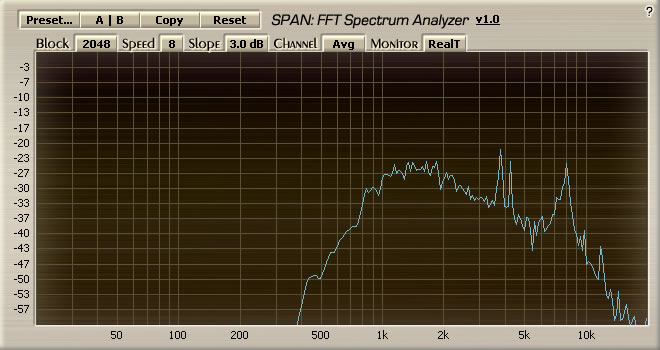
Here, peaks of 3.8 and 4.2k and 8k, occupation between 390 and sloping at around 3k. Depending on how loud this actually was, it would be necessary to adjust your other channels' EQ in the chain. Not just synths, I actually mean once it reaches the mixer channel so in the end that includes all sounds you are deploying in the mix itself. Also, you may have to probe your FX chain to discover which effect or property is causing the peak and analyze the end of your chain too, not right after the synth. If another channel with similar loudness is playing with even peaks, there would be mud right away. Try lowering the octave, or raising it, which will automatically make it a completely different frequency.
You will also want to try analyzing frequencies directly after the synth immediately after it on the chain (assuming you are not using the built-in VST effects). Synths (drums, sounds, etc) do have their own peaks, which is not a bad thing. Peaks are not bad. It is just where you have them, and whether conflict are occurring. Be careful of your Q when cutting. If you are addressing a peak, make a tight Q and deal with that issue you heard with your ears and saw on the spectrum. Being careful not to weaken any of the other frequencies that aren't involved in the issue is very important.
These aren't guidelines or rules or anything like that, just mere suggestion. Sound design is an art that takes years to understand, but being aware some fundamental basics will help you greatly if understood early on.
Last edited by Evolve140 on Jun-03-2011 at 22:56
|


