|
Sorry for the late reply … work is killing me.
| quote: | Originally posted by tecnolover
Without risk of getting into another long philosophical debate let me point out that speculating is pretty much what we have been doing this whole time. Baseless? Why on earth would you say that? Just because you hate the strong possibility that indeed Jefferson did get his idea of deity from a christian source? And again in your statement above you keep bringing up his anti christian writings which is irrelevant to this one point. This argument has in no way been refuted by you or Jefferson's writings and I have to admit I'm getting frustrated that you keep going in circular debate here without hearing what you are saying. Granted, I went off on a tangent with this little argument and I think where it sits is as far as we can go so therfore, I moved back closer to my main argument. That is all.
|
It’s baseless because in the light of Jefferson’s anti-Christian writings you have provided no sufficient counter-evidence that suggests that Jefferson did anything but reject Christianity and the supposed influences of Christianity. Look, I can only quote Jefferson so much … if you refuse to believe what the man writes than so be it. To be honest I’m not sure if a continuation of this argument will yield anything productive. You ultimately brought up this topic under the pretension of having strong evidence to support your theory of the nation being founded on Christian principles, particularly with respect to Thomas Jefferson. I think I have gone well out of my way to demonstrate how Jefferson was anything but Christian and many of the founding father’s were quite similar … if you choose to still believe otherwise than so be it.
| quote: |
How far do we want to go off here? Let me just say that your philosophical question of 'how did I/everything come to exist?' most certainly derives from empirical data. The mere idea of 'I' is learned from a perception is it not? You have to have a self awareness that you exist or think to you know there is 'I'. Mythology is the same. There is nothing that you imagine or think of that isn't founded from empirical data. Questions, pondering, thought itself all formed from empirical data. And ofcourse religion and existence of deity. Can you prove this is not the case? If so, please do! but maybe in another thread so we don't get too sidetracked.
|
While it may be the case that some concepts are derived from empirical data, you have, however, failed to illustrate how Jefferson’s religious beliefs were derived from Christianity or any other organized religion as opposed to philosophical sources for instance. All you pose is conjecture backed up by nothing. And while it is true that while my statements are conjecture as well, I’m am not putting forth the claim that Jefferson was influenced by Christianity and founded the nation on Christian principles as fact.
| quote: |
Jeez! You are by far the most stubborn of all the people I've encountered in this forum yet. Now you are trying to convince me that 'natures god' in Jefferson's writing didn't suppose a deity?! Give me a break! And stop referring to my statements as being anything more than deity. I never said that Jefferson was refering to the christian God. This was about Jefferson putting his deistic religious views in a political document. I really wonder if this is worth my effort. Maybe for others reading this but as for you, I'm convinced you will refute everything even when it's obvious you are BSing here.
|
I will admit that I cannot eliminate doubt that Jefferson made deistic references in the DOI. However, you consistentely referred to the notion of Jefferson founding the nation on Christian principles. Even if Jefferson made vague references to religion in the DOI, you then attempt to link this dubious reference to Christianity as a support of your argument that Jefferson founded the nation on Christian principles. There is no evidence to suggest as such whatsoever..
| quote: |
As far my evidence goes, the drafted document you showed which is the same as the one I have researched is the only FULL oringal draft by Jefferson. The oldest and first draft by Jefferson is only a fragment and contains only ideas. Oh, I did read all your source material ok. But I already knew about the fragment ok. Anyway, if it wasn't Jefferson's own correction, evidence is pretty strong that it was either Franklin or Adams that did. In either case it's there and put in by founding fathers.
|
Despite the fact that the original first draft was in fragments, this final first draft was definitively written by Jefferson. It assuredly was not originally written with the word “creator” in it. And the overwritten word creator was not Jefferson’s handwriting. Furthermore, it was likely not Adam’s input since the handwriting was not his and his views towards religion were even more antagonistic than even Jefferson. It could have been Franklin. I cannot refute the fact that it is in the DOI however, and that some of the founding father’s were of religious inclination, however, I stand by my statement that Jefferson, one of the principal founding father’s did not intend to put it in the DOI. Furthermore, quite a number of additional founding father’s shared Jefferson’s distaste towards religion as evidenced by the fact that many of the founding father’s were accused of atheism by fundamentalists at the time.
| quote: |
Yes, I'm aware that my original argument was about christianity and the foundation of our gov. I have not forgot this. But there are a few other arguments going on here and they all relate to each other. Pariculary the argument that politics and religion (namely christianity) are not part of US government.
|
I feel that we’re beginning to lose sight of our original arguments as we delve deeper into the specifics. I should summarize my argument to say that I don’t believe that the country was founded on the basis of atheism or that the founding father’s were atheist. Many of the founding father’s were deists, and some religion was associated with the construction of our country. If you modify your argument to say that elements of Deism, or some tenets of religion, were incorporated in the foundation of our country, I might be more amenable to your argument. However, to make the statement that this country was founded as a Christian nation or that the founding father’s intended it to be as such, is a blatant falsehood. Many of the founding father’s were openly critical of Christianity, and were skeptical of a religious state. Whatever concessions Jefferson may have made in the DOI to include the basic concept of some kind of a god, he made quite clear that he thought the government should remain distinctly separate from religion as evidenced by his writings upon which the establishment clause was derived:
| quote: |
To messers Nehemiah Dodge, Ephraim Robbins, & Stephen S. Nelson, a committee of the Danbury Baptist association in the state of Connecticut.
Gentlemen
The affectionate sentiments of esteem & approbation which you are so good as to express towards me, on behalf of the Danbury Baptist association, give me the highest satisfaction. my duties dictate a faithful & zealous pursuit of the interests of my constituents, and in proportion as they are persuaded of my fidelity to those duties, the discharge of them becomes more & more pleasing.
Believing with you that religion is a matter which lies solely between man & his god, that he owes account to none other for his faith or his worship, that the legitimate powers of government reach actions only, and not opinions, I contemplate with sovereign reverence that act of the whole American people which declared that their legislature should make no law respecting an establishment of religion, or prohibiting the free exercise thereof, thus building a wall of separation between church and state. [Congress thus inhibited from acts respecting religion, and the Executive authorised only to execute their acts, I have refrained from presenting even occasional performances of devotion presented indeed legally where an Executive is the legal head of a national church, but subject here, as religious exercises only to the voluntary regulations and discipline of each respective sect.] Adhering to this expression of the supreme will of the nation in behalf of the rights of conscience, I shall see with sincere satisfaction the progress of those sentiments which tend to restore to man all his natural rights, convinced he has no natural right in opposition to his social duties.
I reciprocate your kind prayers for the protection and blessing of the common Father and creator of man, and tender you for yourselves and your religious association, assurances of my high respect & esteem.
(signed)
Th Jefferson
Jan.1.1802.
http://www.constitution.org/tj/sep_church_state.htm
|
| quote: |
Just because Jeff/franklin or Adams introduced other mythological ideas also does not justify the other. What kind of rationale is that?! The point is that all are unacceptable in gov if we are to follow a priciple of separation of religion, mysticism, metaphysics and government. That is why your counter example is meaningless and irrelevant justification and it only serves to bolster my point more.
|
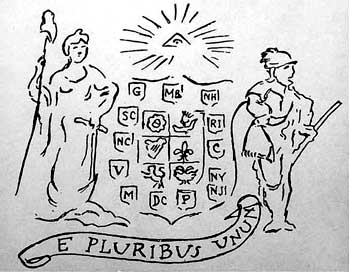
Huh? It bolsters your point more? Look, my argument is not that the founding father’s were on some kind of agenda to eliminate all references to religion from everything that they do. My argument is to refute your statement that these allegorical references to one particular religion is conclusive evidence to show that the founding father’s bore some inclination to this religion and thus intended the country to be founded upon that religion. If that were the case than one could irrationally conclude that since Jefferson/Franklin/Adams made similar allegorical references to Greco-Roman mythology, than they must have bore an inclination towards Paganism and intended that the country be founded on the tenets of Pagan religion. The logical rationality is that they simply made allegorical references to Greco-Roman mythology as they similarly did with Christianity.
| quote: |
FYI-the writing they submitted on the seal 'resistance to tyrants is obedience to God' was none other than Johnathan Mayhew's original concept which was preached in one of the most influential christian sermons of american history. The idea that christians were to resist tyranny. They not only used biblical characature but used a moto that was blatantly in reference to Mayhews concept. They were trying to spur the revolution with christian creed or ideas. why? because obviously the majority of the citizens were christian and to propose it as a national seal shows the incredible strength and popularity of christianity of the day. You aren't fooling anyone Occrider. Certainly not myself and hopefully not others who may be less inclined to research US history.
The revolutionary period in particular was chock full of a mix of gov and christianity and if you really want to seriously try to refute this then get ready for a whole slew of evidene that you can spend your next lifetime trying to refute Occrider. Matter of fact why don't you just rewrite US history according to Occrider while your at it. No. nevermind. because you probably will seriously try and I don't have the time or patience to hear all your rhetoric. I'll just post it in my final conclusions paper which is almost finished as a lot of the evidence and sources are in there.
|
For one so inclined to research US history, I would expect you to properly research some of the blatant misfalsehoods you have presented as fact such as “Washington’s prayer to valley forge” or his reference to “God and Bible” in his farewell speech  . I’ve taken the time to research every one of your statements so I would appreciate it if you refrain from accussing me of being ignorant to US history. Just as a minor technicality, “resistance to tyrants is obedience to God” did not originate from Jonathan Mayhew, but rather was uttered by John Bradshaw: . I’ve taken the time to research every one of your statements so I would appreciate it if you refrain from accussing me of being ignorant to US history. Just as a minor technicality, “resistance to tyrants is obedience to God” did not originate from Jonathan Mayhew, but rather was uttered by John Bradshaw:
http://www.bartleby.com/66/30/8130.html
Yes they considered using allegorical Christian images and phrases as they did with similar images and latin phrases from Greco-Roman culture ... the fact that they rejected all Christian images and phrases in favor of Greco-Roman mythology take as you will. However, nothing suggests that their brief flirtation with Christian images and phrases were in any way an endorsement of Christianity or anything but allegorical references for symbolism. If it holds true that references to Christian images and phrases is an endorsement of Christianity, than why does it not hold true that references to images and phrases from Greco-Roman mythology constitutes an endorsement of Roman mythology??? Clearly a case of selective reasoning.
| quote: |
Anti-christian? Granted some were deists but anti-christian I don't think so. That is much to harsh. From the research I have about Adams and Madison they shifted their ideologies throughout time. It appears they were not exactly grounded in one religious dogma.
|
Perhaps you are correct in that labeling them all as anti-Christian is too harsh. While it seems quite clear that Jefferson was indeed anti-Christian, the same cannot be said with similar certainty of the rest. Adam’s was clearly against Catholicism, and shared similar doubts of the Christian religion as Jefferson:
As I understand the Christian religion, it was, and is, a revelation. But how has it happened that millions of fables, tales, legends, have been blended with both Jewish and Christian revelation that have made them the most bloody religion that ever existed?
-- John Adams, letter to F.A. Van der Kamp, December 27, 1816
Indeed, Mr. Jefferson, what could be invented to debase the ancient Christianism which Greeks, Romans, Hebrews and Christian factions, above all the Catholics, have not fraudulently imposed upon the public? Miracles after miracles have rolled down in torrents.
-- John Adams, letter to Thomas Jefferson, December 3, 1813, quoted from James A. Haught, ed., 2000 Years of Disbelief
Cabalistic Christianity, which is Catholic Christianity, and which has prevailed for 1,500 years, has received a mortal wound, of which the monster must finally die. Yet so strong is his constitution, that he may endure for centuries before he expires.
-- John Adams, letter to Thomas Jefferson, July 16, 1814, from James A. Haught, ed., 2000 Years of Disbelief
I do not like the reappearance of the Jesuits.... Shall we not have regular swarms of them here, in as many disguises as only a king of the gipsies can assume, dressed as printers, publishers, writers and schoolmasters? If ever there was a body of men who merited damnation on earth and in Hell, it is this society of Loyola's. Nevertheless, we are compelled by our system of religious toleration to offer them an asylum.
n John Adams, letter to Thomas Jefferson, May 5, 1816
Can a free government possibly exist with the Roman Catholic religion?
n John Adams, letter to Thomas Jefferson, May 19, 1821, from James A. Haught, ed., 2000 Years of Disbelief
The priesthood have, in all ancient nations, nearly monopolized learning.... And, even since the Reformation, when or where has existed a Protestant or dissenting sect who would tolerate A FREE INQUIRY? The blackest billingsgate, the most ungentlemanly insolence, the most yahooish brutality is patiently endured, countenanced, propagated, and applauded. But touch a solemn truth in collision with a dogma of a sect, though capable of the clearest proof, and you will soon find you have disturbed a nest, and the hornets will swarm about your legs and hands, and fly into your face and eyes.
-- John Adams, letter to John Taylor, 1814, quoted in Norman Cousins, In God We Trust: The Religious Beliefs and Ideas of the American Founding Fathers (1958), p. 108, quoted from James A. Haught, ed., 2000 Years of Disbelief
What havoc has been made of books through every century of the Christian era? Where are fifty gospels condemned as spurious by the bull of Pope Gelasius? Where are forty wagon-loads of Hebrew manuscripts burned in France, by order of another pope, because of suspected heresy? Remember the Index Expurgato-rius, the Inquisition, the stake, the axe, the halter, and the guillotine; and, oh! horrible, the rack! This is as bad, if not worse, than a slow fire. Nor should the Lion's Mouth be forgotten. Have you considered that system of holy lies and pious frauds that has raged and triumphed for 1,500 years.
-- John Adams, letter to John Taylor, 1814, quoted by Norman Cousins in In God We Trust: The Religious Beliefs and Ideas of the American Founding Fathers (New York: Harper & Brothers, 1958), p. 106-7, from James A. Haught, ed., 2000 Years of Disbelief
God is an essence that we know nothing of. Until this awful blasphemy is got rid of, there never will be any liberal science in the world.
-- John Adams, "this awful blashpemy" that he refers to is the myth of the Incarnation of Christ, from Ira D. Cardiff, What Great Men Think of Religion, quoted from James A. Haught, ed., 2000 Years of Disbelief
Numberless have been the systems of iniquity The most refined, sublime, extensive, and astonishing constitution of policy that ever was conceived by the mind of man was framed by the Romish clergy for the aggrandizement of their own Order They even persuaded mankind to believe, faithfully and undoubtingly, that God Almighty had entrusted them with the keys of heaven, whose gates they might open and close at pleasure ... with authority to license all sorts of sins and Crimes ... or withholding the rain of heaven and the beams of the sun; with the management of earthquakes, pestilence, and famine; nay, with the mysterious, awful, incomprehensible power of creating out of bread and wine the flesh and blood of God himself. All these opinions they were enabled to spread and rivet among the people by reducing their minds to a state of sordid ignorance and staring timidity, and by infusing into them a religious horror of letters and knowledge. Thus was human nature chained fast for ages in a cruel, shameful, and deplorable servitude....
Of all the nonsense and delusion which had ever passed through the mind of man, none had ever been more extravagant than the notions of absolutions, indelible characters, uninterrupted successions, and the rest of those fantastical ideas, derived from the canon law, which had thrown such a glare of mystery, sanctity, reverence, and right reverend eminence and holiness around the idea of a priest as no mortal could deserve ... the ridiculous fancies of sanctified effluvia from episcopal fingers.
-- John Adams, "A Dissertation on the Canon and the Feudal Law," printed in the Boston Gazette, August 1765
Twenty times in the course of my late reading have I been on the point of breaking out, "This would be the best of all possible worlds, if there were no religion in it!!!" But in this exclamation I would have been as fanatical as Bryant or Cleverly.
n John Adams, quoted from Charles Francis Adams, ed., Works of John Adams (1856), vol. X, p. 254
As for Franklin, I wouldn’t label him as anti-Christian, however, he did solidly reject it:
I have found Christian dogma unintelligible. Early in life I absented myself from Christian assemblies.
-- Benjamin Franklin, quoted from Victor J. Stenger, Has Science Found God? (2001)
If we look back into history for the character of the present sects in Christianity, we shall find few that have not in their turns been persecutors, and complainers of persecution. The primitive Christians thought persecution extremely wrong in the pagans, but practiced it on one another. The first Protestants of the Church of England blamed persecution in the Romish Church, but practiced it upon the Puritans. These found it wrong in the bishops, but fell into the same practice themselves both here and in New England.
-- Benjamin Franklin, An Essay on Toleration
"But the most dangerous Hypocrite in a Common-Wealth, is one who leaves the Gospel for the sake of the Law: A Man compounded of Law and Gospel, is able to cheat a whole Country with his Religion, and then destroy them under Colour of Law: And here the Clergy are in great Danger of being deceiv'd, and the People of being deceiv'd by the Clergy, until the Monster arrives to such Power and Wealth, that he is out of the reach of both, and can oppress the People without their own blind Assistance."
-- Benjamin Franklin, quoted in The New England Currant (July 23, 1722), "Silence Dogood, No. 9; Corruptio optimi est pessima."
| quote: |
Relax! I threw those in just to stir you up a bit. I wasn't using them as evidence. I don't know the context any more than you do. I don't think I added the source link either so it wasn't to be argued.
|
I see, thank you for letting me know that many of your future posts will contain irrelevant arguments designed to simply “stir” people up.
| quote: |
Yes, please. Any URL's? Mulitple sources please. I would be quite interested in finding out. I have always thought Lincoln was very strong christian. Perhaps I was wrong. That is always a possiblity. peace. warning to time to proof read/spell check.
chau. |
Sure, a lot of opinions and accounts are compiled here:
http://www.infidels.org/library/his...hapter_5.html#1
___________________
Retro ...

|


 Christianity and the foundation of US gov.