|
recent interview.. looks like he will be playing with Rob Hood in NYC! 
Steve Rachmad is known the world over as a multi-talented producer and DJ from the Netherlands. Hailing from the city of Amsterdam he has garnered an excellent reputation for his deep, groovy soundscapes that tend to rest on impressive strings, melodies, funk and soul. Although he is probably best known for his techno-oriented music, electro and disco have guest appearances on the musical menu, adding to the overall diversity of his oeuvre.
With his first gig at the age of a teenager in a small Amsterdam club, it fed a deeper love for music that would later result in Steve's eye for quality, countless stage appearances and before we forget, his massive collection of analogue gear.
His career picked up speed as of 1996 and has been booming since, with a string of major performances and a steady stream of releases and remixes among which his respected album Secret Life of Machines, which came out in 1996 under his pseudonym Sterac. 2006 is most certainly promising, with still a lot in the works as releases on influential imprints such as Get Physical and Music Man are scheduled for release in the world's freshest year thus far.
365mag.com paid a special visit to the house of Mr. Rachmad himself, to discuss what it feels like to have 25 years in music behind, and more importantly, what it takes to stay fresh, warm and inspired during the next two decades.
First of all, my congratulations on 25 years of involvement in music; how have you determined the start?
I usually start counting from the moment that I was able to mix my first tracks, that's actually a while ago...
And mixing, how did you decide to do that, it was probably not as common back then as it is today?
I used to listen to the Dutch radio at that time, which would broadcast end of the year mixes by the likes of Ben Liebrand and Rutger Kroese, summarizing that year's best releases. Programs like Bond van Doorstarters as part of Soulshow inspired me to delve into the world of mixers and cassette decks. At first, the mixing appeared more complex than I had anticipated, and I started to experiment a bit with a record player without pitch control and a simple mixer with only gain controls for each channel. These experiments led me to my first mix, and taught me the turntable trickery I would later use so often in my DJing.
Do you come from a musical family?
Well, my parents did not play musical instruments themselves, and I have never received any musical schooling, which I sometimes regret, so not really. I have picked up mixing and producing completely by myself, simply because I got the interest.
Speaking of production, do you have any clue how many records you have produced over the years?
I estimate approximately a hundred releases, and something like 75 remixes overall, but I might have lost count somewhere.
Wow, that is quite a substantial output per year! When did you release your first track?
Well, I actually started releasing tracks in the early years of the nineties. Before, I simply did not have the means to buy the necessary equipment to record my own tracks. It was not a matter of unwillingness, I was just a young kid, with no cash for a full fledged, hardware based studio, and in fact I could only record mix-tapes at my home.
In the past two and a half decades you have left your mark on the music scene by exploring the borders of techno. How would you describe your own sound?
That is a difficult question. I have always listened to a lot of music, and have put out a diverse spectrum of sounds. I started listening in the 80's, when disco, swing beat and the wave were popular and that's where my main inspiration comes from. Half way to the 80's I switched to house and electro, whilst most people involved in disco switched to swing beat. I still derive a lot of my inspiration from this period.
But, back to my question...your sound?
Well, it is not like my productions are all crafted with the same direction in mind, I only aim for a certain timelessness, coupled with warmth. What I really like about some records, is that they stay fresh. Some records have something about them so that it really doesn't matter whether it was produced ten, five or two years ago, whilst others lose it after two or three months of intensive usage. I aim for this timelessness myself, but that is not always possible, and very hard to predict.
You have left your impression on the world through a deluge of different aliases: Sterac, Parallel 9, just to name a few. Where did this urge come from?
Well first of all, the choice emanated from the labels that wanted to have exclusive rights to use a certain name, especially in the nineties this was really important. I didn't want to have an exclusive contract, as many labels are linked to certain styles, whilst my style simply depends on my mood. I might wake up ready to work with samples, while at another moment I prefer synthesis or sequencing. If I would only be doing raw loopy stuff, I could never have stayed in for so long.
Is it perhaps also a matter of modesty, as you made it difficult for people to recognize the fact that you were behind so many releases?
Well, not really, in fact I sometimes regret it, as people like for example Surgeon are always recognizable by the same name on the releases. In my time it simply was a tool to release on multiple imprints and within different genres of music.
Speaking of different names your titles have relatively far-fetched names, where do they come from?
I have always had a bit of a struggle with finding suitable titles, and sometimes think I would rather release without a name. When I would be making my way through the city of Amsterdam, I would note down all kinds of things that attracted my attention, or looked interesting. Later, I would look back, and pick the name that seemed most applicable. It rarely happens that I produce a track and think of a name while producing.
Although you have released on a plethora of labels, you have also started three labels of your own: Scorp, Ion and Interpersonal Experience, the latter being reserved for electro. Can you tell us a bit more about them?
It was more of a trial, as I was not looking for a label when Rush Hour, a label and record store in Amsterdam, approached me for a label among their 'family'. I was flattered by the request, and actually thought why not? However, instead of opting for another techno label, which would have been the most logical choice, I decided to choose a more electro oriented outlet, as a fresh incentive to force me to actually produce and release in this genre.
How does a label seduce a man like you, Steve?
The Dance scene sometimes seems to be dominated by people that call you and say: "hey, nice record, do you want to release on our label as well?" Then you wait, and you hear nothing from them anymore. After so many years within the industry I have had it with this attitude. I prefer people that really know what you are doing, and show a sincere interest in why you are doing it. At Music Man I have found such genuine interest, the people seem to operate on the same frequency. Apart from that, they will pay you in time and in accordance to what you have agreed upon, something, which is also a bit of a hassle sometimes.
How did you end up producing?
Rutger Kroese took me to a big studio once. He was technician of Bolland and Bolland, very influential Dutch producers at the time. I have seen many studios since, as I visited Jochem Fluitsma's and Erik van Tijn's production pad, among others. Ever since, I have had a love for professional studios, fat tape decks and other heavy gear. I am convinced that it has shaped my sound. Software synths don't appeal to me yet, as I still see added value in hardware. The idea, of basically working from a small screen with a mouse, simply doesn't attract me.
The acquisition of a Roland 808 drum machine was said to form the cornerstone of your studio, is this still the case?
I bought the 808 back in 1985 from the money I had made as a paper boy. In fact, it was my first piece of gear, and that's probably why it used to be so important to me, as production simply started there. I bought it since the SOS band owned one, and Marvin Gaye used one in his epic Sexual Healing. Techno and house didn't exist at that time, they came later. House has made it easier to get started. In the past it was really a matter of composing a singer-songwriter track, with a clear, ballad like structure. In my first productions you can actually hear my background in singer-song writing
1985 is quite a while back, what gear has been inspiring you since?
Well, there is a company called Elektron hailing from Sweden and they have really introduced interesting hardware. I use a Sidstation, a synthesizer on the basis of the Commodore 64 sound chip, a Mono machine (synh-sequencer) and a Machine drum, which is essentially a drum synthesizer. Frankly, these machines combine the sound of the past with the technology of today, really adding to the sonic possibilities, to the extent that you can get lost in the possibilities. But things from the past, like the Minimoog, are still fantastic as well. My gear history is telling though, as I have never sold a piece of gear in my whole life. I just buy it when I am sure about it.
All these machines together, don't you think it is too much sometimes?
In the past I was forced to combine three or four machines, now I have to choose. I remember really knowing my way around the few pieces of gear I owned back then. Now, this is hardly possible, as many synths resemble each other, but differ in the details. That can be a bit of a hassle sometimes.
What is your view on other people using computers?
Well, it is an instrument, which can be played properly or not, like any other instrument. There are people that simply master it, just as well as there are producers that miss out. Some releases really sound cold to me, which is a pity.
Any examples of somebody, who is doing well lately?
Monolake, the founder of Ableton seems to nail it lately, as I really like his Polygon Cities release.
After being in the scene for 25 years, many things must have evolved into a certain routine. Isn't that tiresome from time to time?
Well, it is the intrinsic love for music that drives me, anything else simply wouldn't work. I find it surprising, how some DJs exchange one style of music for another at the split of a second, that doesn't point in the direction of a true love, music wise. I would never want to say, for instance, never to spin techno anymore. It's a matter of the heart.
Any other aspects that have changed?
I used to be quite nervous in the past. Of course, things become a routine, but there are always places that are scary. Especially when somebody is playing completely different music just before you have to play, it can be nerve wrecking. But that is a universal law, as I have seen even the likes of Richie Hawtin getting nervous about a crowd that apparently had not been bitten by the minimal bug yet.
Generally speaking, I find DJing more difficult over time. The travelling, the lack of sleep, the airplanes, I simply will not keep on doing this forever. Perhaps we were born too early; I am still waiting for the machine that can transport me from A to B in an instant. Being successful as a DJ takes its toll on the production. It basically means that you have to catch up during the week, with the chance of hearing issues, as ears need time to recover. I would love to spend just some more time in the studio.
What projects are planned for 2006?
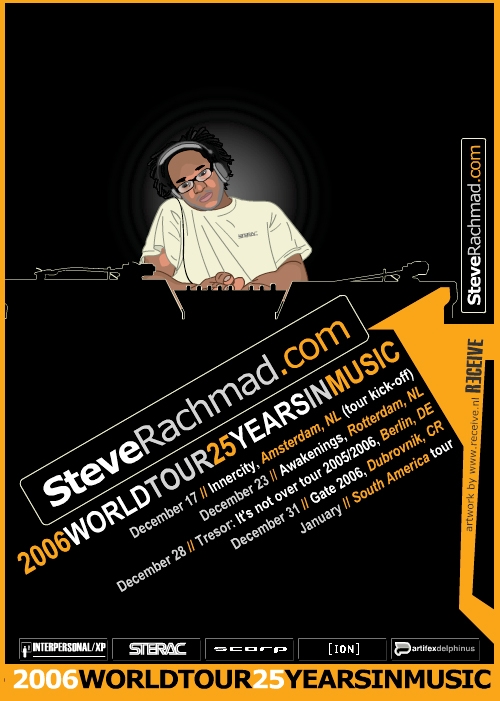
My world tour started at Amsterdam's Innercity event in December last year, with stops in Moscow, Belfast in February, Dublin, Barcelona, Santiago de Compostella and Madrid. South American, Asian and Australian dates are still to be confirmed.
For me Japan offers the ultimate DJ experience. The people are simply more open than anywhere else. I was once booked for a gig with the famous Towa Tei, well known for his involvement in the Deee-Lite outfit, famous for Groove is in the heart amongst others, hammering hip hop and garage. I expected a disaster, but the people went mad, even more so than before. Try the same over here in the Netherlands, and one of the two DJ's will have a bad gig.
Is there something wrong with the Netherlands?
Well, if you have a look at the artists that have visited the place, many people are likely to have seen so much, which makes it seem like it doesn't really matter anymore. When you go to Belgium for clubbing, there is already a lot of difference, which I find a pity.
Is it a European problem?
It surely isn't, as there are many countries that are simply rocking it, for instance Belgium, some places in Spain, but also Scotland, and my absolute favourite: Dublin in Ireland. The venues are usually very small, often somewhere between 150 and 300 people but the crowd simply goes mad, unlike anywhere else!
And, your plans in terms of releases?
Oh, there are so many things in the making. My electro album, as Sterac Electronics, a release on Get Physical, so finally I am catching up speed again.
Finally?
Well, I have moved my studio recently, and I bought myself a brand new mixer. But, although many of my colleagues use the same machine to critical acclaim, it simply didn't work for me. I got back my massive, old Soundcraft, which does have the warmth I am looking for. I simply got the idea that it influenced the quality of my productions. They were ok, but not well enough.
Do you have a top five?
Well, I usually don't give out top fives, because it simply doesn't work like that for me.
In my realm of music, I find it hard to find records that hit the spot. Many things I like are part of a different genre, or simply don't match my profile. Producers are looking for direction it seems, as many colleagues have the same problem. I don't follow the new minimal genre of music, opposed to its Detroit original, it's not like I embrace it. It will be big for another two, three years, before it will pass away again.
___________________
my site featuring news, interviews, techno events...
www.katemanus.net
|