|
Public Transit: BRT and LRT vs. Subway
there has been some discussion on transit in the last couple of weeks due to the mayoral elections. some of you believe a subway is a good way to spend money on transit and some don't know that there is another alternative, and if they do, they don't know enough about it. here is some info comparing LRT and BRT to the subway.
| quote: | Which proposal looks sexier: a Toronto-wide network of BRTs and LRTs (first map) or the Spadina subway extension (second map)?

POTENTIAL FUTURE BRT/LRT NETWORK (via page 31 of the City of Toronto & the TTC’s Transit City report)
Estimated total cost: $1.5 billion (rough estimate)
Estimated ridership growth: 80 million new riders by 2016 (conservative estimate)
OR

SPADINA SUBWAY EXTENSION
Projected total cost: $2.1 billion
Estimated ridership growth: 30 million new riders by 2021
The expensive and inefficient Spadina subway extension doesn’t address the diverse and urgent transportation needs of Toronto, and does little to enhance the quality of life for all Torontonians.However, a massive city-wide BRT/LRT network is a huge step in the right direction.
Imagine a network with lines on:
- Kingston (at Lawrence), along Lakeshore Blvd. to The Queensway (at South Kingsway)
- Queen St. (from Dufferin to Coxwell. Admittingly, this would be difficult to implement)
- King St. (from Dufferin to Queen St. East. This would also be difficult to implement)
- Dundas St. West (from Kipling Station into Mississauga)
- St. Clair West (from Jane to Yonge)
- Eglinton (from Renforth to Kingston)
- Lawrence East (from Don Mills to Kingston)
- Lawrence West (from Jane to Lawrence West Station)
- Sheppard East (from Don Mills to Scarborough Town Centre and then to Markham Road)
- Sheppard West (from Allen to Yonge)
- Finch Hydro Corridor (although the feasibility of a hydro corridor line is questionable. It should be on Finch Ave. instead)
- Jane (from Bloor to Steeles)
- from Downsview Station to York University and then to Steeles (staggered configuration)
- Yonge (from Finch to Steeles)
- Don Mills (from Danforth to Steeles)
- McCowan (from Scarborough Town Centre to Sheppard)
1 - It’s the smart choice:
BRT’s and LRT’s are better suited to our current suburban areas because of their densities and design, as opposed to a subway which grossly exceeds current and projected capacity needs. BRT’s and LRT’s will help establish future transit riding patterns and better land use.
2 - Increases efficiency and attractiveness of public transit:
By taking buses and streetcars out of mixed traffic, their speed and reliability is greatly enhanced. This helps public transit become a more attractive alternative to the car.
3 - Cost is relatively low:
(Note: these numbers are for general comparison only, as each specific line would have different construction variables leading to different costs)
BRTs are approximately $20 million/km.
LRTs are approximately $40 million/km.
Subways are approximately $200 million/km.
4 - Relatively short time span for implementation:
an LRT/BRT line will take approximately 5 years to build
a subway line will take approximately 10 years to build
5 - Helps a large number of people over a large area:
See potential future BRT/LRT network map above.
6 - Addresses a wide-range of interrelated issues:
Economics: job creation, raises property values, increases Toronto’s competitiveness and attractiveness, generates more revenue from increased ridership, addresses the GTA’s estimated loss of $1.8 billion due to congestion
Social issues: less travel time = more personal time, assists in community building, raises civic pride, better mobility, establishes transportation equality, better quality of life in Toronto
Health and the environment: less cars = less smog, less wasted fuel, eases reliance on oil, less driving related stress
Urban planning: the potential for better land use patterns and higher densities along transit lines becomes easier to achieve, less gridlock, stronger public transit with more riders, fulfills some of the ideals of the City’s Official Plan
Psychological issues: addresses the transit dichotomy between the suburbs and the city centre/core. For the suburbs, transit becomes the “smart choice” as opposed to the “last choice”
7 - Addresses current problems:
Inadequate public transit in the inner and outer suburbs, massive gridlock, worsening air quality, long commuting times
8 - Addresses future problems:
Population growth in the GTA estimated to be an additional 3 million people in the next 30 years
The Spadina subway extension does relatively little to enhance transportation in Toronto. The extension is not completely devoid of merit, but its total benefit pales in comparison to a city-wide BRT/LRT network.
The BRT/LRT network makes sense transit wise, cost wise and planning wise. Unfortunately, it doesn’t make sense politically.
The Ontario Provincial government are major supporters of the Spadina subway extension, especially Finance Minister Greg Sorbara. (It must be noted that the Spadina subway extension will stop at the City of Vaughn’s new corporate centre, which just happens to be located in the riding of Vaughn-King-Aurora. Who is the MPP for Vaughn-King-Aurora? You guessed it: Greg Sorbara. He was also affiliated with a development firm that owns many properties near the Vaughn corporate centre. The name of that company: The Sorbara Group)
Mayor David Miller supports the Spadina subway extension, more as a political sop to Sorbara and the Provincial Liberals then as sound transit planning. He’s stated several times that building subways are too expensive, while simultaneously promoting a smaller version of the BRT/LRT network displayed above.
The problem with supporting both projects is that subway construction takes up so much money and time, it threatens to push any serious discussion of a BRT/LRT network (or for that matter the urgent need to buy hundreds of new buses, as well as replace and expand our streetcar fleet) off the table.
If our past experience is any indicator, we are wrong to think that there is enough money to do both projects in the timeframe needed to address massive gridlock, ridership growth, population growth and the quality of life in Toronto.
Unfortunately, many of Toronto’s mainstream and independent media outlets have a defeatist attitude towards public transit, LRT technology in particular. They describe LRT as “uninspiring” and “nothing new”. LRT has never been given a fair chance in Toronto, so if our urban affairs writers don’t seriously discuss all of Toronto’s transit options, then the majority of citizens will continue to think that “improved transit” must mean new subways. True, if you discuss LRT as individual lines, the grand scheme is hard to grasp. That’s why it has to be discussed in terms of a city-wide network in order to galvanize citizens.
Instead of taking David Miller to task for his support of the Spadina subway extension, and challenging him to stand up for all of Toronto, they justify his political pandering to the Provincial government as a trade-off for potential future benefit.
We’ve made too many big-ticket transit mistakes in the last 20 years because of the politicization of transit: building the Scarborough RT, scrapping the Eglinton subway and building the Sheppard subway. Toronto has suffered greatly, in part, due to these terrible mistakes. Building the Spadina subway extension is a continuation of that sad legacy. |
SOURCE
and here is some info on the differences between the 3 types of transit.
| quote: | With all of the recent discussion surrounding transit policies, subway extensions and streetcar rights-of-way, a brief primer on transit technologies seems to be in order. With all of the acronyms that are thrown around in transit discussions, it’s easy to understand why voters may not know the difference between a BRT and a BLT (a BLT is the only one you can eat). Remember that all of the different transit modes, from the local bus route to the commuter rail line, has its own place within a successful public transit system.
WHAT IS A BRT?

(image via the San Francisco County Transportation Authority)
Bus rapid transit (BRT) can be implemented relatively quickly and inexpensively. The major components of BRT’s are:
- buses running in their own lane so that they do not compete with other forms of traffic (can be physically separated lanes that run down the middle of the road)
- by taking buses out of mixed traffic, you can increase speed, predictability and reliability
- traffic signal priority so that buses spend less time at red lights
- approximate capacity of 5000 people/hour (based on 60 foot articulated buses running at 60 buses/hour)
- approximate construction cost of $20 million/km*
For a brief BRT simulation, check out Phase 2 of VIVA’s System Phases.
WHAT IS AN LRT?
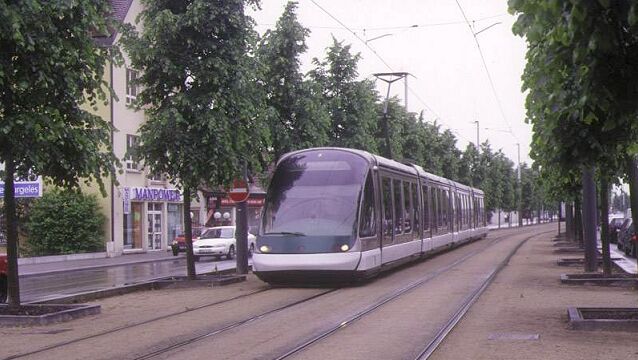
(image of an LRT in Strasbourg, France via lightrailnow.org)
Light rapid transit (LRT) is a distant cousin of the subway, but is much cheaper to implement. It’s a versatile mode of transit that can run on the street, in a separate lane down the middle of the road, in a completely protected right-of-way or in shallow tunnels. In the Toronto context, LRT’s would most likely run in some mixture of separate lanes down the middle of the road (like Spadina or St. Clair) or shallow tunnels. (Note: the Scarborough RT is not an LRT.)
- LRT’s typically involve new style streetcars that are accessible via low floors. Some new streetcars can also be driven from the front and back, eliminating the need to turn around
- by taking LRT’s out of mixed traffic, you enhance speed, predictability and reliability
- LRT’s should have traffic signal priority, which reduces the amount of time they spend waiting at red lights
- LRT’s are environmentally friendly
- LRT stations are simpler and less costly then extravagant subway stations
- LRT’s are more versatile then subways in terms of geographic constraints
- perceived as a more attractive mode of transit then buses, asthetically and in the minds of riders
- approximate capacity is 9000 people/hour (based on two-car trains with 300 riders, running at 30 trains/hour. However, capacity can be easily increased with three-car trains)
- approximate construction cost of $40 million/km*
Check out Hampton Roads Transit’s (Virginia) short LRT simulation video
WHAT IS A SUBWAY?

(image of the classic Gloucester TTC subway car via Gloucestershire transport history)
A subway is a high capacity transit mode which must run on a protected right of way. Subways are best suited to areas with a high density mixture of homes, jobs, schools, recreation, entertainment and shopping facilities.
- approximate capacity of 40,000 people/hour (based on 6-car trains with appropriate signalling and operational time b/w trains)
- approximate construction cost is $200 million/km*
*NOTE: cost is for general comparison only. Inflation has changed cost/km figures over time and each individual line would have different construction variables, leading to different costs.
|
SOURCE
___________________
Deviant Art - Smuncky
My Photos on Flickr
If anyone wants to share their clubbing/nightlife pics go to Toronto Nightlife
"The best car-related innovation we have is not to improve the car, but eliminate the need to drive it everywhere we go.” -Alex Steffen
|