Become a part of the TranceAddict community!Frequently Asked Questions - Please read this if you haven'tSearch the forums
TranceAddict Forums > DJing / Production / Promotion > DJ Booth > Music Theory
Pages (2): [1] 2 »   Last Thread   Next Thread
Share
Author
Thread    Post A Reply
agentdansmith
Supreme tranceaddict


Registered: Sep 2003
Location: Cannock, UK
Music Theory

I've been using the Camelot system for the last 10 months to help me mix harmonically, but after reading a lot lately about how it is much better to just learn the proper notes, I thought it was time that I moved to the next level

I'd like to see what key a tune is in and know straight away what other keys will compliment that.

So to those that use this method, are there any good sites that I can visit that will help teach me this? Are there any decent books that will teach me this?

Ta


___________________
::::: DjTrig.Com :::::
Afterward - July 2009 Mix

Old Post Jul-26-2007 08:22  United Kingdom
Click Here to See the Profile for agentdansmith Click here to Send agentdansmith a Private Message Visit agentdansmith's homepage! Add agentdansmith to your buddy list Report this Post Reply w/Quote Edit/Delete Message
Stu Cox
Supreme smackaddict


Registered: Mar 2003
Location: Southampton, UK

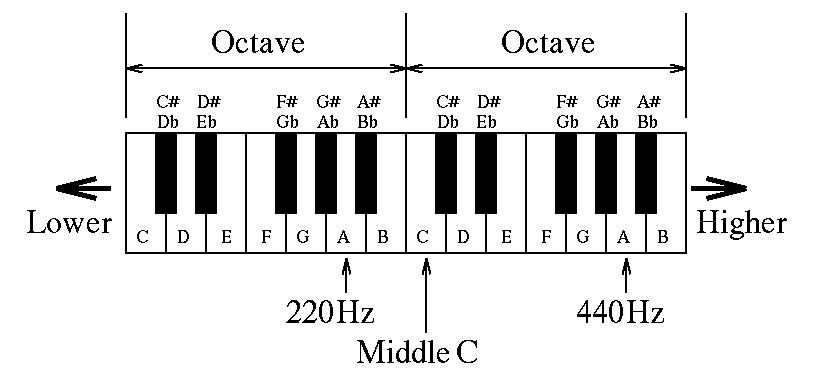
Given a nice little keyboard to work from:


The 'standard' intervals you can use are the tonic (same note), major 4th (5 semitones up) and major 5th (7 semitones up)...

So from Cm you've got Cm, Fm and Gm
From Ab (for example) you've got Abm, Dbm and Ebm

And so on

Then the relative minor (if you're in a major key) is the major 6th (9 semitones up)...

So from Cm it's Amaj
From Abm it's Fmaj

And the relative major (if you're in a minor key) is the minor 3rd (3 semitones up)

So from Cmaj it's Ebm
From Abmaj it's Bm


Then you can just transpose that across the whole scale.


After a bit of practice, you'll be able to look at two keys and know straight off without counting if they'll work (according to the rules)


___________________
Stu Cox |

Old Post Jul-26-2007 09:01  United Kingdom
Click Here to See the Profile for Stu Cox Click here to Send Stu Cox a Private Message Visit Stu Cox's homepage! Add Stu Cox to your buddy list Report this Post Reply w/Quote Edit/Delete Message
agentdansmith
Supreme tranceaddict


Registered: Sep 2003
Location: Cannock, UK

Thanks for that Stu. Are the majors the black keys and the minors the white keys?

I don't know what most of what you just said means so I think I need to start learning from a lower degree.


___________________
::::: DjTrig.Com :::::
Afterward - July 2009 Mix

Old Post Jul-26-2007 09:19  United Kingdom
Click Here to See the Profile for agentdansmith Click here to Send agentdansmith a Private Message Visit agentdansmith's homepage! Add agentdansmith to your buddy list Report this Post Reply w/Quote Edit/Delete Message
Stu Cox
Supreme smackaddict


Registered: Mar 2003
Location: Southampton, UK

Major and minor keys are to do with the scales they use...

So a track in C major will almost exclusively use the notes C, D, E, F, G, A and B, while a track in C minor will use C, D, Eb, F, G, Ab and B (so is unlikely to contain any the notes E and A) - which gives the song a different feel, a bit more melancholy in the case of minor keys (while major keys are more 'happy')

The white notes are the "natural" notes (i.e. non-sharp or flat notes - C, D, E etc) and the black notes are the "accidentals" (i.e. sharps and flats - C#, Eb, etc). Remember sharps and flats coincide, that is C# is the same note as Db, D# is the same note as Eb and so on.


___________________
Stu Cox |

Old Post Jul-26-2007 09:35  United Kingdom
Click Here to See the Profile for Stu Cox Click here to Send Stu Cox a Private Message Visit Stu Cox's homepage! Add Stu Cox to your buddy list Report this Post Reply w/Quote Edit/Delete Message
G-Con
aka Greg Nicot


Registered: Jun 2006
Location: England

just play some tunes dan.


___________________
Listen to and download all my tracks at www.gregnicot.bandcamp.com

Old Post Jul-26-2007 09:42  United Kingdom
Click Here to See the Profile for G-Con Click here to Send G-Con a Private Message Visit G-Con's homepage! Add G-Con to your buddy list Report this Post Reply w/Quote Edit/Delete Message
DiscoStew
Nees more cowbell


Registered: Mar 2007
Location: Dirty South

Great info from Stu Cox here on a VERY important topic. We should get a Music Theory sticky that features the best posts on subjects such as this. I'm sure there are tons of TA's looking for info like this!


___________________
Temporarily retired from the world of DJing.

Old Post Jul-26-2007 13:47 
Click Here to See the Profile for DiscoStew Click here to Send DiscoStew a Private Message Visit DiscoStew's homepage! Add DiscoStew to your buddy list Report this Post Reply w/Quote Edit/Delete Message
agentdansmith
Supreme tranceaddict


Registered: Sep 2003
Location: Cannock, UK

quote:
Originally posted by DJChrisB
Great info from Stu Cox here on a VERY important topic. We should get a Music Theory sticky that features the best posts on subjects such as this. I'm sure there are tons of TA's looking for info like this!


Well lets get this thread stuck at the top then. We can always just delete the irrelevant posts.


___________________
::::: DjTrig.Com :::::
Afterward - July 2009 Mix

Old Post Jul-26-2007 13:58  United Kingdom
Click Here to See the Profile for agentdansmith Click here to Send agentdansmith a Private Message Visit agentdansmith's homepage! Add agentdansmith to your buddy list Report this Post Reply w/Quote Edit/Delete Message
Ryan0751
Supreme tranceaddict


Registered: May 2005
Location: Boston, MA

Negative. The black keys are sharps/flats. D# (D-Sharp) is the same note as Eb (E-flat). In written music, even though the note is the same, the more "appropriate" one will be chosen based on the key (to indicate going up or down).

Major key versus Minor key affects the overall "tone" of a song. Typically, a minor key will sound more "somber" or "sad", and a major key will sound more "bright" or "happy".

Dance music is nearly all written as minor... so there's definitely exceptions to that rule (as a lot of dance music is pretty happy sounding). When you hear a dance track in a Major key, it'll usually sound pretty "cheesy".

For every major key, there is a relative minor key. To determine the relative minor key, you take the tonic of the major key, and count down 3 half steps. So for C Major, you'll hit A minor. The opposite is true... for a minor key, count UP 3 half steps, and you'll hit C major. The key signatures are the same...

Now... what was said about the 4th and 5th is true as far as being compatible keys. If you look at the camelot wheel (which is really the circle of 5ths), you'll see the "C" has to it's right "G" and to it's left "F". The 4th and 5th. Someone was just smart enough in the 1700's to realize that if you take a tonic, find the 5th, find that 5ths 5th, and keep going around, you'll come full circle. Neat huh?

Also, if you look at the outer ring (the major keys), you'll see that they just associate with their relative minor keys on the inner ring. The 4th/5th thing is the same, just shifted 3 half steps.

Oh, if you have access to a piano keyboard/midi controller, you can play around with chords. To play a C major chord, play "C E and G". To play a C minor chord, you drop the 3rd (the E) a half step to Eb. By learning how to form chords, you'll learn how to determine keys without software.

http://www.mixshare.com/wiki/lib/exe/fetch.php?cache=cache&media=easymix.jpg

quote:
Originally posted by agentdansmith
Thanks for that Stu. Are the majors the black keys and the minors the white keys?

I don't know what most of what you just said means so I think I need to start learning from a lower degree.

Old Post Jul-26-2007 15:17  United States
Click Here to See the Profile for Ryan0751 Click here to Send Ryan0751 a Private Message Add Ryan0751 to your buddy list Report this Post Reply w/Quote Edit/Delete Message
hooj1
Back from the dead


Registered: Mar 2004
Location: Land of milk & honey

i feel the best way to learn more about theory and music is to pick up a book about theory and also buy a cheap keybord and learn how to play it.

there are many keyboards out there that have menus and setting that can teach you scales and chords. playing on a daily basis will help you train your ears and you'll also learn how to play an instrument a the same time.


___________________
Digweed is not from this planet.

Old Post Jul-26-2007 18:55  United States
Click Here to See the Profile for hooj1 Click here to Send hooj1 a Private Message Add hooj1 to your buddy list Report this Post Reply w/Quote Edit/Delete Message
discobiscuit
Supreme tranceaddict


Registered: Oct 2005
Location: USA

quote:
Originally posted by hooj1
i feel the best way to learn more about theory and music is to pick up a book about theory and also buy a cheap keybord and learn how to play it.

there are many keyboards out there that have menus and setting that can teach you scales and chords. playing on a daily basis will help you train your ears and you'll also learn how to play an instrument a the same time.


sounds like a good idea...

any music theory book reccomendations?

i'm 24... learning to play an instrument at this age will be very challenging won't it?

Old Post Jul-26-2007 21:01  United States
Click Here to See the Profile for discobiscuit Click here to Send discobiscuit a Private Message Add discobiscuit to your buddy list Report this Post Reply w/Quote Edit/Delete Message
Stu Cox
Supreme smackaddict


Registered: Mar 2003
Location: Southampton, UK

quote:
Originally posted by hooj1
i feel the best way to learn more about theory and music is to pick up a book about theory and also buy a cheap keybord and learn how to play it.

there are many keyboards out there that have menus and setting that can teach you scales and chords. playing on a daily basis will help you train your ears and you'll also learn how to play an instrument a the same time.


Yep - I don't think you can really learn how scales, keys and chords work from no prior knowledge just from reading bits and pieces thrown together in 50 people's different explanations on messageboards.


___________________
Stu Cox |

Old Post Jul-26-2007 21:24  United Kingdom
Click Here to See the Profile for Stu Cox Click here to Send Stu Cox a Private Message Visit Stu Cox's homepage! Add Stu Cox to your buddy list Report this Post Reply w/Quote Edit/Delete Message
pkcRAISTLIN
arbiter's chief minion


Registered: Jul 2002
Location:

excuse my ignorance, but if we're talking about just mixing tunes, how does music theory help at all? if you understand and obey nem's rules, i don't see what a greater understanding will give you??


___________________

Old Post Jul-26-2007 23:23  Australia
Click Here to See the Profile for pkcRAISTLIN Click here to Send pkcRAISTLIN a Private Message Add pkcRAISTLIN to your buddy list Report this Post Reply w/Quote Edit/Delete Message

TranceAddict Forums > DJing / Production / Promotion > DJ Booth > Music Theory
Post New Thread    Post A Reply

Pages (2): [1] 2 »  
Last Thread   Next Thread
Click here to listen to the sample!Pause playbackTrack #4 Ilya Malyuev - Baltic Sessions 010 03-18-07 Part 1 [2008] [0]

Click here to listen to the sample!Pause playbackWJ Henze - "Auroraborealis" (Original Mix) [2003]

Show Printable Version | Subscribe to this Thread
Forum Jump:

All times are GMT. The time now is 23:43.

Forum Rules:
You may not post new threads
You may not post replies
You may not edit your posts
HTML code is ON
vB code is ON
[IMG] code is ON
 
Search this Thread:

 
Contact Us - return to tranceaddict

Powered by: Trance Music & vBulletin Forums
Copyright ©2000-2026, Jelsoft Enterprises Ltd.
Privacy Statement / DMCA
Support TA!