|
| quote: | Originally posted by trancaholic
Your analogy makes no sense for two reasons:
* First, if there has never been any recorded alien abductions how would we know - or even suspect - that gold could somehow mess with the alien's teleportation beams? |
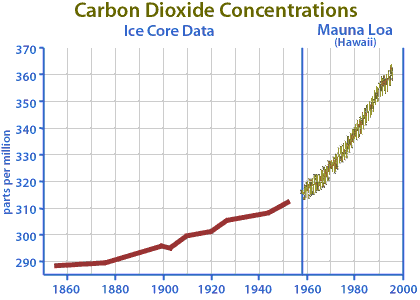
There is a precisely equal body of evidence that gold interferes with alien teleportation technology and that a reduction in carbon dioxide emissions would halt global warming. In both cases, there is precisely no evidence. In fact, in both cases, there is no reliable evidence that the supposed problem to be solved even exists. By the definition of "prevent" one cannot prevent something unless it would have otherwise occurred. Since we have no sound basis upon which to posit that either alien abductions or global warming will occur, any endeavor of ours to prevent them is, deductively, an exercise in futility.
| quote: | * Second, your analogy involves two alternatives: encasing your house in gold and death. Clearly the first option is not available to most people, and considering the general worth of a human life (as inferred from differences in calculations on traffic safety near schools and retirement homes, or as inferred from the price tag of a hired murder) it will actually be more expensive to encase your house than to die. In contrast, with human pollution experience tells us that it is always more expensive to clean up than preventing the pollution in the first place. On the scale of global warming I would say that this difference in price tags will be enormous. Consider some of the harbor cities that would have to be abandoned: Manhattan, New Orleans, Amsterdam, Rome, Rio... Then add all the other cities that you can find in your atlas but didn't think of initially. You can take quite a lot of preemptive measures to fight CO_2 emissions for the amount of money that will be needed to relocate these millions (billions?) of people and their daily lives.
Now, you say that my analogy (which I gave purely for elucidation purposes) is clearly false as criminals gaining entry to houses happen occasionally, whereas the heating of the earth by human pollution never happened. Besides that a good deal of scientists see evidence that you are wrong on the last part, I would attack that reasoning by saying that the difference, which you see, is entirely due to a consciously stated difference in granularity of the two scenarios.
For instance, I have never personally had a criminal enter my house (unless one of my friends haven't told me everything that I should know), so with that kind of granularity it would make no sense for me to lock my door, as according to statistics a criminal coming to visit me must be an impossibility. On the other hand, we have plenty of examples of humans destroying eco systems through pollution in the past, so with that granularity it would make sense to consider global warming (as an instance of pollution) a possibility. |
It seems to me that your argument regarding granularity is flawed by the same leap of faith which has plagued all of your arguments to this point. Although it may be true that no criminal has ever attempted to enter your house, you must surely be aware that there are criminals, and that in the general course of their activities they sometimes attempt to enter houses belonging to people who do not want them to enter, for illicit purposes. If you were unable to make the connection that this means there is a possibility that some such crimilar may attempt to enter a particular house - such as your own - at some indeterminite time in the future, then you would be lacking a fundamental reasoning skill to associate objects of similar properties with actors and actions known to be associated with some of those objects.
However, the relationship between human destruction of ecosystems and the so-called global warming threat is not an example of this type of reasoning. Rather, it is a fallacy of composition. The biosphere consists of, among other things, a large number of distinct ecosystems. It is fallacious, however, to assume that the biosphere itself has the same properties and simplicity of its constituent parts. Therefore, it would be fallacious to deduce that since human beings have destroyed ecosystems as a result of their introduction of pollutants, they could likewise destroy or severely alter the biosphere by a similar process.
If the utility of a particular course of action is properly measured as a cost/benefit ratio, then the utility of measures to reduce carbon dioxide emissions is extremely low, as the costs are outrageously high and the benefits, so far as reliable scientific evidence suggests, are nonexistent.
|