|
| quote: | Originally posted by Gypsy
oh look...they gave the mona lisa a mustache...the true mark of any artist..
this isn't 'art'. in what way does this comment on anything significant or invite any intellectual consideration? i could flip through the pages of Mad magazine and find more thought provoking images. |
Because this was in 1919, before MAD, before people decided they were going to do this. Consider this a reason on why MAD magazine actually does the same thing.
Remember years ago, and again in social thoughts today, the Statue of David, as it is nude, was once (and now again) considered Shock-Art.
'Most' art is some form of a statement, so it's of course debatable as to what would be considered 'shock' art.
An example of a form of 'shock' art could also be attributed to a political standpoint on a certain event in time. Guernica (one of my personal favorites) is a painting by Pablo Picasso, inspired by Picasso's horror at the Nazi German bombing of Guernica, Spain on April 26, 1937 during the Spanish Civil War. The air raid destroyed the city, killing a number of people variously estimated between 300 and 1,600, and injuring many more.
| quote: | The huge mural was produced under a commission by the Spanish Republican government to decorate the Spanish Pavilion at the Paris International Exposition (the 1937 World's Fair in Paris). Picasso said as he worked on the mural:
| quote: | | The Spanish struggle is the fight of reaction against the people, against freedom. My whole life as an artist has been nothing more than a continuous struggle against reaction and the death of art. How could anybody think for a moment that I could be in agreement with reaction and death? ... In the panel on which I am working, which I shall call Guernica, and in all my recent works of art, I clearly express my abhorrence of the military caste which has sunk Spain in an ocean of pain and death. |
|
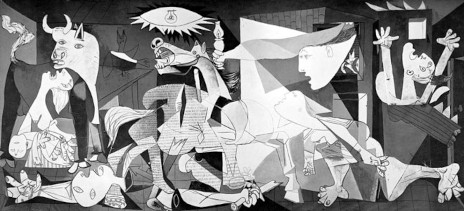
In its final form, Guernica is an immense black and white, eleven-and-one-half-foot tall and almost twenty-six feet wide mural painted in oil. In creating Guernica, Picasso had no interest in painting the non-representational abstraction typical of some of his contemporaries, such as Malevich. The mural presents a scene of death, violence, brutality, suffering, and helplessness without portraying their immediate causes. The choice to paint in black and white contrasts with the intensity of the scene depicted and invokes the immediacy of a newspaper photograph.
Hidden images in Guernica. This de-contrasting of the lower portion of the horse makes it easier to discern the hidden skull-in-profille in the painting. The bull's head is formed mostly by the bent front leg. The head's nose is formed by the leg's knee cap.

Guernica depicts suffering people, animals, and buildings wrenched by violence and chaos.
- The overall scene is within a room, where, at an open end on the left, a wide-eyed bull stands over a woman grieving over a dead child in her arms.
- The center is occupied by a horse falling in agony as it had just been run through by a spear or javelin. The shape of a human skull forms the horse's nose and upper teeth.
- Two "hidden" images formed by the horse appear in Guernica (illustrated to the right):
o A human skull is overlayed on the horse's body.
o A bull appears to gore the horse from underneath. The bull's head is formed mainly by the horse's entire front leg which has the knee on the ground. The leg's knee cap forms the head's nose. A horn appears within the horse's breast.
- Under the horse is a dead, apparently dismembered soldier, his hand on a severed arm still grasps a shattered sword from which a flower grows.
- A light bulb blazes in the shape of an eye over the suffering horse's head.
- To the upper right of the horse, a frightened female figure, who seems to be witnessing the scenes before her, appears to have floated into the room through a window. Her arm, also floating in, carries a flame-lit lamp.
- From the right, an awe-struck woman staggers towards the center below the floating female figure. She looks up blankly into the blazing light bulb.
- Daggers that suggest screaming replace the tongues of the bull, grieving woman, and horse.
- A bird, possibly a duck, stands on a shelf behind the bull in panic.
- On the far right, a figure with arms raised in terror is entrapped by fire from above and b
- A dark wall with an open door defines the right end of the mural.
Source:
Wikipedia
___________________
djchrisallen.net | myspace | ava recordings | facebook | facebook fan page | twitter
|


