|
It's amazing how using the right words will make an argument that much more convincing....
| quote: |
You're Getting Warmer …
The new statistical rhetoric of climate change.
By Daniel Engber
Posted Tuesday, Feb. 6, 2007, at 5:44 PM ET
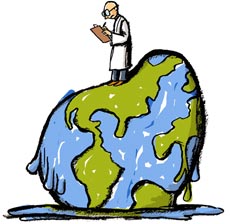
Global warming must be on a hot streak. Just a few months ago we watched polar bears drowning on the melting Arctic ice. In Washington, D.C., the cherry trees bloomed in January, and—wait, was Heaven boiling over?—the president himself warned Congress about the "serious challenge of climate change." But the biggest score came last Friday: A report from the United Nations' blue-ribbon international panel of climatologists declared global warming an "unequivocal" fact, "very likely" caused by human activity.
This upgrades the panel's previous assessment from 2001, which tagged our poor behavior as the "likely" culprit. The words are selected to correspond to precise numerical assessments of our guilt. Six years ago, the authors calculated a 66 percent chance that we were behind the recent warming trend; today they peg it at more than 90 percent. (At one point, they proposed going as high as 99 percent.)
This quantification of doubt is relatively new. For years, climate-change scientists relied on verbal expressions of chance instead of statistical ranges: Effects were "probable" or "possible"; they "could" or "might" be true. As a result, their language of uncertainty was easy to misinterpret, politicians threw up their hands, and skeptics seized on ambiguous phrases to argue that the science of climate change was based more on estimation than fact. But 10 years' worth of new data have emboldened the researchers, and now they've replaced their hazy equivocations with percentage values. This shift in rhetoric—at base, from words to numbers—has made their conclusions more comprehensible and compelling. It's also made them less honest.
The change in strategy began when Richard Moss and Stephen Schneider—a pair of researchers dubbed the "uncertainty cops" by their peers—urged the U.N. panel of climate scientists to fortify their language with hard numbers. The mapping of phrases to percentages, they argued, would make it easier for policy-makers to apply the science and harder for skeptics to spin it. A footnote in the new report explains how their ideas have been applied: If the report says something is "virtually certain," it means there's a 99 percent chance that it's true."Very likely" refers to any probability between 90 percent and 99 percent, "more likely than not" refers to a chance greater than 50 percent, and "unlikely" is somewhere between 10 percent and 33 percent. (Click here for a PDF of Moss and Schneider's recommendations.)
The new system makes it easier for policy-makers to think about global warming in terms of betting odds. You might determine the value of a card game by weighing the chance of winning against the potential payoff. Likewise, the politician can figure the risk of a global disaster by multiplying the chance of its occurrence by its potential costs. It might not be worth our time, for example, to hedge against the tiny possibility of a giant asteroid hitting the Earth, even though its effects would surely be catastrophic. (In gambling terms, betting on a deep impact would be like buying a lottery ticket.) Global warming, on the other hand, seems like a much safer bet.
From a policy perspective, this sounds like a great idea. But when Moss and Schneider first made their recommendations, many members of the climate-change panel were justifiably reluctant to go along. As scientists, they'd been trained to draw statistical conclusions from a repeated experiment, and use percentages to describe their certainty about the results.
But that kind of analysis doesn't work for global warming. You can't roll the Earth the way you can a pair of dice, testing it over and over again and tabulating up the results. At best, climate scientists can look at how the Earth changes over time and build simplified computer models to be tested in the lab. Those models may be excellent facsimiles of the real thing, and they may provide important, believable evidence for climate change. But the stats that come out of them—the percentages, the confidence intervals—don't apply directly to the real thing.
That's why the climatologists had been using vague language about probability—they didn't feel they could draw on the rigorous language of percentages to describe what were essentially subjective judgments. At issue was our intuitive distinction between two kinds of probability, which might be described as "statistical" and "subjective." We might say, in the statistical sense, that the chance of rolling snake eyes on a pair of dice is about 3 percent; subjective probabilities, by contrast, come into play whenever we make a personal judgment based on available evidence. On Sunday morning I used my marginal knowledge of football to determine that the Bears would win the Super Bowl. Jurors use courtroom testimony to decide how likely it is that a defendant is guilty of a crime. And climatologists use scientific evidence to decide how likely it is that we're heating up the Earth.
We haven't always been hung up on distinguishing between statistical judgments of chance and subjective ones. In the 18th century, magistrates were expected to assess the probability of a defendant's guilt by calculating the sum of the testimony against him. Meanwhile, a tribunal that convicted by a 2-to-1 margin could be taken to imply that the verdict had a 67 percent chance of being correct. The elements of probability weren't teased apart until 1837, when Siméon-Denis Poisson divided it into the dual concepts of statistical frequency (called "chance") and subjective judgment (sometimes referred to as "raison de croire").
Poisson's distinction has persisted, more or less, until today. In general, we use numbers and percentages when we're talking about statistical probability, and we use phrases like "doubtful" or "almost certain" when we're talking about subjective judgments. That doesn't mean you can't quantify belief. In fact, most of us have a pretty consistent intuition about how the language of uncertainty relates to numerical values. According to a famous study from 1990, if you ask people to translate the phrase likely or probable into a percentage, most will give a number between 63 percent and 78 percent. Very likely yields a rating of 80 percent to 90 percent. Something that's certain is 98 percent or 99 percent.
But further research revealed that these meanings are stable only when the words are presented without context. In a report on climate change, by contrast, there's no reliable way to know if one policy-maker will ascribe the same percentage to the word likely as another.
That's where the uncertainty cops come in. They tell the scientists to turn their opinions—as the best-informed experts in the world—into numbers. The process of mapping judgments to percentages has two immediate benefits. First, there's no ambiguity of meaning; politicians and journalists aren't left to make their own judgments about the state of the science on climate change. Second, a consistent use of terms makes it possible to see the uptick in scientific confidence from one report to the next; since 2001, we've gone from "likely" to "very likely," and from 66 percent to 90 percent.
But the new rhetoric of uncertainty has another effect—one that provides less clarity instead of more. By tagging subjective judgments with percent values, the climatologists erode the long-standing distinction between chance and raison de croire. As we read the report, we're likely to assume that a number represents a degree of statistical certainty, rather than an expert's confidence in his or her opinion. We're misled by our traditional understanding of percentages and their scientific meaning.
The uncertainty cops argue that in the face of global warming—and the spin campaign to discredit it—we must do whatever it takes to boost the credibility of the experts. If the public is more inclined to believe in percentages, then the experts should give them percentages. It's a reasonable argument and one that could help us to address the precipitous rise in greenhouse-gas emissions. But we have to acknowledge that the new headline-grabbing rhetoric of climate change has elements of propaganda. However valid its conclusions, the report toys with our intuitions about science—that a number is more precise than a word, that a statistic is more accurate than a belief.
----------------------------------------
sidebar
A scientist might, for example, collect data from a pair of dice by rolling them over and over again in the lab. The results would form a frequency distribution; given enough data, it's possible to draw conclusions about which numbers are most likely to come up.
|
>>Source<<
___________________
"...End? No, the journey doesn't end here. Death is just another path...one that we all must take.
The grey rain-curtain of this world rolls back, and all change to silver glass...and then you see it...
...white shores...and beyond...the far green country under a swift sunrise."
|