|
ok sorry to paste so much but read this!!
WHAT LOUD MUSIC DOES TO YOUR EAR
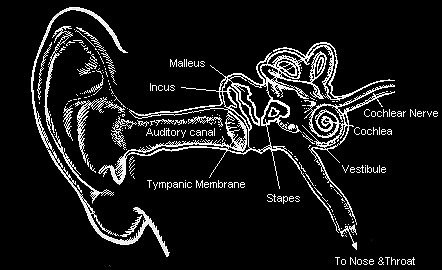
Physiology of the Ear and Hearing
The ear has three areas: the outer (visible part of the ear), middle, and inner ear. A thin membrane, called the eardrum (tympanic membrane), divides the middle and outer ear. When we hear, sound vibrations, or sound waves, funnel through the outer ear and down the ear (auditory) canal, where the sounds hit the eardrum, and cause the eardrum to vibrate.
These vibrations are passed through the three small bones in the middle ear - the malleus (hammer), incus (anvil), and stapes (stirrups). From the middle ear, the sound vibrations are transmitted to the inner ear (vestibule). Tiny hairs in the cochlea (a snail-shaped organ in the inner ear) transform the sound vibrations into nerve impulses. The impulses are transmitted to the brain through the auditory (cochlear) nerve.
Noise and Hearing Loss
Excessive exposure to loud noise can damage the tiny hairs in the cochlea and lead to hearing loss. Generally, this type of hearing loss is reversible (except is some cases of a sudden, very loud noise, such as an explosion).
However, over time, repeated exposure to loud noise can cause permanent damage and hearing loss. This condition is known as noise-induced hearing loss.
Watch your hearing!
Your ears are very delicate, prolonged exposure to sound pressure levels above 85dBA will cause damage to your hearing. If you have ever been to a party or to a concert where loud music was played, you may have experienced Temporary Threshold Shift (TTS). This temporary loss of hearing can become permanent if exposure is done on a regular basis.
One way to tell if you’ve been exposed to excessive sound pressure levels is that you tend to hear a ringing in your ears.
Ringing in your ears, hissing, clicking or buzzing sounds all represent the effects of tinnitus, which is often a side effect of noise-induced hearing loss. Inner-ear cells are sensitive to vibrations. But if they’re damaged, the ears will still record ringing or buzzing, even when there’s no sound.
Remember, it is your high frequency hearing that deteriorates first. Think of what music would sound like if you couldn’t hear anything above 10KHz: just like with a crummy old transistor radio or listening to music over a telephone (no cymbals or high pitched instruments, voices sounding deadened). Protect yourself or just turn it down!
The high frequencies are lost first, so you may have difficulty hearing high-pitched voices. Loss of high-frequency hearing makes many words sound alike, especially those containing the high-frequency sounds S or soft C, F, SH, CH or H. Words like “hill,” “fill” and “sill” may sound exactly the same.
Experimental evidence
Researchers at the University of Florida tested the hearing of some middle and high-school students. The investigators found that about 17 percent of the children had some degree of hearing loss. Most of the hearing loss was in higher pitches, which are usually the first ranges of sound to be lost after hearing damage. The investigators believe that exposure to excessive noise results in a serious hearing impairment at an early age.
Significant hearing losses were detected in a group of students who had a history of frequent attendance to pop music entertainments. Losses due to loud noises in jobs, gunfire, etc. were also identified. (The Lancet 2:203-204, August 2, 1975).
A ‘guinea pig’ showed hearing impairment in his right ear after listening to high-intensity rock music for 88 hours over a two month span. The left ear, protected by a plug during most of the music, demonstrated no cytological changes. The damage to the right ear was permanent. (Archives of Otolaryngology 90:29, 1969)
I’M NOT GOING TO STOP GOING TO GIGS!
Fine, fine. Who said you should?
But if you don’t want to end up deaf in a few years time you MUST protect your hearing now and that means
either a maximum exposure time of 15 minutes per gig – which I don’t see you raving about!
or by using hearing protection – that is ear-plugs.
Problems with Conventional Earplugs
Musician’s earplugs are not intended for maximum attenuation. For that application, conventional foam or fully sealed
pre-moulded hearing protectors or earmuffs are recommended.
Existing earplugs attenuate more than necessary for much of the noise in industry and the environment.
Regardless of their exact construction, existing earplugs produce 10 to 20 dB of high frequency attenuation and the result is that people often reject them because they can’t hear speech clearly.
Conventional earplugs make the wearer’s own voice sound hollow (known as the occlusion effect).
Many people risk their hearing by either wearing earplugs loosely or wearing no protection at all so they will be able to hear voices, machinery or music more clearly.
Finally, cottonwool and tissue are useless. They only reduce sound by less than 7 dB.
SO, WHAT DO THE BANDS DO?
Lars Ulrich/Metallica:
“Three of the four members of Metallica wear earplugs. Some people think earplugs are for wimps. But if you don’t want to hear any records in five or ten years, that’s your decision.”
If I wear hearing protection devices while I’m playing, won’t it be hard to hear myself or the other instruments?
No, actually with distracting noise removed or minimised you will hear more clearly.
If a hearing device cuts down on the noise from my instrument or voice, how will I know what I sound like?
Your ears adjust very quickly to the protectors.
Don’t people in places with loud music or sounds just get used to the volume?
No. Hearing loss and tinnitus (ringing in the ears) are insidious. Problems can occur gradually. People often don’t know they have a problem until it’s too late.
After years of not wearing hearing protectors why start wearing them now?
Protective devices can prevent further damage. Hearing problems because of exposure to excessive noise do not have to happen.
“Musicians’ plugs allow some sounds in, but block others out. The musician’s hearing focuses on voice blending.” (Janser).
These specialised earplugs run from $150 - $200. The price may seem steep, but it’s quite reasonable compared with the financial and physical toll of wearing a hearing aid.
Custom fit earplugs, worn by many musicians, are made from an impression of the ear canal taken by an audiologist or other hearing health professional. The impression is sent to a lab, where the final ear-mould is made. Custom earplugs are comfortable, easy to insert correctly, and filter sound better than disposable plugs.
Your local medic (doctor), audiologist or hearing aid dispenser will be able to advise you further.
TYPICAL HIGH GRADE PLUGS (as used by musicians)
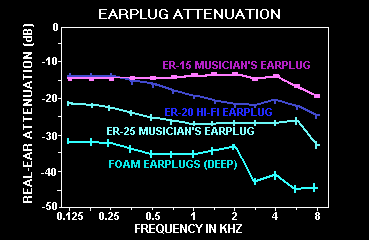
The ER-15 and ER-25 models are popular with musicians because of a special filter that lets the listener hear music at a safe level without sacrificing quality. Instead of cutting out the high frequencies, musician’s plugs attenuate all the frequencies evenly in relation to your hearing.
A flat-response attenuator (reducer) must have a frequency response that follows the shape of the natural frequency response of the open ear, but at a reduced level. Both the Musician’s Earplug ER-15 and ER-25 use a diaphragm, similar to a passive speaker cone, to achieve the desired response curve. The ER-20 uses a tuned resonator and acoustic resistor. To reduce the occlusion effect, a deep seal of the plug in the second bend of the ear canal is necessary. In general, the ER-15 attenuators are designed for environments where the A-weighted sound pressure level is 105 dB or less. The ER-25 attenuators are for use in environments above 105 dB and below 120 dB.
The attenuation shown in the above graph is for an average ear: at least 10 dB of protection for the ER-15, at least 15 dB of protection for the ER-20 and at least 20 dB of protection for the ER-25 are achieved in almost any ear with these attenuators properly in place. These custom ear moulds are to be fitted by an audiologist or hearing aid dispenser.
i Think that answers most questions..... its scaring me enough to think why the fuck didnt i get plugs earlier.... and i think your mad if u dont where them if u go out to gigs regulaly.
get some of these!!!
ER-20's

Cheers
Cam
Last edited by waXology on Nov-11-2003 at 08:58
|


