|
| quote: |
In terms of room acoustic treatment, I would suggest a few things...
-make the studio space rectangular, rather than cubic, as cubic rooms have far too many modes to deal with and are a mess in terms of acoustic value in general.
|
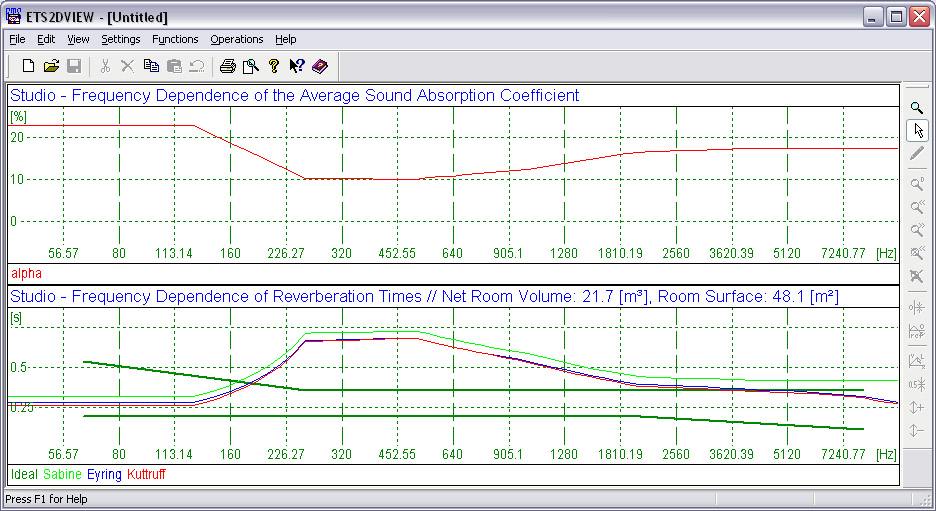
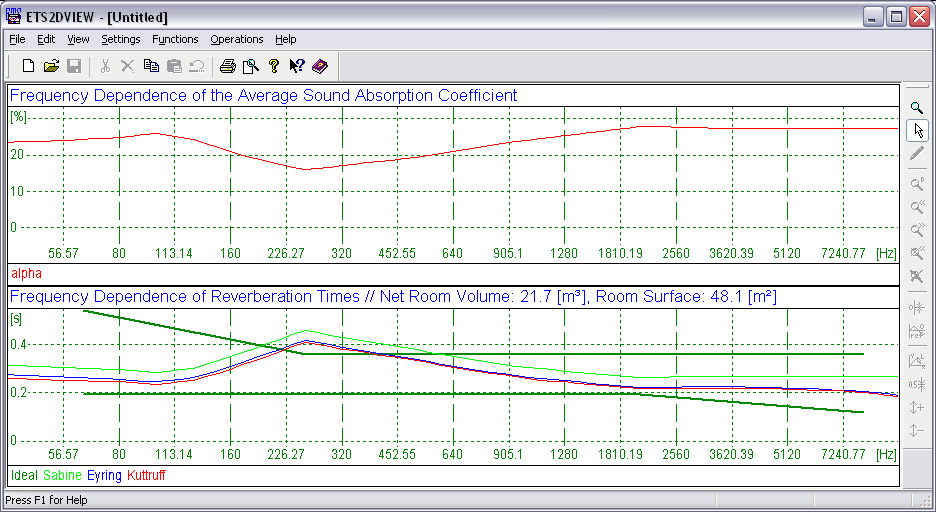
Exact room dimensions were a key part of my thinking long before I got to picking up the first tool. Dimensions are in my previous post, but I'll repeat them here:-
85" high, 105" wide, and 157" Long
This is as non-correlatory as I could get whilst keeping the room a reasonable size.
As an aside, technically a cubic room has the same number of modes as a cuboidal one, it's just that the ratio of intervals between them that makes a cubic room undesirable for accuracy. ;-)
But point is well made for others reading this. the goal is to have the dimensions o your room be as mathematically dissimilar as possible.
ie, Room ratio of h:w:l of 1:1:1 (a cube) is extremely bad news, 1:2:2 (Square room) is also awful, 1:2:1.5 is also bad (Exact ratios) is ungood too.
There's lots of stuff on this out there, if you're interested go read, thought he maths can get ugly quick.
Also the bigger the room the better (to a point), unfotunately my half basement limits my options, but can still be made reasonable.
| quote: | | -considering the inherent costs, don't bother with floating the room in the sense of neopreme support with cement/wood on top. It would require a wealth of other work to have the rest of the room's treatments live up to the isolated nature of the floated room concept. |
Isolation serves two purposes.. Sound in (Not bothered in this case) and Sound out (Very bothered in this case). I don't want to be waking people up in the middle of the night when my 808 boom goes off in the middle of the track!
Many of the "Ideal" solutions are either very costly, or impractical in this space (Lack of height), or both.
I'm going for as many boundaries as I can (Sheetrock > Air > RoockWool > Floor boards) vertically. Sound proofing (as opposed to room treatment) implies non transmission of vibration. that can be done by floating, or large amounds of mass (In this case 3 x 1/2" sheetrock). Each layer needs to be fully sealed (Tape & Joint compound) for it to have real value.
In addition, the walls and ceiling should all not touch, but be caulked and left to vibrate independantly. Not sure how well I'm going to do with that, but we'll see. :-)
| quote: | | -to get rid of your cable mess and allow for acoustic treatments, I would suggest just as you brought up woth your first chicken scratch drawing... to hand the cables inside a cable duct in the ceiling. Try to figure out your best workable number of inputs/outputs possible at one time for your console and computer interfaces. From there, you'll know what kind of audio snake you'll need. |
the ceiling duct is for screens, keyboards, mic and whatever desktop units I have lying around. 4" duck will be tight for the amount of signal cabling going to the desk. Damn I wish everything was on fiber..
Anyway, if you look at the plan, I'm going to build the racks into one wall. This will remove most of the clutter from the studio. I do have to knock a duct through the partition wall for the cables from the rack to the console (ie there are two sets of cabling ducts in the room).
Looking around my hardware store I see that Toilet rings make great duct openings in sheetrock! Think I'll use those for this.
http://remodelist.com/product.php?productid=38483
As for Snakes, without thingking too hard I need at least the following to / from the desk:-
24 Analog ins
12 Inserts
12 Aux Sends
8 Aux Returns
8 Bus Out
8 Bus In
Assorted 2 track returns
Assorted monitoring and master outs
3 x TDIF (24 Digital I/O)
6 x ADAT (24 Digital I/O)
That's a pretty hefty chunk of cabling!
And of course doesn't include the outboard FX, Insturments and assorted goodies in the racks.
| quote: | | -A largely ignored part of home studio design is HVAC. Keep ventilation as much as possible (both you and your gear take value in CLEAN, quality air. Insulate where the air ducts lie in the walls and ceiling using some foam tubes and such inexpensive insulating materials to avoid rattling and ricketting ducts. |
Under control, but not ideal.
Cheapest (but not the quietest) method is a spilt (2 unit) aircon mounted to one wall in the studio. This has a compressor outside, and a fan / heat exchanger inside. No mucking about with large bore, low velocity ducting. It also helps with audio leakage nicely.
My other opion is to take a feed off of the central air unit and put a vent in ont he partition wall.
That partition wall is going to be might useful, as I can deliver services to the back of it with impunity. I don't care if there is a isable duct on the far side of the wall.
| quote: | | -Revolve your designs around your ideal listenning position. Your console, computer, patch bay and rack gear should revolve around your working habits and not the other way around. |
This is mostly true. Give that ideally the best mix position is about a third of the way down the longest dimension (for avoidance of modal nulls which are a fact of life) I need to work where my gear will live in relation to that spot.
Also if I want to wallmount the racks I only have a limited area of the wall I can put them in due to two columns holding up the house (No, I AM NOT MOVING THEM!) :-)
I have a pretty decent idea of how this will work in practice. I will need a rolly chair to move from side to side when working solo, but that is unavoidable if I want there to be enough space for two people to reasonably fit.
| quote: | | -What's under the stairs? Take advantage of the space under the stairs, and work around and support structure in there. It's a great place for power and HVAC/cooling conditionning equipment. |
Under the stairs is going to be packed with rock wool and will act as a substantial trap. In addition sice the construcion of the stairs is far from soundproof I need to prevent leakage as much as possible up them and into the house. Good idea though..
| quote: | | take a measurement of the rectangular space in the basement (I'm talking 100% rectangular) and disclude the stairs. Post the measurements here and I'll work up some dimension, treatment, and design suggestions. I love attacking a home studio space. I designed a space for my final project in college for this type of stuff (audio engineering) |
85" high, 105" wide, and 157" Long. These dimension are actually smaller than what is available (With the exception of the height which is all I have). It's not too late to tweak them a little (A couple of inches either way), but were picked after a bunch of time sat working on room modes. If you can come up with something better though i'd be glad to see the results..
There will be a partition wall up blocking off the stairs with a 1 hour firedoor at the bottom in the same plane as the wall.
| quote: |
-post up these measurements... computer system desktop space required, monitor dimensions, console dimensions, rack (rectangular) space, projected space for keyboards, etc. |
Console (d8b) will be sat on a cutdown Ikea Jerker. Computer screens will sit on a Jerker Desk (Not the adjustable one). Racks are going in the right wall when you are looking at the speakers.
1 keyboard will be infront of the racks. I know that cuts my manipuable rackspace by about a 1/3, but with a planned 84u going in I think I can live with that.. The wall next to the stairs is slated for decks, but not right now (I am already planning on embedding cabling in the wall to tie them to the patchbay.
| quote: | | -lastly... $2000 is a strict and very doable budget, but with the right DIY creativity and throughtful choices at the hardware store, you can make a shweet studio space. I was recently thinking up ways to turn half of my basement bedroom into a production space with a $500 budget for treatment and structure alone. |
I got the free sheetrock. That's saved about $600 right there.
Studs are about $3 each, but I'm muching through them like candy.. :-).
Joint compound and the sandpaper is going to add up too though. Effectively I'm building three rooms (Remeber three layers of sheetrock!)
The really expensive parts are going to be all the fixtures and fittings (Outlets, BX cabling, track lighting (I want track lighting!!!) dimmers, doors & Handles (Doors are around $120 each and I need 3).
Paint and carpet shouldn't be too bad, not sure how much the trim will be but hey, corss that as I go.
Oh and the rack strip is free. I cannibalized a Compaq server rack and removed the front and rear rails to give me the racking for the wall.
Ayway thanks for your commetns and keep 'em coming!
Last edited by Diginerd on Jun-07-2006 at 18:53
|




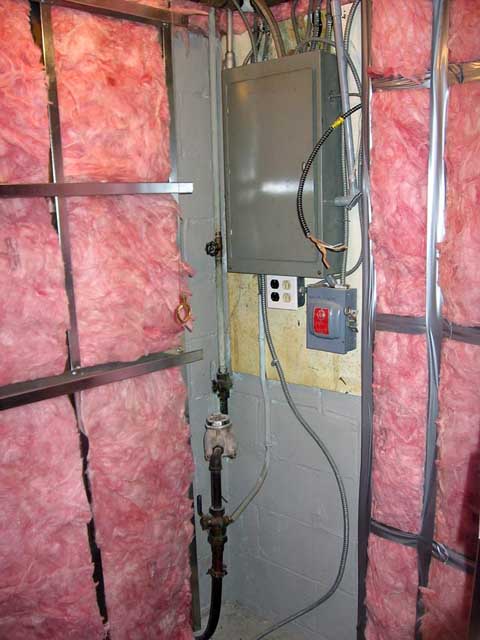


 maybe some rubber shoes come in handy.


