|
| quote: | Originally posted by Krypton
LOL!!
Creationists don't deny they are advocating a theistic view of the origins of the universe. You failed to understand the statement pertained to evolutionists denial that their theory is based on assumptions just like the creationists assumption of a Creator being. For evolution to be true, one must assume life came about by random processes. |
Let's make sure we are speaking the same language before we go any further:
Do you understand the concept of abiogenesis?
Do you understand the concept of biological evolution?
Now, you realize that the former is NOT related to the latter?
I really think this is important for us to get down before we move on. So please respond with your understand of these two when you have a chance.
| quote: | | Science is guided by the scientific method, of which niether creationism or evolution can be proven by the scientific method alone. |
Are you sure you understand evolution well enough? Do you have any knowledge of what researchers do with methodological naturalism (via the scientific method) that demonstrates the factual basis of a change of allele frequencies in a population over time via the known mechanisms of mutation and natural selection? Because this what appear that you do not.
| quote: | | The only way to prove either theory is by taking on their assumptions: either there is a Creator/ or / the Cosmos itself is responsible for our origins. Science is not based on assumptions. |
Hmmm, where have I heard this "assumptions" argument before?:
http://www.tranceaddict.com/forums/...d=&pagenumber=2
You're welcome to continue on that thread with our discussion "assumptions" if you like. Or if you've actually read it in full and still have difficulties, feel free to discuss those here. Otherwise I'd prefer not to cover ground that's been discussed in very explicit detail before.
| quote: | | I use several sources in my debates. Whatever the personal views of my sources are doesn't concern me. It is the substance of the arguements they present, and if they are useful, I'll use them. |
Judging by the arguments presented with one of your sources that I flushed out, one would hope you examine their arguments with a bit more scrutiny prior to using them.
| quote: | | Great demonstration of how assumptions work to prove evolutionary theory. When Pakicetus inachus was first found, all Mr. Gengrich had was a posterior portion of the cranium, two fragments of the lower jaw, and isolated upper- and lower-cheek teeth. Yet, he claimed this creature as the ancestor of the whales, when even with a complete skeleton, there is no link between the creature and whales. |
Hmmm, I see. You do realize that there is a great amount of information that can be told from a skull, right? Let's take an initial look at the Pakicetus skull:
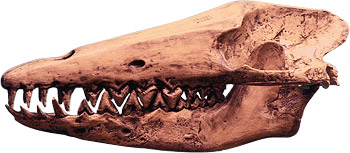
Now compare that to the skull of a modern-day false killer whale:

and now compare to that of a modern german shepherd:
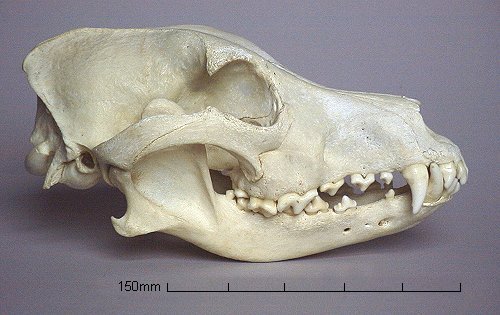
Which one does it look like to you?
Some more discussion on the aquatic features:
| quote: | Most interesting are two partial innominates that together show the ilium to have been shorter than the ischium (Thewissen et al. 2001: p. 277 and Fig. 1n ). Length of the ilium is the most important determinant of the PC-II score reflecting aquatic adaptation (Tables 6 , 7 , Figs. 3 –6 ), and an innominate with a short ilium implies that Pakicetus was much more aquatic than a tapir.
Gingrich, Philip D. (2003). Land-to-sea transition in early whales: evolution of Eocene Archaeoceti (Cetacea) in relation to skeletal proportions and locomotion of living semiaquatic mammals.
Paleobiology: Vol. 29, No. 3, pp. 429–454. |
That paper is in response to this:
More on the tapir:
IOW, what we're seeing here is Pakicetus is demonstrating exactly what we would expect from the early transition from land to sea - primitive features of cetaceans that also lived around the water.
More here as well:
| quote: | Some features of the pakicetid skull (Figure 2a) suggest an amphibious lifestyle; the eyes, for instance, are on top of the skull.
...The skull of Pakicetus has orbits that are high on the side of the skull and face up, or dorsally (Figure 9) . This placement is unique among cetaceans and is similar to that in crocodiles. Dorsally facing orbits help submerged crocodiles in watching potential prey items above the water.
THEWISSEN, J. G. M., BAJPAI, SUNIL. Whale Origins as a Poster Child for Macroevolution. BioScience: Vol. 51, No. 12, pp. 1037–1049. |
Now if you have peer-reviewed primary literature that supports your claims that Pakicetus is terrestrial only, I'd love to see them. There are most certainly terrestrial features (tympanic membrane, no pressure from pressure changes in the ear, molars similar to mesonychids), but we also have the aquatic features as well (features mentioned previously plus the other teeth similar to later cetaceans like premolars, whale-like sagittal skull crest, narrow braincase, and jaws more elongated) - hence a wonderful transition with a semi-aquatic animal.
| quote: | | Are you going to say that two completely different systems somehow are related, especially when saying a wolf-like animal (relatively small) evolved into a gigantic animal totally suited for life in the open ocean, NOT flaviul riverbed environments. |
I don't have to say anything - the data clearly depicts that just fine.
| quote: | | We have hundreds of millions of fossils, and should find no difficulty finding clear relationships between kinds. |
1. Define "kinds". Be specific in your description
2. What's your point?
| quote: | | Pakicetus inachus, even if found in riverbed material does not prove ANYTHING. |
Because you say so? Or is there other positive verifiable evidence that somehow repudiates it better than your word?
But if your incredulity simply does not allow you to examine the aquatic features of the skull, then can you tell me what it is and why it shares features to that of both aquatic AND terrestrial critters?
| quote: | | Evolutionists were declaring this a missing link before a complete skeleton was even found. |
One does not need a complete skeleton to deduce common features of the skull with certain aquatic critters. It really isn't that difficult.
| quote: | | Can we demonstrate in a laboratory that fully functional land-dwelling animals can evolve into fully functional open-ocean dwelling animals? No, and never. |
If we could, that would be a tremendous falsification to evolution. You do understand this concept, right? It's the basic tenet of evolution with the known mechanism of mutation and natural selection. Such mutations combined with the process of natural selection does not simply occur with a "poof!" that delineates in such a drastic manner that you are desperately hoping for to supposedly "prove" evolution. That simply does not occur along such a short timeline. Sorry.
| quote: | | I don't argue this, evolutionists do. When asked to demonstrate complete transitions between species through scientific methodology, "The process takes millions of years." is the excuse to explain why they can't demonstrate this assumed process (species level) here and now in the laboratory environment. |
You do realize that evolutionary researchers are not confined to their laboratories, right?
I'm just curious - how do you personally define "macroevolution"?
And why is the thought of evolution taking so gosh darn long so gosh darn difficult for you to accept?
| quote: | | From my point of view, these so-called transitional fossils are all fully functional animals in their own right whose species is either extinct or living. |
No problems with me on that. Agree 100%.
| quote: | | If extinct, they do not pass on their genes, so no transition to another species is possible. |
I think you're confusing yourself a bit here with the concept of extinction. The reason why a given critter population is extinct is NOT because it could not pass on its genes to future populations, but because that given population simply could not hack it out in its given environment or got outcompeted in its environment.
It seems that you're representing the concept of extinction purely in biological/genetic thoughts without the fundamental influence of the surrounding environment as well.
| quote: | | If not, they should still be alive, and demonstrate here and now that they are transitional. |
Oh dear. That's a horribly erroneous thought, but let's go with it for a moment. If we are to assume that these "transitional" species that are now extinct are somehow still alive today, why would they have gone extinct in the first place?
Can you not see that basic contradiction in the logic? How could an extinct transitional fossil demonstrate itself to be a transition by being alive? Or to ask another question along those same lines - what compels you to think that a transition species MUST be alive today in order to aptly demonstrate it is a transition?
It kinda defeats the purpose of being a "transition", does it not? If it were indeed a live "transition", then it would no longer be extinct, correct?
And as Neo pointed out it would do you a bit more credit to know a bit more about speciation before arguing further on this point:
http://www.talkorigins.org/faqs/faq-speciation.html
http://www.talkorigins.org/faqs/speciation.html
| quote: | | When it comes down to it, I believe in a Creator being, and universal purpose. |
Because the positive, verifiable and falsifiable evidence points to such? Can you give some examples that verify this, or are we simply going on unfounded beliefs? Because quite honestly I really don't appreciate inserting unsupported beliefs in the realm of methodological naturalism whenever one sees fit.
| quote: | | I'll always argue this point of view. |
Suit yourself. We'll continue to wait for the positive, verifiable, and falsifiable evidence that demonstrates your argument.
| quote: | | Everyone starts at a basic assumption of which everything else they believe comes from. |
What was the "assumption" again of evolution that you seemingly keep referring to? I guess I'm a little confused at what you call an "assumption." Are you referring to dating methodology? If so, explain.
Genetics and molecular biology? If so, explain.
Paleontological evidence? If so, explain.
| quote: | | I've just chosen to believe that we did not come about by unguided, random change that somehow brought together an infinite number of systems into one inter-dependant system. I simply cannot ever see how there could not be a Creator. |
Terrific. Now tell me, what exactly differentiates your belief from that of my personal God, the Great Cookie Monster from the Planet Zoinks!?:
http://www.tranceaddict.com/forums/...+cookie+monster
Or the Incredible Flying Spaghetti Monster?:
http://www.venganza.org/
How does one differentiate the two with positive, verifiable, and falsifiable evidence? Please explain.
___________________
Whence September dusk grows crisper still,
with leaves all crimson conquered,
I yearn to shout,
and dance about,
and stick pickles in my honker...
Last edited by MisterOpus1 on Jul-17-2007 at 00:15
|


